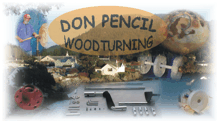
>Shouldn't the set screw that holds the bit in the shank for angled boring bar and the curved bar be on TOP of the tool 1)so the shank can be held flat against the grinder rest for shaping and 2) so that tiny screw doesn't fall out into the shavings if it vibrates loose? It looks like it is in the "manual", but it's not the case with mine.
>I didn't realize it until I went to switch the bit from the straight boring bar (which I ground with the set screw on top) to the angled bar. What the heck???? Then I looked at the curved bar and it was the same way. It doesn't make sense to have the screw on the bottom. With the set screw on the bottom, you cannot keep the shank flat against the grinder tool rest for shaping/sharpening. How long before that tiny screw vibrates loose and is lost forever in the shavings? If you look at the pictures on Pencil's web site all of the set screws are on top, which is logical. Now I have a bit shaped for the straight bar which cannot be used in either of the other two bars. :(
>I make my own boring bars, and I typically would put it on the top. However, I can't say that it makes a difference for sharpening because I use a round rod with my bars, and I typically sharpen them by hand with a diamond files or my Tormek (not still in the bar...)
I have noticed that the set screw fills and packs with sawdust. I just wonder if having it on the bottom makes a difference? Do you still have to pick it before you put a hex key in?
>I make my own boring bars and put the set screw on the bottom. The reason is the setsrcrew fills up with shavings and you have to clean them out to adjust the cutter or remove it for sharpening. This is especially true for green wood. I made my first one with the setscrew on the top and spent way too much time cleaning out the setscrew with a scratch awl. I've never had one fall out. At least not so far.
>I leave a supermagnet (a bunch actually) on the leg of my 3K stand, and attach various tools. One of my "tools" is a finishing brad that has been ground to a needle-like point, expressly for picking sawdust out of set screws...
Next time, I'll turn the bar upside down and put the cutter in screw side down.
>After going out to the shop and working with it some more I can see the point about the set screw collecting dust (it's on the top on the straight borer) but I could blow it out easily. Maybe I couldn't have if I had let it sit in there for a long time. I did have the set screw loosen once in the angled bar when I was cutting some nasty grain, but I was able to tell it was loose from the sound and feel of the bit. It is so tiny (the wrench looks to be about 1/16") that I am afraid to tighten too hard on it. As a novice trying to learn, I tend to take the directions that come with tools at face value, especially if, in my feeble mind, it seems logical. It gets a little frustrating when you are told to "do it this way" and you find that the tool you have doesn't agree with doing it that way.
>Over the years I have discovered that it is about a 50/50 as to whether the individual turner is "pro" screw on top or screw on the bottom.
All of the comments in this string are valid, depending on on the turners point of view.
The screws were photographed on top, as we began manufacturing them that way. After a great many complaints about the screws being on the top, mostly from professional turners, I switched them to the bottom.
I typically take the cutter out of the bar for sharpening on the grinder or usually just use a diamond card to freshen the edge while it's in the bar. I've made a little jig to hold the cutters while grinding so I don't give myself a manicure :)
My gripe with the screws on the bottom of boring bars is that I sometimes catch it on the mouth of the opening and that ticks me off. Especially on the larger boring bars. I find the screws sit proud of the bar quite a bit, and I have to hop over the opening of the vessel and then the tool rest to clear the screw to get the bar out. It's probably a function of the operator, I'm sure.
I was thinking if the screw was situated on the right hand side....it might not be a bother for grinding or for catching on the openings? I'm sure that's been thought of and there's a reason why they don't.
>Now I understand. Sure glad I didn't pre-shape all 4 of my bit blanks using the straight bar (with screw up) on the grinder! I came awfully close to doing that, but the "little voice" said "just wait" and I obeyed. :)
>Know what you mean about the manicure! I'm really spastic when it comes to holding tiny things on the grinder...especially tiny round things! I do fine with the larger square Scorpion bits and the teardrops. I am going to have to make a jig for the little guys. I don't know if having the set screw on the side would work...I would think in that case there would have to be zero tolerance between the size of the bit and the hole or you would have up/down movement or vibration of the bit. Would probably still collect dust as well. I do like the Scorpion and Stinger tools so far. I just finished a piece using them. Clearance of the pistol grip handle is awfully close on my Mini...I have to have the tool rest higher than I am accustomed to, but it does work.