Home Articles Forums Gallery Marketplace Videos

WoodCentral Forums

Knowledge You Can Build On — Est. 1998

Premium Live Edge Slabs, Hand-Selected in the Berkshires. Shop Unique Hardwood Pieces.

Last night's demo material

Posts

Last night's demo material

#1

Last night's demo material

Mike Schwing from Md.

>This was the handout from our club demo last night. The goal was to help new-ish turners learn how to apply a finish that didn't take days and was still satisfying. We spent a lot more time on sanding technique than the article depicts. I thought it was well received, and comments led me to think that some folks here might take something away from it positive. Hope so anyway. Because we meet at a Woodcraft - I try to use products that can be bought at that store, and it shows with my references throughout - please don't take that to indicate that is the only source of them.

--------------------

A Satisfying Quick Finish, by Mike Schwing

Truly excellent wood finishes cannot be achieved in a short period of time. They take weeks and months of work in preparation, application, drying/curing, sanding, buffing, and polishing. Few turners have the patience, equipment, and desire to create �showroom� quality finishes on their work.

Fortunately, very satisfying high sheen finishes can be accomplished in a short manner of time with the right techniques and tools.

This is only one of them. It will involve wipe on lacquer based products that can be purchased from most any turning supplier. We�ll be using Mylands Cellulose Sanding Sealer and optionally their wipe on Lacquer. A word of caution - they can make you dizzy if you don�t take appropriate measures.

First � a note about surface preparation. Shiny surfaces are a result of even, directed light reflection. An even surface, free of defects, will produce a shinier surface than one that is uneven. A common adage among many woodworkers is that �the finish goes on before the finish goes on�. This means that surface preparation has much to do with the final finish. A workpiece sanded to 220 grit will take much, much more effort to bring to the same shine that a piece sanded to 600 or 1000, or even 12,000 will. Indeed, sanding to 12,000 grit often polishes some woods to an acceptable finish that requires nothing more. Woodcraft sells a product called �Micro Mesh�. It is fine, cushioned back sandpaper that offers grits up to 12,000. Their 1500 grit is approximately equal to 400 grit aluminum oxide sandpaper. (note � there are those who will say finishes will not stick to surfaces sanded to such a high grit, but none of those have been able to produce any proof � I�ve asked)

Our �satisfying quick finish� begins at the sanding stage.

1. Sand your surface up to at least 1000 grit with aluminum oxide paper, or 4000 with micro-mesh. Sanding higher is wasted effort for this finish as the steel wool is about equivalent to 4000 grit micro-mesh. Any higher is wasted effort.

2. With a lint free cloth (no paper towels or sponges), rub on a thin coat of Mylands Cellulose Sanding Sealer. Rub it in evenly, but don�t go over a spot more than once while wet, as it�ll gum up and leave tracks.

3. Wait for it to dry. 10 minutes is plenty.

4. Turn the lathe on, medium speed. Take a wad of 0000 steel wool (Liberon wool is by far the best � that cheap stuff is just that � cheap) and move it over the surface. The goal here is to knock back the sealer so it just fills in the pores. Turn the lathe off and inspect the surface. If the sealer was not dry you will see little streaks have formed. You can knock them off with the lathe stopped. Remove any scratches by rubbing the wool in circles by hand.

5. Repeat steps 2 � 4 for a total of 3 coats. For each repeat, remove less of the sealer so it starts to build a little thickness.

6. (optional) At this point you have a nice, low sheen finish. If you wish, turn the lathe on again, medium speed, and place you palms on the work, one one top, one on bottom. Apply just a bit of pressure so it starts to heat up. You will notice a gloss form. The right amount of heat seems to be the closest to what you can tolerate. This will produce a perfectly acceptable finish to many. If you are satisfied, great. If you want a deeper finish, switch to the mylands lacquer and repeat steps 2-4 for a few coats until you are satisfied. You may also use step 6 on your last coat. Using the lacquer is totally optional. The sealer will produce a very nice finish on its own.

7. If you have buffing wheels, now is the time to use them. Starting at Tripoli and a high speed, work your way over the surface evenly. The move to white diamond, then carnuba wax. This will produce a gorgeous display type finish, but not suitable for utility/food use. An entire bowl can be finished thusly in under an hour.

The above will give what the title implies � a Quick, Satisfying Finish. It won�t be perfect, it is not glossy like lacquer, and not water safe/durable like an oil finish, but the folks in our demo thought it was an improvement over many of their efforts. One word of note � the sealer is not optically clear, and as so is not suitable for a �build� type finish., thus the knocking it back with steel wool after each coat. Using it as so will eventually discolor the wood and obscure the grain.

Products used:

Micro Mesh - http://www.sisweb.com/micromesh/

Woodcraft sells a kit that includes 2 of each grit from 1500-12,000 and a cushioned sanding pad. Micromesh lasts extremely long � one set lasts me 6 months.

Mylands Cellulose Sanding Sealer - http://www.myland.co.uk/turning.html

Both the sanding sealer and melamine lacquer, can be found at Woodcraft and Packard, too.

Liberon steel wool - http://www.woodcraft.com/family.aspx?DeptID=2332&FamilyID=5216

Without doubt the finest steel wool I have found anywhere.

Don Pencil buffing systems - http://donpencil.com/buffingsystems.htm
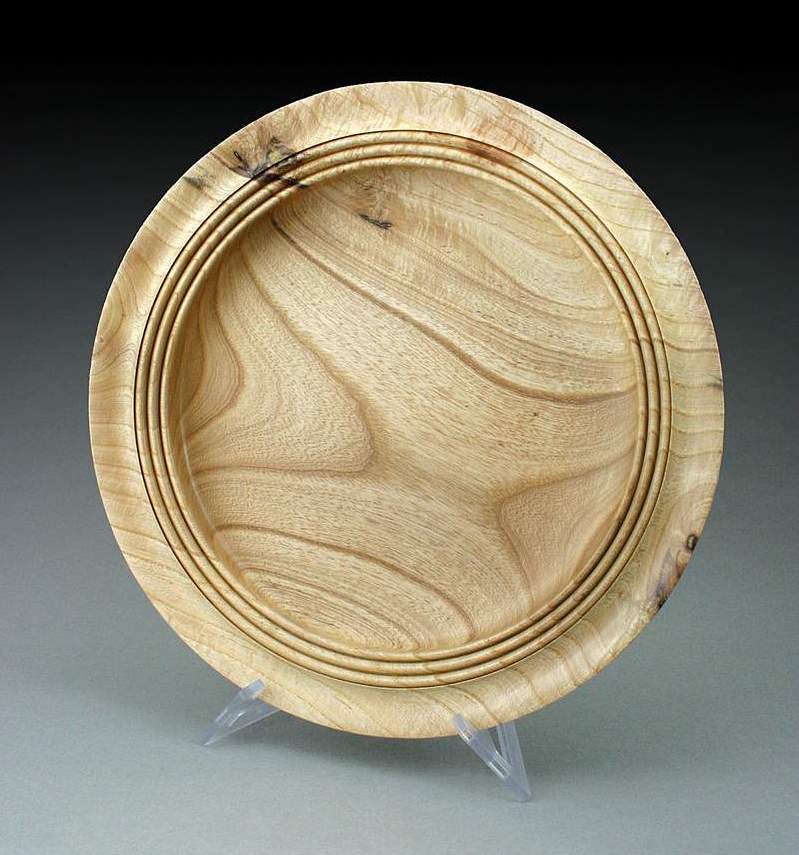
Re: Last night's demo material

#2

Re: Last night's demo material

Mark Kauder, Phenix City, AL

>Mike,

I am with you on this - to a point.

I suggest that they do not use a sanding sealer, just use the lacquer.

Sanding Sealer - to get a sanding sealer the manufacturer of either the Lacquer or Shellac based products just add a serate (a kind of soap) with the only purpose to keep sandpaper from clogging. You might notice that sanding sealer is cloudy in the can - that cloudyness is the serate. Though it is somewhat clear when dry, there is some residual cloudyness in the finish - clouding the view of the wood - if ever so slightly. Using a straight lacquer you can follow the same process.

I am a little leary about using a buffing wheel - too easy to burn or burn through a lacquer finish. Even in the automotive industry, we used slow buffing not high speed. But to each his own.

Mark

Re: Last night's demo material

#3

that would be another

Mike Schwing from Md.

>Just demo'ing one of hundreds of ways to finish something off Mark. This application is actually quite different than using lacquer only - using the mylands lacquer gives a very different finish, and is not as easy to work with the buffing wheels as you have noted. Using the sealer leaves a nice, tactile feel to the surface, while leaving a very high sheen, but not quite a gloss. Using the lacquer gives more depth, and more gloss, but is harder to work with. This was geared towards folks without much experience with either wheels or finishes.

Re: Last night's demo material

#4

Re: Last night's demo material

RonZ

>Mylands sanding sealer is as clear as laquer, I thin mine with 50% nitro thinner so the first coat soaks in the wood and then builds up from there [learned from Chris Stott]. Myland's is melamine based, the stuff once [or maybe still]used for counter tops. Three good coats should withstand a beal buff.

Re: Last night's demo material

#5

Re: Last night's demo material

RonZ

>Not bad but I disagree on the following points:

Liberon 0000 steel wool is equivilent to 600 grit, Tripoli is about 800 grit and white diamond is 1000 grit. Carnauba is just a wax and I can get a good gloss for instance on my tops that I make that are like Bonnie Klein's and I have gone directly from tool to 220 grit to wax. I have also learned it is futile to sand above 400 grit as the sanding sealer will not soak in as is meant to.

So if you sand to 400 grit, apply a few coats of Myland's sanding sealer and cut back with Liberon's 0000 steel wool between coats, you have progressed up the grades and have a finished product at 600 grit. Now if you proceed to the Beal system you will remove any imperfections and be left with and aproximate 1000 grit finish. Now if you crave further perfection you can try micromeshing up to 12000. IMHO it's a waste of time and any additional sanding is purely theraputic for thos that enjoy it. =o)

Re: Last night's demo material

#6

Re: Last night's demo material

Jennifer@Indy.USA

>Fantastic Mike....printing now!

Re: Last night's demo material

#7

Re: Last night's demo material

Mike Schwing from Md.

>Ron, your response kind of pisses me off. If you don't like what I posted, don't use it.

I didn't ask for comment, critique, nor suggestions on how to improve this. I stated very clearly that this was only one approach to finishing that I have had good success with, and that if it helps anyone, great.

If you don't like it, either show where it is dangerous, foolhardy, or doomed to failure. That would be fine. But if you want to post an article about a finish that you have had success with, by all means take the time to write one, demo it, and gauge feedback live and in person.

I asked for help with the chainsaw article, and got exactly what I asked for. Next time perhaps I'll hold back on any info that might prove helpful to someone.

Re: Last night's demo material

#8

Re: Last night's demo material

Dan Lanicek in TX

>Thank you, Mike and Mark. I've been experimenting with different finishes lately. I will give this a try but plan on using Deft lacquer. Call me cheap, but I just can't justify spending $17 for ~1/2 qt. of sanding sealer.

On a similar note, what is the difference between Myland's sanding sealer and Deft's sanding sealer?

Re: Last night's demo material

#9

Re: Last night's demo material

Gerry in Maryland

>Thanks for the demo Mike.

I saw it. I felt it. It is as you say "A Satisfying Quick Finish". All in under an hour too.

Gerry

Re: Last night's demo material

#10

OT, old Micromesh

John K Jordan

>When I started woodturning I was a little suprised to see Micromesh used so much for wood. I never imagined using it on wood!

Back in the mid '70s used a Micromesh kit to restore the glazed and scratched front plastic windshields on one of our airplanes, a Cessna 172 I think. It worked very well although it took all morning to restore the windshield. It looked like a new one, so clear it was amazing.

Just for fun, I found the old box with the half-used grits (I save everything and know exactly where it is... right) and compared the two. Besides the cost (then $15.80, now $42) the kits were very similar with the same grits and sizes included.

The old one was marketed mostly to aircraft owners for plastic restoration but suggested use for motorcycles, boats, etc. I did find the word "wood" on the box but not in the instructions. The new one is all about wood.

The old one has far more extensive instructions (probably needed for plastics) in a little book, the new had a single printed sheet. The old one included antistatic cream and polishing cloths.

The old one did recommend using it wet with water/detergent for plastics.

JKJ in East TN

Re: Last night's demo material

#11

Re: Last night's demo material

Ed Kelle

>Thanks Mike! Our club is starting a small turning group tonight and this is perfect timing. I will be sure to tell about the chainsaw sharpening tips as well. Many thanks for taking time to write and post these helpful techiques

Re: Last night's demo material

#12

Ric Taylor

Re: Last night's demo material

Ric Taylor

>I use Myland's sanding sealer a lot, and I like it very much, but what comes out of my can is not clear.

Ric

Re: Last night's demo material

#13

Ric Taylor

Thanks, Mike..... Good Information!

Ric Taylor

>

Re: Last night's demo material

#14

Re: Last night's demo material

Ron in Drums PA

>Mike I think he was expressing a opinion and offering a alternative method. I don't see a problem with that.

Thanks Mike and RonZ - I like both your methods but my method is a bit different.

Re: Last night's demo material

#15

Re: Last night's demo material

Mike Schwing from Md.

>Everyone has a different method, and I'm admittedly a little touchy right now (potentially serious medical issue). I am frustrated by responses, in general, that are critical, or even simply suggested improvements, where not requested. It frustrates me when I see it happen to others even more so than when it does to me. Despite my best attempt to simply say "this is just the way I do it", and "there are many others" people have criticized that method rather than present their own. I didn't ask for the critique, as I did in the chainsaw article.

It makes me, honestly, want to convert to lurker status.

Re: Last night's demo material

#16

Re: Last night's demo material

RonZ

>it's slightly yellowish in color like Karo syrup but it is anything but cloudy.

Re: Last night's demo material

#17

Re: Last night's demo material

RonZ

>My humble apologies for pissing you off. Your post did not say 'do not comment' or anything else along thise lines. I also cannot a'scertain the level of ones discomfort over comments nor medical issues [may you be healthy and happy].

You did say; 'The goal was to help new-ish turners learn how to apply a finish that didn't take days and was still satisfying.'

While I'm not a seasoned professional, I do teach basic woodturning, specifically to young and impatient boys. The process as you described it, appears to take twice the normal ammount of time and effort that will render similar results of the method I mentioned. My method isn't the only one but it works for me and many others. Many have there own method and to each his/her own. I also try as much as I can to learn from everyone.

This is an open board and I personally am too busy turning to post frequently. I think about three times before I post. I thought we shared a certain level of comraderie and thought that my constructive criticism might be of value. I will certainly take note not to comment on your posts and perhaps it should be placed in the mast head 'Do not comment on peoples' posts unless requested.

Re: Last night's demo material

#18

Re: that would be another

Mark Kauder. Phenix City, AL

>Mike,

You are absolutely right there are 100's of ways to finish and I should have asked if the Mylands was a cloudy sealer.

I was mostly passing on what Russ and Sam Simpson have taught me about most sanding sealers.

The buffing is only MY experience with NC Lacquer. It occurs to me that Mylands may not be a Lacquer.

I should have couched my response with more than the term 'Suggest'.

Mark

Re: Last night's demo material

#19

Re: Last night's demo material

Philip Duffy

>Mike, a real contribution to those of us who are still learning the secrets of a finish that brings a smile. Thanks!

Very best luck on that possible medical problem. Phil

Re: Last night's demo material

#20

Re: Last night's demo material

Doug Trembath

>Ron, can you cite a source for your grit equivalents? I think you may have left off a couple of zeros on some of them. I don't have the reference available at present, and have only a couple of minutes to respond, so forgive me if I'm a little fuzzy on the numbers as well.

I routinely sand up to 2500 using wet-or-dry 3M paper before I apply any finish, and heartily maintain that I get a better finish doing so. Remember that the surface finish determines the final surface, and that lacquer and all other finishes will continue to shrink over time as they slowly lose solvents.

I use steel wool occasionally, but not on a show quality finish, oil based or lacquer. I use wet-or-dry, again, up to 2500, then buff.

Tripoli gives a surface of much higher grit than you cited. I believe it's in the thousands, rather than hundreds. White diamond is around 20,000 grit to my memory. That's the figure I have heard bandied about. Think of the particle size, and the mirror like sheen achieved with these products, and then look at the finish from 1500 sandpaper, for instance.

Doug Trembath

Studio in the Woods

Re: Last night's demo material

#21

Ric Taylor

Not at All

Ric Taylor

>Well, you must not be shaking the contents of the can before pouring, because it is very definately cloudy and not at all like Karo syrup. It looks like milk and melted butter mixed mixed 50% with water when it comes out of the can. I've used it every few days for years.

Ric

Re: Last night's demo material

#22

Re: Last night's demo material *LINK*

RonZ

>...>>


Your response

× Share

Share on

✉ Email this page