Home Articles Forums Gallery Marketplace Videos

WoodCentral Forums

Knowledge You Can Build On — Est. 1998

Buffing Master's Magic Spray Lacquer?

Posts

Buffing Master's Magic Spray Lacquer?

#1

Buffing Master's Magic Spray Lacquer?

Jeremy in LA

>Hi there! Does anyone know if I can use the Bealle buffing system on Master's Magic Spray Lacquer (or any lacquer for that matter)? I know I know, if I apply lacquer correctly there should be no need, but indulge me! :) I just don't want to ruin something great by trying to make it super-great. Maybe I'll just go test it myself on a small piece of something (wow there's a thought!). In the meantime, your advice is appreciated! Thanks!

- Jeremy

Re: Buffing Master's Magic Spray Lacquer?

#2

Ric Taylor

Re: Buffing Master's Magic Spray Lacquer?

Ric Taylor

>Jeremy,

I don't know about that particular brand, but you can use the buffing system on lacquer with excellent results. Just keep the rmp low, I run about 500 rpm or less, use light pressure, and take your time. Lacquer is soft. If you use a high speed or high pressure, you will take the lacquer right off.

Ric

Re: Buffing Master's Magic Spray Lacquer?

#3

Re: Buffing Master's Magic Spray Lacquer?

John Lucas

>Jeremy

I don't know about that particular brand but I buff lacquer all the time. In my shop it's almost impossible to spray lacquer and not get some dust nibs so I always buff unless I use a rubb on finish.

The trick to buffing laquer with the beal is a light touch and very little compound on the wheel. It's really easy to cut through the lacquer. I buff using my lathe and turn the speed down to about 1000 rpm. then I just touch the wheel for a few seconds with the compounds.

When I first started using the Beal I was melting the lacquer. Not fun. I slowed the lathe down and used lighter pressure and got great results.

Re: Buffing Master's Magic Spray Lacquer?

#4

Re: Buffing Master's Magic Spray Lacquer?

Russ Fairfield

>I know that nobody wants to hear this, but you should give the lacquer at least a weeks before buffing. A couple weeks is better, and a month would be best. It takes that long for the solvents to evaporate and for the lacquer to get anywhere close to its final hardness. Anything less than a week and you run the risk of damaging the lacquer because it is still too soft to be buffing on it.

Re: Buffing Master's Magic Spray Lacquer?

#5

True for all finishes

John Trant (Baltimore/DC area)

>This is true of any finish and it is even more important for oil-based finishes.

John

Re: Buffing Master's Magic Spray Lacquer?

#6

Re: Buffing Master's Magic Spray Lacquer? *LINK*

Mark Kauder, Phenix City, AL

>I have spent a great many hours buffing out cars and now bowls. Here are my 2 cents worth.

1) If you are not sanding before buffing, you are just polishing the dust nibs, ect if you buff w/o sanding.

2) If your finish is pretty good, I few minutes with 800 grit and then 1000 grit will improve the finish tremendously.

3) On something as small as a bowl, and the fact that you are going to lightly buff lacquer anyway, I think that power buffing is a waste of buffing compound and is a mess.

3) In the auto painting business, when you want to do a superior job, you follow power buffing with hand rubbing/buffing.

Get yourself a bottle of 3M Finess-it II or any good swirl remover/rubbing compound at Auto Zone, and it will only take 5-10 minutes to buff our a decent sized bowl.

Mark


http://www.markkauder.com

Re: Buffing Master's Magic Spray Lacquer?

#7

Keith Tompkins

Re: Buffing Master's Magic Spray Lacquer?

Keith Tompkins

>Jeremy, Lacquer, in my opinion, always needs to be buffed. using the beall system is going to take some getting used to, as John stated. Expect to burn through the layers of finish at first.

You can accomplish the same thing by hand with less chance of burning through. A turning is small in comparison to flat work, so even by hand it is a quick operation.

For a superb finish, expect to spend almost as much time as it took to turn and sand. I apply many coats, up to twenty coats, then wet sand, starting at 500 grit wet or dry paper, ending up with 2500 grit. I then apply automotive buffing compound with a rag in a circular motion.

Re: Buffing Master's Magic Spray Lacquer?

#8

Re: Buffing Master's Magic Spray Lacquer? - long

Mark Kauder. Phenix City, AL

>Jeremy,

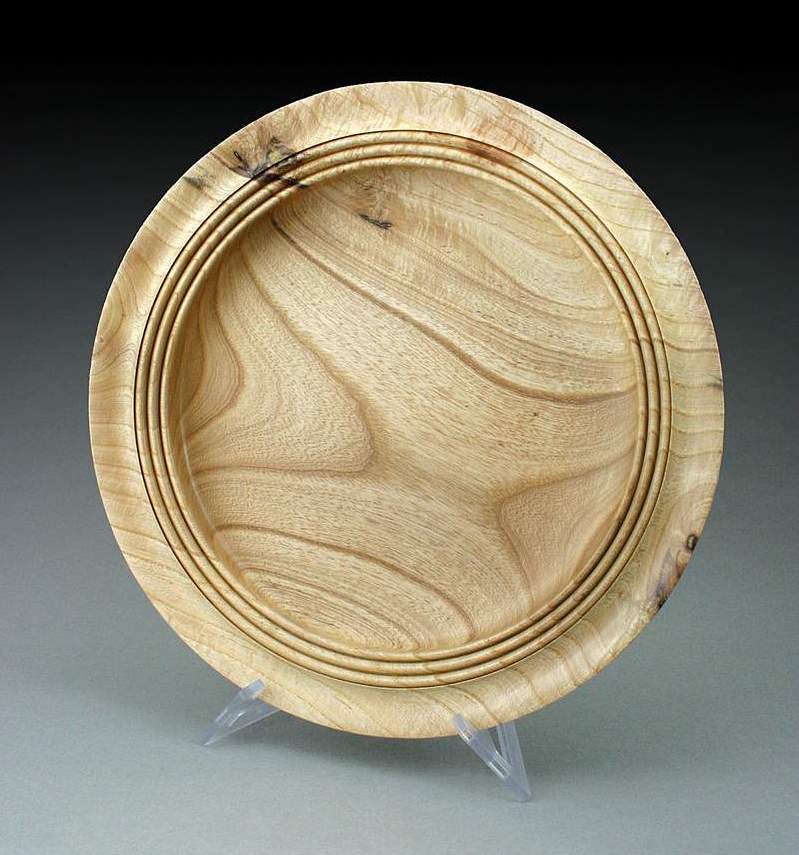
Most of what Keith and I have described above supposes that you want a glass-like finish, i.e. no grain showing in the finish (see the bowls on my website). If you want a different finish, let us know so the we had give you the appropriate help.

If you do indeed want a glass-like finish, I have a couple of recommendations, and a process that cuts the sanding time dramatically.

Suggestion 1: You really need to be spraying from a gun, and not a can. The lacquers in a can have low solids, and are thinned quite a bit to allow them to spray at low pressure of a can. Low solids means that it will take forever to fill any grain. By the time you do a relatively small number of bowls you could buy a small compressor and spray gun. You do not need a high price gun, a $50 Hausfeld Campbell "Touch-up gun will work very well. And you can do quite well with a small air compressor, you will only be spraying for a few minutes at a time.

Suggestion 2: If you do not feel that you can swing the spray rig, buy a $23 gallon of Deft brushing lacquer. You can apply it thicker with a brush. I am not a big fan of Deft for this kind (glass-like) finish for two reason. 1) low solid content, 2) it has a retarder in it that allows the lacquer to dry slower so that the brush marks can flow out. This retarder also stretches the time that it takes the lacquer to fully cure (see Russ's note above - and add about 50% to his times). BUT Deft is far superior to spray can lacquer.

Now for my system:

1) I use Behlen's Stringed Instrument Lacquer or McFaddens Guitar Rubbing Lacquer (do web searches for them). Both have very high solids content. They are also formulated to be resistant to the abuse that a stringed musical instrument takes, but flexable enough to allow the wood to move, without cracking - just like a bowl does. Lacquers that are appropriate for furniture, may not be appropriate for bowls.

2) Sand to at least 220 grit. I do all my sanding on the lathe - power sanding. I also do the next couple of steps while leaving the bowl on the face plate or with the chuck tenon still attached.

3) Spray 3-5 heavy coats of full or near full (un-thinned) lacquer, each about 10-15 minutes apart. No need to do anything between coats - lacquer melts into the subsequent coats - no need to sand for adhesion. Don't worry too much about runs.

4) The 12 to 24 hours later, I put the bowl on the lathe, run the RPMs to about 200 (you can go 500 if that is all the slower your lathe will go down, and with a good sharp cabinet scraper held on the bottom of the bowl, I scrape the bowl smooth. This leaves lacquer in the grain and levels the surface, the lacquer is working as a grain filler. I then power sand it with 220.

5) Apply 3-5 more coats.

6) Allow the bowl to dry 24-36 hours, and then power sand with 320. If it is smooth at this point, part it off the tenon, etc.

7) Apply 3-5 coats to the uncoated bottom. and 1-2 on the rest of the bowl.

8) Allow to dry 24-36 hours again, and then wet sand with 400 grit. If you attain a good smooth finish, got to 600 grit.

9) Spray the bowl with a 50/50 mix (lacquer and thinner). 3 coats. Be careful not to get runs at this point, or you will do alot more sanding.

10) After 48-72 hours, wet sand starting with 1000 grit and proceed to 2000 grit. Then hand buff with the swirl remover. Alternately you could sand up to 1200 grit Micro mesh.

11) After about 2-3 weeks, check to see if additional drying has made any surface irregularities show up. If so, you can spot sand that area, starting with 600 grit and work up. Remember, never sand it a small circle with one or two finger, always in larger circles and preferably with palm of you hand. This leave a flatter surface - no sanding divots.

This sounds alot worse than it is. Most of your time is spent waiting for lacquer to dry. Wet sanding is one of the few things you can do while watching your favorite movie/TV show. Lay a towel in your lap, a small bowl of water at your side, and sand away.

Basically, I probably do the same thing as Keith, except that I use the scraper and power sanding to level. Alternativly, you could sand with 220 grit off the lathe. I just think my method is faster. Since I do 90% of all my bowls this way, and I have 5-7 bowls going at a time, I wanted a faster way.\

If you are using Deft - double the drying time and probably double the number of coats to get the fill.

Questions - ask away.

Mark
Re: Buffing Master's Magic Spray Lacquer?

#9

Keith Tompkins

Re: Buffing Master's Magic Spray Lacquer? - long

Keith Tompkins

>Good suggestions, Mark! I'll have to try the scraper...do you ever use sanding sealer?

Re: Buffing Master's Magic Spray Lacquer?

#10

Re: Buffing Master's Magic Spray Lacquer? - long

Mark Kauder, Phenix City, AL

>No, basically most sanding sealers are just thinned down lacquer with a serate in them like talc in them to keep the sandpaper from clogging. Seems kind of redundent to me, especially when after sanding the wood to 220/320 I am not sanding the wood any more - just the lacquer.

I have used some of the vinyl sealers recommended for use under these stringed instrument lacquers. Sam Simpson told the that they add a little bit of elasticity to the bond between the bowl and the lacquer, but are not absolutely necessary.

Mark

Re: Buffing Master's Magic Spray Lacquer?

#11

Re: Buffing Master's Magic Spray Lacquer? - long

tek-Brunswick, Ohio

>What is the vinyl sealer like to work with? Does it sand like sanding sealers?

Re: Buffing Master's Magic Spray Lacquer?

#12

Finally, The truth

Russ Fairfield

>I am glad that someone else has spoken the truth about sanding sealers. A lot of woodturners see them as the "magic finish". In reality, they are what they are, a thinned down finish (lacquer or shellac) with something added to make the sanding easier. And, that something, whether it be stearates (stearic acid, an ingredient of soap), talcum powder, or whatever, is opaque and will mask the grain and color of the wood.

My dictionary defines opaque as: blocking the passage of radiant energy and especially light.

Is that really a property that we want for something that we are using as a finish?? It seems to me that we should be trying to add brilliance to the wood grain, not cover it up with something so we can't see it. Lacquer has the transparency that will add those properties to a finish. A sanding sealer does not.

Everyone who thinks that a sanding sealer is a good thing should look into an open can of the stuff. If you cannot see the bottom of the can, there is no way what you see will become invisible after it has been put on the wood.

Everyone admires the brilliance, clarity, and depth of Mark's lacquer finishes. The connection that is usually missed is that, they wouldn't be nearly as bright and clear if he were using something that was opaque and masked the wood grain grain and color. Listen to what he says.

Re: Buffing Master's Magic Spray Lacquer?

#13

Re: Buffing Master's Magic Spray Lacquer? - long

Russ Fairfield

>Mark,

Have you tried any of the plasticizers??

There are some modern products on the market, but I am still doing it the old-fashioned way with Castor Oil. About a tablespoon per quart does wonders for a lacquer.

Re: Buffing Master's Magic Spray Lacquer?

#14

Re: Buffing Master's Magic Spray Lacquer? - long

Mark Kauder. Phenix City, AL

>Russ,

No I have not, and I have wondered about them every since I heard (saw) you mention them one time. HOWEVER, it is my guess that a plasticizer, of some type, is the key to why the Stringed Instrument Lacquer/Guitar Lacquers are more flexible.

Mark

Re: Buffing Master's Magic Spray Lacquer?

#15

WOW!! Now those are some responses! :)

Jeremy in LA

>Wow thank you guys for going waay beyond what anyone could hope to get for an answer when posting a question :) I've been getting ready for an art show I have tonight, so I didn't even check this again until now, and there is literally years worth of experience and information in this thread. I just wanted to say thank you, I have read everything through once, and I'm going to be coming back after tonight and re-reading all of it probably ten times.. :) Then, I may have some follow up :D So thank you! :)

Re: Buffing Master's Magic Spray Lacquer?

#16

Thanks Mark

Steve Mushinski

>Very good information Mark. I have copied it and made a print out for my turnering information binder. In a few weeks when things warm up in Toronto I will give this exact method a good try and see if I can attain results somewhat like yours. Thank you for being so detailed in you answer.

Steve

× Share

Share on

✉ Email this page
