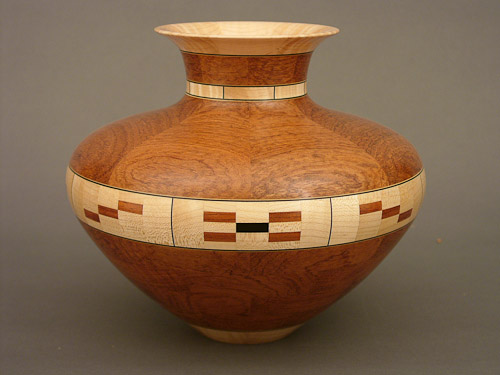
>Many customers ask if the finish on a product is food safe. Many manufacturers of finishes, such as Behlen's salad bowl, state that their product is FDA approved food safe. Lots of people claim that certain finishes are safe, others say they are not. Some speak of the driers as being unsafe. Some say that once a finish has completely cured, it's safe, regardless of it's chemical composition.
I've visited the FDA website and like all government bureaucracies, it has made my head hurt......bad! Does anyone know if an actual list of finishes, deemed safe by FDA actually exists and if so, where might it be?
I'd like to see if the various finishes that I use are listed and then add the claim to my product tags...........with confidence.
>Hi Mike - I'm retired from a 20-year career with the FDA. I worked in the medical technology end of things, not the food end, but I can shed a little light on this subject for you.
Despite claims you may read, the FDA does NOT "approve" anybody's finish. They don't have the time, the resources, or the inclination to study that topic at that level of scrutiny. They have many more immediate things to worry about, some of which are literally a matter of life and death.
In a nutshell, here is the situation for wood product finishes: some years ago, the FDA (with some outside help) compiled a list of ingredients that might be used in a finish. Not to say that all of those ingredients would be used in any particular one finish - some might be used in one, others used in another. What they say about the food safety question is that IF a finish is made from ingredients that are on the list and IF the finish is "properly formulated", then the finish (when cured) poses no known food safety hazard. Properly formulated means simply means used in the right proportions. All of this is written out in mind-numbing detail in the 21st chapter of the Code of Federal Regulations, so when you see some printing on a can of finish that mentions "21 CFR .....(other numbers)", that's what that is referring to. Basically, the FDA provides guidelines for how to mix a finish that will be food safe and relies on the manufacturer to follow those guidelines. THey do not test anybody's finish, nor do they inspect anybody's facilities or anything like that. Like I said, they have lots of other more pressing things to worry about.
If someone markets a finish that they specifically claim meets those guidelines, as Behlen does, and the FDA found out somehow that it didn't - i.e., using ingredients not on the list or using the wrong proportions - then they would attempt to get that company to either change the mix or quit claiming that it meets the guidelines. How much actual regulatory power they have in that case, I'm not sure. But most companies would cooperate. FDA doesn't tell anyone what they can or can't use in a finish, they only insist that IF you claim it meets these guidelines, then it really has to do so.
Behlen is the only one I've seen that makes this claim, for their Salad Bowl finish. There may be others.
The main reason that this is so low on the list of priorites is that the question of food safety is not an easy one to answer. Some ingredients are known to be toxic to humans, others are known to be toxic to animals and suspected for humans, others are a big question mark. Stuff like this takes years of study to establish.
Lots of knowledgable people argue that any finish, once it's cured, is food safe. I'm inclined to believe that.
>Thanks, yes you have cleared up some things. I also agree that most finishes, when properly cured are safe. You also gave me a starting point to do a search and find that FDA 21 CFR 175.300 is the reg that applies. While it doesn't list the individual products, it does list substances used as ingredients. I also find that FDA's wording is "safe for food contact surfaces".
I too have read and re-re-re-re-re-read the FDA documents as well as many other federal, state, and medical documents concerning this. I came to the same conclusions as you stated.
There is simply no actual proof. And the wording of almost all of these documents is sufficiently vague and broad to make them practically useless in regards to figuring out whether a particular product or set of products can be listed as "food safe".
Every time this topic comes up there's usually someone shouting that it's all safe once XYZ condition is satisfied (usually relating to the solvents). Of course, there's the vague reference to "some study, somewhere" or "I once heard" or "a document by someone" proves it. When pressed, the conclusive information is nowhere to be found. That doesn't keep me from looking, however.
It's one thing to subject myself to a guess at what's foodsafe and what's not. It's another thing to give or sell products that I've made to others proclaiming it is "safe". It's still quite a different thing to suggest to others that they do the same when I have nothing concrete to back it up.