WoodCentral Forums

Est. 1998 — 27 years of woodworking knowledge

A sanding tip

Posts

A sanding tip

#1

A sanding tip

Mike Schwing from Md.

>Based on a reply to an email I received on sandpaper sources, there is a tip about how to remove those all too common circular sanding scratches we find in our turnings that are power sanded with the lathe turned on. It works like a charm, easy as cake to do, and since I found this little tip/method, I can honestly say there are none of those frustratingly hard to remove, but extremely easy to see marks in my work. Hope it helps someone.

-------------

On almost all of my work I use a combo of the "Wave" discs in a powered drill and Micro Mesh. I start with the work on the lathe at a very high speed, maybe 1500-1800 rpm, IF I'm comfortable with the work spinning that fast.

I usually start with 80 grit wave discs with a firm pad to remove any tear out that might exist as well as any tool marks or high spots. I then switch to the soft pad and proceed to 100, 120, 180, 220, 320, and 400. After sanding each grit with the lathe on, I lock the spindle and go over it with the same grit with the powered sanded but lathe off. This will remove all of those lousy circular sanding marks so prevalent in turned work, and I only spend another minute or so for each grit. It is fast work.

From there I go to the Micro Mesh and do not skip grits. I start at 1500, which is supposedly the same roughly as 600 wet/dry paper and go all the way up to 12000. If it happens to be maple I'm turning I'll grab a handful of shavings and burnish it after the 12000. See Russ for confirmation of this last step as it has caused controversy when I've relayed it in the past.

Hope this helps.

-----------------------

ps..I don't mean to start another brou-ha-ha over the long term effects of applying finish to surfaces that are so smooth or burnished. This works for me.
Re: A sanding tip

#2

Re: A sanding tip

Bill Luinetti

>Mike, I've seen your very impressive work on this site, and it is impossible to argue with your success.

I have two questions for your technique, however: (1) when you start Micromesh, you are hand-holding the finishing medium with the lathe on, correct?, and (2) what is your final finish medium (wax, shellac, nothing)?

I had asked a question several days ago about power sanding, and your post answers some about technique.

Bill Luinetti

Re: A sanding tip

#3

Re: A sanding tip

Mike Schwing from Md.

>Bill, thanks for the nice words. I could have expanded on the micromesh technique.

I use a wad of foam/sponge that I wrap the micromesh pad around. It keeps more surface in contact with the work than my fingers do, and it keeps them from getting hot! You gotta keep that micromesh moving, and especially away from sharp edges as it will melt, particuarly the higher grits.

As for finish, I pretty much use this sanding technique for all of my finishes, regardless of whether they're lathe applied lacquer or sprayed, oil, wax, or varnish.

And I use a cheapie Black and Decker rechargeable drill.

Re: A sanding tip

#4

Re: A sanding tip *LINK*

Mark Kauder, Phenix City, AL

>Mike,

Let me pass on a tip that Russ gave to me a couple of years ago. Go to Industrial Abrasives, and you can buy a 36"x39" sheet of velcro backed sandpaper, anywhere from 60 to 600 grit for about $15 (about the same as I paid for 50 wavey edged disks). From this, you can make 350+ disk for a 2" sander.

In the WC articles section is a thing on how I cut them into 2.5"x2.5" squares on my bandsaw. Using them square is the same as using the wavey edged ones. It is good sandpaper, but at this price, you do not have to wear it out to save money. Like someone (maybe it was Ellsworth) said - You should use sandpaper like someone else is paying for it.

Mark


http://www.industrialabrasives.com/01713.html?SESSIONID=cc243e5733fc5883d5139746744b9a71

Re: A sanding tip

#5

A non-sanding tip

Bob Hackett

>Mike,I`m sure your process works for you and I sure can`t argue with the results but...

I like to remove any tearout or flaws left by sanding before finishing with a cabinet scraper.

Many times if nothing else works on dificult wood the scraper is where I start.After spot scraping the problem areas I find I can usually start sanding with 220/300 or finer.

Just another way to skin the circular swirl or torn endgrain cat.

I plan to use your techniques for the finer grits as I don`t presently go to micro abrasives other that ultrafine Scotchbrite pads.

Like I said,when it comes to finishing if you ain`t the man I`m gonna follow your lead till he gets here.;^)

Mainely,Bob

Re: A sanding tip

#6

Re: A sanding tip

Wally Dickerman at Green Valley, Az.

>Mike, your tips are good, but I do it a little differently. Rather than start sanding with 80 grit, I prefer to shear scrape, using oil, until all tool marks and endgrain tearout is gone. Then I can start sanding with 150 or 180, using oil. Sometimes with 220. Your circular sanding marks can be caused by running the drill in the wrong direction. I have a Makita right angle drill, which I use, but more often I prefer a Vic Wood inertia sander. Won't work inside an open bowl, but then I seldom turn open bowls.

Wally

Re: A sanding tip

#7

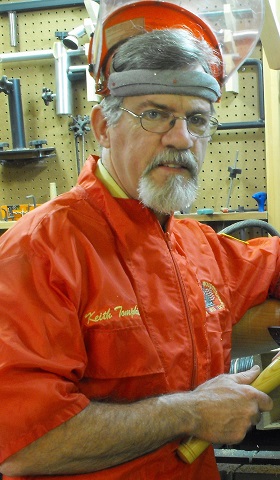
Keith Tompkins

Re: A sanding tip

Keith Tompkins

>My solution to the circular marks....I don't power sand! I guess I'm one of the few who doesn't.

Re: A sanding tip

#8

Re: A sanding tip

Mike Schwing from Md.

>I think I didn't describe "circular marks" properly , according to the responses.

What I was referring to are the telltale "scratch marks" that show the lathe was running when the piece was sanded. The same marks occur if using handheld sandpaper, if one isn't careful enough to keep the paper moving, and sometimes even if you are. They appear as straight lines that run the circumference of the work.

They show up on my work regardless of grit if I'm sanding with the lathe on, and I can remove them almost as easily if I turn the lathe off and hand sand in different directions on each successive grit.

Maybe in 10 or 20 more years I'll be good enough to start at higher grits, but at my current state of development, I can make some very small work out of a much larger blank if I take the time to get every tool mark out. Sanding is a quick cure for a short time in the hobby. It also may be due to the fact that I'm extremely critical of my own work.

I'm going to stick my neck out and use Bill Grumbine as a defense mechanism here, as I've read him say he usually starts with 80 grit, too, but I doubt it is for the same reasons.

Re: A sanding tip

#9

Keith Tompkins

Re: A sanding tip

Keith Tompkins

>Hi Mike, I'm like you, I despise sanding marks. Recently, someone handed me a turning to critique; he commented " I hate sanding". My reply...." yes, I can see that!" Luckily, we both had a good chuckle!

Seriously, I think my hesitance to use any power sanding techniques stems from seeing flat work sanded with orbital sanders.

I usually start with 120 grit or finer, always using a foam pad to hold the paper. I wash down the turning with a damp cloth and let it dry overnight....that raises the grain bring any deeper scratches to the surface. I also usually hand sand with the grain as a final touch.

To me, it seems the lighter woods are more difficult to remove sanding marks..any defect really stands out. I think many turners are not willing to spend the time to sand thoroughly, which can ruin an otherwise good turning.

Re: A sanding tip

#10

Sanding......

Russ

>We have to be careful when we useing techniques as a measure of skill and experience. If sanding grits are to be used as such a measure, then I would have to be rated as a gross "beginner" who will never rise to any level above that. Why?? I start sanding on almost everything at 60-grit; and there are a lot of other woodturners, more experienced than I, who do the same thing.

The reason is that the 60-grit is used as a shaping tool. While others are refining the shape and surface of the wood with scrapers and other turning tools, we are using the 60-grit sandpaper to do the same thing.

It is faster for us to do it that way, and there is less wood removed in the process. Others will chose do it a different way. It has nothing to do with skill or experience.

Re: A sanding tip

#11

Re: A sanding tip

Peter Teubel

>Odd. I use the wave discs exclusivily (starting at 100 grit), the lathe spinning at 1200, and the drill at 2500. I never get those "hand sanding" straight line marks. I power sand anything and everything I can...including spindle work (if possible).

Re: A sanding tip

#12

Re: A sanding tip

Mike Schwing from Md.

>Peter, this is interesting! I wonder if it is due to your high speed sander. Mine revolves at about 100rpm. What brand/model are you using?

Re: A sanding tip

#13

Re: Sanding......

Bob Hackett

>for me it`s not a measure of anything to say what grit someone starts at other than to say if you have a trick tha allows you to start at xxx or finer it just means you spend less time standing at the lathe with a respirator on.

I think we can all agree that sanding is one of our least favorite chores(one reason I like hand planes too).I listen whenever someone says something that will get me thru it faster while still leaving no rogue scratches and that 3d finish.

Mainely,Bob

Re: A sanding tip

#14

Re: Sanding......

Mark Kauder, Phenix City, AL

>I may be a loner here. I am a convert - I used to hate sanding. Then some years ago, Gary Hern pointed out to me that when I finished turning with a gouge, if I wanted a truly good piece, I was only half done. The sanding and finishing are critical.

I love sanding now, truly. This is where I can really refine curves because once it is really smooth, at say the 150 grit level, you can really feel and flat spots in a curve. This might necessitate going back to the gouge or a fine scraper, but as often as not, I can refine the curve better with 60 grit.

Power sanding has really made the difference. Sanding inside a enclosed form is still a chore, and is the most potentially catistrophic - get a "Catch" with the sanding pad on a long extension, and it can end up going through the side of the bowl (DAMHIKT).

I find that I spend the most time with the 60-80-100 grits, and then things move very quickly from there up. I go to 400 when using Lacquer, and as much as 2000 when using Oil-poly finish.

The most Time I spend on sanding, is the hand sanding for hours on the lacquer.

Sorry this is so long - just feeling long winded this morning.

Once again, just my opinion. Your mileage may very.

Mark

Re: A sanding tip

#15

Re: A sanding tip

Mark Mandell - Gone Round In Jersey

>Mike,

I'll ditto Peter's comment. I use a 2,500 rpm Milwaukee close quarters drill (angled, not 90*), but I run the lathe much slower, 150 to 300 rpm max depending on the grit. Allows a lighter touch on the paper to reduce heat and preserve the velcro loops longer.

I also prefer the Power-Loc disc set for heavier grit on the inside of bowls; eliminates worrying about the abrasive slipping and melting the velco pad hooks when working the initial rough spots and tearouts.

Mark

Re: A sanding tip

#16

Re: Sanding......

Mike Schwing from Md.

>Ok! so this, for me at least, has been been a good thread.

I'm with you Mark. I like sanding, too, just not the mess it can create. Since I started out building furniture before getting the turning bug, I was well aware that building the work is maybe half of the project, finishing can take much much longer.

Funny, I was thinking along the same lines as you, the hand sanding in between lacquer coats take the majority of the time.

I also find that the first grit - 80, is the only one I spend any real time with. They decrease rapidly after that.

Thanks everybody for the input. I'll put it to good use.

👍 This page answered my questions

Your vote helps other woodworkers quickly find the answers and techniques that actually work in the shop.