Mesquite turnings
Jay Sullivan
>Here is a mesquite pot I just finished. It is 5 1/2 inches wide and about 4 1/4 inches tall.
Comments and critiques desired.
Jay
Est. 1998 — 28 years of woodworking knowledge
Mesquite turnings
Jay Sullivan
>Here is a mesquite pot I just finished. It is 5 1/2 inches wide and about 4 1/4 inches tall.
Comments and critiques desired.
Jay
And a Wormy bowl
Jay Sullivan
>
Re: And a Wormy bowl
TDaniel
>Jay, I think this one would look better if the bottom were smaller. Wally could give some good pointers here as this design is in his direction.
TD
Re: And a Wormy bowl
Jay Sullivan
>Thanks for the input TD. The bottom *is* smaller than it looks. The angle of the photo isn't that great. It is about 1/3rd the size of the largest diameter. Wally taught me that!
Jay
Re: Mesquite turnings
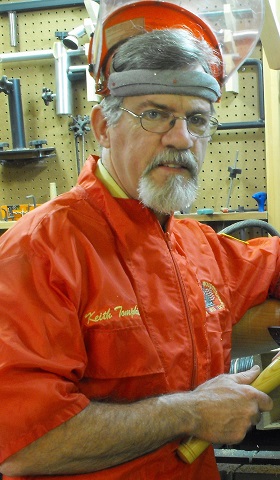
Keith Tompkins
>Hi Jay, this piece is interesting if you flip the image over. Viewed this way, as though it was a bowl form, what is now the foot seems too elongated, the curve a bit too slow in relation to the rapidly accellerating curve on what now is the top.
In other words, (my opinion) I would start bringing the neck in a bit sooner, making the overall helght a bit shorter, and creating a more balanced piece.
I'm nit-picking here, it's a nice piece. I'm critiquing it as though it were my own piece. very nice, Keith
Re: And a Wormy bowl
Ruth
>Jay, TD, et al,
Albeit having a smaller bottom in direct proportion to the top is considered good art form, I really like the looks of the squat form that this "appears" because of the wrong photo angle. I've seen many turnings done with the bottom done as this appears and it can be very appealling. Not all of them are, but then not all the ones with smaller bottoms are appealling either.
One woman's opinion! : )
Ruth
Re: Mesquite turnings
Jay Sullivan
>Keith,
Thanks for the thoughtful response. Nit-picking is what makes us better turners. The thing I was *trying* to pull off here was a "squashed" old southwest pot. I agree about the neck being too long .
Thanks,
Jay
Re: And a Wormy bowl
Jay Sullivan
>Ruth,
And I respect your opinion! This bowl 'barely' has a bottom, which makes it look like it is too big.
Thanks
Jay
Re: Mesquite turnings *LINK*
Darrell Feltmate
>Jay
Considering that this is a picture and that the squat, Southwest form is not my favorite, here goes.
First of all the finish looks to be clear, that is no scratches or tool marks. The finish itself appears to be consistent over the piece and suitable to the genre although a bit more satin might be appropriate.
The top appears to be a bit unresolved. It should have more lip or none, perhaps with a slight incurve to be consistent with the Southwest theme.
The curves are flowing with the exception of a subtle but too fast alteration from out to in about 1/4 up the side of the piece. The neck to body curve is clean and flowing with excellent balance.
I can not really see the bottom of the piece but it looks to be consisitent with the form. Remember that the rule of 1/3 the diameter for the foot is made up and has little application unless you are looking directly at the piece with your eyes on line with the bottom. It is helpful, not mandatory. These were originally functional forms in pottery and as such had wide bases.
Overall this is a well executed form that could be better with a subtle touch here and there. Nicely made.
http://www.aroundthewoods.com
Re: Mesquite turnings
Mike Rubes
>Hi Jay,
I like them both. The first one sort of reminds me of either chemistry class (like a wood beaker) or an old water pot. I like the holes, gives the wood character.
How was the mesquite to turn? What finish did you use, it looks really nice. Also, just curious what you did for a foot on the first piece? Did you reverse chuck it to finish the foot or perhaps cut it from a wasteblock?
Thanks for the pics,
Mike
Bad memories from Chemistry 101 in Apex, NC!
Re: And a Wormy bowl
Ruth
>Jay, I can see what you mean about this bowl barely having a bottom making the bottom look too big. I'm seeing it something like a bag full of black jelly beans! : ) yum
This particular turning could use a little fine tuning, but there's nothing wrong with the basic form to my eye..........could be I'm just hungry, too!!
Ruth
Re: Mesquite turnings
Jay Sullivan in So AZ
>Thanks Mike. Mesquite is hard, but turns very nicely! The finish is one coat of oil followed by the beal buffing system.
Jay
Re: Mesquite turnings
Bill Hale / The Wood Spinner
>Darrell
That is the most technical review I have seen. Most of the time I go by the seat of the pants method and develope flowing lines and balance. Possibly, if you would not mind, I would appreciate a listing of all of the basic formulas and directions as to what is considered proper form.
Good turning and be safe
Bill
Re: Mesquite turnings
Wally Dickerman at Green Valley, Az.
>Jay, you're improving a lot. Since you asked for a critique, I'll offer my bit. The photo angle doesn't show the bottom area very well, but I think that the olla form should have the curve to the bottom giving a little more lift. A SW pottery olla form should be with a round bottom....no foot. Also, if it is indeed an olla form, the opening would be a little larger. You can find some good examples by googling olla. Pronounced oiya, folks.
If these are some of that mesquite root, it's a really tough wood.
Wally
Re: Mesquite turnings
Jay Sullivan in So AZ
>Thanks for the response Wally. I *love* getting crituques from you, so please don't stop. Since I finished that piece, I have seen some examples of olla's and have to agree with you on both points.
...and yes, that mesquite root **is** tough -- and beautiful.
Jay
Re: Mesquite turnings
Jay Sullivan in So AZ
>Darrell,
Thanks! Your points are well founded. This was my first attempt at this form. With all the help I have received here, I am sure the next will be a little 'closer'.
Jay
Turning "rules"
Darrell Feltmate
>Bill
Formulas for wood turning (esp hollow forms):
1)think of the object in thirds and the largest diameter should be at one third or two thirds
2)each third can be thought of in thirds and the curves aligned to fit withing those thirds
3)a foot should be about 1/3 of the largest diameter
4)the ratio of height to width should be about 1 to 1.4 or vice versa
These are the standard formulas BUT none of them really work, especially when considering historic forms. In these cases the forms are established and what we turn should be in the same mode or purposely, dramatically different. The other thing is that we are making failry small three dimensional forms. The "rules" only apply when we are looking directly on to the piece.
For example, take a look at one of your pieces by using your camera. Place the camera five feet from the picture. Assume you are 6 feet high. with the piece at 29" above ground, the usual height for a table, place the camera at 6' and snap. This is a shot from normal eye height to a piece on a table or for a sitting person with the piece on a coffee table.
Now take a picture from 32" high. This is the height from which all rules are made.
Third, take a photo from a foot above ground. This is the piece on a shelf about 7' up.
Upon comparing the pictures you will find that the perception of the ratios has changed. It is even more dramatic when using our binoular vision. If the grain is curled, tigered or burled, all bets are off.
This being said, there are a few things to watch for. First of the "rules" will help in making a piece that looks "good." Second, when turning an historic form, be faithful to the form. It was developed to work well and usually to look esthetically pleasing. Third, balance the piece. There are no rules to this, just that it should be in balance with itself. Forth, curves should flow. There should be a reason for a change in direction; a smooth curve, a fillet, a flat, a bead, a cove.
Finally, when you are satisfied, it is likely right. Here is one for fun. Turn the piece upside down. If it still looks good it likely is.
I can feel a web page coming on :-)