WoodCentral Forums

Est. 1998 — 27 years of woodworking knowledge

Fear!

Posts

Fear!

#1

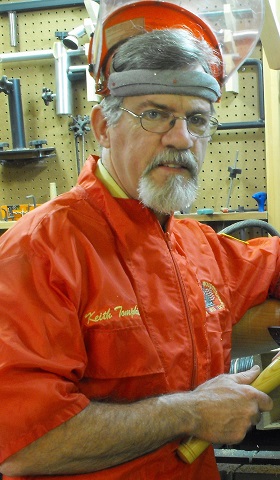
Keith Tompkins

Fear!

Keith Tompkins

>David's post below reminds me of a subject many turners experience.....FEAR.

While a healthy amount of fear may be a good thing, it can also, as woodturners, stop us dead in our tracks!

It's possible to look at many turnings, and observe where the maker stopped a cut, instead of making a long, continuous curve. It may be possible that foot size and wall thickness may be determined by a certain fear factor also.

The fear factor is most apparent in spindle turning, where the skew chisel is required to give a piece definition and sharp detail. How many turners will grab a scraper instead of risking an attempt with the skew? The final result is a mediocre turning at best.

Somebody a while back posted a thought on "self-imposed limitations"......fear may be the biggest of all. White-knuckled grip, anyone?

Re: Fear!

#2

Re: Fear!

TDaniel

>There is nothing wrong with knowing one's limits and capabilities; why would anyone want to risk injury by pushing beyond their skill level. You build skill by learning cuts on small pieces of green wood and when you can turn that safely you move on to larger and drier wood, pushing beyond your feeling of confidence is asking for a trip to the local ER.

Re: Fear!

#3

Re: Fear!

Mike Schwing from Maryland

>The mere mention of a skew chisel is enough to raise my heartrate - the sight of one - I'm reaching for the detail gouge to defend myself from the skew. AAAAIIIEEEEEE!!!!! I swear it sits there on my bench taunting me. It is DEFINITELY the one tool that I can be sure is "ready to work" sharp at all times because it never has been used for more than a few seconds at a time.

"Ok, lets try this thing again, you've read the book, watched videos, lets do it...ok...ok...wow what an incredible surface..little more..little more....BANG! FUG!" Away you go little skew.

Re: Fear!

#4

Re: Fear!

John Lucas

>Mike

Don't give up on the skew. Start every session with a scrap piece of wood. A short piece at first maybe 6 inches. Pull out the skew and true up the wood then cut a whole bunch of beads. Don't worry about the quality or whether or not you get a catch. Just think about where the bevel is on the side of the skew that you can't see. Try to keep this in contact with the wood. Losing the bevel is why the skew catches.

When you've turned beads, good or bad from end to end throw it away, put up the skew and go on with your tunring. Pretty soon you'll be turning most of the beads on your scrap piece.

Nick Cook says that you have to use up all the catches in a skew before it will behave. Mine are almost used up.

Re: Fear!

#5

Learning where to draw the line

Bob Hackett

>As the skill level goes up the fear goes down.

Two things to remember here.The first would be that you don`t grow by doing the things you are comfortable doing.Challenge lends to growth.

The second is no less important,and I quote"A fool and his work are soon parted,usually at high speed".

If you are avoiding doing something because the frustration level is high,I would suggest practice till you master the technique.One less self imposed limitation.

Safety is not the place to push the envelope.If you avoid something because it may lead to a catastrophic failure,You are showing correct application of common sense.In this case fear is a good thing.Some injuries you never come back from.

Mainely,Bob

Re: Fear!

#6

Re: Fear!

Joel Hunnicutt

>I agree with you Keith. There is another kind of fear that I fight also. Fear of failure to try new things. I have certain shapes that I produce pretty well, but I have to force myself to try new ones because I'm afraid that they might not turn out as well. I have to keep reminding myself that I will never grow if I'm afraid to fail.

Re: Fear!

#7

Re: Fear!

KenGeorge

>Mike,

Get someone to show you, one on one, how to use the skew. I too suffered from "skewitis" until a brief session with an experienced turner and now can use the skew with only occasional catches. It really makes a difference to have that one on one coaching.

Good Luck,

Ken

Re: Fear!

#8

5' 4" and 195 lbs *LINK*

Darrell Feltmate

>Keith et al

One of the great cures for a lot of turning fears is free, green wood. Fear the catches of a skew chisel? After the first couple you realize that only the wood gets hurt or maybe the skew needs a touch on the grinder. So what if a few feet of free wood get hurt? Try it again and again. Hurricane Juan left me with a couple of cords of spruce. Great practice wood and I love the look of spruce for good pieces. Not free? A few bucks to a local pulp cutter who is likely getting $40 a cord and you have a lot of fear cure. Lately I have practiced going through the sides of free poplar and spruce hollow forms. Got some nice finished ones too. Fear of going through the side of really gorgeous burl with thin sides? Sure, but I am working on the cure.

On the other hand there is the quite realistic fear that starts "only an idiot would do this. The wood is going to blow apart and bit me." This is a signal to evaluate, have a coffee, and think of a better way or think of a reasonable way to aquire skills to enable safety in turning. It is easier to have a happy new year at home than it is in the emergency ward.


Wood Turnings by Darrell Feltmate

Re: Fear!

#9

Re: Fear!

GeorgeBalock

>Joel,

Good posting. You hit on an interesting topic, making what you are comfortable with and not stretching your design ideas. Somwhere, someone suggested the book "Art and Fear" It talks about how we as artists are sometime paralyzed by fear of failure and perfectionism.

I have been interested in adding some carved details to my work for a while, but haven't had the courage to take the carving tools in hand to a "finished" piece.

Fear is what keeps us safe both physically and psychlogically. But without taking risks can we grow both in skill level and artistically?

George

Re: Fear!

#10

Re: Fear!

Andy in Raleigh

>It's keeping my work small. The broken gouge I posted happened with a piece less than 5" in diameter. I am getting a lot more confident in spindle turning, but my "bowls" are still small thick walled cups right now.

It is a little scary to look back at the number of "I will never" statements that I made and have since done. Not too crazy; things like using a dado blade ("I will never use my TS without a splitter/guard"), parting off small turnings under power and power carving with a trim router.

Re: Fear!

#11

The Taming of the Skew,..

Peter Teubel

>I was a "skewless" turner for the past couple years. I read the books, watched the videos, etc. Just like the infamous Raffan back-hollowing technique, it was not until I forced myself to learn it that I realized how easy it was.

Flashback to November 2003...

I preparation for a Christmas crafts show, I was turning a number of snowman ornaments (from an article in the AAW Journal by Nick Cook). I had made dozens last year and most were given away as gifts. The left overs were sold at a local fair in October with great success. For this show, I wanted to have LOTS of the available. I figured if I could learn to use the skew properly, I could cut down production time by eliminating sanding.

I ripped a few common 2x4s into blanks and went to town. I learn two things...1) skewing soft pine is a GREAT learning experience because it cuts so easily...and 2) I could make the ornaments a little bigger because the wood was so light.

I turned well over 100 ornaments. And the last 50 or so were sand-free (well almost...the parting area needed a bit of belt sanding to clean up). All those ornaments gave me alot of skew practice. Am I an expert now? No, but I am more comfortable with the skew than ever before.

Besides proper technique, I have found that the #2 most important aspect of skew usage is a VERY SHARP edge. If you can shave the hair off your arms with it, its not sharp enough. Its the only turning tool I hone....and I do it with a ZAM covered soft felt wheel mounted to a 1750RPM motor.

Re: Fear!

#12

Re: The Taming of the Skew,.. (opps)

Peter Teubel

>I my previous post,I meant "If you *CAN'T* shave the hair off your arms with it, its not sharp enough."

Re: Fear!

#13

Re: Learning where to draw the line

Arch

>Hi Bob, Don't forget that "all art consists of drawing the line somewhere" I suspect it's the same for knowing where to cut, chisel scrape and skew.;) The proper technique of using a skew is not hard to master, but a skew doesn't suffer inattention gladly. A 'waving' gouge is a lttle bit forgiving, a 'waving' skew isn't at all. Arch

Re: Fear!

#14

Skew training wheels

Bob Hackett

>For those just starting to master the skew.Try putting a cup type dead center in as a drive center.Instead of getting a spiral down the spindle or a catch that startles you and breaks your concentration completely,the piece will just stop spinning.Just tighten the tailstock to get things going again after you lose traction.This is an old turner`s trick that was passed on to me years ago.

Mainely,Bob

Re: Fear!

#15

Re: Fear!

David Hammond, in Powder Springs GA

>I think one slight disctinction in this discussion is two kinds of fear: one, is the fear of losing a digit or more to spinning wood, and the other - the fear of design failure, the fear of failing to execute a new shape, finish or whatever. I'm young, so I don't think as much about the fear factor involved in a peice like the cherry end grain below - not to say that I don't watch my fingers. After two and half years, and busted and burnt knuckels, you learn where to put your hands, and that gouge. So there, I think that kind of fear is not only good, but absolutely necessary. But that fear of failure - I would like that, personally, to be done away with in my work - if I visualize a new peice, I oughta go for it - that's the only way some of this new stuff is being produced by these professional artists.

David - lovin' my fingers, but trying not to be too worried about the failure of execution in design.

Re: Fear!

#16

Keith Tompkins

Re: Fear!

Keith Tompkins

>That's exactly the point,Terry.

If your find yourself in the situation where fear becomes a factor, it's an indication that 1. You have reached the limit of your ability 2. NOW is the time to seek the assistance of an accomplished turner, whether through a turning club or private lessons. 3. If a technique is giving you trouble, you need to practice, practice, practice until you have mastered it.....the fear will be gone.

When you attempt anything that creates the feeling of fear, it's time to step back and evaluate the situation. I demonstrate segmented turning techniques.....I would never want to be responsible for anyone injuring themselves attempting to create a segmented piece. I keep that thought in the back of my mind throughout my talks.

PS I admit....turning one of your huge bowls would give me some amount of trepidation.

Re: Fear!

#17

Re: Fear!

Kirt

>Keith again you bring up an interesting subject! I agree the fear of failure is something I face when I reach a certain point in my turning as I hate to lose something that I have spent a great deal of time on-when I feel like this though I know that it is the time to go ahead and try the "unthinkable" and due to this attitude I have grown as a turner and my experience with tool control and finishes has been greatly enhanced because of it. As for fear of injury I am one that believes our "natural instincts" should be heeded,however after careful deliberations and planning the action to its outcome I go ahead and attempt the "technique" or "cut" as safely as I can(or as safe as I can justify within my own level or rules of safety). When we have fears of injury sometimes it behoves us to learn to overcome them or to understand why we are in fear of what we are about to attempt because risk is a part of everyday life-we all had to learn to drive,swim,bicycle...amongst other things that would have seemed dangerous to most of us that are now common place activities that had we not conquored our fear of them would have regulated us to fairly dull and capsulised lives. In no way do I suggest my concept of safety is the same as anothers or is better or worse but it is mine-so one should use what common sense they have and do what they can without submitting to pressure from others and attempt to stretch the risk level in a way that seems justifiable to yourself(I can attest to following the advice and urgings of others to set aside my own rules for my own safety and it has cost me some injuries that could have been very serious!). All said and done in the end fear is something to be respected,and perhaps at times conquored but never taken lightly whether in areas of design or personal safety .Each of us has a choice to make and in the end we are the only ones that can make those choices and ultimately it is ourselves that must live with our decisions.

take care,play safe

"turning to keep warm in the Canadian North"

Kirt

Re: Fear!

#18

Keith Tompkins

Re: Fear!

Keith Tompkins

>We've all heard people say"that's the way I've alway s done this, and I don't intend to change". I'm guilty of this one myself. We get so used to doing something a certain way, that we become afraid to change. One way to grow as a turner or artist is to approach a new technique or a new form with an open mind.

That's one of the best aspects of this forum....I'll read a post and think to myself..."wow. why didn't I think of that"?

Re: Fear!

#19

Re: Skew training wheels

Tom in Red Deer

>I agree heartily with this idea. I have a Oneway "Safedrive" for that exact reason. No matter what tool I use for roughing, if I mess up, the piece just stops. Gives my heart a chance to slow down and my hands a chance to stop shaking.

My skew is nearly house trained but the parting tool...

Tom in Red Deer

Re: Fear!

#20

Keith Tompkins

Re: Skew training wheels

Keith Tompkins

>Hi Tom, with the parting tool, start high on the turning, and raise the handle to cut. also make a clearance cut along-side of your cut for clearance to prevent binding.

👍 This page answered my questions

Your vote helps other woodworkers quickly find the answers and techniques that actually work in the shop.