WoodCentral Forums

Est. 1998 — 27 years of woodworking knowledge

Designing chisel mallets and hammers.

Posts

Designing chisel mallets and hammers.

#1

Designing chisel mallets and hammers.

Derek Cohen (in Perth, Australia)

Mallets and plane hammers are relatively easy to make, and often one of the first tools made by many starting out. But what makes for a good chisel hammer? I have seen some woodworkers wacking a chisel with a lump of wood. Some prefer a claw hammer.

Once upon a time I purchased a plane hammer with a head made of brass and Cocobolo. It had a long, narrow and straight handle, which stayed in my hand as long as I gripped it tightly. The Cocobolo head cracked, and the hammer went to live on a shelf.

A few weeks ago I resurrected this hammer, replacing the Cocobolo with UHMW, and fitting a new handle. This hammer is now my go-to for wood handled chisels which are not reinforced by a hoop, when chopping dovetails. It has inspired me to comment on what I look for when making a chisel hammer. This is the hammer ...
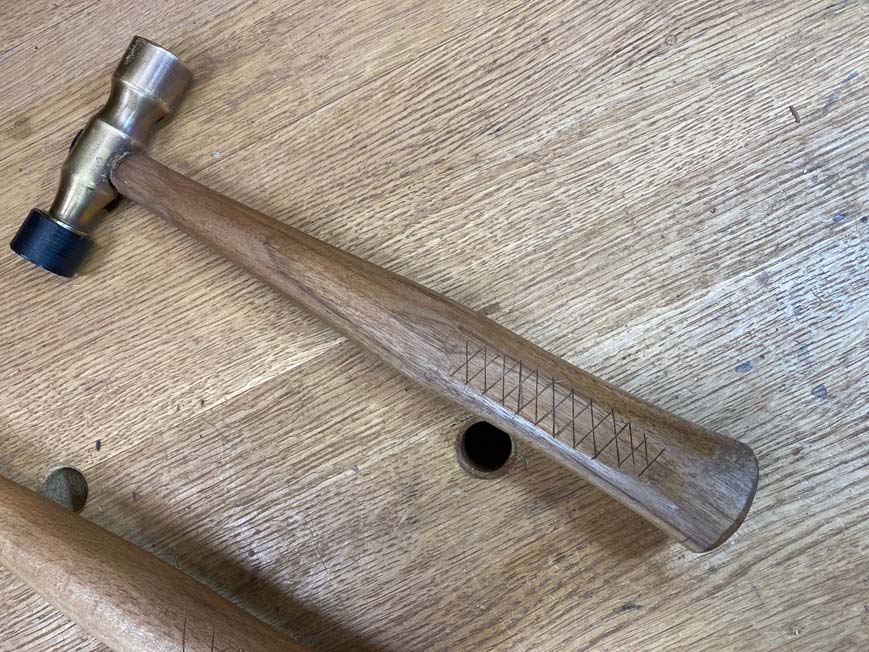

I love UHMW and use it on most of my chisel hammers. It is elastic enough to avoid damaging any wooden surface, but hard enough to offer good feedback. It is available in the form of cutting boards, and I have some from salvage yards. This head was turned on my wood lathe ...
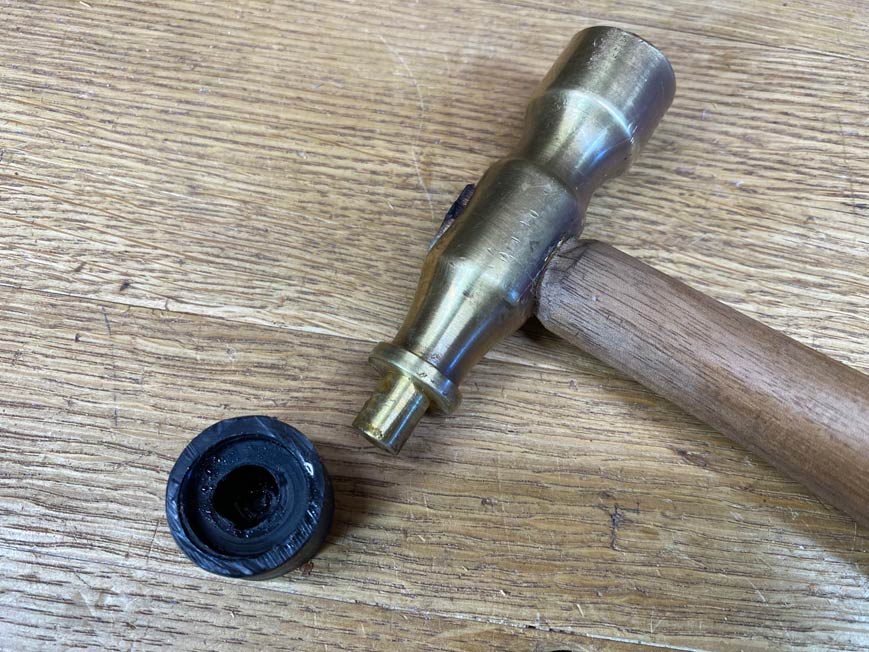

The Black Walnut handle was rough turned on a lathe, and then shaped with a drawknife and spokeshave. The end weight was 12oz/350g.

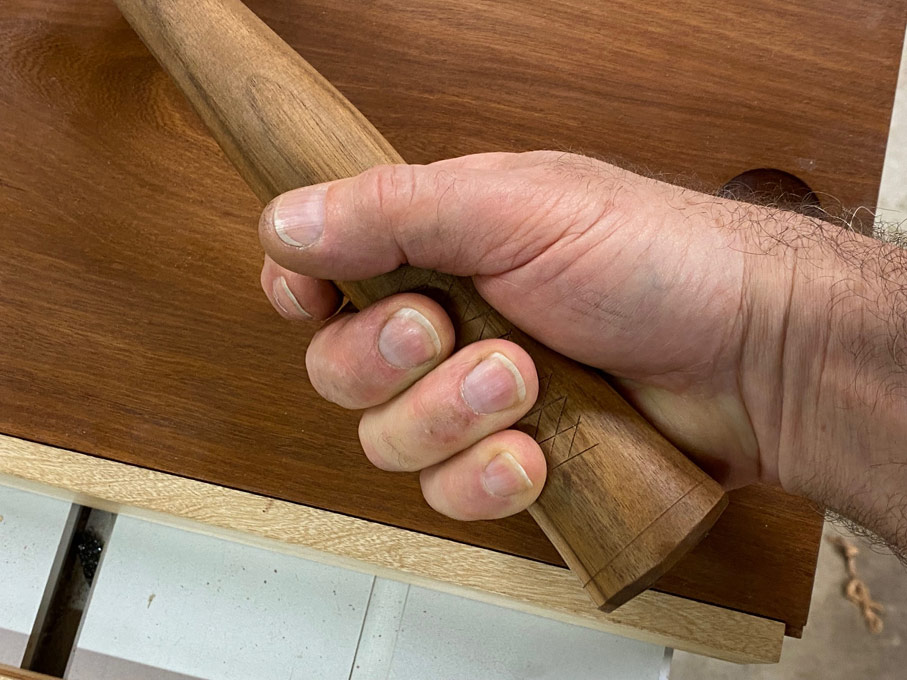
The handle needs to be seen in three-dimensions. It is oval as well as recessed to fit a hand. The recess prevents the hammer flying off into outer space, while the oval makes it fit the hand.

The length of the handle is the third dimension - the shorter, the less impact; the longer, the greater impact.

This is comfortable ..

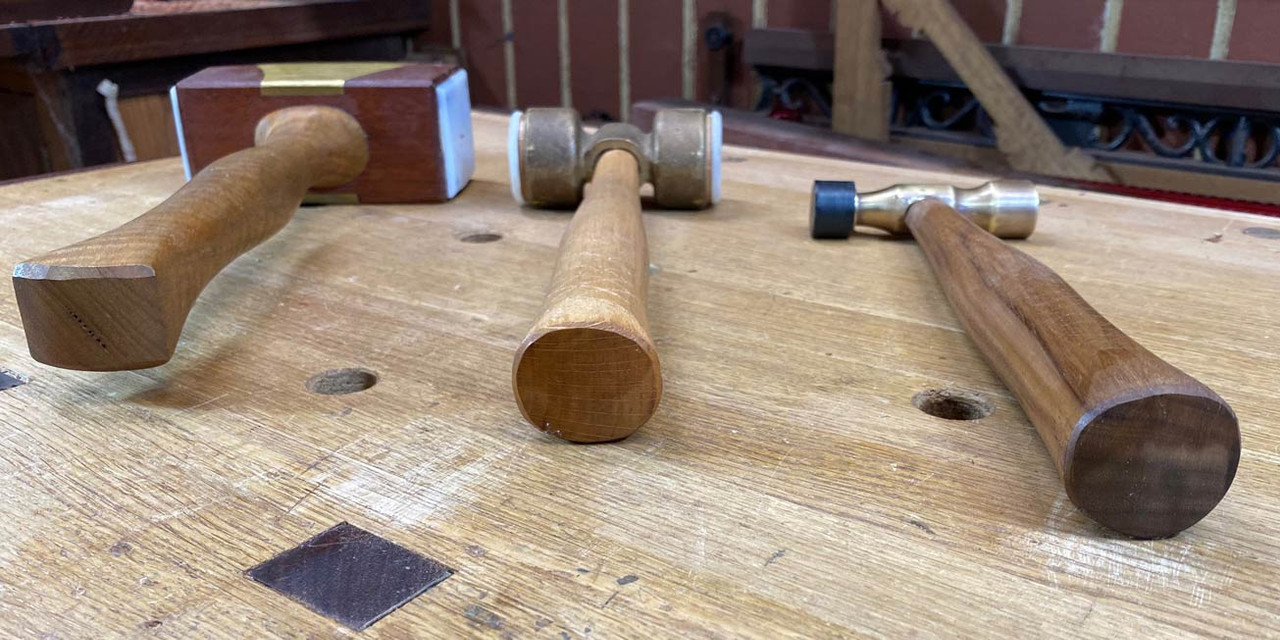
A really heavy hammer such as the one on the left (38oz/1070g) is intended for morticing into hard wood. Thus has a double recess and allows it to be used in a choked position. I rarely use this hammer now days as it it simply too heavy.

It has been replaced by the middle hammer ...
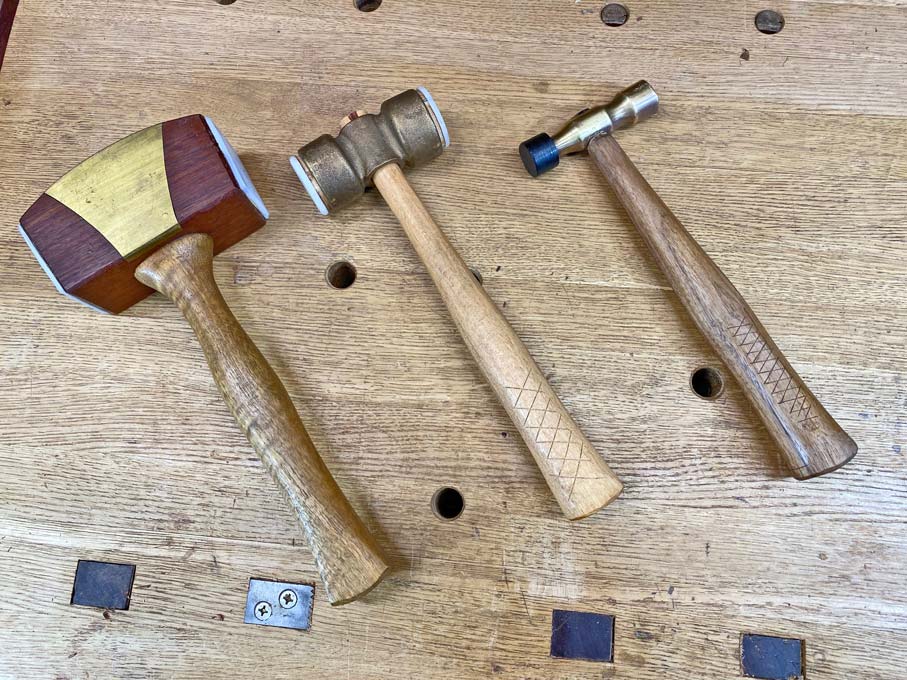

This began life as the Veritas Cabinetmaker's Mallet. UHMW was added to the faces (epoxy and nails, for those asking), and a new handle made from Hard Maple. The brass head helps it reach 23oz/655g. This is a great hammer for morticing.

Fruit woods make good handles. Avoid run out, look for long grain. Some of the worst handles I have had are hardwoods, such as Jarrah - just to brittle with its short grain.

There is no doubt that a small and heavy head has advantages over another hammer which weighs as much but has a large head. Further, my preference is a flat face, rather than the rounded edge of a carver's mallet. I know some prefer the latter, but in my experience it waste energy and requires more care to avoid a glancing blow. The large mallet, above, was styled after a traditional joiner's mallet, and the head weight increased with brass infill. The aim was to find a way to increase weight in a smaller head. In the end it just was too heavy. One does not need to apply brute force.

I believe that the ultimate expression of the chisel hammer is the Japanese gennou. These are designed for working with hooped Japanese bench butt chisels, or oire nomi. I have two, one 13oz/370g and the other 16oz/450g.
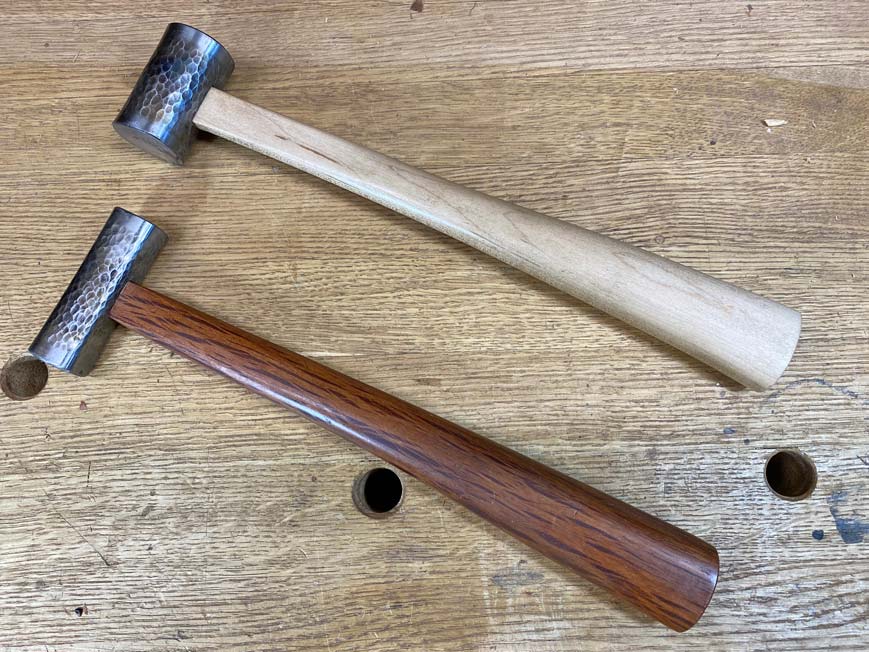

The heads are hardened steel on the outside with softer steel internally to act as a shock absorber. These were made by Tenryuu.

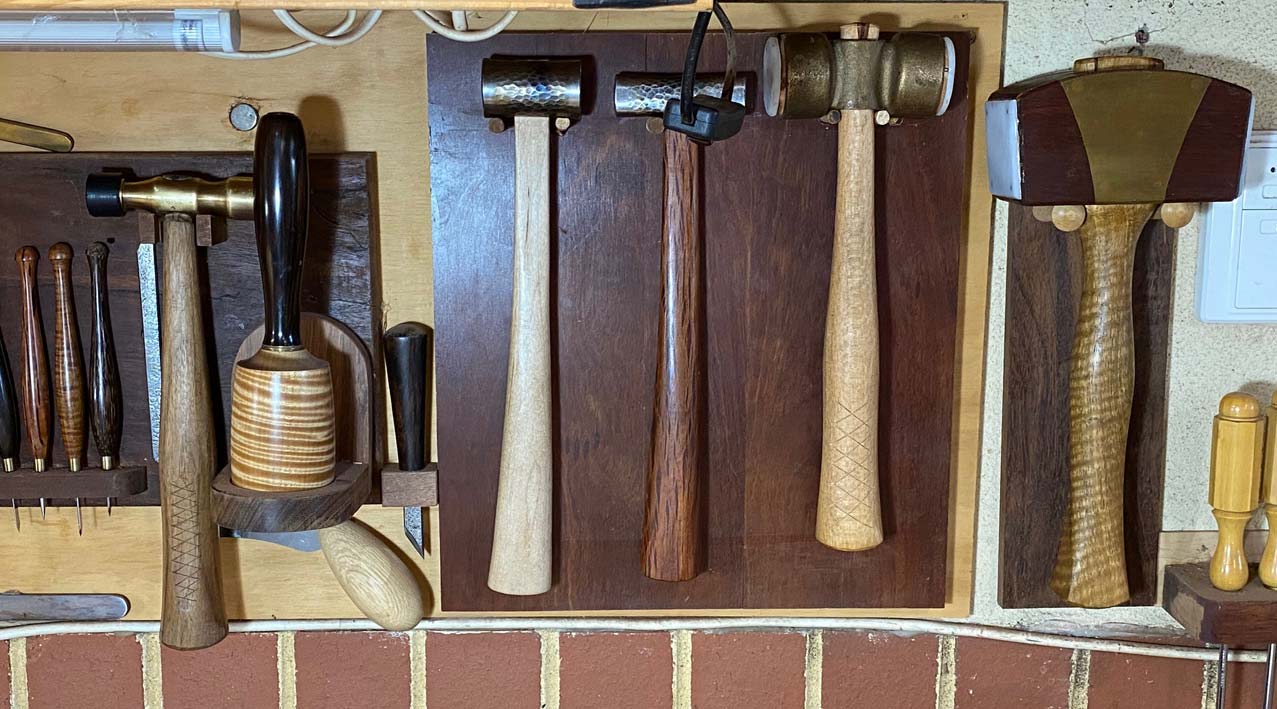
I shaped these handles in a traditional style. They curve as well as taper. This is not as clear in this photo, but more so in the last picture. The curve influences the striking angle and the taper safeguards the grip.

Regards from Perth

Derek

Re: Designing chisel mallets and hammers.

#2

Re: Designing chisel mallets and hammers.

Warren in Lancaster, PA

Traditional mallets for striking chisels have short handles and heavy heads. The motion is very much different than swinging a hammer. A hammer is swung with a lot of motion in the wrist. A mallet with a heavy head is swung with more arm motion, little wrist.

We see these mallets with large heads in historic drawings. Fortunately Roubo gives dimensions: handle 8 inches, head 3X5X7 inches

Re: Designing chisel mallets and hammers.

#3

Re: Designing chisel mallets and hammers.

Derek Cohen (in Perth, Australia)

Warren, I recall you posting a picture of a Roubo-type hammer once. It was short handled with a large head. Would you mind posting it again?

The large mallet I made and used for a time would fit with this one. The main difference being that the handle can be both lengthened or shortened. For control I would shorten it … which was one reason why I stopped using it - there were other designs for me which offered more control and less fatigue with sufficient power.

Can you write something about the design and advantages and disadvantages of the Roubo-style hammer?

Regards from Perth

Derek

Re: Designing chisel mallets and hammers.

#4

Re: Designing chisel mallets and hammers.

Warren in Lancaster, PA


Here is a picture from Diderot.

A mallet with a heavy head speeds up the work, but is too heavy to swing like a hammer all day. So this short handle is much more comfortable and effective.

Someone who is used to a hammer will keep wanting to flick the wrist, which is no fun with a mallet with a short handle and weighing two pounds or so. The motion with a short, heavy mallet is different and easier on the wrist.

The beech "joiner's mallets" are a 19th century design, post hand tool era, that have longer handles and are used like a hammer.

Re: Designing chisel mallets and hammers.

#5

Re: Designing chisel mallets and hammers.

Derek Cohen (in Perth, Australia)

Many thanks Warren.

What tasks do you use this mallet for - morticing no doubt. Dovetailing?

Do you use any other mallet and can you make a comparison?

Regards from Perth

Derek

Re: Designing chisel mallets and hammers.

#6

Re: Designing chisel mallets and hammers.

William Duffield

From Roubo, L'Art du Menuisier, Translation by Don Williams


The joiner’s mallet is a piece of wood which is normally of hornbeam or oak which has 7 thumbs in length by 4–5 in height, and 3 thumbs thick. It should be rounded at its ends so as not to damage the work when hitting it. Its length and its thickness should taper toward the base to give it more force, and that it always be level [perpendicular to the striking point]. Its handle should be of a tough/pliant wood and have about 8 thumbs in length from below the mallet [head], Fig. 8.

Re: Designing chisel mallets and hammers.

#7

Re: Designing chisel mallets and hammers.

john jesseph

Awkward looking. I wouldn’t get on board with that design.

Re: Designing chisel mallets and hammers.

#8

Re: Designing chisel mallets and hammers.

Warren in Lancaster, PA

Roubo wrote that the mallet is "ordinairement de charme ou de frene. That is "usually of hornbeam or ash". Not oak. Oak in French is chene.

Re: Designing chisel mallets and hammers.

#9

Clint Searl

Re: Designing chisel mallets and hammers.

Clint Searl

I wonder if the referenced hornbeam is related to either American Hornbeam or our Hop Hornbeam, both of which are hard and tough.

Re: Designing chisel mallets and hammers.

#10

Re: Designing chisel mallets and hammers.

Warren in Lancaster, PA

The European hornbeam is Carpinus betulus. Our hornbeam in America is Carpinus caroliniana. They are closely related and similar. We see European hornbeam on the soles of some Primus planes.

Re: Designing chisel mallets and hammers.

#11

Re: Designing chisel mallets and hammers.

William Duffield

My favorite carving mallet is turned from hop-hornbeam, Ostrya virginiana.

If you are going to impact its end grain, Carpinus is a better choice for a mallet head; if you are going to impact its long grain, Ostrya is better. This is based on their differences in impact resistance, but there are other considerations. Carpinus endgrain head allows a flat head and saves material if you make a two piece mallet with an ash or hickory handle. An Ostrya long grain head allows you to turn the whole mallet in one fell swoop, but gives you a curved striking face. This is usually considered an advantage for a carving mallet (or at least not a fault) since you may be carving curved sweeps. When striking a long grain surface, the edge grain faces are stronger than the face grain. A baseball bat is branded on the face grain for the purpose of reducing breakage, but a home made mallet may not be.

Re: Designing chisel mallets and hammers.

#12

Re: Designing chisel mallets and hammers.

Warren in Lancaster, PA

I use the heavy mallet for mortising, housings, half blind dovetails, heavy timber work, etc. I usually use a carver's mallet, about 15 ounces, for lighter work.

I made this dogwood mallet in 1979. (Cornus florida). I did not know I would be using it for this number of years or posting it on the internet. There were no internet fora in 1979.


Re: Designing chisel mallets and hammers.

#13

Re: Designing chisel mallets and hammers.

Joe Rogers, North Eastern West Virginia

Sir William, as I was instructed about the label on wood bats some 60 years ago, I get sideways watching Major League Baseball now days. The players grew up with Aluminum bats and don’t have to pay for their wood bats as professionals. As a result they pay no attention to the label at bat. And they break many bats. As a youth a broken bat often ended a baseball game. Then saving up for a suitable replacement.

I am aware of wood grain as a matter of course ever since then.

Joe

Re: Designing chisel mallets and hammers.

#15

Re: Designing chisel mallets and hammers.

Steve Voigt

Thanks for posting this Warren, I'm glad to see it along with the Roubo snippet.

It is always funny to see a reflexive comment like "looks awkward." How can one know until one has tried it?

PS for anyone who's wondering a "thumb" is about 1-1/16".

Re: Designing chisel mallets and hammers.

#16

Re: Designing chisel mallets and hammers.

Warren in Lancaster, PA

If you would watch a guy who has been a carpenter for 50 years try to swing this mallet, it would be awkward, to say the least. It is a very different motion. It is valuable to look at historic texts because, as in this example, it is not obvious what the most efficient methods are.

The French word pouce meant both thumb and a unit of measure in the 18th century. After the change to the metric system, it is no longer used for measurement, so Google Translate comes up with thumbs. In the 18th century, however, when used as a measurement, pouce was translated into English as "inch". Most translators today translate it as inch, as I did last week in this thread.

Re: Designing chisel mallets and hammers.

#17

Re: Designing chisel mallets and hammers.

Mike In Los Angeles

Is there somewhere to look for a description or illustration of the motion best used? Thanks in advance

Re: Designing chisel mallets and hammers.

#18

Re: Designing chisel mallets and hammers.

Warren in Lancaster, PA

Mike, I looked at some mortising videos, but nothing stood out. There were three types of workers: some swung the mallet like a hammer, some used a long handled mallet, but choked up, which is a little awkward because the end of the handle is flopping around, and some used a heavy carver's mallet, which is short handled, but probably not as heavy as what I am talking about. Generally the videos concentrated on the chisel action and hardly showed the guy swinging the mallet.

I think that if you make a mallet that is in the 32 ounce range and has a handle that is only 8 inches long, you will soon enough discover a comfortable rhythm and action.

Re: Designing chisel mallets and hammers.

#19

Re: Designing chisel mallets and hammers.

Wiley Horne

“…comfortable rhythm…”

Rhythm is the key (in my limited amateur experience). I notice that the efficiency of my mortising depends mostly on the time between strikes—the time it takes to disengage the chisel and reposition for the next strike. Mostly, the striking hand is waiting for the positioning hand.

To say it another way, the positioning hand sets the pace. An efficient and effective rhythm between the two hands is helped along if the strike is a short stroke which does not change body posture, nor draw the eye away from the chisel repositioning. Thus, a short throw with a heavier mass leads to a better rhythm (for me) than a higher-speed strike with a lighter mass involving a longer throw and change in posture.

Thinking here mostly about a cabinet size mortise with, say, a 1/4” chisel. The motion could be quite different with a larger chisel and bigger mortise which requires a heavier strike. What are others’ experiences?

Wiley

Re: Designing chisel mallets and hammers.

#20

Re: Designing chisel mallets and hammers.

Charlie

I wonder what the average life expectancy was back then, and how many craftsmen were just racked with repetitive motion injuries, arthritis, etc.

There there are the artistic problems of rendering perspective, foreshortening, etc.

These illustrations are interesting, to a point, but they probably tell only 10% of the entire story. I would assert that there were just as many handle lengths and head weights as there were craftsmen. You impute a uniformity from a breathtakingly few sources. And this whole "we" thing... always good for a laugh.

Re: Designing chisel mallets and hammers.

#21

Re: Designing chisel mallets and hammers.

Mike In Los Angeles

Thanks so much Warren and Wiley, I have a 1/4” mortise to chop today that’ll be about 16” long, so I’ll be thinking about all this.

Is hard maple unsatisfactory for a heavy mallet like has been described? I could probably dig up a chunk of something softer if necessary.

Thanks again

Re: Designing chisel mallets and hammers.

#22

Re: Designing chisel mallets and hammers.

Warren in Lancaster, PA

The two woods recommended by Roubo, European ash and European hornbeam, are just slightly harder than hard maple. The persimmon and dogwood I use for mallets are harder than these.

Hard maple is also similar in density to the ash and hornbeam.

👍 This page answered my questions

Your vote helps other woodworkers quickly find the answers and techniques that actually work in the shop.