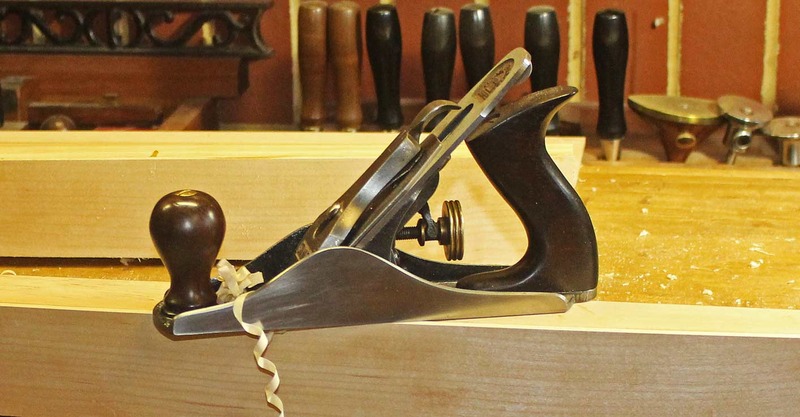
Over the years, I seem to have gathered a stable of smoothing planes. (Look what followed me home. Can I keep it?) The one I am currently curious about, my brother found for me in Silicon Valley. It is a nameless Bailey design #3 size. The only marking I can find on the plane is "No 3" cast in the toe. But what I am curious about is the blade, which is tapered and stamped "BUHL". Do you think the blade (nd chip breaker) may be original to the plane? I haven't cleaned this one up yet, much less tuned it, so I don't know how it will perform.
OK. It looks like the tapered blade could likely be original to the plane. I suppose what I'm really curious about is the reason they chose to put a tapered blade on a #3. Of, course, I'm familiar with them on wooden planes, and especially on molding planes, but I don't remember seeing one on a Stanley/Bailey design plane.
It looks like Buhl Sons Co. in Detroit, MI was a wholesale hardware company who also offered hatchets, and put a much more elegant stamp on them. They also offered pocket knives. From this, you could deduce (or guess) that, like other hardware companies, they rebranded planes made by someone else.
IMO, No. 3’s are great—3’s and 5’s. Did I catch the 3 bug from you?
It’s amazing how good a Stanley Bailey actually is. With not a lot of tuning—I get the mouth of the plane on the ground, and put enough time (3 minutes) into the chipbreaker to get it working right. but that’s it other than sharpening. Never bothered with blue-printing frogs, for example.
The hump-back chipbreaker, patented in the 1850’s or 60’s, is just fine. Adjusting the blade without loosening the holddown screw is sorta remarkable—something you take for granted until you use an adjustable infill.
I like woodies for long planes, but the No. 3 Bailey (and its clones) can hold their heads up in the world. Particularly like this Type 11:
and also this Pre-WWI, with the cracked and welded side—if anything it’s a little sweeter than its sister above (or is it brother?), so they take a beating too:
My apologies for the "patina"; it is still in "as found" condition. In addition to the pic of the iron, you get the chip breaker, lever cap, and the plane itself. You can just make out "BUHL" stamped in the top of the iron, which has a tool steel edge welded onto the softer steel of the majority of the iron. Someone made a feeble attempt at flattening it, which reveals a substantial dishing (concavity). The back of the iron was treated to a bit of the same investigation, and also shows that it is higher around the edges.
I've added Union to my list of its possible manufacturers, as it looks a lot like the center plane in this picture,
My go to smoother is a post war (WWII) Stanley #3 (with rosewood tote and knob), that also works very well. I bought it at an antique barn (with several vendors) for $30. I now also have this ¿Union? and a more recently acquired #603 that I've equipped with a PM-V11 blade. The Bedrock has the same decal as the #3 in your pic, an "APR 19" patent date, and a two tone (half sapwood) rosewood tote.
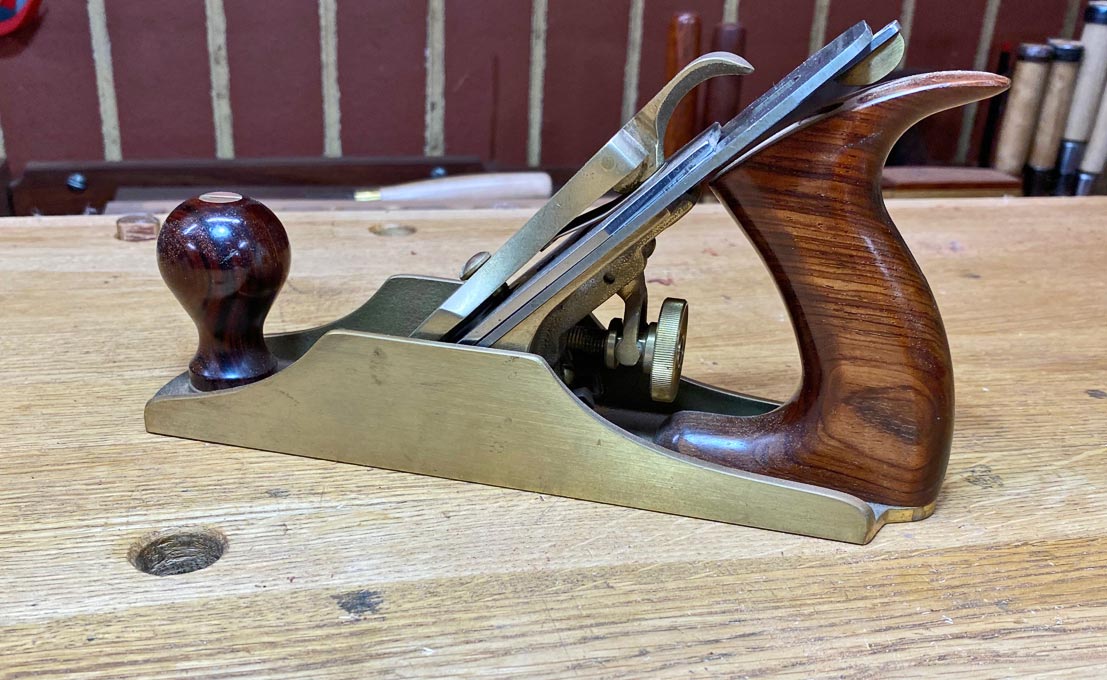
My other #3 is an LN. This has a Veritas PM- V11 blade and the original LN chipbreaker (LN planes cannot use other makes). The handle and nob are made by LN in Cocobolo, which has long been discontinued. The nob is for a #3 but the handle is for a #4 (I have larger hands), which I modified to fit …