WoodCentral Forums

Est. 1998 — 27 years of woodworking knowledge

Sargent block plane

Posts

Sargent block plane

#1

Sargent block plane

Eliot

This plane doesn’t adjust in what I would call the “normal” way. It doesn’t slide up and down along the frog; instead it pivots around an axis. So an adjustment changes three variables all at once: depth of cut, blade angle, and mouth opening. Is this design a good one? What is the best bevel angle for such a plane?

Re: Sargent block plane

#2

Re: Sargent block plane

Steve D, in CT

That sounds very unusual. Do you have a pic of the adjustment?

Any plane with a bevel up or double iron will lose mouth opening as the blade is advanced. Only bevel down single iron planes will maintain a constant mouth size regardless of blade setting.

The arc you describe sounds like a typical lateral adjust except that the depth should be independent of the lateral. When initially setting the plane you will want to dial in the lateral adjust to be even, then adjust the depth.

After sharpening, I typically try to advance the blade until I feel the cutter somewhere. A small piece of wood works for this. I'll tweak the lateral and retest. If there is no cut on either side I'll advance the depth again and repeat. Eventually the lateral will be set and only the depth needs adjustment.

Re: Sargent block plane

#3

Re: Sargent block plane

eliot feldman

I said it mostly wrong. The blade does not pivot. I assumed that it did because when you turn the brass depth adjustment wheel, it does go up and down -- not forward and back. So I assumed that the blade was actually pivoting about a HORIZONTAL axis (nothing to do with lateral adjustment that has to do with pivoting about a vertical axis) and thereby causing the cutting edge to move slightly up and down in the mouth. I said "mostly wrong" because there is a pivoting action going on. When you turn the adjustment wheel up and down, it does cause a little notched thingy to rotate back and forth, and this notched thing engages with slots on the underside of the blade to move it back and forth. PIC TO FOLLOW.

Re: Sargent block plane

#4

Re: Sargent block plane

Steve D, in CT

No need for a picture. That lever is common to Millers Falls, older Stanley and apparently Sargent planes.

The levers do avail themselves to fine adjustment at the expense of backlash. Direct adjustment like on shoulder planes or LN type block plane adjustments are limited by the pitch of the threads.

I just got a plane with a RH threaded adjuster and it's a pain keeping track of the direction for advance. I'm using it for roughing so it's not adjusted as often or closely as a plane for fine work.

Re: Sargent block plane

#5

Re: Sargent block plane

eliot feldman

Thanks, I was about to send a photo. And yes, I also find it a pain to keep track of which way to turn the adjustment wheel. But I like the results from this plane very much as long as I keep the blade sharp. OH, and what about a good angle to grind the bevel? I suppose the answer would be the same as any other low angle , bevel up block plane. Or is it?

Re: Sargent block plane

#6

Re: Sargent block plane

Steve D, CT

If you have this adjuster then it’s not a low angle plane. With the low angle there isn’t enough room for the lever and the adjustment is in line with the blade. Here is a photo of a MF and Stanley plane with the stud adjuster and a Stanley with the newer adjuster.

The bed angle is 20 degrees on all of these so sharpening at 25 degrees gives a 45 degree cutting angle, same as bevel down. You do have the ability to get higher cutting angles by increasing the bevel angle.

Re: Sargent block plane

#7

Re: Sargent block plane - ugh!

Derek Cohen (in Perth, Australia)

Hi Eliot

It's almost 2022, and I think that you should treat yourself to a decent block plane. Both Veritas and Lie Nielsen made superb block planes. They adjust well and are comfortable in the hand. You really cannot go wrong with either a Veritas DX60 or a LN 60 1/2. The Veritas is quite space age but very ergonomic, while the Lie Nielsen ticks the boxes for a traditionalist.

The cutting angle is an interesting issue. Typically, low angle block planes are set up with a 25 degree bevel on the 12 degree bed for a 37 degree cutting angle. The idea here is that this cuts end grain more easily. However, I think of a block plane as a one-handed plane and want to use it to chamfer and smooth face grain as well (like a small smoother). Easily done - just add a 35 degree micro secondary bevel.

Why not just get a standard angle (20 degree bed) block plane? Because the 12 degree bed block plane not only gives you more options, but the lower lever cap is more comfortable in the hand.

Regards from Perth

Derek

Re: Sargent block plane

#8

Not that black and white...

Steve D, in CT

I have no doubt that the Sargent can be pleasant to use and produce good work. Between the Veritas and LN for new planes I think that the Veritas is a no-brainer. The Veritas is available with a choice of blade steels and has lateral adjust. LN is solidly built and looks nice but has A2 only and the lateral adjust is via hammer. Also, the adjuster can move the blade to the right when adjusting.

That last factor is what made me replace a LN low angle jack with a Veritas version and I am glad I did it.

If you want a splurge, NX60s have been available quietly outside North America. That is a polished stainless version of DX60.

Re: Sargent block plane

#9

sage advice

Bill Tindall, E.Tn.

I have a shelf of "old" block planes awaiting motivation to get them sold. The two I use are from LV. I have long forgotten what annoying features relegated the old block planes to the surplus shelf. I recall crappy blade steel is one factor. As cheap as I am they are there for good reason. The old spoke shaves are located there too, replaced by the LV.

LV adds ergonomics to old tools. Their designers research the varieties of the tool in their extensive collection of old tools. With this knowledge they design the most functional tool they can. The result is attractive to those that use these tools. The shoulder plane offers the most compelling example of their process.

That said, some get great satisfaction finding orphans and restoring them to original capability. Hence, the advice is good if the goal is to make stuff with them. Not relevant if the goal to turn something useless into something good as new.

Re: Sargent block plane

#10

Re: Sargent block plane (bevel angle)

Bruce McCrory

I think most "experts" use 30-degrees as the safe minimum for edge durability; that, OR I am fantasizing. I seem to always end up with a 25 - 27-degree primary. The overall angle to the wood takes care of itself. You can calculate it, but angles of attack always mess with the ultimate cutting angle.

Regarding old vs. new, my palm loves a mutilation of the Millers Falls #57. (It's a mix of breeds and fits the "57" moniker.) However, and after testing every new block of reasonable cost, I found a second #57 of pure breed. I am happy with a backup tool.

I understand your passion for a specific model.

Re: Sargent block plane

#11

Re: sage advice

elioty feldman

You know, I'll probably go out and spring for one of these-- just because you guys said so! AND it's a new year! But here's the little thing that bugs me: I sharpened Sargent blade in the argent block plane on the fine CBN wheel, honed it first on the fine Spyderco and then the super fine Spyderco, and then on green stuff crayoned onto the shiny side of some Masonite hardboard. ( All stuff I learned from Derek.) Then I planed some maple. I believe that those gremlins who can sneak through walls, got into my shop and, behind my back, turned the maple into a glass block-- chatoyance and all. What do you make of that?

Re: Sargent block plane

#13

Re: sage advice

eliot feldman


Happy New Year! What a fine review! But I have a better plane than that! I think I'll restore it!

Re: Sargent block plane

#14

Re: sage advice

eliot feldman

O.K. so now I can wear long pants and get the Veritas Dx 60. Which of the blades they offer should I get: A2, 01, or PM-V11?

Re: Sargent block plane

#15

Re: sage advice

Bruce, a MN Galoot

I have the DX60 with the A2 iron. I see no advantage to it. I use it a lot and if I only had waterstones to sharpen, I’d get rid of it and get the PMV iron.

BUT, you’ll love that plane, no matter which blade you choose.

Re: Sargent block plane

#16

Re: sage advice

eliot feldman

I have water stones, but not just those. Lately, following Derek, have been been using the CBN wheels (that I already had for sharpening my turning tools) followed by honing on ceramic Spyderco stones. Would that change your advice? What are the trade offs among these three options?

Re: Sargent block plane

#17

Re: sage advice

Bruce, a MN Galoot

No, I’d still get the PMV11. It’s reportedly easier to sharpen than A2. I sharpen with diamond paste on cast iron, so it matters less now than it did before.

Re: Sargent block plane

#18

Re: sage advice

eliot feldman

I just ordered it with the V11. Thanks for the advice.

Re: Sargent block plane

#19

Sargent plane - consider the Stanley 203 instead 


Re: Sargent block plane

#20

Stanley 102 = my favorite roughing plane!


Re: Sargent block plane

#21

Block Planes in review

Derek Cohen (in Perth, Australia)

I wrote a review of the Veritas block planes in 2008, which included the Lie Nielsen.

http://www.inthewoodshop.com/ToolReviews/VeritasPremiumBlockPlane.html
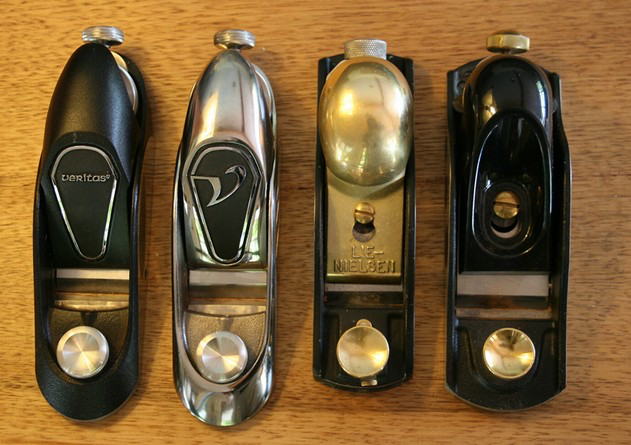

The bottom line is that one would be very happy with any of these planes. They all plane wood as well as each other. Where they differ is in their ergonomics. That is much of the content of the review.

Back then the steel choice was O1 or A2. PM-V11 did not come along until later.

Now PM-V11 is a better steel than the other two: it holds an edge longer, and (if you hollow grind or use a micro secondary bevel) it will hone as easily as O1. The PM steel is also fine grained like O1. What’s not to like?

Do not despair if you are not using PM-V11. All the other steels work just fine.

There is W1, a wonderful, buttery steel, which holds an edge less as long as O1 - just sharpen them a little more often. I used A2 for many years shooting endgrain, and it held up perfectly well with a 25 degree bevel. Now we also have the choice of sharpening with David’s Unicorn profile, and there is the promise of a durable edge.

I have three go-to block planes (I have a lot more than three - yes I know .. but the medication is not working!): a Veritas NX60 with PM-V11 sharpened at 25 degrees, a Veritas DX60 with A2 sharpened at 50 degrees as a small smoother, and a LN #103 (20 degree bed) with O1 sharpened at 25 degrees for chamfers.

Regards from Perth

Derek

Re: Sargent block plane

#22

Re: sage advice

Bruce McCrory

You will like the DX-60. Just be wary of your Honey possibly listening in to the race car noises you make while using it.

Oh, I think you will need to work the blade free-hand when sharpening. I believe the blade shape fits no sharpening guide; even Veritas.

Re: Sargent block plane

#23

Re: sage advice

Steve D, in CT

The blade should work in a Veritas MKI guide, which is the top clamp version like the old Millers Falls one. There is a 3 position roller to add a secondary and final bevel, which cuts time on the finish stones way down.

If you hollow grind you should be good too. It cuts way down on the amount of material to be removed by the stones.

Re: Sargent block plane

#24

Re: sage advice

eliot feldman

Looks as though I'm on the right track. Thanks to all.

As for freehand sharpening, as I have said, I now sharpen on CBN wheels using Tormek equipmnt. The plane blade or chisel is held in the Tormek holder, which will hold just about any blade, and slides along the Tormek rod at a fixed distance from the wheel. I then finish with Spyderco ceramic stones. I believe one of the ads for V11 actually says that one should use ceramic.

Re: Sargent block plane

#25

Re: sage advice

Philip F Duffy

Any thoughts on the Wood River series if similar planes?

👍 This page answered my questions

Your vote helps other woodworkers quickly find the answers and techniques that actually work in the shop.