WoodCentral Forums

Est. 1998 — 27 years of woodworking knowledge

Technique question.

Posts

Technique question.

#1

Technique question. 

Oskar

I´m making a serving board/cutting board for a friend. It will have two cutouts for the fingers where the underside meet the short ends, so that it is easy to lift from the table.

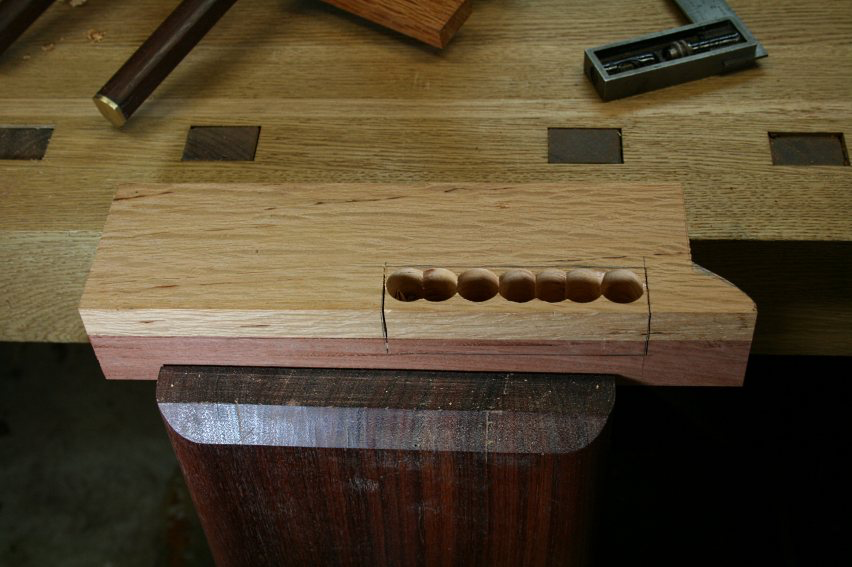
I drilled out most if the waste and started chopping the rest. Of course I find that on one side it is easy to pare down to the long grain line, since I´m paring with the grain while on the other the grain runs the wrong way. Since this is a short, stopped rabbet it is hard to work the long grain part in any other direction.

Although not a main show surface, it is still a show surface, and very much a "feel surface" and I want to finish it cleanly.

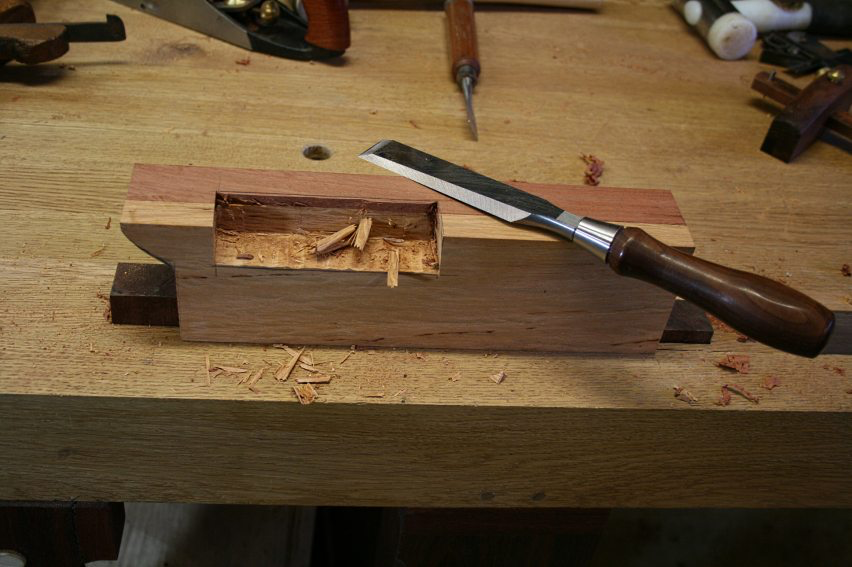
I resorted to removing the main part of the wood by doing release cuts with the chisel (see pic), stopping any tearout to propagate further than the next stop cut. Now I´m finishing up with a router plane, trying to slice my way out from the corner towards the edge. The router plane is however slow and I wonder how you would cut these finished surfaces. Is there a more efficient and clean way of doing this.

The question applies to any stopped rabbet with show surfaces in difficult grain.


Re: Technique question.

#2

Re: Technique question.

Bill Tindall, E.Tn.

Step 1 If doing by hand tools (I would have wasted most of this wood out with a router free hand) pick wood with straight grain in this area. Then just chisel it. What you show is essentially a half blind dovetail tail board in terms of wood removal. It chisels easily when the grain is straight and miserably when it is not. I think I would have more control with chisel than router plane. Fine shavings if the grain dives down.

Re: Technique question.

#3

Re: Technique question.

Wiley Horne—So. Calif.

Hi Oskar,

You’re doing great! If I were finishing up from where you are now, I would use a rasp (or coarse file) to erase the tool marks from the main finger-touch surface, and likewise a rasp to ease or round the touch edges. Then smooth the entire finger-touch area with sandpaper. After applying whatever finish you will use, rub out the indented area for smoothness using wax on 400-600g paper (or similar).

Wiley

Re: Technique question.

#5

Re: Technique question.

Oskar

totally agree Bill, choosing wood that is easier to work would be better. Now I only had this cherry board that would fit to the measures my friend wanted.

It really is miserable chiseling with this much diving grain, hence my question. The router plane works ok, but slow and hard to get a finished surface comparable to a cleanly pared. But maybe my router plane needs more tuning.

Re: Technique question.

#6

Re: Technique question.

Oskar

thanks Wiley, agreed, rasping and sanding would work. However I´d like to keep things not rounded and finish with crisp chamfers. But maybe sanding is the solution at the end..

Re: Technique question.

#7

Re: Drill and chisel

Oskar

Thats clear, I used a forstner bit and a chisel to remove the bulk. The question was, how to make finished show surfaces in such a stopped rabbet, when the chiseling is against the grain.

Re: Technique question.

#8

Re: Drill and chisel

Derek Cohen (in Perth, Australia)

To prevent tearout, take very thin shavings. Preferably across the grain, if you can. Finish with a cabinet scraper (= card scraper).

Regards from Perth

Derek

Re: Technique question.

#9

Re: Drill and chisel

David Charlesworth

We often cut a stick of wood which is the right thickness to support the handle end of the chisel.

This helps to eliminate diving, and keeps the base horizontal.

best wishes,

David Charlesworth

Re: Technique question.

#10

Re: Drill and chisel

Oskar

Thanks David,

just so I understand you, the stick is put between the bench and the handle, so that the chisel back is horizontal? Effect is the same as of using a paring block?

Re: Technique question.

#11

If doing all by hand, three steps

David Weaver

mortise most of the bulk wood out. If concerned about lines, strike a line short of the final line so that top fibers won't tear across the marked line. Work the wood in the direction that it prefers.

Then, once most of the weight is out, pare near the line with an incannel gouge, then pare and mortise to finish (the incannel gouge eliminates long straight grain lines and doesn't allow lateral splitting or tearing like you'd have with a straight chisel). The corners are just worked into progressively.

If one was doing 20 of these, setting up the drill press would be a lot faster, but doing one, i'd be faster and safer just using hand tools.

Re: Technique question.

#12

Re: If doing all by hand, three steps

Oskar

thats an interesting suggestion! will try this for sure.

Re: Technique question.

#14

Re: Technique question.

William Duffield

The shape of your hand hold is wrong.

If using hand tools, I would saw several diagonal relief cuts to remove the bulk of the waste and pare down to the final shape with a carving gouge. If using power tools, I would choose a quarter round bit in a router. The significant advantage to either of these methods for a product used in food preparation is that they don't leave any inside corners that are difficult to keep clean.

Re: Technique question.

#15

Re: Technique question.

Oskar

Thanks for your reply William. Makes sense not to have an inside corner. But too late to change that now, and I do not think it is a terminal mistake. After all it is on the underside, and the food will be on the top, which is easy to clean.

But your point is valid, a curved shape would be easier to pare from the bottom and towards the edge . Thank you, will do that if I make another one.

Re: Technique question.

#16

Re: Technique question.

William Duffield

I agree it's definitely not a fatal error, just make sure you "knock off" the corners. A rounded finger grip is also more comfortable for the user. But, executing a fair curve with a gouge (especially if you want it to look like it was cut with a core box bit :D ) takes quite a bit of skill.

Looking at the picture of the row of Forstner bit holes, I wonder if it would be effective to do them with a spoon bit (or even a ball end mill) in a drill press, which would make shaping the quarter round groove easier.

Re: Technique question.

#17

Re: Drill and chisel

Mike In Los Angeles

So would this be considered more or a “trick?” Or is this a technique?

;-)

👍 This page answered my questions

Your vote helps other woodworkers quickly find the answers and techniques that actually work in the shop.