WoodCentral Forums

Est. 1998 — 27 years of woodworking knowledge

Serious Grinder (not for sharpening)

Posts

Serious Grinder (not for sharpening)

#1

Serious Grinder (not for sharpening)

David Weaver

It became apparent to me that belts and files aren't really the way to go with filthy old files to grind off the outer bits. Belts get beaten up by that kind of thing, and that just equates to constant spending. Files, same thing - that filth is no good for files.

I've switched to using my small baldor grinder, but even though it's got cast rests, with a wheel balancer on it, it's got no dust control and the cast rest on my al-ox wheel is bending under the use.

In my search through the high speed 8" grinders, the stuff sold by woodworking retailers is really kind of junky for any heavy use, but I found a cast guard/cast rest 11 amp jet grinder (with a vacuum port on a couple of different sites for $250 and while I can say that it might not be ideal for sharpening anything, it'll obliterate anything put to the wheels and there's a lot less heat than using the belt sander or baldor grinder (which weren't removing material quickly enough to send the heat off with the sparked material).

https://www.jettools.com/us/en/p/ibg-8-8-industrial-bench-grinder/578008

(the price difference from one retailer to the next was pretty shocking -$250 to $450, all with shipping included) .

I've never gotten anything from jet that was anything other than somewhat underwhelming, but this grinder is legitimate. Assembled in the box other than the rests (two screws), 65 pounds and dead smooth with two cheap wheels (and good dust collection).

Never had much of an issue with dust from wood other than asthma, but with the baldor grinder, the airborne dust was causing serious irritation with my eyes (not sure why), even with some accommodation to move air out of the workspace.

Not by any means useful for anyone else but me - not an appropriate grinder for honing anything due to the speed and power - but great for kind of moving into making a bunch of metal things old school way (roughing things to shape and then finishing shape and surface by hand) and strong enough to run a high speed belt attachment down the road If I decide to make a bunch of knives.

I love the 6" baldor cast rest and guard grinder (great for light grinding), but this is a case where overseas production - if this thing holds up - makes it cost much less to get something that's 4 times as much machine for about 60% of the cost of the baldor. There's a VS version, too, but I don't trust the speed controls in pretty much anything (unless they're 100% analog) to hold up and I need brute force only.

I don't think there's much market for heavy grinders at this point other than machine shops and mechanic shops, and the knife guys are in love with 2x72 variable speed grinders, usually with a long platen (not looking for that for several reasons, and not sure there is any level of dust control on that kind of belt grinder, either).
Re: Serious Grinder (not for sharpening)

#2

Re: Serious Grinder (not for sharpening) *LINK*

Bruce, a MN Galoot

Here’s a homemade grinder that will take care of business on any file you could choose. Go to 13:40 to see the file disappear.


Homemade belt grinder.

Re: Serious Grinder (not for sharpening)

#3

Re: Serious Grinder (not for sharpening)

David Weaver

I have a feeling that his materials cost several multiples of my grinder!!

With those tires, I expected it might be two stroke powered with a shifter.

Re: Serious Grinder (not for sharpening)

#4

Re: Serious Grinder (not for sharpening)

Bruce, a MN Galoot

He has a commercial shop with its own water jet cutter. It’s not your normal shop or owner. The guy is seriously talented.

Re: Serious Grinder (not for sharpening)

#5

Re: Serious Grinder (not for sharpening)

David Weaver

I'm fairly sure that his channel helped me find a second bench vise (metal vise) that dewalt makes with QR. I have yet to mount it, but need to.

The bit at the end where he shoves the bar stock into the belt on that grinder is alarming!! I'm guessing my half dead shop vac wouldn't catch all of the particles from it (does OK with the wheel grinder, though, and the dust deputy - an otherwise useless piece of gear on the top of my mid-line chip barrel - allows me to see if any sparks are making it to the bin filled with plane shavings).

Placeholder here for post later where I wheel a burning plastic garbage can of plane shavings out of the garage for meltdown and consumption in the driveway.

As far as metalworking tools go, it seems like there's woodworker level (hollow grind, light sharpen), mechanics/weld/small knifemaker, etc (strong enough to remove metal) and serious fabricator (like that thing - grind a dune buggy out of solid billet without changing the belt).

Re: Serious Grinder (not for sharpening)

#6

Re: Serious Grinder (not for sharpening)

Wiley Horne

Hi David,

Congratulations. But please put a mask on. Enough of that metal dust is getting to your lungs to do harm.

Wiley

Re: Serious Grinder (not for sharpening)

#7

yes on that...

David Weaver

...this is part of the reason for the grinder purchase - this one, at least, pulls enough of the dust (large cast guard, large shop vac) to not leave much or anything noticeable in the air (not the case for the baldor, but I have to leave the outside of the cast guard off on the baldor).

But I have a 2x48 belt attachment and contact wheel coming for this grinder also, and to my knowledge, there's no good way to capture dust from those, so my half face respirator (something I rarely use) has been back on my head again lately. Not only does the metal dust end up everywhere in the air, but it's really much more persistent than you'd ever expect (well, you may expect it, but for someone who works wood and would expect the metal dust to be "heavy", not all of it is. Some of it may be the product of combustion when the sparking occurs and it is *really* persistent in the air).

This is maybe one situation where my asthma and sensitivity saves me. I noticed it right away and aside from the respirator and the vacuum, will have to plan any really heavy grinding to coincide with an open garage door, an exhaust fan and to be done at the end of a shop session rather than at the beginning.

Being detached from the world of power tool use, it's not something I'd normally plan for, but doing most of this metalwork by hand (time wise), it's not going to be that much of an inconvenience and can be done after I wear myself out hammering, filing and pushing the vixens around on metal.

(my aim in this shop is always to have clear boogers!! maybe not anyone else's goal in life, but it's one of mine) .

Re: Serious Grinder (not for sharpening)

#8

Re: Serious Grinder (not for sharpening)

Derek Cohen (in Perth, Australia)

David, I suspect that these bench grinders are a lot more common than you realise. It is difficult to translate these machines US - Australia, as the voltage is different, and we use different motors. Often the hp is the same.

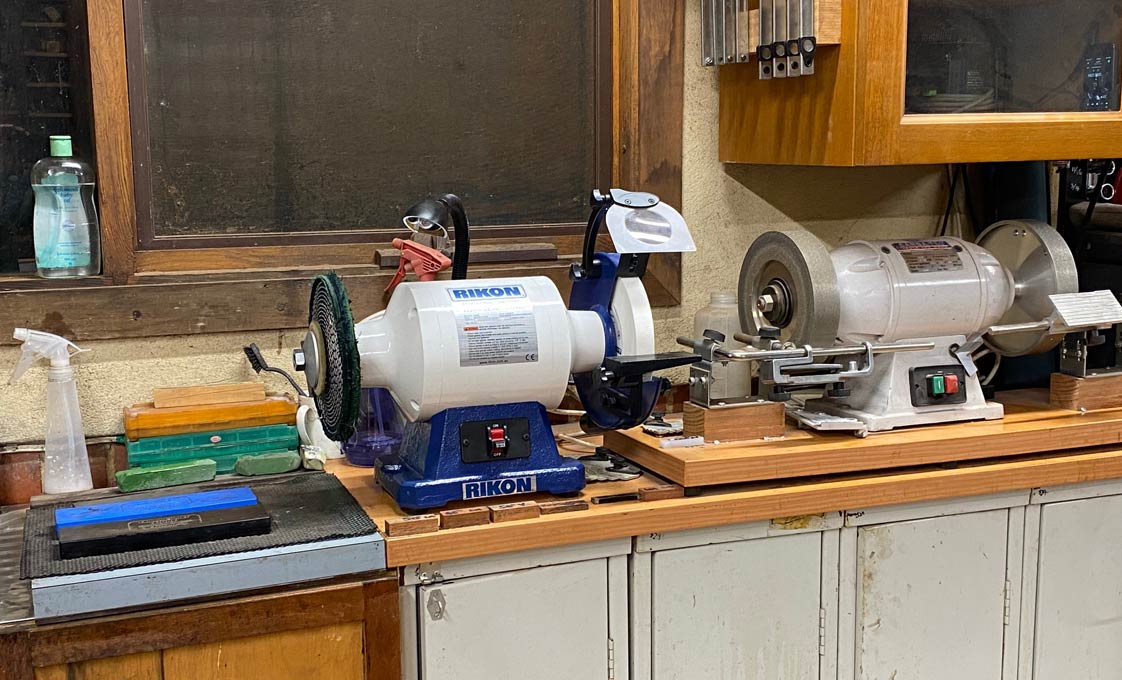
I have a Carbatec-banded (was also sold by Axminster in the UK under their name) bench grinder which looks the same (with the usual cosmetic differences). I also have a Rikon, which is a US brand, I believe. Both are 8”, both are half-speed, and both are 1hp. Both came with dust collection ... the shrouds now having been discarded for CBN and mops, respectively.

Below: the Rikon’s remaining shroud has since been discarded as a white stitched mop has been added there. The Carbatec sports CBN wheels ...


Regards from Perth

Derek

Re: Serious Grinder (not for sharpening)

#9

check the wattage

David Weaver

the consumed wattage for this grinder is 1300-1400 watts.

What's very common here are grinders sold at 4-5 amps (less than half the power) and referred to as 0.5-1 horsepower (5 amps being 600 watts here)

This grinder is probably actually well over a horsepower unless it's really inefficient. It spins up to speed crazy fast and can't be slowed grinding metal.

I see a low speed rikon for nearly the same price as the jet - 7 amps. I don't see the grinder you have on carbatec's site, but they have one similar to the rikon at 750 watts.

There's an underlying issue here (750 watts is plenty for the wheel - maybe you could slow it down whereas you can't with 1300-1400 - but even if you could slow it down, it would grind material quickly. My baldor grinder is 400 watt equivalent and it's plenty strong for minor metal removal -but I anticipate putting a platen and wheel belt grinding attachment on one side of this that runs at 5500 feet per minute, and that'll be a power sucker for anything pressed on the platen (not for making chisels - but my gimmicked method to make chisels with floats and files just doesn't work well with long flat knives - kind of a bummer - unless each type has a jig/backer to support the blade.

But, you're right - the garden variety 8" grinders around 50 pounds are pretty common here (actually, it's a bit of a shock to see that rikon grinder for $240 in the US), but they're common at half the speed or half the power or both. This one is marketed to welding/automotive/fabrication groups, and is sold attached to multitool in variable speed form (which I don't trust to be good for the long term, or to be useful at lower speed under load).

Re: Serious Grinder (not for sharpening)

#11

Re: dewalt...

Steve Voigt

Why do you say a more powerful grinder is not for sharpening? I can't see why more power would ever be a bad thing.

Also, FWIW I have that DeWalt you linked to…as you implied, it's garbage. :D

Re: Serious Grinder (not for sharpening)

#12

Re: dewalt...

David Weaver

Actually, I had a much cheaper grinder than that to start, and for bevel grinding, it did well.

If I'd have guessed, I'd have leaned toward it being good for tool setup but not able to measure up to its horsepower rating in heavy grinding.

Grinders and buffers seem to be one of the few things decent at low cost, but I guess the windings at 110v are enough that there's no 65 pound 1400 watt grinders for $125.

Lots of grinders still made in Taiwan, too, instead of China.

I'd secretly like to still get one of those giant silicon carbide wet job grinding wheels.

(As far as more power and a bigger motor potentially being problematic sharpening, I just get the feeling that a slip and a catch/jam with a really big grinder could be a disaster. Could be wrong and maybe am just being a chicken. )

Re: Serious Grinder (not for sharpening)

#13

Re: check the wattage

Derek Cohen (in Perth, Australia)

David, I looked at your grinder and cannot find figures specifying amps. I have no idea how to convert specs to amps. What I do see is your bench grinder varies (with mine) only in being high speed. It is also 1 hp - which is 750 watts. I doubt that our 240v is different to your 115v in these circumstances.

I have done some heavy/hard grinding on the Carbatec, and never came close to even a hint at stalling it.

By the way, I purchased the Carbatec bench grinder about 7 or 8 years ago, and it is no longer sold. The Rikon was purchased after you published the info on the Unicorn profile.

Regards from Perth

Derek

Re: Serious Grinder (not for sharpening)

#14

11 amps at 120v

David Weaver

The grinder that I bought is, of course high speed (no variable, though that's an option, I'd rather have it be as plain and simple as possible). It's 11 amps at 120 volts. If it was labeled for wattage, somewhere between 1300 and 1400. I don't intend to use it for anything other than coarse grinding, though at some point, I won't be able to resist seeing how easily it burns a bevel with a gray wheel.

As mentioned, I found the highest speed and output power that I could find only partially for heavy handed annealed steel grinding, but more so that it wouldn't be underpowered for high speed belt grinding (which would challenge the more typical 600-800 watt machines)

Given the fairly low price, I expected it to be more crude and rough running. I also expected it to be made in China rather than Taiwan.

Re: Serious Grinder (not for sharpening)

#15

perhaps I'm going nuts...

David Weaver

...but I ordered another one of these grinders this morning to use separately on the belt grinding attachment, and so that I can have a cutoff wheel on one and grinding wheels on the other.

I like using the machine itself enough for grinding the filth off of files and sizing things that having the belt grinder hanging laterally off of the side would get in the way, anyway (or I'd turn and get a shirt string or something in a belt or wheel and end up as a cautionary tale).

I'd love to get the 10" version (which is the same machine with bigger wheels and guards), but for some reason, the 8" version is $269 (less a site discount from the retailer ordering it for drop ship) and the 10" version is $569. This is pretty spectacular given the motor and housing is the same (11 amps) and the design is otherwise identical.

These are taiwanese, and Jet also has a line of chinese grinders that are so little difference in price that it makes no sense. The chinese grinders have a higher horsepower rating per amp by a long shot. :b

I'm guessing the marketing department determines the "horsepower" rating on the machines, and 11 amps on the 8/10 inch taiwan grinders is "1 horsepower" while 10 on the 10 inch chinese grinder is "1 1/2" as jet expects people to be searching for "1 horsepower" 8 inch grinders.

The dust deputy was white, but it's dark gray now inside!

Re: Serious Grinder (not for sharpening)

#16

Chris Scholz

Power is Amperage times Voltage

Chris Scholz

Not all that hard to translate...

Power [with units of Watts] equals Electric Current [with units of Amperes] times Electric Potential [with units in Volts].

Power [with units in Horse Power]: Divide Watts by 745.699872. So for marketing purposes, your 750 W grinder has a 1 hp motor.

Double the Voltage and you only need half the Amps to get the same power. But make sure your motor can take the higher voltage. For example your 750 W grinder draws just about 7 A in the US but only 3.1 A in Europe.

For industrial users you need to be concerned about power factor (i.e. active vs. reactive power), that's how you pay your utility provider. For residential users power factor is not a concern.

The nameplate of your motor tells you how much power the motor draws from the electric grid. to get an estimate of the mechanical power at the shaft of the motor, multiply the wattage by 0.75 to 0.95, lower number for smaller motors like in bench grinders, larger number for bigger and more expensive motors that you might find in latest generation electric cars.

Finally, the torque at your shaft output determines how hard it is to slow down your grinder.

Torque [in Nm] is shaft power [in W] divided by angular velocity [in rad/s]

or if you prefer rotations per minute [rmp]

Torque [in Nm] is shaft power [in W] divided by (2 * pi * rpm) * 60 s/min

If you prefer ft * lbs to Nm just multiply the results by the appropriate conversion factor

Hope this is useful.

Re: Serious Grinder (not for sharpening)

#17

My 1300-1400 watts comment...

David Weaver

..came from waffling about looking up volt amps being the same as watts exactly.

1320 watts would've been my answer (but I couldn't recall if there was any small adjustment) and then didn't want to post after looking it up later that it would be the same.

But that's what I found, as you're saying - watts and VA, same. Strangely, I had a TV/appliance repair uncle who was a gifted maker of electronic items and he had that wrong "they're almost the same", and it's stained me for life!!

I could've misheard him, too (the boring story that goes with it is the introduction of early power backups for desktop computers).

So, these grinders are labeled as 1320 watt grinders which is bonkers strong if just using an 8" gray wheel (but makes them a great candidate to use the grinder as a power source for more than just wheels). I can't help but think that if I manage to catch something between the rest and the wheel at any point ever, the result will be disaster, but I also may just be chicken from using a small 6" grinder or a lighter weight 8" grinder in the past.

As you're probably aware (what caused me to chicken out from saying 1320 watts at the outset), if I were to say that volt amps = watts and I was even narrowly incorrect about that, the thread would've bloomed with discussion about the figure being wrong.

Re: Serious Grinder (not for sharpening)

#18

Your uncle was correct...

John in NM

They aren't really the same thing at all beyond DC power and AC with simple resistive loads. The reason they get called the same is that when we discuss wattage on a day to day basis in a woodworking forum, we're really discussing VA by making the assumption that an AC motor is a resistive load for the sake of simplicity. If one isn't designing motors, that assumption is quite reasonable enough to make - things like unbalanced inrush currents don't matter by the time motors get to us and we're using them. That is the kind of subject where the differences become important.

However, that class was a long time ago, and after lunch as I recall, so I may be exposing my relative ignorance. If so, I blame the pizza and beer from the joint a couple blocks from the physics building :D

Re: Serious Grinder (not for sharpening)

#19

Chris Scholz

Re: Your uncle was correct...

Chris Scholz

That’a right. The usual convention is to use Watts for real power and VA for apparent power. The Watts do the real work, difference between watts and VA is the power factor. VA always larger or in the best case equal to Watts.

This becomes important it you design, repair, optimize electric motors, if you install and maintain electric systems, if you are an industrial user or if you run a utility and are concerned about power quality.

Since none of us really ever accurately measures the torque of our grinders or the electric to mechanic efficiency or our power tools, we’ll be ok call it Watts and agree the we might have a 30%-something uncertainty in the numbers we quote.

👍 This page answered my questions

Your vote helps other woodworkers quickly find the answers and techniques that actually work in the shop.