WoodCentral Forums

Est. 1998 — 27 years of woodworking knowledge

Assembling a dovetailed drawer

Posts

Assembling a dovetailed drawer

#1

Assembling a dovetailed drawer

Bill Tindall, E.Tn.

There are endless demonstrations on how to make a dovetail joint; fewer on what to do with it. I have not seen anyone else assemble a drawer so what follows is self-taught for better or worse.

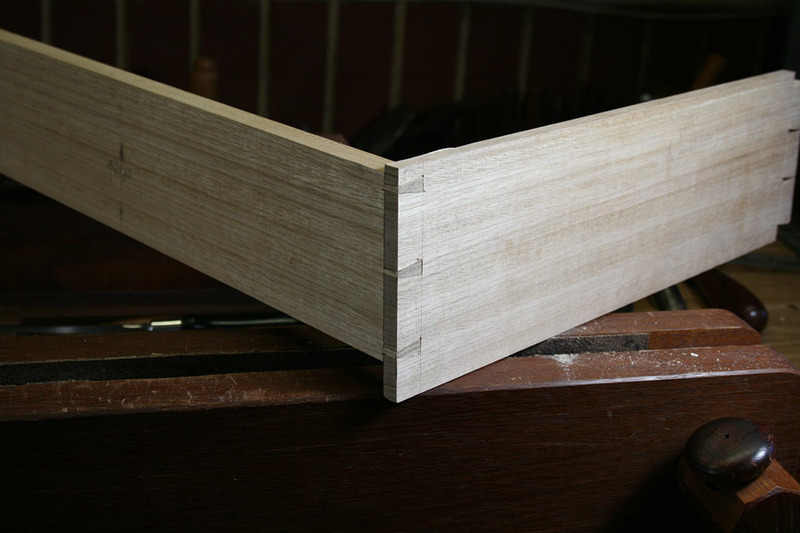
Pic 1


Step one is to carve a tiny chamfer on the inside of the tails. This chamfer will guide the joint together when things get frantic during assembly.

Ideally what follows would be illustrated as it was being done on an unassembled drawer. Not possible, so we need to make do with a recreation on a finished drawer.

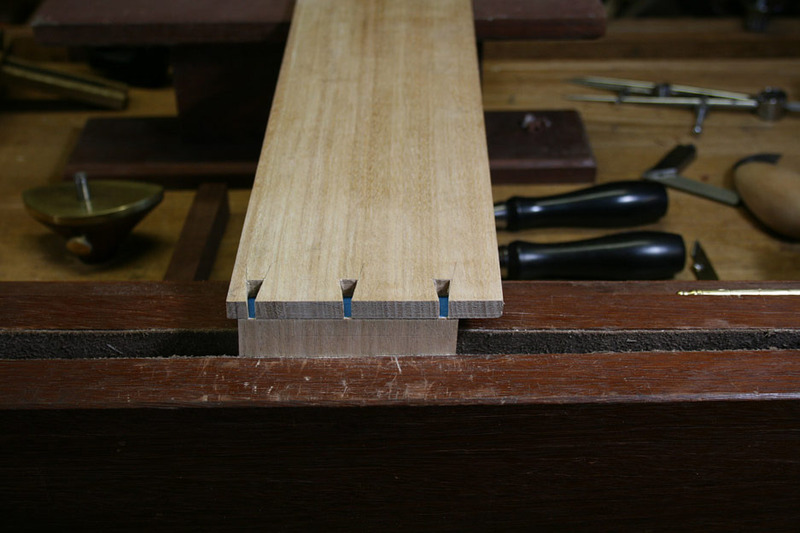
Pic 2


Apply glue to both mating surfaces of joints 1A,B. I always apply glue to both mating surfaces. It ensures wetting both surfaces, essential for a bond to form. Glue is at the ready and the spatula shown is ideal for application.

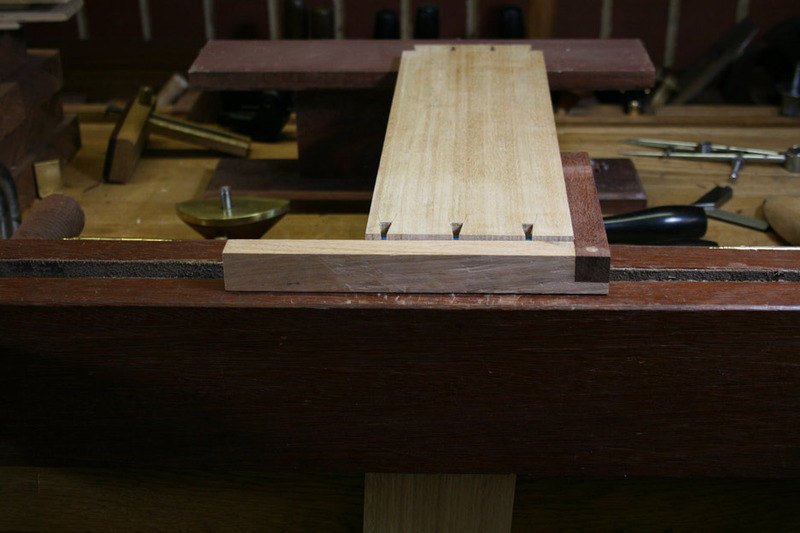
Pic 3


With side 1 flat on the bench add the front and back pin boards and seat. Ideally the joint has been properly prepared and these joints will gently slide tight.

Pic 4


Add glue to both mating surfaces of joints 2a, b and add the drawer side. Tap it to seat the joint.

At this point the joints are likely not tight. Glue may be keeping the joint slightly apart.

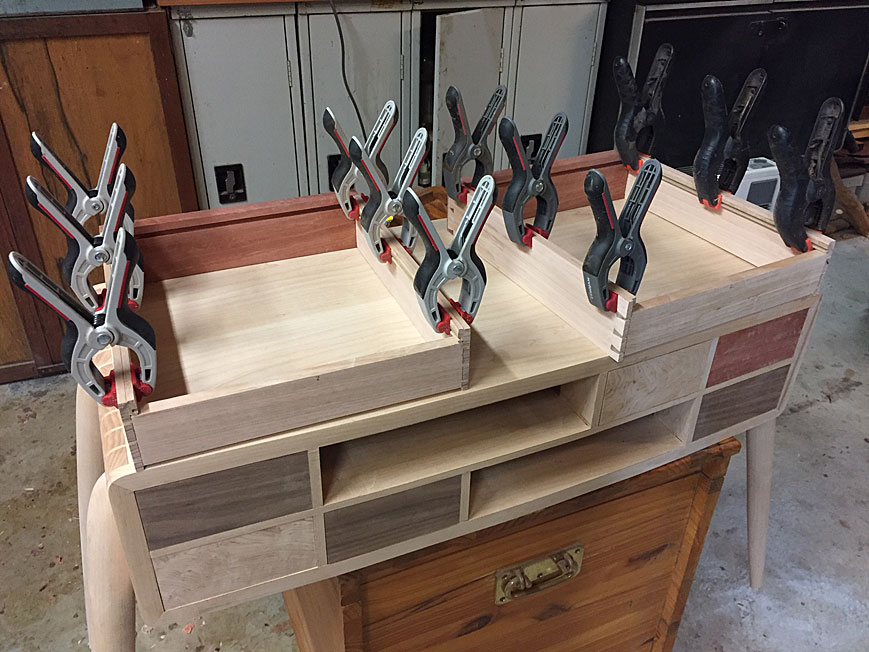
Pic 5


Apply clamp pressure to the length of the drawer to pull the tails against the front and back. I typically just use one clamp and reposition it up and down the drawer height, on each side, until the tails seat. I might have to hold clamp in place a few seconds to allow the offending glue to squish out of the way.

Pic 6


Repeat clamping up and down the drawer sides to seat this orientation of the tails. It may be necessary to repeat the previous step of the tails don’t stay in position.

Finally square the drawer and set aside to dry. Or install it in the opening, shim into place and let it dry where it will live.

Re: Assembling a dovetailed drawer

#2

Re: Assembling a dovetailed drawer

David Weaver

A good summary, I think, but I know nothing about furniture..

.... (Except that the fewer clamps involved with carcasses and drawers, the better things seem to go)

Re: Assembling a dovetailed drawer

#3

Re: Assembling a dovetailed drawer

Bruce McCrory

Yes, I can identify with your observation Bill. I was pretty sure that faeries do the final glue-up of these joints. You could have eased those of us with fantasies and suggested that some people do their own joints.

A question: Rather than slip the clamp back and forth to compress the joint, why not use two (or, more) clamps?

Also, it never occurred to me to slide the wet box into the case for custom fit.

Re: Assembling a dovetailed drawer

#4

Re: Assembling a dovetailed drawer

Bill Tindall, E.Tn.

A question: Rather than slip the clamp back and forth to compress the joint, why not use two (or, more) clamps?

Quicker. Once the clamp snugs up the joint and squishes out any trapped glue it is not longer needed in this position. It is easier to loosen it a turn and slide it to another location.

Not made clear....the drawer is snugged, clamps off, square checked and adjusted by squeezing corners as needed and left unclamped for glue to cure. I want to know what shape the drawer is in as the glue cures. If clamped the drawer can spring into some other shape when the clamps come off.

Re: Assembling a dovetailed drawer

#5

Re: Assembling a dovetailed drawer

Wiley Horne

Really good point Bill. Also, tight clamping can force a good drawer out of square, particularly if the baselines are undercut even a smidgen.

Wiley

Re: Assembling a dovetailed drawer

#6

This should be a "sticky"

Jim Matthews

Excellent tutorial.

The paper labels are ideal visual aids.

I just assembled a dovetailed box for childhood mementos (the original plywood box fell six feet to land directly on a corner, naturally).

I still marvel at makers that can build using these cursed things.

Re: Assembling a dovetailed drawer

#7

Re: Assembling a dovetailed drawer

Brian gunsmith From colorado

Frank Klausz published a VHS titled "dovetailing a drawer" from a desk. Layout, dovetailing, assembling and fitting.

Re: Assembling a dovetailed drawer

#8

Assembling a dovetailed drawer - additional notes

Derek Cohen (in Perth, Australia)

Thanks Bill. This is such an important area in drawer building. I welcome others to post their thoughts.

I suspect (when I think back to my first days and my own anxieties) that one is so focussed on getting the dovetailing right, the forward planning does not take place. Then it is a scramble at the last minute. Or, the drawer fails to fit well, which is followed by "fixing" the poor fit, which never recovers, and remains a poor fit.

The more experience, the better one understands, and the better the forward planning. As in life, forward planning is everything.

Step 1 is to fit the drawer front and rear to the opening. I aim to get these the exact same size, front and back, and this warns you ahead of time whether the drawer case is square. One can get away with the sides being angled, the front and rear need to be the same width for a piston fit. Some like the rear to be 0.5mm narrower (I think that David Charlesworth does this).

My plan is to fit the width exactly, and this is where a shooting board is a great help as you can sneak up on the fit.


Building these lipped half-blind drawers, attention was given to an exact fit to the sides ...


.. and also meeting the centre of the drawer dividers ...


... while keeping the grain running sequentially ...


An adjunct to step 1 is awareness of wood movement. Expansion and contraction is across the grain, which translates to being okay to fit tightly in the horizontal, but the vertical must allow for movement. Generally there is a couple of mm between the top of the drawer front and the upper side of the case.

This was especially a concern when building this drawer ...


I was aware that the height of the drawer was not great, with corresponding small changes expected. What I did was to taper the top of the drawer front. It looks full from the outside, but is lower on the inside. This reduced the area further. In four months since building, which coincides with the wet Winter period here, there has not been any movement at all. Phew.

Sawing the front and rear dovetails: For a piston fit, it is essential that the front/side sections are exactly square. If they are even slightly out of square, the drawer base will rock, and then you will be forced to plane it square. This will remove material from the sides, which will affect the drawer fitting inside the drawer case.

It begins with transferring the (in my case) tails to the pin board. This the rear of the drawer, which is more difficult that the front, as there is often less to align ...

The key, for me, is a wooden square I built to align the sides to the front ...


Fitting the parts: I must point out that I saw dovetails to their exact depth. I do not leave them proud in the marking out. The reason for this is that I want to test fit the drawer (sans drawer bottom) before glueing up. If there is is anything to plane away, it will be from the sides.

Glueing up: If you have done everything right, and all the sides are square and the correct size, when you glue up the dovetails, the last side will just fall into place, dovetails dropping into their sockets without having to be moved left-or-right ....


The drawer (sans bottom) is placed in the drawer case until the glue is dried. This may be a tight fit, and require a bit of a shove, but it will go in.

The advantage of drying in the drawer case is that the fit is better.

Tweak the fit: Once the glue is dried, the fit can be adjusted until it slides smoothly. The drawer bottom is still not yet fitted.


Slips and drawer bottom: Now is the time for the drawer slips to be added ...

The drawer bottoms are then fitted, with particular attention to their widths. Using slips requires that they are also rebated, which adds to the complexity in fitting ...
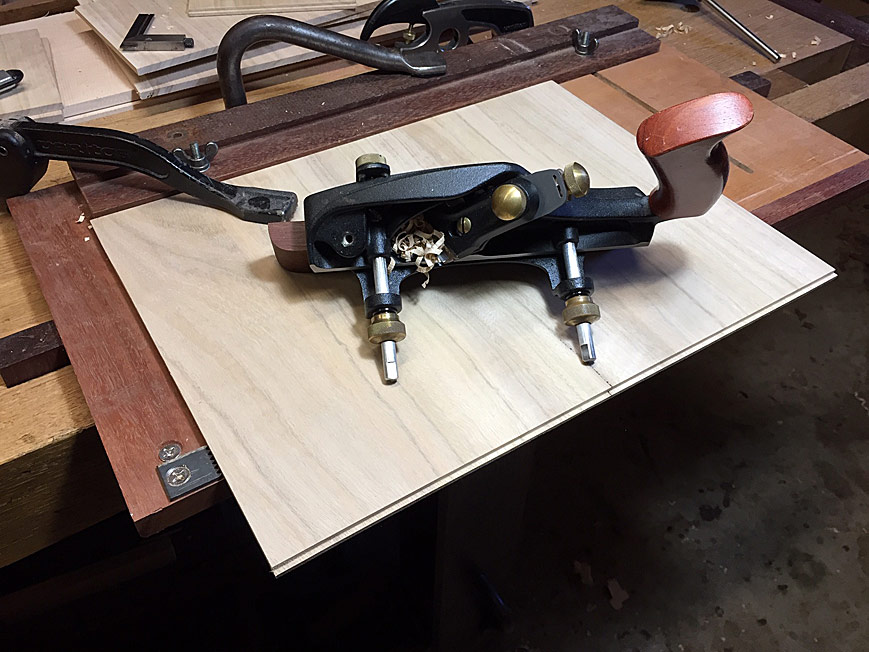
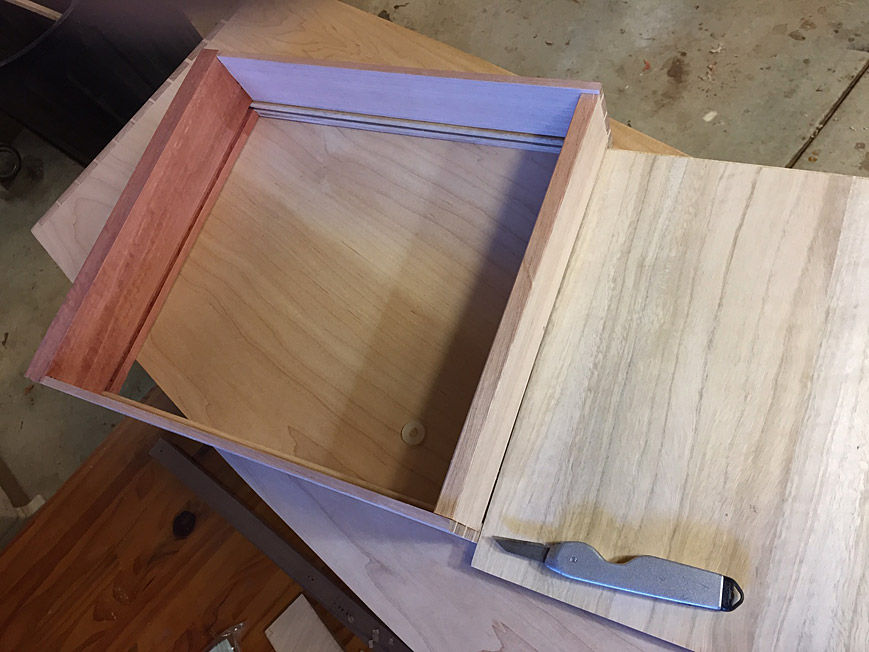

If there is any tightness when fitting the drawer at this point, I know the issue lies with the drawer bottom. A smidgeon here-or-there comes off with a shoulder plane.
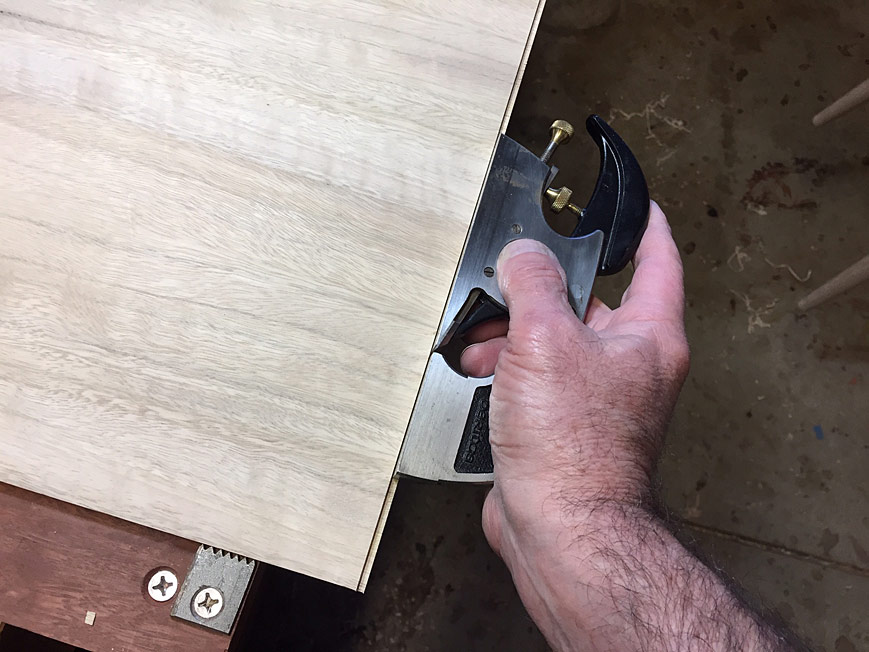

Satisfaction is a drawer that slides smoothly in-and-out, and closes when pushing on a corner :)


Regards from Perth

Derek

Re: Assembling a dovetailed drawer

#9

It can be simple

Bill Tindall, E.Tn.

1. There is no substitute for practice.

2. Practice where the goal is a functional joint, not a joint to enter in a dovetail beauty contest. Success will come more quickly if the stress from practice is eliminated.

If we could get over dovetails being a measure of a woodworkers worth it would remove some of the fear of using them.

Re: Assembling a dovetailed drawer

#10

correction?

Bill Tindall, E.Tn.

Generally there is a couple of mm between the top of the drawer front and the upper side of the case. I think this value a misprint. This amount would be an unattractive too big gap for even a large drawer, unless building under very low humidity conditions.

While on the topic of how much height clearance to leave..... This question does not have one answer. The answer depends on the height of the drawer, the relative humidity of the shop and the relative humidity of where it may live.

A tight fitting drawer works smoothly. I strive for a drawer that can be closed by pushing on one corner with a finger. However, a sticky drawer is vastly more intolerable than one too loose.

Before I deliver furniture with drawers I set the piece in the most damp environment I can find- garage in the winter for example. It is not uncommon for the case or a drawer to move and become bindy during this test. I adjust by planing and so far I have not delivered a piece that presented further problems.

Re: Assembling a dovetailed drawer

#11

Re: Assembling a dovetailed drawer

Bruce McCrory

Thanks for clearing up misguided impressions. I suppose this means I have no excuse for making sloppy-fit drawers anymore.

Re: Assembling a dovetailed drawer

#12

Let Go

david charlesworth

Derek,

In my DVD on drawer making and fitting I started by tapering the carcase just a smidge. Wider at the back by two thicknesses of masking tape.

The drawer was fitted from the back, the aim being a drawer which slides out without friction, but tightens up when 2/3rds open, thus warning you not to dump the contents on the floor.

It was an interesting exercise but possibly not of use for large drawers, and I said that a parallel opening might be more useful.

Best wishes,

David

Re: Assembling a dovetailed drawer

#13

Re: Let Go

Hank Knight

James Krenov also used this method. I learned it from Craig Vandal Stevens, a Krenov student. They made small case work with small, sometimes dainty drawers. It doesn't work with large drawers. It's hard to build a large case to those close specifications (it is for me, at least), and the seasonal movement of a large drawer will be enough to bind it in the closely fit opening. But it's really nice on smaller work. The drawer tightens up perceptibly just as it reaches full opening and almost gives a sigh as it surrenders to be removed from the case.

Re: Assembling a dovetailed drawer

#14

Maybe...

Jim Matthews

I'm like most basement hacks: along the shallow slope of the learning curve.

My latest box using dovetails fractured along the (highly figured) grain of two adjacent sides.

It was a snug, Warrington "persuader" fit.

As the glue dried there was an audible "bang" from the basement.

I'm still at the stage of getting salvage practice.

Re: Assembling a dovetailed drawer

#15

Re: Let Go

david charlesworth

Hank,

It is great to hear from someone who has used this technique.

I wonder if Krenov learnt it from Karl Malmsten in Sweden?

I totally agree about timber movement. My demo for the DVD has had issues with the sides changing shape.

It would have been better to use quartered timber. But it proved impossible to buy quartered boards of American Walnut in UK. Something about the timber yards being set up to cut Pine.

Best wishes,

David

Re: Assembling a dovetailed drawer

#16

Quartered lumber and technique comment

Bill Tindall, E.Tn.

The unavailability of quartered walnut has nothing to do with mills being set up to saw pine. I have read that about 80% of the world's hardwood lumber is harvested from the Appalachian Mountain chain, where I live. We sold hardwood lumber for about 30 years and at one time I was investor in a small hardwood mill. Bottom line, I know a bit about the topic. See WoodCentral Articles section for how hardwood lumber is produced (under my name).

There are three kinds of mills commercially producing lumber in the US- mills to saw lumber for construction (primarily pine in the eastern US), mills to produce hardwood lumber for furniture and architecture trim, and barrel stave mills to produce quarter sawed white oak for wine and whiskey barrels. These mills are single purpose and impossible to saw hardwood on a framing lumber mill or hardwood for furniture on a stave mill.

There is but a tiny market for rift and quartered hardwood lumber. A very few small mills produce it or it can be graded out of lumber produced from normal operations. But there is no large demand so there is no large mill dedicated to sawing it. Hence, it will not be found at the local hardwood lumber store. Nor can one order a 1000 bdft pack of quartered XXX from a commercial wholesaler. (the exception is oak flooring where these is one mill producing it in quantity)

*****

I have done quite a number of large case pieces in the past 20 years. In my experience it is impossible to hold the tolerances of the case and drawers to achieve piston fit or variable "let go". I have not heard it claimed that anyone producing Period Furniture case pieces strives for this kind of fit. (Call backs from a customer with a sticky drawer are a fear that is avoided)

Target one of these goals and the risk is a sticky drawer down the road. Krenov claimed to achieve the controlled bind at the extension of a drawer. I don't doubt given his skill and patience he achieved this result on his tiny case pieces with their tiny drawers. We do not know what the fate of this fit was when the piece found its way to New Orleans, of Tuscon.

My experience leads me to strive for a fit that works smoothly in the most humid location I can find. A 20" case side made from one or two pieces of lumber is going to move over the seasons and become more or less flat. If this side is the guide for a large drawer accommodation is needed to deal with this movement.

On a large drawer I want 1/16 to 1/32" total clearance for the ends of a drawer front, and more clearance, not less, on the interior drawer sides. Height clearance is so dependent on variables I am reluctant to suggest a clearance. Again it will be more clearance interior than on the front.

Re: Assembling a dovetailed drawer

#17

Re: Quartered lumber and technique comment

Warren in Lancaster, PA

about 80% of the world's hardwood lumber is harvested from the Appalachian Mountain chain

Seems a bit over done.

Here in Lancaster County we have a robust woodworking industry. Most of the rift and quartersawn stuff comes in large bundles. However they are available for amateurs, albeit more expensive. We get a lot of oak from the midwest.

There is also hardwood coming in from Europe, Africa, South America etc.

Re: Assembling a dovetailed drawer

#18

Re: Quartered lumber and technique comment

Bill Tindall, E.Tn.

In the context of what I read I believe the African, South American and Far East lumber was considered tropical. European production is piddly compared to US and central states piddly compared to Appalachian. There simply are no large forest tracts in Indiana, or western Europe, compared to Appalachian which is an almost continuous timberland from North GA to the NY border. Within a short drive from where I live there are two mills producing 125,000 bdft of lumber per day, and several other smaller operations!

When you have the opportunity, ask who is producing these large quantities of quartered lumber you referred to. All species, or just oak?

Re: Assembling a dovetailed drawer

#19

Re: Quartered lumber and technique comment

Sgian Dubh

"On a large drawer I want 1/16 to 1/32" total clearance for the ends of a drawer front, and more clearance, not less, on the interior drawer sides. Height clearance is so dependent on variables I am reluctant to suggest a clearance. Again it will be more clearance interior than on the front."

My strategy with larger case pieces and their traditionally fitted drawers (runners, kickers, and drawers with or without slips) is very similar to yours, Bill, and for the same reason, i.e., expansion widthways of the front and sides causing jamming. Leaving a gap of about 1 mm, particularly in the height, is a good strategy for any drawer taller than about 100 mm (~4"), with taller again drawers maybe getting and extra half millimetre or so of tolerance. Generally, tolerance in the width of the drawers can be a bit tighter, maybe allowing as little as 0.5 mm overall, i.e., 0.25 mm allowed at either end.

Drawers mounted on metal slides generally need a greater gap than this, about 2 mm all round to allow for the slight inherent wobble or swaying action of the slides in action. Slainte.

Re: Assembling a dovetailed drawer

#20

Re: Quartered lumber and technique comment

Warren in Lancaster, PA

Sounds like you dismiss anything that does not happen in one or two counties in eastern Tennessee.

Re: Assembling a dovetailed drawer

#21

?

Bill Tindall, E.Tn.

"compared to Appalachian[hardwood] which is an almost continuous timberland from North GA to the NY border.

One of the large mills I referred to is in Eastern TN, the other SW Virginia and neither in the county I live in or its immediate neighbors. It would be interesting to trace your logic to see how you got from what I wrote to what you replied.

I have visited/bought from other large Appalachian mills sawing over 100,000 bdft a day in NC, SC and GA. Similar sized mills will be found GA to PA.

My point, is that hardwood, as it is typically defined (oak, maple, beech, walnut, cherry, poplar, etc), production in the Appalachian mountain chain dominates the world market. The reason is the favorable temperate climate promotes good growth rate of the hardwood species typically used in furniture/architecture, and this forest land is extensive. This combination is not replicated elsewhere.

Re: Assembling a dovetailed drawer

#22

hardwoods

Warren in Lancaster, PA

My point, is that hardwood, as it is typically defined (oak, maple, beech, walnut, cherry, poplar, etc), production in the Appalachian mountain chain dominates the world market.

No, that is not how we typically define hardwoods. If you limit your definition of hardwoods to woods that grow in your own backyard, then what you are saying is 80% of the trade in Appalachian hardwoods comes from Appalachia. An extremely parochial perspective.

Re: Assembling a dovetailed drawer

#23

Re: ?

David Weaver

Common on the english forum to see folks importing american cherry and maple and using quite a lot of it (especially the pros).

Over where warren is, there are a lot of amish mills who will work for little and some may custom saw (a friend of mine just had a pair of large logs milled for $65 - all flatsawn, though.

Two guys here who are pros who will custom saw anything you want, but you have to know those guys. They generally stock about 10k board feet at a given time and sell everything a little below retail market. The retail stores here have wood from coin sorter mills.

interesting guy on youtube for a while (he's retired now) who mentioned making a living IIRC sawing about 3-5 or 7k board feet of pine a day on a frick mill until a decade or two ago (numbers varying based on how many working for him and how much business he had). Once in a while, he'd saw a log into wide boards and then stack the boards up and run them back to the mill again to make common dimensions like 1x6 (more or less said that everyone likes the wide boards, but they sit without selling). Those of us hand tooling would've loved the wide boards either to use directly or saw lumber from to get good aesthetics.

He said something along the lines of needing an operation big enough to have a grader on staff (or the furniture mills would take in what you sold them and then undergrade the lumber and cut what they pay you), needing steady customers or a marketer selling your lumber, and then at the same time, competing against mills that were intentionally going into debt waiting for prices to improve. Sounded impossible.

I'm obviously in the middle of appalachia (which allows the small specialty guys like the guys I use). Warren's area has far more consumers of hardwoods, so not similar to here.

Re: Assembling a dovetailed drawer

#24

Re: hardwoods

Bill Tindall, E.Tn.

If you insist on including what we commonly refer to as the tropical hardwoods into the equation then US hardwood production (which is largely Appalachian, commonly defined as GA to PA) is not even half the world production. The leveling of the rain forests in South America and East Asia dominate.

If we limit the definition to temperate zone hardwoods (add birch to previous list) then the US dominates the production of "hardwood" lumber that winds up in furniture and architecture, excluding hardwood that winds up as paper and construction material. There simply isn't a lot of temperate zone land suitable for hardwood tree growth that has not been turned into agriculture land. Europe got clear cut in 987 AD and what was left in eastern Europe the Russians leveled after WWII to launch their "agriculture revolution.

Someone from our hardwood lumber industry that did mission work in Romania told me they had excellent hardwood forests but they were underutilized. We hiked all over Czech Republic and I didn't see but scrappy beech in the forests. But there were stupendous white oak and linden preserved in parks.

Re: Assembling a dovetailed drawer

#25

Re: coin sorter mills?

William Duffield

I can't figure out what a coin sorter mill is, with the exception of coin sorter money mills, which sort coins, bo don't mill any lumber. Can you elucidate?

My mommy told me not to take any wooden nickels. :D

👍 This page answered my questions

Your vote helps other woodworkers quickly find the answers and techniques that actually work in the shop.