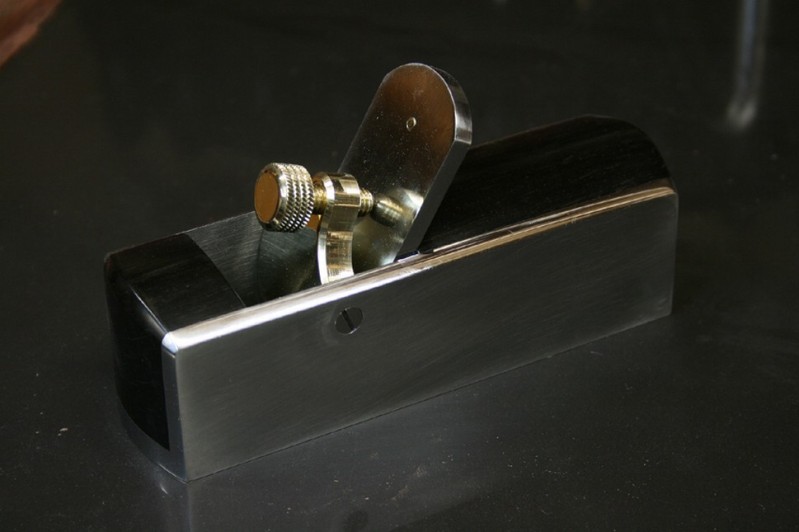
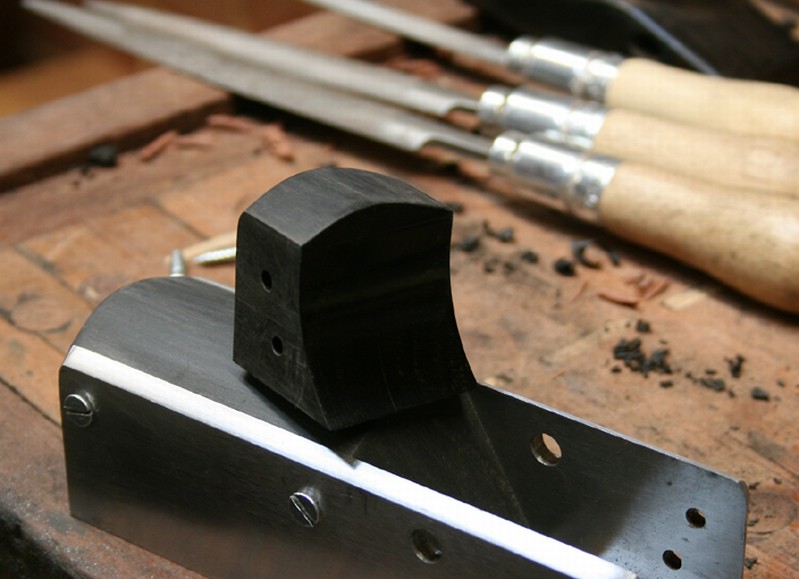
Make sure there are no rough places anywhere around the mouth; the sides of the mouth can make trouble. It is nice if there is some clearance between the plane iron and the sides of plane, like 1/32 or more.
We usually polish and round the cap iron. If the cap iron is too close to the edge for the thickness of the shaving, the shaving does not exit cleanly.
The shape of the cap (generally the angle, but height if the cap is also thick and tall) has a lot to do with the ideal wear.
Most of the inexpensive machine made wooden planes that I've seen lately address the issue of not having a very good cap iron or good finish level by just making the wear very steep or making it very short.
The roughness can, of course, be a problem, too, but a bad angle match with the cap iron and it'll clog.
I don't know a formula for this, but would guess if the fat part of the cap away from the point of contact is narrowing any significant amount toward the wear (which can occur if fixing the problem by opening the mouth instead of steepening the wear), there will be trouble.
I have used the same trying plane on every board since January 1979. The cutting angle is 43, the angle on the cap iron is 80 for a total of 123 degrees. The angle on the wear is 15 degrees from perpendicular (105 degrees).
One guru has said that the angle on the cap iron plus the bed angle could not exceed 90 degrees. Another guru said that if I look in the mouth of my plane there are all kinds of scratches from jam ups. A third guru said that Kato's numbers do not add up. Needless to say these people are lacking in experience.
Depending on who is talking, I guess it's awfully easy to declare something will work or not work.
I find it very difficult to talk about things I don't have much experience with, and even then, to make definite statements.
I've got certain preferences from making a bunch of planes, and a few things in mind to try when encountering various cap iron shapes (and heights - I don't like a cap iron to have the boundless spring that a lot of the emmerich, etc, type caps have). But if someone does something different and it works, it's awfully hard to tell them that it doesn't. Or maybe for some people, even after hearing that something else works, maybe it's really easy to tell others that it doesn't.
Jim, basically, there is no room for the shavings to escape, and they are becoming trapped between the chipbreaker and the escapement.
The choices are these:
1. Change the escapement, or
2. Change the chipbreaker.
The escapement can be dealt with in one of two ways. David suggests that you make the wear steeper. I do not think that the Krenov plane has a traditional wear.
The wear might look like this ...
... and David is suggesting you do this (this is a high angle bed Krenov plane I built quite a while back). Note the wear is a higher 90 degrees here ...
Many Krenov-style planes are not built with a traditional wear, but instead with an escapement that ends in an angled corner. This cannot be opened for fear of opening the mouth. I built an infill with an escapement like this ... of course, in that plane, there was a steel sole as well.
To maximise the escapement space, where it was not possible to make this shallower, what I did instead was to hollow out the escapement ...
You could do this using a scraper ala the square-ended chisel of Bill Carter (grind the end of a chisel square and use it as a push scraper).
2. Change the chipbreaker: Either pull the chipbreaker back, or lower the leading edge of the chipbreaker. Both these provide more clearance. Neither eideas are great for tearout control, although the latter idea is feasible still ... reduce the thickness of the chipbreaker, but leave the leading edge steep..
your top picture is what I'd wanted to see to examine the trap on the hock type irons, etc.
I've mentioned before that I like the older cap irons (the wards and mathiesons) where the cap is rounded at the tip and then gets shallow quickly to get out of the way.
it's possible for someone to modify the hock type cap irons to take the top part of the angle off some (where you can see that it's nearing the wear).
Warren mentioned relatively tight angles if I interpreted them correctly, but I suspect that there is a lot of room at the top of his cap iron relative to what there would be if it were tall and 50 degrees flat.
If one is employing a close set cap iron does it matter how open the mouth is?. I solve similar problems to what is being described by simply opening the mouth without noticeable adverse consequences. But then I may not be sensitive to adverse consequences that other's would notice.
Jaming is quite common with wooden planes, since their design usually implies a chimney kind of escapement, where metal planes are usually more "open".
If the shavings get clogged by one side only, it's usually something inside grabbing them (rough spot, gap between the blade and chip breaker / cap, ...). This part is just maintenance and smoothing.
It they appear to be clogged in a tidy parallel fashion, then I would blame the geometry. This part is where great planes stand out.
planing the tips of small things (e.g., beveling, etc) and starting on boards on ends or side edges where you may accidentally dip the plane handle down and catch wood and lever it off.
I'd like to claim that I came by that through reasoning it out, but I came by that by prying chunks off of the edges of boards.
I'm not much of a user of coffin planes, but when I made a few, I thought it would be nice to have one with the insides made like an infill plane (the wear in front of the iron falls away rather than back toward the iron).
I made this smoother out of purpleheart, excavated the area in front of the mouth and made an insert to achieve this. It works great.
Unfortunately, the berg iron that I have for it isn't that great (it's chippy), and I haven't addressed it.
Of course, you couldn't make a plane like this and sell it (it looks like an old beater plane from the bottom and the insert is fixed - not a fan of screw held inserts for various reasons - so it doesn't look intentionally made like an adjustable screw-held insert would be). But, you can make a plane like this and use it!
This purpleheart is almost dense enough to sink - the coffin smoothers I've liked the most are made out of denser wood so that their weight is closer to metal smoothers (I don't work much softwood or mahogany where the lighter beech smoothers might excel).
Isn't a mouth opening that would suffer those issues way beyond what would be necessary to prevent a shavings jam? I old planes I have seen a mouth gape open 1/4".
Returning to my question, does a tight mouth do anything positive if the close cap iron is employed? This question is important because "we" have been schooled that a tight mouth is critical. Read the Finck Krenov plane making book and the most of the angst of making the plane is fretting about keeping the mouth tight. I had a high angle plane that would not clear shavings with the cap iron set close. If the mouth isn't doing anything beyond preventing the problems you describe it can be opened up if shaving clearance is encountered.
Read the Finck Krenov plane making book and the most of the angst of making the plane is fretting about keeping the mouth tight.
Bill, I have an original Krenov plane, made by Jim himself. When he sent it to me it was set up for planing, indeed, it arrived with shaving in its escapement.
I made a note of the settings Jim used, and the chipbreaker was set 1/16" from the edge - too far back to be making an impact.
Perhaps someone might correct me, but it seems to me that this was not a technique he used or taught. I could not find any reference to setting the chipbreaker in his books.
I have been to the school 3 times with no evidence the students ever heard of using the cap iron to do anything but hold the blade in place. Curious they even used a double iron plane.
...but I have never seen anyone else describe planing and smoothing as warren would.
I didn't ever pick up on what warren said until I got the kooky idea that keeping the plane in the cut more consistently was better than spot smoothing.
And then I think warren referenced something from nicholson saying the same thing - finishing smoothing with overlapping strokes and through shavings.
I won't leave dirty tracks around conversations of krenov as I have only seen bits of his texts quoted from different people and when I compare all of them, I don't think they give an accurate picture (e.g., I saw someone mention that he only sharpened to a certain level and then liked favorable woods because of it - but the context was someone advocating atom splitting sharpness as needed for smoothing, especially in discussing figured wood - which isn't true. Nobody would ever do much smoothing of figured wood with .001" shavings).
yes (the big mouths are a matter of sloppy plane making or setup and not due to a mechanical need - or on old wooden planes, maybe due to a lot of wear).
In something like an older infill where the inside of the mouth above the sole is carefully filed to match the cap iron, the mouth can be almost nothing and be no detriment to the cap function, but there's no great reason for it to be that tight. Something like a 16th is nice on a smoother.
There is one jamming problem that comes into play with tight mouths that has not been mentioned. The bottom of the wear where it meets the sole needs to be crisp. If this edge gets rounded over it can trap shavings. I did not think this was Jim's problem.
Especially in a tight mouth wooden plane this area gets worn precisely because it is doing its job of damping down the shaving. Probably harder woods and tearout prone woods cause more wear on this edge. One main cause of having to resurface the sole is to make this edge crisp enough to avoid jamming.
This problem does not occur in a double iron plane, where the mouth is usually somewhat larger.
The reason for getting this plane working was to manage mostly edge planing smaller pieces.
It's about 11" long and feather weight - ideal for use when my hands tire.
Thanks to all who chimed in, the plane is now usable.
As it turns out each was correct in some aspect. The plane wasn't built by me and now I see much of why it wasn't finished. This was a laminated assembly that had a subtle skew induced in the bed and wear sections during glue up. I still can't figure how this happened, it's doweled for alignment but somehow the front section was offline.
This left the mouth a trapezoid, with uneven presentation of the blade.
* The bedding angle was not constant - being a pinned design the dowel was tight to the bed on one side and wedging made the blade twist and this was enough to cause constriction above the mouth, against the wear.*
Like I said - lotsa Itty bitty problems in a plane that looked fine.
Cautiously scraping the wear above the mouth gave the shaving enough wiggle room to clear the throat. This was tedious but I didn't want to overdo it..
The plane works best at a brisk pace. Used slowly, the shaving curls tight enough to roll up under the dowel cross pin.
****
Smoothing the cap iron made a HUGE difference, which lead me to seek out other rough surfaces. The wedge was undersized, and too close to the shaving.
A replacement wedge, with a polished and rounded surface helped a little more.
The exposed dowel, wedge and wear were coated with Slippit - care taken not to apply wax to the mating surfaces.
*****
The sole also had a minute twist, probably from the same misalignment. This made full width shavings impossible.
Scraping helped remove the "proud" areas, including behind the mouth. This deformation from wedging surprised me, but examination showed it clearly enough.
Gentle sanding on a (relatively) flat surface got alignment close enough to pull it all together.
A little shaping makes it comfortable, although I would prefer it about half again wider.
The original kit comes with a flatsawn sole of some harder species, but I think I'll leave well enough alone.
Better they rust in your basement than mine - plenty spares available.
****
The real advantage of taller irons is ease of lateral adjustment.
These little Hock blades are excellent, they're easy to sharpen and take to buffing well.
Once set, they're not too the hand such that you would notice. The mating between the cap iron and blade is better than most engine manifolds.
It's the fiddly adjustment that has me witholding my highest endorsement.
****
There were so many minutia out of spec on this little plane - it turns out each suggestion was correct and rectifying them all yielded a working little plane.
I needed something between my smoother and Jack- this will do nicely.
1) The Fine Art shows pictures of the cut away, pre assembly plane.Basically ahead of the blade it is about 60 degrees, and steepens to maybe 70 to the sole. The point where it steepens is where the sole is attached which was probably about 5/16"-3/8" thick at that point (latter in order to save wood they got really thin, and are basically useless anyway. That set-up has the wear about parallel to the kind of breakers he was making, though they are different from Hock breakers. Prior to glue-up the blade should hit the wear at about 1/16" above the sole, so in the end the mouth could be anything, some photos show it less than vertical with a nice round above the base.
For my own Krenovs, I keep the finished plane parallel to the breaker, or vertical, or to the blade if there is no breaker. They pretty much all work. I also started making the upper two thirds of the escapement about 45 degrees, doesn't seem to hurt anything
2) The positioning of the crosspiece is really important. It is 1 1/4" up, but the pictured piece which is triangular and much larger than the tenons which are 3/8". I keep the blade side almost the same as the tennonr, and I round the forward edge as much as possible and get the whole thing as high, away from the mouth, and back as possible. It is always really stout, it should never break in use.
3) I would never worry about wear opening the mouth. In a shop with power tools, you can turn these things out, to first cut in 45 minutes (all contouring and finishing extra). None of mine has ever worn significantly. One of them is hard maple and is a scrub plane. It has been used very heavily, including on boards that are rough sawn, and may even have grit, The finish has never worn. There are some scratch like dents. Basically looks nearly new. Since they are so fast to make, there is little reason to ever wear any particular plane all that much. Make them to work as well as possible, and don't worry about the wear.