WoodCentral Forums

Est. 1998 — 27 years of woodworking knowledge

Japanese blades and CBN wheels

Posts

Japanese blades and CBN wheels

#1

Japanese blades and CBN wheels

Aaron Rappaport

Hi Everyone,

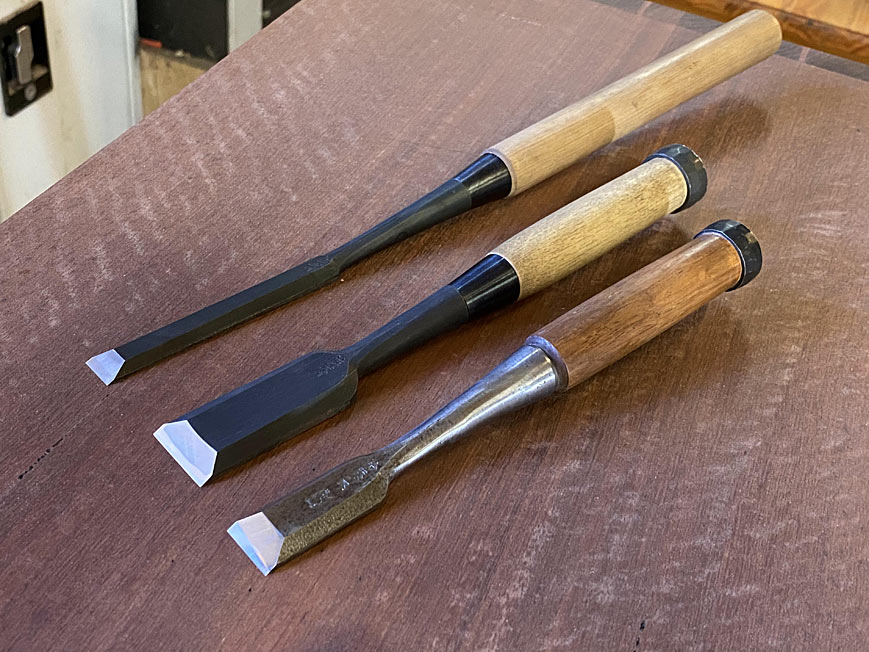
I'm thinking of putting a CBN wheel on my grinder, but I can't find any information about using one with laminated-steel Japanese blades. Does anyone here do this?

My concern is that the mild steel layer might glaze the wheel. I'm hoping that the cool-grinding that CBN wheels allow would allow me to grind my laminated chisels and plane blades closer to their edge, with less fear of removing their temper.

I'd try for something approximating a flat grind in order to avoid weakening the edge, as hollow grinds from wheels smaller than 10" are not recommended for Japanese blades

Thanks! Aaron

Re: Japanese blades and CBN wheels

#2

Re: Japanese blades and CBN wheels

Bruce McCrory

Derek Cohen uses CBN and (I think) puts his Japanese laminates to the CBN wheel. He frequents WoodCentral. He has a personal website, In the Woodshop; the guy with the fuzzy head of hair, if you google more than one shop.

Re: Japanese blades and CBN wheels

#3

Re: Japanese blades and CBN wheels

Aaron Rappaport

Thanks. Alas, I can find no discussion of grinding Japanese blades with CBN wheels on his site. I seem to recall Derek remarking once that someone had told him that if grinding laminated blade with CBN caused the wheel to load with the soft steel portion of the blade, then one could unload the wheel by grinding some hard tool steel with it. But I don't think Derek ever reported a test of that.

Perhaps he'll be along in a bit to answer.

Aaron

Re: Japanese blades and CBN wheels

#4

Re: Japanese blades and CBN wheels

Derek Cohen (in Perth, Australia)

It is possible to grind Japanese laminated blades with a CBN wheel. If the CBN wheel does load up, simply grind some hardened steel to clear the grit.

I have ground some cheaper Iyoroi Japanese chisels for a quick fix ...


The edge holds up perfectly well. There is no weakness caused by the hollow grinding.

I do not do this with any of my other Japanese laminated blades simply because I treat them in the traditional manner by honing full faces. I prefer seeing the way the hard cutting layer stands out from the soft reinforcing layer.


Regards from Perth

Derek (who does not have "fuzzy" hair :) )

Re: Japanese blades and CBN wheels

#5

CBN and Japanese

David Weaver

I've cleaned up a lot of japanese chisels on a CBN wheel (high speed, 6") and never had any ill effects other than unsightly chisel bevels.

I haven't had any wheel loading or any other issues that I've noticed (if they occur, regular use with hardened tools eliminates them).

Re: Japanese blades and CBN wheels

#6

Re: Japanese blades and CBN wheels

Bill Tindall, E.Tn.

Disclaimer: I know nothing about Japanese chisels.

However, I have hollow ground blades for many years on a 7" wheel. Some points that could be relevant to grinding a laminated blade.

Once an edge is established that is orthogonal to the chisel side don't ever loose this reference edge when grinding. Grind to near it, remove wear with 1st honing step. As a result the hollow never gets to the edge. And the flat is extended in the next step

After grinding the next step is some sort of 1st honing. This step will establish a flat bevel on the hard portion of the lamination.

A solution to your fear of heat is grinding technique. For those skeptical of grinding I do a demo. 3600 rpm grinder, 80 grit wheel, thin Stanley plane blade. Light touch on a crowned wheel; no blue metal. When refining to near the edge I am barely touching the tool to the wheel and only touching the wheel to a small portion of the tool, and always moving the tool.

Re: Japanese blades and CBN wheels

#7

Heat

David Weaver

A long OWT for japanese chisels has been absurdly low tempering temperatures and chance of ruin (in some cases, stan covington has mentioned career craftsmen in Japan who actually believe that synthetic stones lead to high end chisels that are suitable for nothing but the trash - as in, a small synthetic abrasive will permanently ruin a chisel through and through).

After the last trolling dust up here, a quick look at hitachi's tempering schedule shows White 1 starting around 325F (on the high end of hardness).

While that's below tempering colors, the idea that japanese chisels will go soft with the tiniest amount of power grinding is just factually incorrect. Perhaps there are softwoods in japan soft enough that extremely undertempered chisels will hold up, but there must be a lack of A/B testing to feed the idea that there is some advantage to overhard chisels.

As you say, same principles apply - grind short of the edge, continue on. When I refurbish new to me chisels, I will sometimes grind them off square, and then grind them to the edge or nearly to the edge when bringing the full bevel back to meet the squared edge. They may have one sharpening cycle of odd behavior (if they're really hard and the edge is fully ground off) and then it's gone.

If damage is prevented when using the chisels, then there's never a need with japanese chisels to grind again. I tempered an overhardened chisel a few weeks ago (terrible edge behavior, quite old, nobody ever fixed it) and then unicorned it and was going to post a video of the whole process, but I got so overzealous pushing the edge that the tang/handle joint couldn't handle the bashing. That's a chisel that was supposed "ruined" by tempering to 325 degrees. It was still ice hard on the stones.

Re: Japanese blades and CBN wheels

#8

A separate tip for the dippers

David Weaver

I've ground a lot of tools - unhardened and hardened. Unhardened, you just try to keep from burning your fingers or allowing slag off of the wheel to build up on the cast rest as it actually erodes the rest.

Hardened, the only chisel I've burned recently is a V11 bench chisel (just browned the tip, but since it was a chisel for the uni-test, I had to square all of that off and then do much more work than I would've had I not browned the tip).

I found it a lot more handy (vs. dipping or whatever else) reprofiling the edge a second time with a wet paper towel scrap folded over and laid on the back of the chisel. If bits of a soggy paper towel touch the grinding wheel, nothing happens. The steel back from the edge stays so cool and draws the heat from the edge out so well compared to a chisel that's heating up.

Re: Japanese blades and CBN wheels

#9

good tip for heavy profiling

Bill Tindall, E.Tn.

Good sharpening technique will preclude any risk of overheating when simply sharpening. But, when the tool needs substantial material removal the risk is there. I like the paper towel suggestion.

Re: Japanese blades and CBN wheels

#10

Re: A separate tip for the dippers

Wiley Horne

Great idea, David! Thank you.

Wiley

Re: Japanese blades and CBN wheels

#11

Re: Japanese blades and CBN wheels

Aaron Rappaport

Thanks to everyone for your informative replies! I have a lot more confidence going into the decision to get a CBN wheel now.

Best, Aaron

👍 This page answered my questions

Your vote helps other woodworkers quickly find the answers and techniques that actually work in the shop.