Home Articles Forums Gallery Marketplace Videos

WoodCentral Forums

Knowledge You Can Build On — Est. 1998

A question about all the sharpened edge pictures

Posts

A question about all the sharpened edge pictures

#1

A question about all the sharpened edge pictures

Bill Tindall, E.Tn.

They have been interesting but what to conclude?

1. Is there a conclusion from this effort?

2. Would all the edges look the same after planing 50 feet of cherry, and hence for the Practical Planer removing wood to get a fit, there is no significant difference between them?

Re: A question about all the sharpened edge pictures

#2

Re: A question about all the sharpened edge pictur

David Weaver

The fine edges would wear more evenly for the first several hundred feet.

Not sure at what point it becomes material, but 1 micron diamond edge life is about 15-20% better than fine Oilstone.

Re: A question about all the sharpened edge pictures

#3

Re: Lots…

Steve Voigt

Hmm, I thought there were a LOT of interesting takeaways from the pics. I'll list what I thought and Dave or anyone can disagree if they like.

1. Most modern finishing stones are within a fairly narrow band. That is, here wasn't some huge advantage for a particular medium.

2. Fine Arkansas stones do very well. There's a persistent claim that even the finest oilstones are a much lower "grit" than fine waterstones (as if grit actually mattered) but the pics make it clear that the end result of sharpening on a fine Arkansas is as good or better than all but a very few waterstones.

3. Precursors to Arkansas stones don't fare so well. Arkansas stones do better, which makes sense because they drove most of the others from the market in the late 19th c.

4. Natural stones (both oil and water) are pressure sensitive in a way that synthetics are not. That is, using a light touch produces a noticeably finer edge. The biggest observed difference by far (in terms of heavy vs light touch) was the Washita, which seems to explain its historical popularity as a one-stop sharpening stone.

5. Abrading an oilstone does not have a significant detrimental effect on the edge. A number of people have claimed that abrading a stone results in an edge comparable a much coarser stone (e.g. abrading a trans ark gives an edge comparable to a soft ark). The photographic evidence presents a strong counter to this claim, and shows that abrading results in a scratch pattern that is perhaps a tiny bit coarser overall, but is also more uniform.

6. With applied compounds, the backer is as important as the media. A coarse compound applied to a forgiving backer will produce a much finer scratch pattern than the same media on a harder backer. Not a surprise, especially given all the buffer testing that's been going on, but it's nice to see the pictures.

7. Metal polish on softwood outperforms all other applied compounds. The only thing that looked better in the pics was pure crom ox powder on wood, but the difference was slight and the time investment with the crom ox is prohibitive.

This is obviously just my interpretation, so please fire away if y'all disagree.

Re: A question about all the sharpened edge pictures

#4

pretty much covers it...

David Weaver

...it's nice to get a look under the scope from time to time to see what's actually occurring.

One of the first things I ever used a microscope for was to look at the edge made by two japanese natural stones I'd bought. One from a retailer and another from a guy who was in maine who said he had been working as a pro for the last decade and had taken a quarter of an inch of height off of the stone that he sold me.

What he sold was a hiderayama tomae (a relatively worthless stone, especially for tools). It didn't feel very sharp. The other green stone that I bought from a retailer seemed less sharp than my synthetic stones. The microscope ratted them out. They weren't that fine cutting.

The abraded oilstone pictures let me know that I should give the washita a shot with a little bit of scuffing and see what the edge looks like. The buffer will manage any shortcomings that it might have. It feels nice when it's been abraded.

Re: A question about all the sharpened edge pictures

#5

Some notes

Warren in Lancaster, PA

3. Precursors to Arkansas stones don't fare so well.

I think this is hard to judge, for two reasons. One is that we don't always have the same natural stones that were used historically. Andre Roubo was complaining about the declining quality of Turkey stones available 250 years ago. We might be looking at stuff that was second quality in the 16th century.

The other thing is that it is hard to get the most out of a stone without considerable experience. I would not expect to get near the performance that Tim Zowada gets from a coticule. His surface with slurry is rougher than 8000 grit and his surface without slurry (same stone) is finer than 30,000 Shapton.


4. Natural stones (both oil and water) are pressure sensitive in a way that synthetics are not.

The King waterstones are pressure sensitive. They can cut faster or slower depending on touch. At one time this quality was considered important.

5. Abrading an oilstone does not have a significant detrimental effect on the edge.

I have certainly seen surfaces that were made with edges from abraded translucent stones that were not as good as what I was getting with a soft Arkansas. There are an awful lot of factors to sort out. Again, skill is a big factor.

Re: A question about all the sharpened edge pictures

#6

Re: Some notes

David Weaver

Coticules have separate rub stones. They're generally foreign material (as in, fast cutting stones that slurry easily). I doubt the base stone and the rub stone are similar, and if they are, the coticule pictured here is an unusually slow and fine one.

There are such coticules, but the bulk of them are coarser or the slow cutting ones that cut clear like the second picture (my finer stone may achieve that cleared - I have a third coticule that I haven't pictured, too) .

This is true for the older labeled stones, too, as I've had them (they do vary). One of the worst things about coticules is if one is looking for a fine one that has reasonable enough speed to be used quickly (they do exist), it may take spending $5000 or more to find one, and there's always a loss on selling.

At one point, I had one that was about 11x3 and a really nice natural combination stone that would've fared well under a microscope that was about $300 (which isn't terrible considering how good it was) for a 9.5x2.25 inch stone. Ultimately, it was excellent, and the edge had a nice quality (smooth), but it wasn't more practical than anything else I've gotten so I only kept cheaper stones.

But what's shown in tim's pictures isn't really applicable to any woodworking stones that I'm aware of - it's likely due to a slurry stone and a base stone that aren't the same stone, and much time at very low pressure. A laminated tool or carving tool with a small point of contact probably wouldn't work that well. I tried several of my coticules for tools and the particle shape just isn't that great for them. If you hear of carpenters or tradesmen using them, they're usually from somewhere near belgium.

Re: A question about all the sharpened edge pictures

#7

Re: Some notes

Warren in Lancaster, PA

Tim gets similar results from the Chinese 12k. Both of these have been sold by Woodcraft and I have tried them both.

But you missed my point, which was that getting the most out of a stone takes skill. Especially for these natural stones that have complex properties. I would not want to dismiss a historic stone without some years of daily work. Plenty of people have dismissed the Arkansas stones with little experience under their belt.

Re: A question about all the sharpened edge pictures

#8

The experience factor

Bill Tindall, E.Tn.

Is the claim that it takes experience (weeks, months, years?) to use these natural stones consistent with the division of labor in a shop using hand tools?

During my days with Alan Batty he said that the apprentices did the sharpening. It was their first job to master. I think I recall being told the same at Colonial Williamsburg. If indeed sharpening was an early skill for apprentices to learn, and the rest of the shop was dependent on the result, good enough sharpening would seem to be easy to learn. Apprentices didn't land jobs because they scored 800 on the woodworking SAT.

My pedestrian planing is readily supported by pedestrian sharpening, so I don't have a horse in this race. Just curious what the situation was.

If one needs to clean the saw marks off the top of a drawer side and the plane reliably does the task (today's agenda making drawer parts) it is difficult for me to see how the result could be made better through more experienced sharpening. Difficult for me to see does not mean I am deny the possibility. You all work in a different plane, somewhere high above my good enough.

Re: A question about all the sharpened edge pictures

#9

Thanks

Bill Tindall, E.Tn.

I could not have gleaned those insights from that mountain of work.

The pressure situation on the ARK stone and the picture strongly suggests that this stone moves metal was well as removes metal.

I have had my nose in a geochemistry book of late. The chapter on the deposition of silica that was biogenic revealed that the gross geology of the ARK deposits is common world wide. The rock is smushed shells/skeletons of organisms that extracted silica from the sea. It seems remarkable that ARK is the only world location where the details resulted in a superior sharpening stone.

Re: A question about all the sharpened edge pictures

#10

Re: Some notes

David Weaver

I get that part, the skill part. It's really more a matter of experimentation that I'd like to think of it as.

I got lost in the part where we started looking at coticules with slurry stones when we're talking about woodworking.

I've had about half a dozen or maybe a little more of those chinese stones, too. The first one that I got was the best (some of them are a little harder and have what look like stretch marks on them). Maybe half of them self slurried, which wasn't very good, but the stones that do self slurry make for good slurry stones.

I still have at least two of them and at least one is a good one. I'll add one of them to the stone listing below if I don't forget.

Re: A question about all the sharpened edge pictures

#11

Re: The experience factor

Warren in Lancaster, PA

In my shop I like to sharpen all the tools for a beginner at least until he can notice when a tool is getting dull. I think working with a dull tool forms bad habits. Even when a guy knows how to sharpen, it seems you sometimes have to tell him it is time to sharpen.

There is no way I would want a beginner sharpening tools for my use. Facility with the tool is dependent on the quality of the edge. There is no way a Williamsburg carver is going to let a beginner sharpen his tools. I don't think you have been there many times.

In the 18th century I can imagine that anyone taking on the responsibility of having an apprentice would want the brightest kid available. The less time you have to spend training the kid and the faster he gets going the better it is for the master. I have had guys with 800 on the SAT in my shop; yes they are easier to train. It is nice when they can follow the logic of what you tell them.

Re: A question about all the sharpened edge pictures

#12

What the curators say vs. what they do

David Weaver

Williamsburg has curators. The curators sometimes give discussion about the areas (or maybe a lot? I haven't been there in a long time).

If the shop does one thing and the curator says another in a presentation, there will be two different answers.

I have trouble believing that an apprentice wouldn't get really good at sharpening really quickly under the criticism and guidance of a shop master using the tools. There is no similar situation now (who is really doing that much day in and day out work with hand tools and can afford an apprentice who is career minded?), and it sounds like the various schools around have teachers sharpening or keeping up shared tools. One of the comments on my videos (or somewhere else - I can't keep them straight now) was the time savings for the chisel sharpening method if the tools can be refreshed that quickly and hold up well.

We have to be realistic about the various "woodworking classes", they're vacation destinations. The point of the classes is to sell classes, not to make gainfully employed woodworkers. If a student can't handle sharpening, the person operating the class can either tell them it's not for them, or perhaps sell 8 more $750+ week long classes to that person in the future. Or dumb down the sharpening methods (and all methods) so that they yield instant success but become too cumbersome to really do more than once or twice.

All of the strong makers that I've ever seen have a desire to get the sense for themselves, but if they'd have worked with a good shop master, they are all smart enough that they could've been taught sharpening very quickly.

I think we have to be careful about one man shops and what they would've meant for apprentices where shops were basically small production. The economic drive would've been different and the shop master would've needed to cede some of the work (including dimensioning precisely and sharpening some or all of the tools) to someone else. We have a current climate of some specialists - I'd bet George wouldn't find a lot of beginners' edges suitable, but if he had a shop with 8 workers in it and a work volume that demanded everyone stay subscribed, then getting the workers to sharpen tools appropriately would suddenly make a lot more sense and if they could do it as well as the master (which shouldn't take that long - couple of months across the board for all of the tools in the shop?), there wouldn't be a great reason for the shop master to do it.

Re: A question about all the sharpened edge pictures

#13

Re: What the curators say vs. what they do

Warren in Lancaster, PA

It sounds like you haven't been to Williamsburg very much either.

Re: A question about all the sharpened edge pictures

#14

I've been there four times...

David Weaver

..as a kid. I don't know who leads the discussions with presentations.

Perhaps instead of telling people what they don't know and sitting on it, you could actually tell us what you're trying to communicate. That seems to be a long-running theme.

"It looks like you don't know much about this"

"It's subtle"

These things aren't really that hard to communicate, and if I really wanted to know what they do at CW, I guess I could call George. Though I recall the last time he mentioned they used lower carbon steel than something like 1095, and the blacksmiths at least for a while delivered irons with edges that were far from prepared (because they thought it was historically accurate), you said he might be confused. I found that to in poor taste.

https://sawmillcreek.org/showthread.php?272154-There-s-nothing-wrong-with-A2&p=3044094#post3044094

George seems to have recounted the same thing recently (I thought it may have been 1075 that he mentioned, but here it is again just this past month - 1080. I recall the original discussion being that the blacksmiths had trouble with the lamination process with higher carbon steel).

I have never known if this gimmick of telling people they don't know something and then refusing to describe what you're talking about is on purpose, but the posts of later injurious recounts because people don't take your advice have a whole lot to do with it.

As does skating past information that doesn't agree with what you prefer - I noticed that when the outcome of the slurried fine arkansas stone showed something different than what you claimed, the subject switched to coticules with slurry stones. Mysteriously. I didn't expect the same outcome with a slurried finish stone, but it isn't something i'll dance past when the topic comes up again.

Re: A question about all the sharpened edge pictures

#15

clarfication

Bill Tindall, E.Tn.

What I thought I was told was that in furniture making shops of some centuries ago the sharpening was an apprentice job. I do not recall learning anything about how Colonial Williamsburg operated. And I may not be remember correctly.

I have been there one time and with no interest in returning. I was annoyed by the reenactors more interested in playing their roles than engaging in informative discussions. For example, in the rifle shop they were investigating forge welding of rifle barrels. I inquired about forge welding and was treated to a superficial answer, typical of everywhere I want. Later I was at the Dollywood fall festival where there was a smith plying his trade. I asked him about forge welding . He took up two pieces of metal and proceeded to forge weld them, explaining in detail what he was doing and what he was looking for.

Re: A question about all the sharpened edge pictures

#16

Re: The experience factor

Steve Voigt

If one needs to clean the saw marks off the top of a drawer side and the plane reliably does the task (today's agenda making drawer parts) it is difficult for me to see how the result could be made better through more experienced sharpening.

Not a criticism here, just an observation.

A lot of the testing and discussion with sharpening has focused on two situations: chopping, in a way that mimics dovetailing, and planing with a smooth or try plane (Dave's tests). But there are so many other situations to think about. For example, if I'm cross-grain chiseling the four end chamfers on a plane, I want maximum sharpness, and also minimum resistance, because that means more control which is important when freehanding critical surfaces. Durability is not a concern because I'm going to resharpen every 4 chamfers whether I need to or not, because there's no point in taking chances with an almost-complete object that going to cost four or five hundred bucks.

The point is, everyone reading this forum has there own ways of working, and priorities. Ultimate sharpness is not needed in some situations, but in others it is. Highly customized sharpening angles for different situations may be necessary for some and not for others. The virtue of the mass of sharpening pics Dave posted (and the unicorn pics that Winston and Dave posted) is that we can all usr them as a reservoir, and take what we need. There's not a one size fits all solution.

One thing I'll agree with you on, Bill, is that "experience" by itself is not the key. I've been sharpening for twenty five years, and sheer repetition beyond a certain point doesn't matter. What matters is experimentation, with both techniques and materials. And there again the pics can help by suggesting a hypothesis that serves as a starting point.

Re: A question about all the sharpened edge pictures

#17

Re: clarfication

Steve Voigt

I have been there one time and with no interest in returning. I was annoyed by the reenactors more interested in playing their roles than engaging in informative discussions.

Can't comment on the other trades, but Bill Pavlak and crew at the Hay shop will definitely go into as much detail as you want, especially if they know you're a woodworker. They are the real deal.

Re: A question about all the sharpened edge pictures

#18

Brand New and Baroque Already

David Weaver

I only went there as a child. I don't know anyone who currently works at the museum, and I would've been too shy to ask a question (and I'm also not the type of person who wants to know a little of something so I may not ask much for questions in most places now, either).

George mentioned several times that his objective was to get out of the working public after about a decade and a half, that he more or less worked on the end of his bench so that people could see what he was doing (and he's left handed, I don't know if his bench was handed the right way).

When you look at a page like this:

http://www.cybozone.com/fg/wilson1.html#wilson6

you can see the type of work that George was doing entirely by hand in front of people. I don't know if the lute rose at the top is something that he carved in front of people, but he told me (and it says there) that someone stuck their finger through it just to test it. He also told me (which he posted on the blue forum, too) that some of the work he could identify as his because nobody else there could do it.

That creates a dynamic for the demonstrator trying to do good work - identifying the serious question (visitors almost ought to get badges "i am a serious question visitor and not someone bringing my kids here because I want them to have an educational vacation - something my parents did") folks, vs. people who are just making conversation, and the occasional visitor who wants to tell you that they could do everything you're doing in front of them, that only the huge amount of tools that you have makes you do better work than they can.

I may be a bit more plain and direct in person (as in I would say "I'm looking for substance, more than that, like ___)", but that may turn off a demonstrator - that would be their problem and not mine. I'd bet 90% of the museum visitors remember charismatic presenters more than they do skilled craftsmen. In my photo albums that my mom left me the last time she was here, there's one or two pictures of actors and a zillion pictures of the shops. Some guy is in the instrument shop standing in front of hanging instruments, but it's not george even though george was still there - it was a not larry, not marcus, not george journeyman.

What I know about George is that he will say "I think you don't know what you are talking about here" or "i think that's not correct", and he will instantly tell you whatever it is you want to know about. It's never a mystery - when you tap out what he knows about a subject, then he'll say that. Compared to some of the things I read on the forums, it's refreshing.

One last line - George told me a story (i may butcher the details) about being in the instrument shop and finishing an instrument and then saying to someone "it's brand new and baroque already", knowing full well that people would've had a sense of humor several hundred years ago, but what I recall from that was that they voiced a preference that he didn't joke like that lest it make the tradesmen look like simpletons.

I won't say why the curators sometimes say things that are different than what the craftsmen do or think, despite that being criticized. I'm no closer 6 hours later to having a clue how that was a relevant response to the statement.

Re: A question about all the sharpened edge pictures

#19

Re: clarfication

David Weaver

I think my comment was inferred to be something else (not by you, Steve), as if it's just a free for all at Williamsburg and the curators and tradesmen just tell different stories.

What I meant by it is that the trades and curators, etc, likely are in agreement in general. When the small details are sussed out and someone isn't just an employee of CW, but is also interested in historical precedent, it's inevitable that there would be some disagreement with what the curators say.

When I went to CW as a child, unless a blacksmith was making nails or one of the typical things they did at the time just so people could see something get completed, they were standing at the front of their areas just talking.

The gun, instrument and cabinet work was stellar. What I don't know about it is whether or not everyone who worked there as a shop master was as bonkers about knowing everything as George was. I'm not going to try to entrap george into saying things that he's read or learned that were different than what the curators said, and at the same time, as a public visitor (unless things have changed a whole lot), we heard from and saw the people in the shop.

Not intending to say anything about the level of work there - it's stellar - better than can be done economically in most places because the work being done isn't dependent on economic viability, and unless the "gates to the zoo are closed so the animals can be animals for a while", there probably isn't a lot of time to just stand in the shop and work without interruption.

Re: A question about all the sharpened edge pictures

#20

Re: The experience factor

Sgian Dubh

I think it's time to haul out this hoary old chestnut again Bill, because these sharpening threads can get a bit too serious ... and lacking any fun.

****************************************************

A Lesson in Sharpening.

A perennial subject in woodworking magazines and forums is that of sharpening techniques. No other furniture making topic seems to generate so much tedious verbose nit-picking and circular bickering in woodworking forums, along with the publication of innumerable 'sure fire' and 'infallible' methods in blogs, video demonstrations on YouTube, and articles in magazines. For some reason most of these espoused methods for getting a sharp edge on a tool seem to take an inordinate amount of time, and require a large array of bits and bobs to do the job-- I sometimes wonder if the process of sharpening is the main objective of the exercise for the people that describe them, rather than the means to working wood effectively.
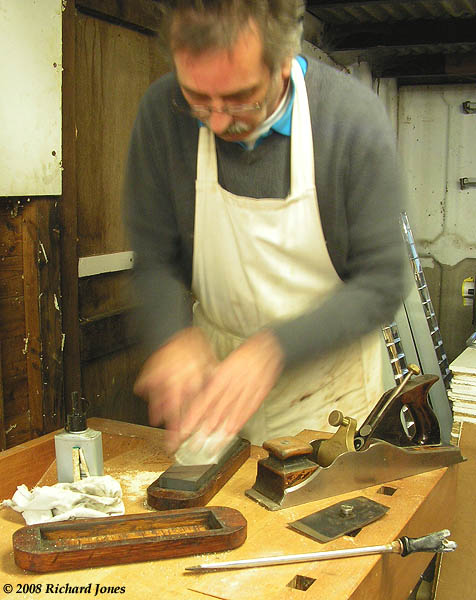

Naturally, the subject is of interest because blunt tools aren't much use. The opening preamble to many of these articles often cause a wry smile for they bring back memories of my initiation into the 'dark' art. Many authors make points about those that struggle at it, and possess a workshop full of dull tools. Conversely, it is sometimes said that those that can do the job tend to be fanatical about grits, slurries and bevel angles.


My experience is that there are really only two types of people when it comes to sharpening:

* Those that can’t.

* Those that can.

In the first group, those that can't, you'll sometimes see every sharpening system known to man arrayed around their workshop gathering dust. They have fancy grinders, oilstones, water stones, ceramic stones, diamond stones, guides, pieces of sandpaper, jigs, etc. Sometimes just about every hand tool they own is chipped, dull and mostly useless.

In the second group, those that can, I haven’t observed much fanaticism about slurries, grits and bevel angles. In all the workshops I’ve worked in the only concern is to get the job done. It’s a case of, "Plane’s blunt, better sharpen it." Dig out the stone, sharpen the blade, shove it back in the plane, and use it. The equipment is minimal. A grinder, a stone of some sort and lubricant along with a few slips for gouges and the like, and perhaps a bit of oiled leather charged with a bit of fine powdered abrasive for some final stropping.

Going back to the early seventies when I trained, learning how to sharpen tools was undertaken within the first few days. I don’t now recall precisely the order of my instruction, but it went something like this. I was handed a plane by the cabinetmaker I was assigned to and told to "Get that piece o’ wood square." I didn’t know why, but I’d done a bit of woodworking at school, so I had a vague idea what to do. I fooled around with that lump of wood for twenty or so minutes, and got it something like. All this under the watchful eye of the crusty old guy and his ever present roll-up hanging out of the corner of his mouth.

"Okay, I’ve done that." I said, "Now what do you want me to do?"

I was told to hang about for a minute whilst he picked up his square and straight edge and proceeded to scrutinise my handiwork, which was followed by a non-committal grunt and some desultory foot sweeping of the plentiful shavings on the floor; the wood was probably only about ninety or so per cent of its original volume.

"Now sonny, let’s do the next job," he announced. "Pull that jack plane ye’ve bin usin’ apairt and let’s have a look at the iron." I did.

"Hold the iron up so’s ye can see the cuttin' edge," he instructed-- he was a Scot. Again I did as I was told.

"Now, can ye see it? Can ye see the ‘line-o’- light’ at the shairp end there?" he wheezed, as he tapped a line of ash onto the floor and stood on it. He was referring to the shiny reflection visible when cutting edges are dull.

"Aye," I said, after a little eye squinting, and other pretence of intelligence.

"How shairp does it look to you boy?" he enquired.

I thought about this for a moment or two, seeking the right response to my tormentor, for I hadn't really got a clue what he was talking about, and finally replied rather hopefully and a bit brightly, "Pretty shairp, I’d say."

He laughed out loud, and hacked a bit. "Dinnae be the daft bloody laddie wi’ me son. If ye can see it, it’s blunt. I could ride that bloody iron ye're holdin’ bare-ersed to London and back and no cut ma’sel’. Get o’er here an’ I’ll show ye something."

You can probably guess. Out came the oilstone from his toolbox and quick as a flash the iron was whisking up and down the stone, flipped over, the wire edge removed, and finally it was stropped backwards and forwards on the calloused palm of his hand. You could shave with it. I know, because he demonstrated how sharp it was by slicing a few hairs off his forearm. On went the cap iron and the assembly was dropped back in the plane. This was followed by a bit of squinting along the sole from the front whilst the lever and knob were fiddled with and that was it. He took a few shavings off a piece of wood and it went back in his toolbox. It took, oh … a few minutes.

"Now son, that’s a shairp plane. It’s nae bloody use to me blunt. Ye may as well sling a soddin’ blunt yin in the bucket fer all the use it is to me," he explained with great refinement. "I’ve aboot ten mair o’ them in that box, an’ they’re all blunt. Ah’ve bin savin ‘em for ye. There’s a bunch a chisels too. Let’s get ye started."

For what felt like forever I sharpened his tools for the one and only time he allowed me to under his rheumy eyed and critical stare, and things gradually got better. After a while he stopped telling me what a "completely daft stupit wee bastit " I was, and a bit later he started offering grudging approval. I had to sharpen some tools more than once because he kept on using and dulling them. When I’d done the lot we stopped and surveyed the day's work.

"Aye, nae too bad fer a daft laddie's fust effort," he commented darkly, sucking hard on his smoke, "I think ye’ve goat whit it takes. Time’ll tell sonnie. Remember, ye’ll never be a bloody cabinetmaker if ye cannae even shairpen yer f*ckin’ tools. Lesson over. Dinnae ferget it."

I haven't.

Re: A question about all the sharpened edge pictures

#21

I'm sort of in the cants?

David Weaver

I've read that from your page before.

I'm in the cants, sans much for honing guides, sandpaper, jigs or chipped edges.

The buffed tools have a little bright stripe on them, but i'm not troubling you saying that - I know what he means about being able to see the wear on an edge.

Once in a while, I get a stone or two that just isn't very good and think "why am I wasting my time with this crap?". Then I find another one that's just sensory bliss and the jones (not richard), the other one is satisfied and justified.

Re: A question about all the sharpened edge pictures

#22

Re: I'm sort of in the cants?

Sgian Dubh

David, I can't really see you being a member of the 'cants' as you put it. From what I've seen and read, you do seem to have a bit of a thing for sharpening, and a bunch of sharpening gear, but your experimenting with all sorts of stones, charged leather, honing compounds, buffers, and the like does result in usable sharp edges. That's unlike many of the 'those that can't' group in the partially apocryphal story I posted - I was truly aware that quite a few in that group really seemed unable to get a decent sharp edge.

Your recent buffing thing (unicorning [yeuch name]) is certainly interesting to me. I've experimented with it a bit, although I've not had much chance, not enough playing around with anyway to come to a conclusion. Slainte.

Re: A question about all the sharpened edge pictures

#23

The name is supposed to be yucky!!

David Weaver

that makes people remember it. And not as my last name.

:)

you can tell people things that they really really like -they might remember them. Or you can tell them things they are really annoyed by, and they'll easily remember them.

I despise the name "Scary sharp". Scary fiddly. Scary fragile. Scary tedious.

I remember it, though. I don't know anyone who has had a serious injury with a sharp knife, but I know two people who have had surgery because they stabbed some part of their hands trying to cut something (that they shouldn't have been cutting) with a dull knife.