Home Articles Forums Gallery Marketplace Videos

WoodCentral Forums

Knowledge You Can Build On — Est. 1998

A note to anyone exploring Unicorn Profiles

Posts

A note to anyone exploring Unicorn Profiles

#1

A note to anyone exploring Unicorn Profiles

Bill Tindall, E.Tn.

A robust conversation is occurring by emails among people contributing to exploring how to best take advantage of this discovery. If you are exploring the variables that are involved in creating the Unicorn Profile and generating results you may want to be part of these conversations. You can begin by posting some results of your work here on the Hand Tool Forum.

Re: A note to anyone exploring Unicorn Profiles

#2

A little more ...

Derek Cohen (in Perth, Australia)

There has been a great deal of interesting photography of buffed edges to date. I don't have the microscope to add to this, and so I will just take what has already been presented that provides evidence of enduring edges. Edges which last longer are lovely, but ...

... I want the edges also to be sharp and take the type of shavings that are evidence of a working tool, not just a long-lasting, but dull-ish edge. Rounded edges increase the cutting angles from 20/25 degrees to 40-ish degrees? I mean, chisels are not expected to act like BU planes, are they? Or the scraping chisel of Bill Carter?

Then I sharpened a chisel. Not just any chisel, but a Marples Boxwood with a 20 degree bevel. Actually, 5 of them. I wasn't in my right mind when I hollow ground them to 20 degrees - thinking that I could do with a few chisels with low cutting angles for dovetails - especially when they struggled to hold an edge at 25 degrees!

And the new buffed edge? Well, it took amazing shavings. Amazing! And it did not stop taking these amazing shavings .... which is a miracle, since the blades of these chisels are made of cheese.

They looked like this .. unfortunately not the Marples, but a Stanley #60 chisel (we all have a few of these for opening paint cans). The wood is Tasmanian Oak (similar to White Oak) ...


Sharpening system? Nothing much. I had a much used 6" stitched mop soaked in Lee Valley green compound. This was chucked into my lathe ...


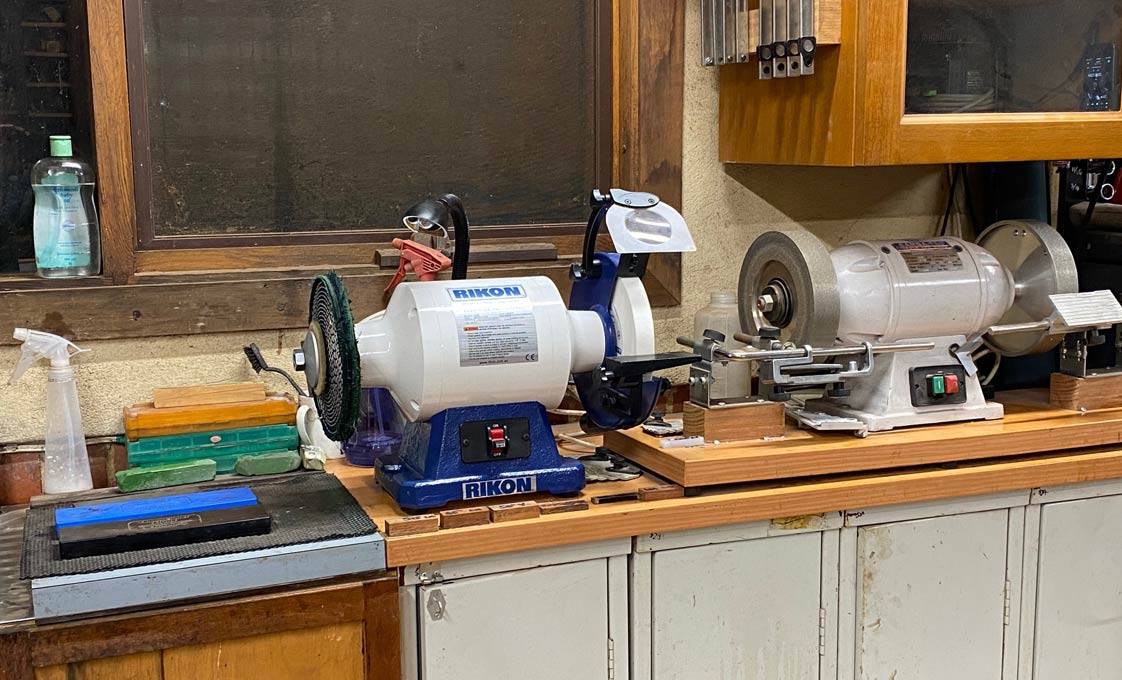
The wheel was spun at 1450 rpm, which is the speed of a half-speed bench grinder in Australia. I use an 8" half speed bench grinder to hollow grind blades, so it made sense to use the same speed.

The bevel was presented to the spinning mop and angled about 10 degrees (please note, if you are reading about this method for the first time, that the mop is spinning away from the edge).
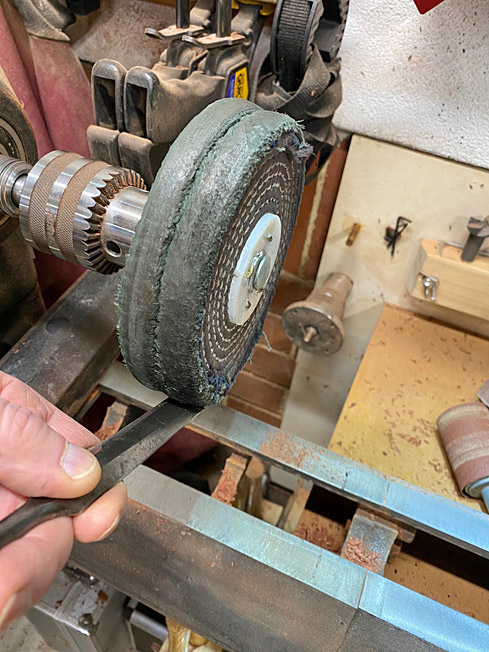

This resulted in a fine wire, and rather than buffing this off on the mop as David has done, I wiped the back of the blade on a section of hardwood with green compound.

Having satisfied my self several times over that this method worked, and that it looked a Good Thing, I decided to purchase another grinder rather rely on the lathe .


I got to thinking about trying this out on plane blades. In fact, I did so, and realised that it may not be a good idea. All the bench plane blades I have are cambered. Planing with a buffed cambered blade created shavings that were stringy, indicating an uneven edge. You can get away with this in a chisel, but not a plane blade. I shall try again, but that is my initial observation.

I also tried this with block plane blades. Now this was different: 25 degree straight bevel, just like a chisel. But would it cut differently, especially on end grain where low cutting angles are expected to rule?

A LN blade was hollow ground at 25 degrees, and then went through a typical process of extra fine diamond stone/Medium and Ultra Fine Spyderco ceramic stones, and a final polish on green compound-on-hard wood. At least the green compound would be the unifying medium.


The surface/shaving on Jacaranda (the softest wood to hand) looked like this ...


The buffed edge looked like this ...
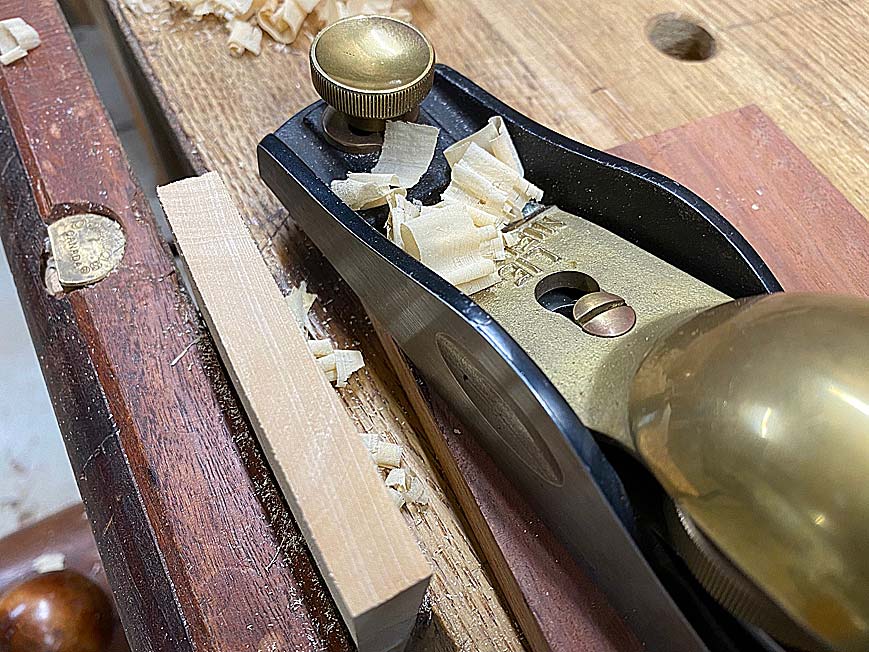

The buffed edge felt sharper and left a cleaner surface.

This was repeated on Jarrah end grain. First the honed blade ...


.. and the buffed edge ...
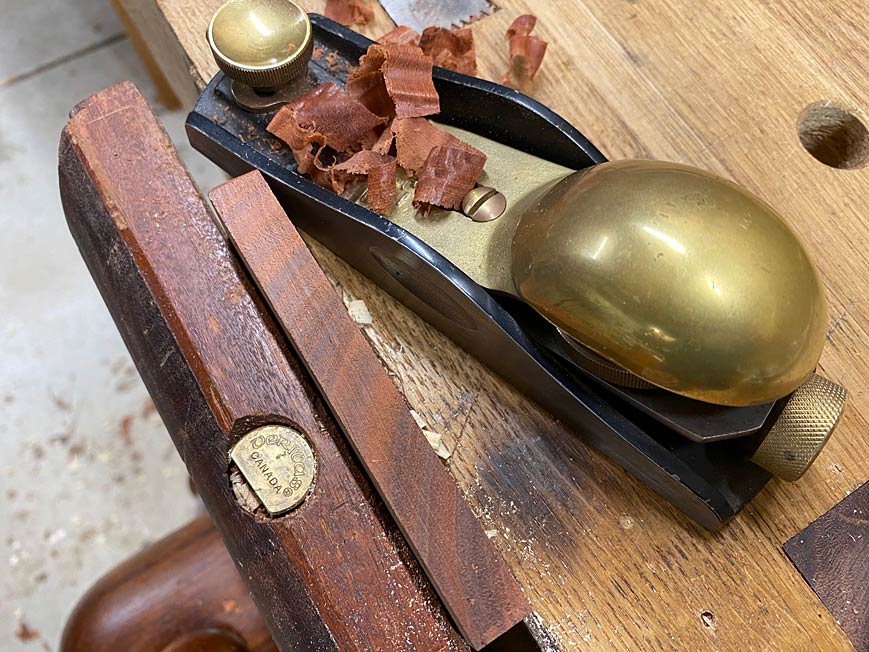

Nothing in the two? If so, that is a win.

Regards from Perth

Derek

Re: A note to anyone exploring Unicorn Profiles

#3

Informative report...

Bill Tindall, E.Tn.

But then your reports are always informative. But the compliment bears repeating.

When discovering what seems to work for one set of conditions what is needed to confirm is to explore over what range of conditions the discovery works. To this end you have added to the useful knowledge.

While David reported he was successful profiling a chisel at 20 degrees that angle is so extreme from my comfort zone that I have not tried it. Your data moved my needed beyond 25 degrees.

Good to hear green stuff works. Everyone has green stuff.

Great you explored the block plane. I need to buff mine.

I had not thought of buffing the side of a scraper to polish the edge. Would be faster than what I have done in the past.

Try it on your tomato knife. Success. Cut some cherry tomatoes for salad last night. Wasn't going well. Buffed....effortless slicing.

Re: A note to anyone exploring Unicorn Profiles

#4

Re: A little more ...

Warren in Lancaster, PA

That is more like it, Derek. Looks good.

When you did your chisel tests years ago, I was really astonished that the Stanley did so poorly. I don't even like Stanley chisels, but I just could not help thinking something was very wrong. My memory is that you did three cuts and the chisel was done.

Re: A note to anyone exploring Unicorn Profiles

#5

Re: A little more ...

Winston

Derek, I'm glad that you tried it out and had good success with the chisels and planes! Sometimes when I write about the good results I've been getting, I start to think maybe I'm crazy or have mixed things up somehow. So it's good to get confirmation.

A few thoughts about your experiences:

It's possible that what seemed like a burr on the back of the blade was actually largely buffing compound. That's what I found when I looked at the back of a buffed blade under the scope. Of course, stropping off the back on a piece of wood won't do any harm even if that's what's happening in your case.

This is the back of the blade with compound:


Regarding the uneven edge you got for the plane blade, what kind of stone are you using before buffing?

I found that if I go directly from the 1000 grit diamond plate to the buffer, or even sometimes from Shapton 1000 to the buffer, I sometimes get a wavy (but smooth) edge, and I think it's due to the large burr that was left from the stones. The buffing removes the burr, but leaves behind some of the uneven shape of the burr. This is an example of a wavy edge:


As you said, that probably doesn't matter for chisels, but it does for planes. I found that if I went to a finer grit first, I was better able to get a straight edge. I suspect that the kind of buffing wheel and compound can make a difference here, but I'm not sure. (My guess is that a stiffer wheel and more abrasive compound will do a better job straightening out an edge than a soft wheel and fine compound.)

I've been wondering how a buffed edge will behave in a bevel-up plane. For example, if the blade has a 30 degree bevel, but then a tiny 45 degree microbevel only in the .001" or .002" right at the edge, does it leave a surface like a blade with a full-size 45-degree bevel, or a 30-degree bevel, or something in between? That's something that still has to be looked at.

Re: A note to anyone exploring Unicorn Profiles

#6

Re: A little more ...

David Weaver

Those wheels are loaded and compact, I wouldn't have done the wire edge removal on the edges, either. The edges of mine are like puff.

One of the challenges of this will be communicating details like that.

Re: A note to anyone exploring Unicorn Profiles

#7

Re: A little more - restoring buffing wheels...

John Aniano in central NJ

David,

What method/technique would you recommend to Derek (and others) in order to "uncake" his "loaded and compacted" buffing wheels and return them to a clean and "puff" state? The usual toothed rake/old hacksaw blade method or something else?

John

Re: A note to anyone exploring Unicorn Profiles

#8

I'd recommend buying a new wheel...

David Weaver

..I've seen the wheel rakes and other toothing methods that are used to remove compound from industrial wheels and when buffing musical instruments, etc, but I've found pretty good wheels of various types for about $7. It's easier to start with a fresh wheel, and there may be a use for the caked wheel.

For example, I tossed a felt wheel aside years ago after having trouble with it heating and damaging edges, but just realized that on pocket knives, it's a pretty good step on a knife before a light buffing on an edge. it has enough influence to do some honing and it's stiff enough that it doesn't round much of anything.

I'm thinking the caked wheel would excel at that.

Re: A note to anyone exploring Unicorn Profiles

#9

A note to anyone exploring Unicorn Profiles

Tom Colligan

In the past 18 months I decided to make the bevels on all chisels and plane irons 30 degrees.

Does this rule out buffing their edges as you're doing from your 20 or 23 degree bevels? Thx.,

Re: A note to anyone exploring Unicorn Profiles

#10

Re: A note to anyone exploring Unicorn Profiles

David Weaver

You can buff them lightly close to the bevel angle.

Re: A note to anyone exploring Unicorn Profiles

#11

Re: A note to anyone exploring Unicorn Profiles

Wiley Horne

I’m having good luck presenting the chisel at an eyeball 10 degrees to the bevel. I seem to recall this is what Derek did too.

Tom, bear in mind, buffing a few seconds at 10 degrees, say, does not translate into increasing the cutting angle by 10 degrees. This is not grinding. The actual cutting angle increase will be less than that—last couple of times I did a 10-degree presentation, the cutting angle increased by 3 degrees or less. See my post above in response to John Aniano for a photo of results.

Wiley

Re: A note to anyone exploring Unicorn Profiles

#12

This is a disturbing question

Bill Tindall, E.Tn.

In the past 18 months I decided to make the bevels on all chisels and plane irons 30 degrees.

Does this rule out buffing their edges as you're doing from your 20 or 23 degree bevels?

Why disturbing? Because it says we have not made clear how simple this procedure can be. It can be made complicated with nuances, but it doesn't have to be if the goal is simply improving the durability of an edge. To my knowledge nobody that has tried buffing has failed to improve an edge.

To repeat what I have said before.

Step 1 Sharpen as you always have

Step 2 Stick the chisel into a moderately hard, charged wheel so that the wheel deforms around the tip for a few seconds. (that would be under the wheel when rotating toward you so the force of the wheel pushes the tool away from the wheel and not into it) where it would catch and you would have to retrieve the chisel from some body part)