I'm using Sycamore with Poplar as the secondary wood.
The sides show, so I'm using something odd out of my stash.
It is bright, almost lemon colored. It's dense, but not particularly hard.
It Rip cuts beautifully but is difficult to Cross cut.
It is friable. It takes a beautiful finish off the plane but chiseling (particularly crossgrain) leads to splintering. The shavings turn tightly, against the grain and form a "corkscrew" with the grain. It is neither waxy, nor oily.
It smells distinctly like tobacco, while sawing.
Any ideas what it might be? I got it nearly 10 years ago, with lots of unmarked "orphan" shorts that Old Timers couldn't bear to burn.
Note that Anigre has a faint odor of cedar, while Yellowheart has a mild, unpleasant odor.
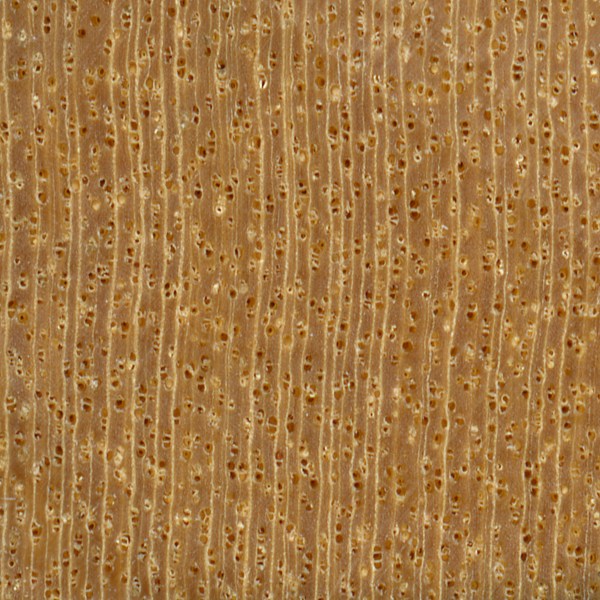
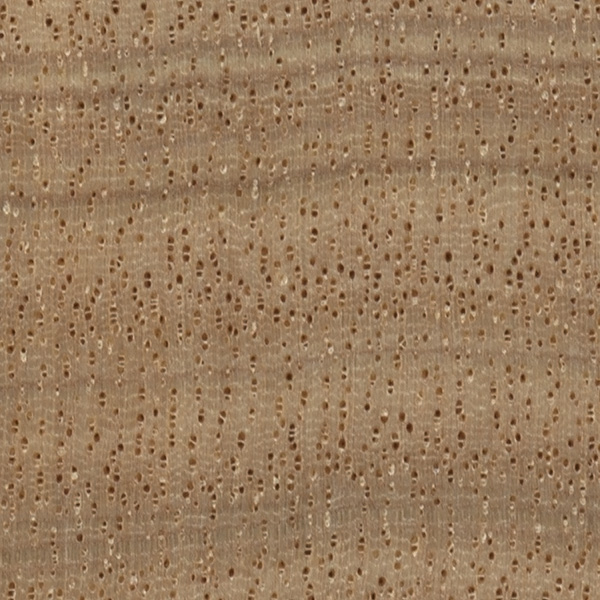
Does you stash include other tropical hardwoods, or just Appalachian hardwoods? For a positive identification, a much clearer picture of the end grain would be needed. That would require the end grain to be sliced very cleanly with a very sharp chisel and a photomicrograph of at least 10x. You can get that resolution through a microscope with a camera mount, or with an auxiliary lens attached to a cell phone.
I usually use Bruce Hoadley's "Identifying Wood" as a reference, but he doesn't provide any information on either of these species. An alternate strategy would be to take a sample end grain shaving, a sharp chisel or block plane, and a 10x loupe to your nearest Woodcraft or other hardwood dealer and compare your sample to what they have in stock.
You can buy a clip-on 50 power lens with light for your phone for less than $20 on eBay. Then you can easily take a picture of the enlarged end grain as well.
Yellowheart grows in Brazil, while Anigre is from Africa. I don't think I have samples of either one in my stash. Every so often, I kick myself for not buying a few boards of Anigre from Ellis when he was having his moving sale. I'm reminded again every time I visit Hearne Hardwoods and give his yellow lab, Annie, a rub behind the ears.
Here is the magnifier I use with my iPhone, $13.50 plus shipping from Amazon:
It has a light and batteries and a zippered case. The reticle is 3/4" square and graduated in 1/16" and 0.5 mm. To focus it, you need to put a spacer about 3/32" thick between it and the sample. These samples are bossé, Guarea cedrata, or maybe G. thompsonii, from East Africa.
These pics have nothing to do with Yellowheart. They are just to show you what you can do with a cell phone and a cheap magnifier. They were laying out on my bench and are very photogenic, have interesting, curly figure, so you can get a view of both rift sawn face grain and end grain. They also have lots of shiny stuff in the large vessels. It's silica, which is why I think it is G. cedrata instead of G. thompsonii.
Bossé from iPhone, wetted with mineral spirits:
Bossé with iPhone and 10x magnifier:
Bossé with iPhone digital zoom and 10X magnifier. I lost a bit of resolution because it isn't quite in focus. I'm going to have to work on it.
I turned on the phone's camera so I could see what I was doing on the phone screen, and set the rear lens down directly on the magnifier (on the ocular lens). Then I set the magnifier directly on the surface of the wood sample and turned on the LED lights built into the magnifier. This was a little too close, and the wood was out of focus, so I dug through my wedge stash and put two of them under the magnifier to lift the objective lens a smidgen away from the sample. (The focus knobs on a microscope would be a lot more convenient, but until my son finds me the right microscope, this will do.) After I have the spacing right to focus sharply on the surface of the sample, I will make a thin wood spacer, and drill a 1" diameter hole through the middle of it, and thin it to the the proper focus.
Later this afternoon, I'll try to get a better picture of my setup.
Now, how am I going to do that? After my morning coffee, I realized I only have one phone, so how can I take a pic of the phone with the phone?
With some further thought and another cup of coffee, it dawned on me that I could use my appropriately named ADD SLR (Canon 80D) to photograph the iPhone and magnifier in situ. I could clear off a much larger area on my bench, set up the DSLR on a tripod with extension tubes and supplemental lighting, and shoot with that, and then upload the pics from the camera to my laptop, but it would not be nearly as useful a tutorial for people who want to do wood sample photomicrographs without a huge expense and annoyance.



 SLR (Canon 80D) to photograph the iPhone and magnifier in situ. I could clear off a much larger area on my bench, set up the DSLR on a tripod with extension tubes and supplemental lighting, and shoot with that, and then upload the pics from the camera to my laptop, but it would not be nearly as useful a tutorial for people who want to do wood sample photomicrographs without a huge expense and annoyance.


