Home Articles Forums Gallery Marketplace Videos

WoodCentral Forums

Knowledge You Can Build On — Est. 1998

Half Blind question

Posts

Half Blind question

#1

Half Blind question

Bill Tindall, E.Tn.

no not those kind of half blinds........


I am making a utilitarian desk for the kitchen (AKA killing time waiting for daughter to make up her mind about the details of a coffee table) . The top rail is dovetailed into the legs with the usual half blind. Not bothering my usual routering the waste approach, I sawed and chiseled traditionally. My usual way to wasting out a half blind leaves me paring the wall waste behind the saw kerfs with the piece vertical, an operation I find trivial in this orientation.


With the more conventional approach this waste is chopped with the leg flat on the bench, not vertical in the vice. I saw at once what had escaped me before, the need to deepen the saw cuts that define the socket, either by over sawing as I see in antiques or by some variant of what Derek has showed by "chiseling". The walls are not near so nice to pare looking down on the socket.

The fact that this coarse grained ash didn't split and pare reliably made matters worse. No wonder ash is absent in Sack's compilation of "good, better and best" American Period Furniture. on to the question....


As practiced in the Headly shop rails supporting drawers are installed with half blind half dovetails. Their many favorable attributes has led me to assemble anything with drawer supporting rails this way. The process is to saw the vertical side of the socket exactly where it needs to be, saw the slope a bit proud and with the aid of a 14 degree guide block pare the slope side to just accommodate the dovetail of the rail. Fine adjustments are made by planing the flat side of the half tail if needed.

It all goes quickly after a couple of practice rounds. The socket wall paring problem encountered in conventional half blinds is replicated here. But Derek's "chisel" technique of deepening the saw kerfs won't work here because the chiseling would be cross grain. Overextending the saw kerfs is less an option on the narrow leg, than on a wider and hidden drawer divider.


Anybody got ideas for making these "stopped" saw kerfs easily. I have been using a Japanese pull saw with the end cut off so the teeth go to the end. With short pull strokes I can get some depth at the stopped end but I still have to extend the saw kerfs to the bottom of the socket by chiseling.

Re: Half Blind question

#2

Re: Half Blind question

David Weaver

saw the kerfs part of the way, remove the waste with a chisel until you're just short of the saw groove and then saw the rest of the way.

I'm not aware of any saw that will clear sawdust well that deep without being extremely coarse (like a toolbox saw with giant induction hardened teeth), and those tear up the work.

sawing half depth and then full depth once the lateral waste is removed allows the saw teeth to clear dust.

Re: Half Blind question

#3

Re: Half Blind question

Warren in Lancaster, PA

I think you can safely over cut a small amount on the inside, but in the end cutting the corners out is done with a chisel. If you remove what you can from the saw cut area you get a little guide surface to register the chisel. I think this is one of those cases where a flat, single bevel does better, because it makes a better wedge to push the waste out of the way. Also the chisel does not get stuck in the cut as readily.

If you look at better and best you will probably see more full dovetails than half tails. in this application.

Re: Half Blind question

#4

you nailed it

Bill Tindall, E.Tn.

clogging up dust in the end of the saw slows it to a stop. I shall try what you suggested. I just finished dovetailing another leg and in the course realized this limitation. I hate picking up a tool and not finishing what I picked it up for but in this case- saw, chisel, saw, chisel- may turn out to be the winner.

Re: Half Blind question

#5

But why?

Bill Tindall, E.Tn.

"If you look at better and best you will probably see more full dovetails than half tails. in this application."

If you look anywhere except in the Shenandoah Valley one sees more full dovetails. I don't know why unless cabinet makers were smitten by symmetry :)

The compelling advantage of the half tail is the ease of adjusting a tight fit. Just plane the flat side. For someone that cuts this joint only a few times a year this advantage is compelling. I have built numerous small, medium and large chests of drawers with this joint and the cases go together square to +/- 1 mm on the diagonals. It seems to have no disadvantage I have detected.

As far as "seeing", my family thinks dovetails are like underwear- not to be seen in public. These are unconventionally on the inside of the leg so it looks like a M&T from the front. I could have M&T the middle dividers but I like making this joint and I can make it quicker than a double M&T I would have used in a leg.

I have gotten over my aversion to over sawing (well not really) some and over sawing is a big help. Probably if I got over fretting about digging the waste out of the corners where the saw don't reach I would realize it not the problem I am making it.

Re: Half Blind question

#6

Re: you nailed it

David Weaver

I don't do much furniture, but you managed to hit one of the few things I've done a lot (there's a stopped cut like this in a plane, but I do make it all at once since it's OK to go slow on it).

When I cut dovetails in the top case (full length against most recommendations, and for good reason), I got so lazy that I tried different saws due to this. The black stanley tool box saws do well to cut full depth, but even cutting a 12" long socket, they're aggressive and inaccurate and I found dealing with the inaccuracy worse than the lack of speed.

At any rate, I tried several saws and found that accurate is essential, but the back and forth in partial waste removal (doesn't have to be that neat, just run a chisel right across through there with a mallet in one or a couple of passes)

Sloppy or neat, as long as the sawdust can escape, the saw works as expected.

I tried cutting every other tooth out of a cut down saw plate a few years ago when "kerfing planes" were the rage to get such a deep gullet that the teeth could clear, and that didn't work either. In that case, not many repetitions of resawing need to occur to make a kerf unnecessary (just saw to the line on both sides of a board).

Re: Half Blind question

#7

Re: But why?

Warren in Lancaster, PA

A symmetrical dovetail is marginally stronger than a half tail. If you make a half tail that is 15 degrees the corner of the tail has short grain that is somewhat vulnerable. If you make a full tail, 7.5 degrees on each side, you get the same amount of flair but have much less short grain problem. One place we do have a problem with higher angle dovetails in general is that when we take them apart for repair (like a drawer for example), the extreme corner of the tail can break off and stay glued in the socket.

Re: Half Blind question

#8

Re: Half Blind question

Derek Cohen (in Perth, Australia)

I saw at once what had escaped me before, the need to deepen the saw cuts that define the socket, either by over sawing as I see in antiques or by some variant of what Derek has showed by "chiseling". The walls are not near so nice to pare looking down on the socket.

Yep ... you got it now! :)

Anybody got ideas for making these "stopped" saw kerfs easily. I have been using a Japanese pull saw with the end cut off so the teeth go to the end. With short pull strokes I can get some depth at the stopped end but I still have to extend the saw kerfs to the bottom of the socket by chiseling.


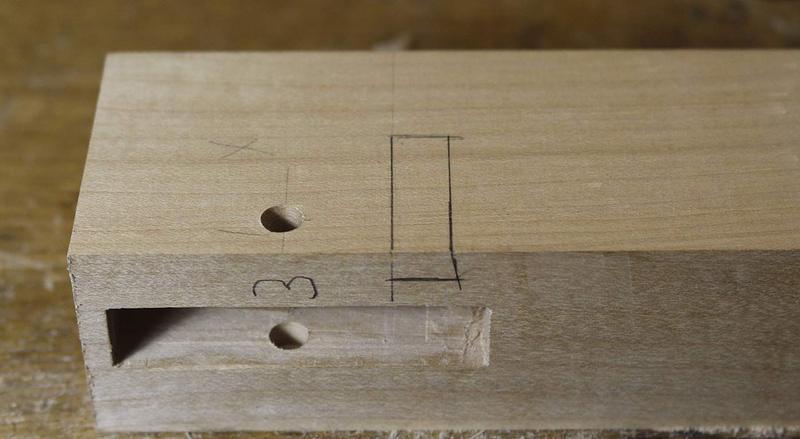
For these short sliding dovetails, I leave them parallel ...


It is easy to chop out the waste.

For longer sliding dovetails, they are tapered.

In all cases, the sides are sawn at the angle (I made a guide with one side at 1:7, which is the same as my dovetail planes). There is a relief section at the end to enable the azebiki saw to drop lower. I would do this with a Western saw as well, creating a space for sawdust to go - otherwise the kerf with clog up) ..


As this was so wide and so long, I used a power router to remove the bulk of the waste ..


Use a chisel and/or router plane to remove the side waste, and then you can fine tune, if necessary, with a side rebate plane (Stanley #79 with angled depth stop) ..


These are recently taken photos from the hall table build along I posted a short while ago ...


Regards from Perth

Derek

Re: Half Blind question

#9

Re: Half Blind question

Sgian Dubh

Posted a bit tongue-in-cheek I have to admit, and definitely not in the hand tool tradition. I've never before thought to try one for that type of sliding dovetail and similar types of joinery, but seeing your joint images and your question caused the idea to pop into my mind for some reason. I suspect a multi tool might be a bit aggressive. I have however found these Multi Tools can be remarkably accurate cutting across the grain used with care, and maybe one might have application to finish off the hard-to-reach corner after you've done the bulk of the work with a hand saw. I might even try my multi tool one day on a similar joint just to see if it's a completely daft idea ... or not, ha, ha. Slainte.


Re: Half Blind question

#10

"Great" minds thinking alike

Bill Tindall, E.Tn.

No joke.....I often lay in bed in the AM slowly awakening. These are creative times and my mind wanders. This AM I drifted to the problem at hand and up popped this same multi-tool. Where we differed is that I was not so bold as to go public. My loss. You get credit for the invention. :)

I would try it though, if I owned one.

Re: Half Blind question

#11

Oh, richard...

David Weaver

...ever the proponent of power tools :)

Re: Half Blind question

#12

question

Bill Tindall, E.Tn.

"There is a relief section at the end to enable the azebiki saw to drop lower."

I don't know what this sentence describes.

The top of that mortise looks frail. Personally, I would not risk that little end grain at a mortise top.

Re: Half Blind question

#13

Multi-tools

John in NM

They are extremely useful for building/remodeling. If you have one with adjustable speed, they might suffice for some furniture work as well.

I favor the more aggressive blades (Harbor Freight of all places was where I saw one with Japanese handsaw style teeth - very useful). In a pinch you can cut through a 2x4 with one, but they really are better for detail work. Only trouble is that the teeth snap off fairly easily, but since I use it mostly in construction that is to be expected. I buy these 20x a time on Amazon and figure they are disposable like jig saw blades.

The one I have is Rigid, because they make lots of different heads for it. Right angle drill and sheet metal shear are the two that looked useful to me (the rest duplicate proper tools I already have). I'm planning to put a new roof on a house soon, that metal shear is going to be very handy.

Re: Half Blind question

#14

Re: Oh, richard...

Sgian Dubh

David, I'm aiming for full power tool woodworking in the near future. I've made a start by dumping all my analogue measuring tools. Nowadays, I'm almost exclusively battery powered digital/laser measuring, e.g., digital tape measure, digital rules, digital calipers, laser level, etc. All the batteries have run out though, so I have a problem as we're also in lockdown. In the short term I'm having to use parts of my body, bits of string, pencils, and anything else useful I can lay my hands on.

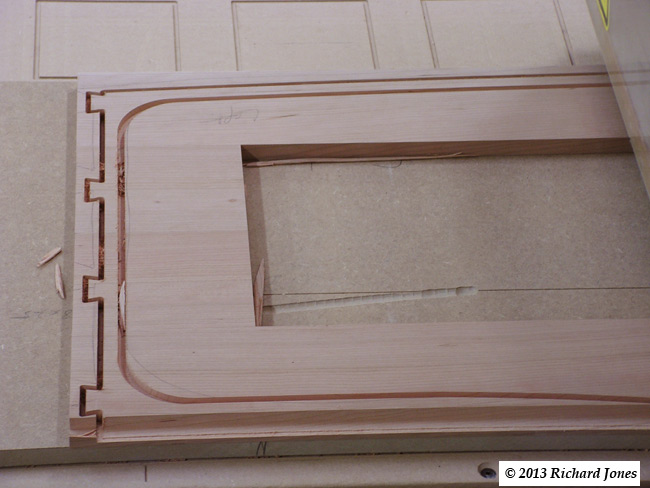
And for your delectation, CNCd dovetails, the CNCd groove for a tambour, panel cut to length and width too, and the rebate for the back panel in the bottom of a cabinet, also hacked out on the CNC machine - just thought you might get a bit of a kick out of it, ha, ha. Slainte.


Re: Half Blind question

#15

Re: question

Derek Cohen (in Perth, Australia)

"There is a relief section at the end to enable the azebiki saw to drop lower."

I don't know what this sentence describes.

The top of that mortise looks frail. Personally, I would not risk that little end grain at a mortise top.

Explaining ..

First part: the azebiki saw plate is curved and cuts on the pull. The saw is designed to start a cut in the middle of a board. However, doing this would create a curved cut. Not helpful enough for a sliding dovetail. By having a cut out at the far end of the mortice (chiselled away), the azebiki teeth can cut from lower down, which would create an even (rather than curved) kerf. Simple, ain't it :)

Second part: the mortice in question is angled on both sides (unlike yours). As I explained at the time this was made, the legs angle away, and the sliding dovetail must be locked in from both sides. The mortice shoulders of the socket are further protected from breaking away by the covering shoulders of the mating tapered sliding dovetail.


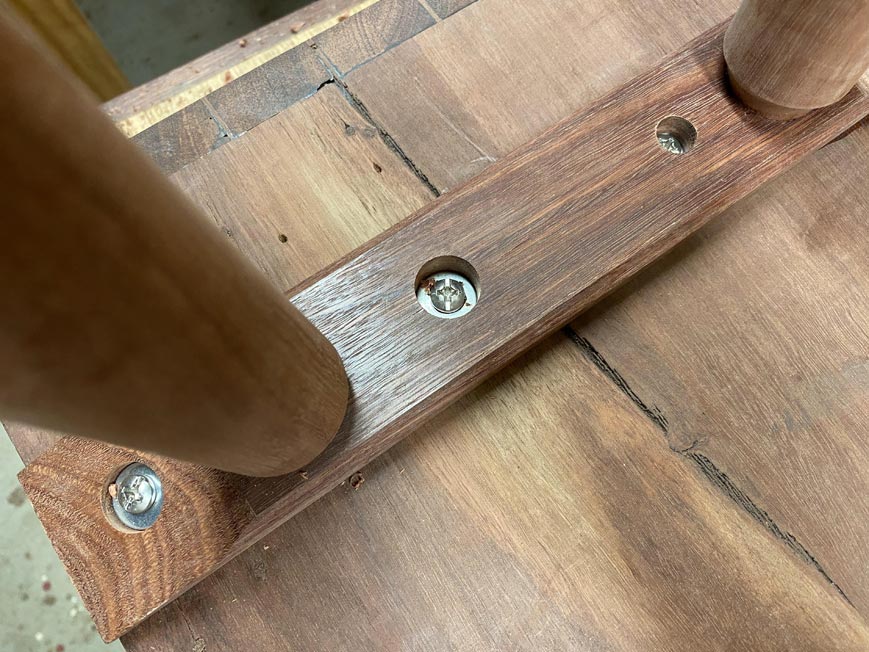
Further ... you need the big picture here ... any twisting was minimised by bolts at judicious points.


Of course, this has nothing to offer your construction :)

Regards from Perth

Derek

Re: Half Blind question

#16

Until you go way way up the ladder...

David Weaver

..that's how the folks making guitars for money are doing it. While their machine is roughing parts and cutting the cavities in body after body, they can market, respond to emails and curate customer lists.

I haven't thought of selling any of my guitars, but it'll be a necessity soon. I can build 5-10 a year without issue if i'm not working on much else - just in hobby time, completely by hand. where will they go? I don't have time to think about it yet, but if I had a CNC, I could've emailed fender about license fees for their peghead profile while it was milling bodies!

Re: Half Blind question

#17

(way up the ladder)

David Weaver

...there are still people making classical guitars with hand techniques and french polishing, but the customer list is pretty short vs. the ones that sell for $1200, and I believe their prices are in the 5 figures.

Re: Half Blind question

#18

Re: Half Blind question

William Duffield

How about a Fein MultiMaster? :D ...ducking and running...

In a different sliding dovetail application, with a different grain orientation, and with a full dovetail, not a half dovetail, I have drilled a relief hole at the end of the slot that provides clearance for the end of my dovetail saw plate. You might choose a crosscut backsaw for your application. Note that the relief hole has t be a bit wider than the bottom of the slot and has to be covered with the cheeks of the tail. A bit of compressed air, maybe even from a soda straw, is helpful to keep the sawdust out of the kerf.

Re: Half Blind question

#19

Re: Oops. Should Have Read...

William Duffield

...Richard's suggestion before posting.

Re: Half Blind question

#20

Re: Half Blind question

William Duffield

Isn't an azebiki saw just a hand powered Fein MultiMaster? :D

Re: Half Blind question

#21

Yes, but *LINK*

Bill Houghton, Sebastopol, CA

you need to practice wiggling your arm, at least - preferably your whole body - at high rates of speed to get the same effect.

They teach people learning mandolin to play tremolo (see link, if you're not familiar with mandolin tremolo) by starting very slowly back and forth and slowly speeding up. I suspect a similar learning technique is needed here.


https://www.youtube.com/watch?v=IbJ1pDmFPL8