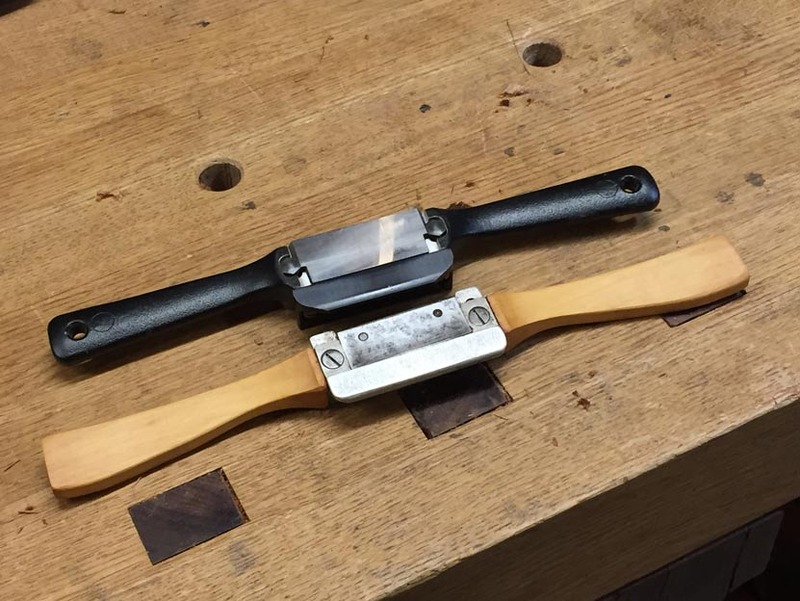
Years ago before I started building chairs I bought a spokeshave kit from Dave's Shaves. I built a shave with a piece of maple and used a brass wear plate. The kit came with instructions and a hock blade with screws. The shave worked but I never liked it so it sat on a shelf for years. I use boggs brass shaves when shaping spindles. I have been looking at LVs large spokeshave for help in shaping chair seats but the price has held me back. Recently Fine Woodworking printed an article on building a spokeshave using the same blade I have in my Dave's shave. I got a piece of Walnut and decided to make a 14" long spokeshave. I used boxwood for the wear plate. I used it for the first time today on a chair seat and it works great. The picture shows the new shave as well as the body of the original.
So what is it you like better about the new vs old? Different shape to the handle or do you think it is just more familiarity with shaves now?
I have an old boxwood shave that I just love. Works better than any of my others, but the blade is showing its age and miles. I've been thinking of trying one of those blade kits, but I never could convince myself to do it.
Maybe I'll try one and make a beech handle (lots of sticks of beech around my shop). If I like it I'll make a new handle out of some special rosewood I've been saving.
I, like many others, made these shaves. I never found a use for it and bought the LV set when it came out. The home made shave blade is flexible and it would bite off more than it could chew. Worked ok for end grain but I don't shave much end grain. So, what is the key to success with this style?
The old one was poorly made by me due to lack of knowledge of how the tool works. It shaved but it was clunky and hard to control. This one works well taking away the facets from the drawknife on seat edge contours. It works fine on end grain as well. These are pine seats.
I found that a tight mouth helps with these low angled shaves. One of the reasons my old one worked poorly.It is different from the metal bodied shaves in function. I would not use it to shape spindles. I use the LV or Boggs shave for spindles.
I have little experience with these types but I will be exploring them further now that I have a decent one.
That was my issue. Shavings would jam under it, I supposed because it flexed but maybe because the mouth was not tight. I didn't like the LV equivalent either. I expect both failures were my lack of experience but I never knew what to correct.
I have been on a bit of a boondoggle for the last year working with wooden shaves, so I will try to share what I have learned.
Some background. I have a bit of an affinity for vintage felling axes and carving axes, and like to make my own handles. Best tool for the job is a spokeshave.
Traditionally, wooden shaves were not easily adjustable. Typically the blade was set unevenly. One side very closed up, the other was set to be more open. Depending on the shaving thickness you wanted, you had to find the sweet spot left to right - took some practice.
I started using the Boggs shave (works great) but then decided to make a few of my own. I have gone through a few bodies and chucked several. Here is what I have finally learned (I think).
1. If the blade isn't stiff enough, you might as well throw it away. The blade will flex, the shavings get thicker, and it jams up.
2. This one is more subtle. If the blade can wiggle forward or backward as you use it (due to a bad inset on the blade), or pivot around the point where the post intersect the blade (not tightened in place strong enough), the mouth changes, the shaving thickness changes, and it jams up.
3. If the blade is stiff enough, and is restrained properly, the mouth size is not a deal breaker. It may take some time to get the exact angle of attack and then be able to hold it as you shave each stroke, but they still can work great with some good practice. A bit more on this later.
I actually prefer a wooden shave now for work like making axe handles. I tend to make and use shaves with blades somewhere between 2 and 3 inches wide and 1/8" thick. That is measured as cutting surface, not distance between posts.
You could make a shave (as Paul Sellers shows in a excellent video on youtube) that isn't really even adjustable. And have it work great. I like mine to be adjustable.
The adjustment mechanism on the Lee Valley shave is second to none. Super easy to adjust, even on the fly. I have made a few totally from scratch, but have copied that concept because it is so superior.
The mouth took me a bit to figure out. At first I thought that was my problem. turns out it was the blade moving. With a wide mouth, skill in repeatability is a bit more critical but they still work great. I have some shaves with a very tight mouth, and some that are much wider (kind of like a scrub plane type of shave)
When I make a shave, I cut the body and make the wear plate (brass or boxwood or lignum) so that the mouth is totally shut when the blade is in the proper position. Then I can slowly lap away the wear plate (without the blade in place) and tune the mouth to exactly the size I want. As the sole - the wear plate - is lapped away, the blade has to adjust some, but it is the mouth that is altered.
This turned into a novel. Hopefully it is helpful so someone can come up to speed faster. I fought a flexy blade, then a blade the moved for months before I got a shave the worked great. Now I love it.
I have a few old boxwood shaves and a Boggs shave I haven't used much. I figured when I retired I could learn to use them--and last week I gave notice I was going to retire.
This forum has already taught me a great deal and it's posts like yours with detailed information from experienced users that are the most helpful.
Great post Pat, you sold me on trying Lee Valley's kit.
I just bought some Osage Orange for axe handles today. Probably going to belt sand those to shape as I usually do, but maybe I'll give a shave a try and see how quite the Osage takes the edge off the blade
I have never done an Osage handle. Could be a bit of a workout.
I think you will find it much more pleasant than sanding. No dust, nice and quiet.
With regard to axe handles specifically, grain direction can shift on you as you work your way down that handle. Have to watch out for that sometimes.
If you have a sharp draw knife, that can speed things up a lot in the beginning. It can also ruin a good handle if you get lazy about grain orientation. I have a few handles that are a bit too thin in places and a few in my woodpile because I was pulling too hard and not paying attention. Like anything, it takes practice.
Jack, can you say how you designed the wear for the mouth of your spokeshave? Specifically, how it is in relation to the blade - coplanar or angled?
I do not have much experience with vintage wooden spokeshaves, instead have used many metal as well as some modern wooden ones. A few years ago I was building a few travishers. These were based on a design by windsor chairmaker, Peter Galbert.
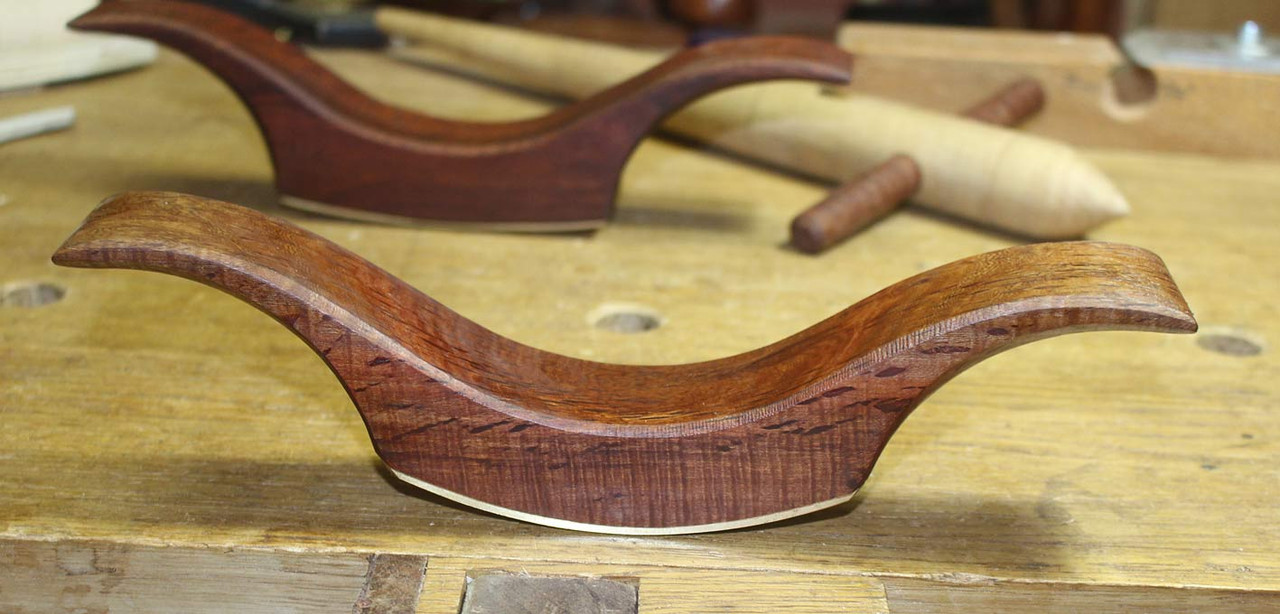
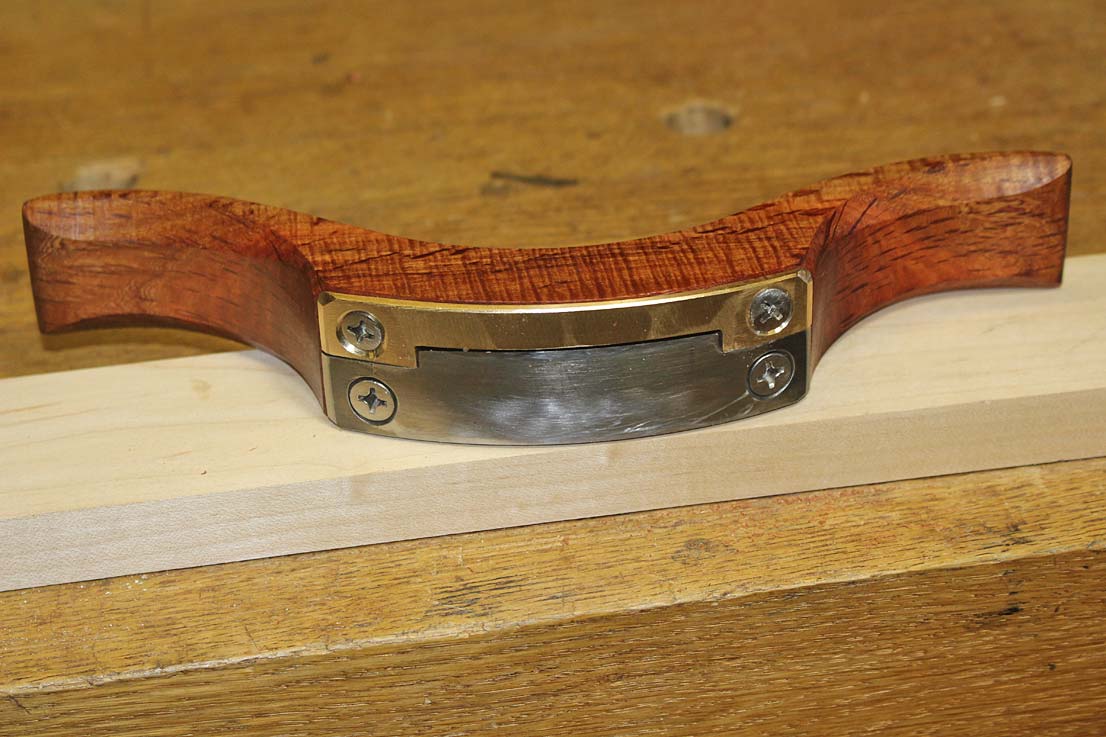
The notable feature of these travishers is the design of the mouth/sole ..
... the wear angles at 3 degrees away from the mouth.
The effect of this is that forward pressure reduces the depth of cut, and the shaving taken is quite fine. Place pressure on the rear of the sole, and the depth of cut it increeased, with a thicker shaving taken (it may be thr other way around ... )
It occurred to me that this must be the same with vintage wooden spokeshaves. However I do not own any in good enough condition to test this out. I have HNT Gordon woodies, but they are really like small hand planes. Metal spokeshaves, similarly, have coplanar soles. Even the curved ones - the wear area continues into the mouth. It does not drop away.
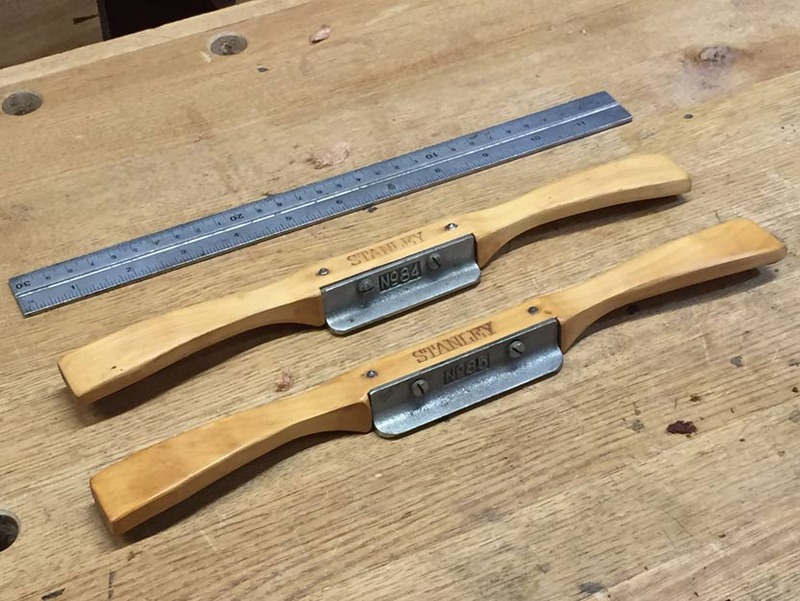
The closest I have is a set of wooden Stanley spokeshaves, such as the #84 ...
The wear here does angle, and I can induce a thick and thin shaving in the same manner to a travisher.
Interestingly, this is not the case with the Veritas LA spokeshave, which resembles the Stanley. The wear is parallel ..
If this is correct, I find it interesting that a common recommendation for metal spokeshaves - to open one side and close the other - is suggested for woodies. If woodies are designed to be used like the travisher, then the blade can be left in a single position.
Hoping for enlightenment ....
Regards from Perth
Derek (and hoping everyone out there is safe and healthy)
I followed the method in the article in FW. It called for a 2 deg tilt to the wear plate. I used boxwood, made the wear slightly fat and shaved it down to where I wanted it. I think this is what was wrong with my first shave. The brass wear plate was even with the iron. I keep grabbing the new shave and it is more useful than I first thought.
I typically shoot for 2 to 3 degrees on the wear angle. I saw your comment and honestly couldn't answer it so I have been out testing a bit.
I always try to keep the wear flat, so have never noticed any difference in everyday use. When I intentionally add extra pressure to front or back, I think the shaving does change a bit, but not really so much that I would use that as a technique.
Perhaps it is the mouth size (quite tight) of the shave I was using. Another option is that the curved nature of your travisher makes the effect more substantial. If that was the case I would guess that you could see the same thing with a flat shave as you chamfer and edge (very small contact area).
I will have to play more with a more open mouthed shave.
I really appreciate your comments. As one spokeshave junky to another, would you pleas clarify your comment to the effect that the Veritas spokeshave is your preferred adjustment mechanism. Their Low Angle shave or their Large shave? As you know, they're vastly different.
How do you typically hold a blank for shaping? I use shaves mostly for short gunstock shaping, I hold those in an F-clamp that then is clamped in my bench vise. But then stocks of that type are flat on each end so it was an obvious choice.
Most of the reason I shape handles on the belt sander is that their shape lends itself well to the method.
I made one today out of a piece of hickory for a friend at work. Most horrible, tiny chunk of wood I ever used for a handle, but it was something he got from a relative's farm.... probably going to break first trip out.
One thing though, that wood was pretty dense, even as hickory goes. Might yet stand a chance.
I followed the method in the article in FW. It called for a 2 deg tilt to the wear plate. I used boxwood, made the wear slightly fat and shaved it down to where I wanted it. I think this is what was wrong with my first shave. The brass wear plate was even with the iron. I keep grabbing the new shave and it is more useful than I first thought.
Jack, I would file the brass wear plate, creating a 2-3 degree angle away from the mouth. What have you got to lose - you don't like it as it is, and the parallel wear may be the problem.
I could modify the brass to work but I'm done with brass wear plates. I prefer the feel of the boxwood and I have plenty of it on hand. The old shave gave up it's iron to build the new one and it will go in the junk drawer now. Something else I have used and like for wear plates is bone.
I have been using the new spokeshave for the past few days. I hadn't planned to use it for spindle shaping but it was close to hand so I tried it. I just finished shaping a set of spindles for a chair using it and this shave has not jammed even once. Not since I made it. I have used it on green red oak,dry red oak and a white pine seat blank. I also used it a little when shaping a hard maple step rail for a bar stool. No jams. This is my new go-to shave.
Sorry,no picture but I got the piece of bone from the supermarket. They sell beef bones for soup. I buy them for my dogs. I cut a flattish section off the bone and sawed and filed it to shape. It works similar to hard wood. I glued it in place. I don't remember what glue I used but I believe hide glue works for this. It is a porous material so almost any glue that works on wood should work for bone.
I'm not really responding to one specific post here, but I wanted to chime in on the issue of using a slightly rounded or angled "wear" (which i'd rather think of as the front of the sole). AFAIK this all got started with the Peter Galbert video below. Start watching at about 2:20 for the money part. The range of adjustability he gets out of a tool with no adjusters is quite impressive.
I've made a similar shave for my own use, and it works as advertised. I recommend burying a couple flat head screws underneath the blade, so you can make a semi-permanent adjustment to get the cutting depth where you want it, then leave it. I believe Caleb does the same thing.

 long spokeshave. I used boxwood for the wear plate. I used it for the first time today on a chair seat and it works great. The picture shows the new shave as well as the body of the original.

 )