Putting a burr on a curved scraper
Jeremy Osner
Do you guys have any special tricks for curved scrapers? Also how frequently do you find you need to re-burnish the scraper? I seem to be able to put a little burr on but it wears away quite fast.
Knowledge You Can Build On — Est. 1998
Putting a burr on a curved scraper
Jeremy Osner
Do you guys have any special tricks for curved scrapers? Also how frequently do you find you need to re-burnish the scraper? I seem to be able to put a little burr on but it wears away quite fast.
Re: Putting a burr on a curved scraper
david weaver
roll the burr about 20 degrees over the bevel angle on the scraper, same as any other scraper, but more deliberate on an outside curve.
If working curves similar to the scraper radius, the burr should last about as long as a straight edge scraper, but if the radius of the work is much wider than the scraper, a point of contact is doing most of the work and the burr will be worn or pushed off by the wood faster.
Medium or fine india is what I use to touch up the radius parts and then just polish the edge if you need finer. Fine stone on the face. I can't remember doing too much filing to the two curved scrapers that I use on a regular basis. Better to just stay ahead of huge amounts of wear occurring at the edge with frequent touch ups.
You can use fully hardened steel with no burr, too, but my experience with that and curves is that it's no time savings and spring steel is fast to wear on a medium or fine india stone, hardened is more like sharpening chisels and gouges.

Not curved, but...
Clint Searl
...a spare chisel makes for a dandy small scraper. Roll the edge of an old Craftsman/Stanley and have at it. Easy to drive and maintain.
Re: Putting a burr on a curved scraper
Derek Cohen (in Perth, Australia)
Hi Jeremy
Pete Gilbert recently had an article in FWW mag on this very subject ...
https://www.finewoodworking.com/2018/09/26/how-to-sharpen-and-use-a-curved-scraper
There is also a video here ...
https://www.finewoodworking.com/2018/09/12/sharpening-curved-scraper
You may need to be a member to access these.
For scraping which needs a round scraper, my go to is this thick scraper I made from the rear of an O1 plane blade.


It is sharpened by hollow grinding the sides ..

.... on a bench grinder ...

It holds an edge a long time. I use a CBN wheel, generally an 80 grit (just because it is quicker as it is immediately available). A higher grit could be assumed to produce a finer finish. The finish, nevertheless, is surprisingly excellent. I highly recommend others making something similar.
Regards from Perth
Derek
Re: Putting a burr on a curved scraper
Wiley Horne
Hi Derek,
Great tool. I’ve been meaning to ask you, what do you do after grinding? Just use it? Or polish both sides and work a hook?
Wiley
Re: Putting a burr on a curved scraper
Jeremy Osner
wow, thanks!
Re: Putting a burr on a curved scraper
Derek Cohen (in Perth, Australia)
Hi Wiley
I just use it. No further preparation is needed. That is the beauty of this tool. It is amazing what it can do on curved end grain.
I cannot take credit for the idea. Actually, it was mentioned to me first by Philip Marcou, planemaker, about 10 years ago. Then I saw one on the Stewmac site: https://www.stewmac.com/Luthier_Tools/Types_of_Tools/Scrapers/StewMac_Ultimate_Scraper.html
They have a video here: https://www.youtube.com/watch?v=a7XRbfbpXiE
But so easy to make if you have an old - hardish - steel blade.
Regards from Perth
Derek

Stew-mac
Jack Guzman from Maine
I have one of those scrapers. I use it for chair seats. I prefer my flexible curved scraper for the job but use the stew-mac in difficult areas.
Scraper metal properties?
Bill Tindall, E.Tn.
I enjoy sharpening conventional scrapers even less than plane blades. Could what Derek demonstrated minimize my scraper annoyance? I intend to try this idea, but the details?
How important is the thickness of the metal? Its hardness? Old plane blades are readily available in similar hardness and a variety of thicknesses. Is there a minimum thickness for optimum scraper preparation by simply grinding? Is a 90 degree grind better than an angle grind? Is an old Stanley plane blade an effective option?
Floor scraping. I scraped a floor some years ago. The scraper was a metal plate simply ground at about 45 degrees with no post grinding burr applied. I fabricated the scraper blades from a saw mill band saw blade. When I got it right it would roll off 3" wide oak shavings like a plane. During leveling 250 sqft of floor I got good at sharpening these blades (6" belt sander, 220 grit)
A red devil paint scraper simply filed at an angle will also peel off shavings like a plane.
It would seem that lots of metal formats will scrape wood. The obvious variables are metal hardness, edge angle, thickness, refinement of edge, other? Edge life and ease of preparation are properties to improve. Nothing beats the speed of what Derek demonstrated. Is the hardness and/ or thickness of this scraper critical? Is 90 degrees optimum.
Since first working CPM 3V I thought its tenacious burr would make it a dandy scraper metal.
I wonder if the relatively soft plate scrapers we typically use are a historical result of scraping with a piece of scrap saw blade, an idea developed in 1680 with no thought of improving since. Today we have grinders and cheap harder "scrap" steel in the form of plane blades. Should we be using scrap plane blades instead? Scrapers could be David's next research project. 
question
Bill Tindall, E.Tn.
the scraper is simply hand held..? Unlike a conventional scraper one's thumbs wouldn't get burned, another advantage in addition to simply grinding.
Answer
Derek Cohen (in Perth, Australia)
Bill, this is the easiest tool to use. It is one of my favourite tools.
The steel is 3/16" thick. It came from the rear of a Veritas O1 plane blade, which I had shortened to use in a plane I built.
There is no heat build up.
There is no preparation for the edge beyond a hollow grind. The grind is stopped as soon as a fine wire is felt.
It is amazing how easy it is to peel off shavings, effortlessly.
On the left are from the curved edge; on the right, the straight section (these look like they were taken more cross the grain) ...

The finish is excellent. It can be improved on, of course, but many would be happy to finish on it.
Here's the outside of a curved drawer. The wood is hard, figured Jarrah. It is quite interlocked. It was first planed across the grain, and then finished with a small smoother. There are scallops from cross grain planing ...
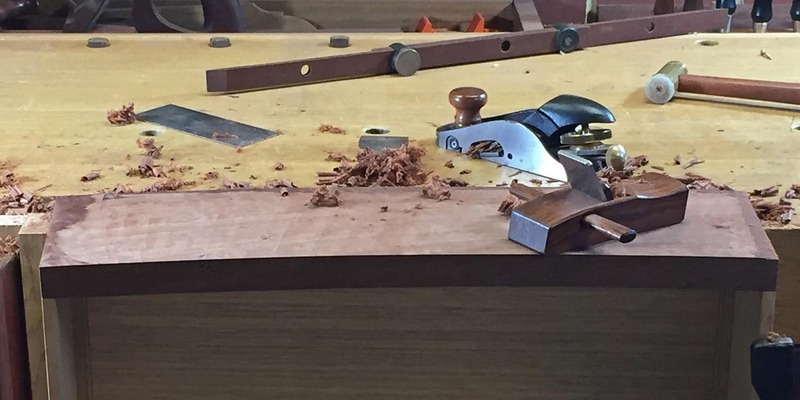
... and there is tear out from the HNT Gordon palm smoother in spite of the 60 degree cutting angle ...

The scraper easily removes the tearout and maintains the level ...
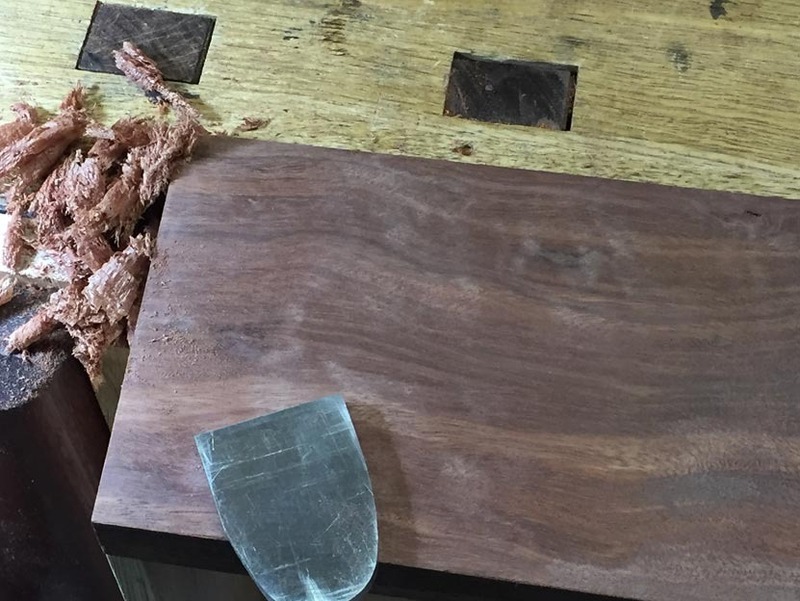
The surface was sanded with 400 grit to remove any tool marks (it is the outside of a drawer for a chest). On the right side you can see the difference made by a thin scraper ...

Regards from Perth
Derek
Impressive and another question
Bill Tindall, E.Tn.
Is the thickness important or could I do the same with a Stanley blade or any surplus blade........ that is, beyond the grind what other property is critical?
Just avoiding burned thumbs is sufficiently attractive.
I can retrieve pieces of planer and jointer knives from the scrap barrel at the saw shop. I am imagining such a piece ground at a slight camber being perfect prelude to sanding. Just like in planing I'm after material removal with no concern of surface luster.
Re: Impressive and another question
Derek Cohen (in Perth, Australia)
Bill, the Stewmac scraper is 1/8" thick. Mine is 3/16". I have another which is about the thickness of a Stanley blade, made from an unknown steel from a wooden spokeshave, which has Asian origins. It, too, works well. It does not appear to be about the thickness of the steel. However, it is likely that the thicker steel sections act like a heat sink.
By contrast, I have tried to make a scraper from a Stanley blade, without success. I suspect the steel was not hard enough. Years ago, the scraper that Philip Marcou made was either D2 or carbide. Probably the latter, but Philip really likes/liked D2 for blades.
Regards from Perth
Derek
stew mac's width..
David Weaver
...i mean thickness. wrong word...
The videos show someone (Can't remember his name..burns?. not mr, but brian or something) making the deliberate hollow. A stanley iron works (I have used a stanley iron like this since before I ever saw the stew mac video, but not much), but the advantage of the thickness is in the ease of finding center to grind it. Unless you have a grinder set up to hit dead center on the stanley blade, you'll appreciate the depth of the hollow that the thicker blade provides.
I'd make a comment about these being material removers, but almost everyone sands, so it doesn't matter if they leave a little bit of scratching, or a slightly dull surface. It's a waste of time to hone them in my opinion, unless someone is insistent that they get the finish from the same tool (curve scraper and burnisher works better).
The bedding scraper that bill (gosh, terrible with names today -.....) carter uses also works well the same way. grind a hollow on the end of a super hard chisel at 60 degrees, it's shockingly fast at removing material from woods that are just about impossible to pare and that maul the saw temper floats (like LNs). You can get in trouble with it because it's such a pleasure to use that it's *too fast*. A great tool for neck pockets on guitars, too, where the edge of the pocket will be seen and can't afford any tearing, and bad grain orientation on a body may not allow paring.
I've not notice a heat build up issue with a stanley iron (which i admit I don't use much now), but if I make one of these purpose built, it'll be 3/16ths next time like derek's.
what's important?
Bill Tindall, E.Tn.
I hope to be beating on a live horse not a dead one. By learning what makes Derek's scraper work we may find other ways of taking advantage of the fundamentals. So, is the edge angle afforded by the hollow grind on the wide blade critical? Would a straight across grind work as well, or a bevel on a thinner blade.
Derek....I assume your scraper can be/is used on each side/face, not an insignificant advantage over a bevel on a thin scraper?
M2?
Bill Tindall, E.Tn.
M2, a common tool steel for woodworking and metal working is widely available in many shapes and sizes already hardened. Must try it. One could even find ways to mount sections of jointer and planer knives in some holder.
Re: what's important?
David Weaver
If you can nail a hollow grind dead center in the thickness and not remove all of it, you can continue to hone it just like a plane iron and control the geometry very well.
Except honing like a plane iron means honing on its edge instead of a bevel that's some other angle.
If you have a trick jig, I guess you can hone the hollow without losing the edge geometry (Derek can do that), but if you want more than straight, then you have to work the hollow and not get all the way to the edge.
Hopefully that makes sense - easier to locate the hollow within the thickness and then hone on the edge if the thickness is greater.
Re: what's important?
Derek Cohen (in Perth, Australia)
Derek....I assume your scraper can be/is used on each side/face, not an insignificant advantage over a bevel on a thin scraper?
Bill, all my scrapers can be used on both sides. The thick one is no different.
Ideally, when hollow grinding, one hits the centre of the blade and this creates an equal wire on opposing sides. However, this is not essential. The blade is forgiving. Sometimes I get one edge only, and then I flip the blade and get the other edge. There does not appear to be much of an issue - what seems to be important is that there is a wire. Being hand held, the hand compensates with the angle presented to the wood. Having said this, it takes a few seconds to centre the blade, and this is preferred, if only because there is a time saving as well as a consistency.
I'll try and get some more photos, and even perhaps a video, this weekend.
Regards from Perth
Derek
Exactly.
Re: M2?
Derek Cohen (in Perth, Australia)
Bill, I suspect that the defining quality for a scraper - which is prepared on a grinder - is the hardness of the steel. That this creates a suitable wire. After this, there will be some steels that are expected to hold the shape of the wire longer. M2 should respond to the heat issues in scraping, but is it as abrasion resistant as, say, M4?
Many years ago I made a scraping blade out of a hex key for a router plane for use when there was reversing grain. This steel was pretty hard ...


My website article is here: http://www.inthewoodshop.com/ShopMadeTools/Stringing%20Cutter%20or%20Scraper%20Blade%20for%20Router%20Plane.html
Regards from Perth
Derek
wire
Bill Tindall, E.Tn.
If the "wire" is critical then toughness is the metric of importance. M2, while greatly harder and more abrasion resistant than 0-1 will not be as tough. M2 steel is what is most likely in your jointer knives and many lathe tools. In any case I have a thick M2 planer blade and I am anxious to try it today.


