There's been a good discussion below on advantages of CBN wheels for grinding tool edges. I understand the concept of cool cutting but what I would like to see is how people grinding with CBN wheels present to tool to the grinding wheel since essentially all of the wheels sold are square faced except the wheels sold by Tools for Working Wood.
I've learned to free hand grind with a wheel with slight radius and this method is almost fool proof even with beginners. I've had limited luck with square wheels and with most jigs.
For narrow items, I lazily allow them to sit on the CBN wheel without moving. Things like chisels, of course.
I missed the crown when I went to CBN because I was used to having that point of contact accuracy.
For wider blades, if the hollow is cut too much to one side or the other, I move the iron up the opposite side of the wheel slightly (my rest is always set at 90 degrees - something i didn't do right away, but that alleviates issues of differing iron thickness, tapered thickness chisels...all kinds of stuff).
My wheel is radius edge, so if I want something more similar to the old crowned feel, I'll work on one edge or the other.
That said, the radius is far too steep to be a crown, it just goes around the side of the wheel for who knows what...turning tools? I don't know.
very lightly holding a chisel in a single spot on the wheel feels like a party foul for a long time before you get used to it and your brain stops sounding the "it's going to burn!!" alarm
Phillip, as I have mentioned before, a crown is unnecessary since the CBN wheel is truly flat and you will not get a catch. You can move the blade squarely into the wheel, or you can apply more pressure to one side of the blade or the other. A light touch offers great precision.
Because the face of the wheel is so flat and does not change shape, it is possible to set it up as per a Tormek, that is, square the blade holder to the wheel and run the blade along the face. This produces an even and smooth grind every time.
There is nothing to square up. As a result, since the wheels grind so cool, you can safely grind to the edge of the blade.
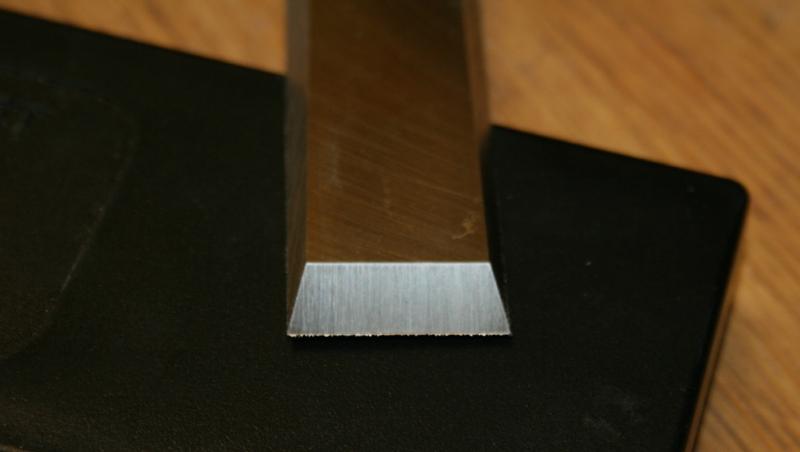
This is the grind on a new 180 grit CBN wheel (I get a smoother finish 5 years down the track) on a 1" PM-Vll chisel blade ...
2 or 3 strokes on a Medium Spyderco ...
and 2 or 3 strokes on an Ultra Fine Spyderco ...
The irony is that the grind is so good, you do not need to do it much! This grind is good for many sharpenings.
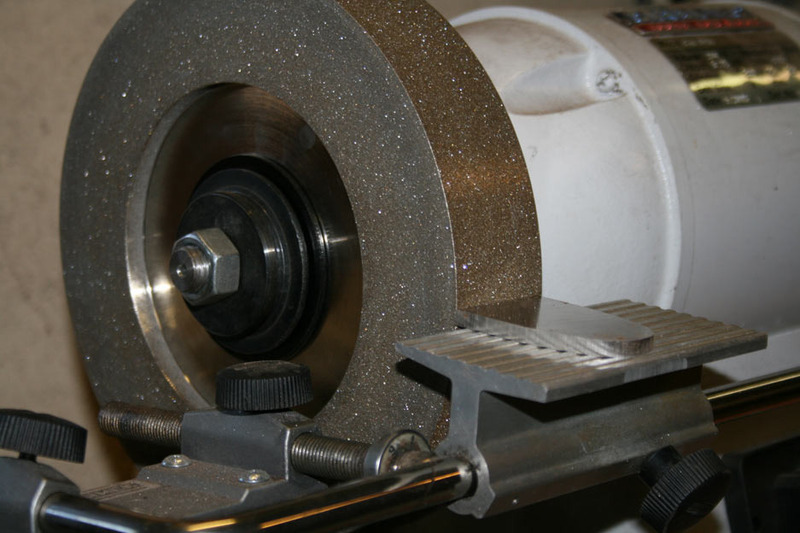
This is my set up ...
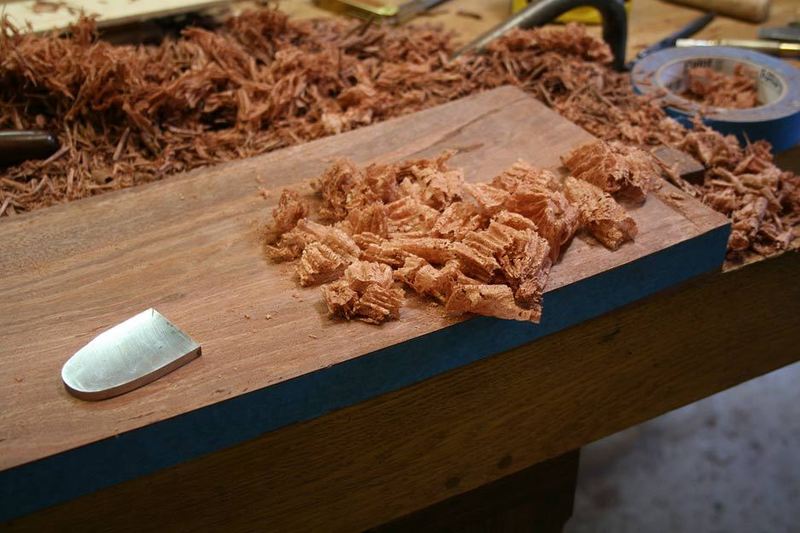
Here's a bonus: I made a scraper out of the rear of a Veritas O1 blade (3/16" thick). This is hollow ground on the CBN wheel - just enough to raise a very fine wire ...
I just now reground an LN 2-3/8” A2 iron. Started from the factory grind, which was at least 30 degrees by eye. Used a Tormek T-7 with 10” CBN wheel from Woodturners Wonders. Wheel is 200 grit.
I reground to an eyeball 25 degrees—meaning I didn’t measure the presentation to the wheel. It turned out to be 26 degrees. Took me 4 minutes to grind the whole bevel away, just moving the iron across the CBN stone and back—I put a bit of biasing pressure on the corners, just to give it a little smile. Ground to a heavy burr.
It was square off the wheel. Sharpened across the bevel on Sigma stones—1000, 2000, 13000. Then gave usual test on NY Times.
So are you using a jig for blades wider than the wheel?
"Because the face of the wheel is so flat and does not change shape, it is possible to set it up as per a Tormek, that is, square the blade holder to the wheel and run the blade along the face. This produces an even and smooth grind every time. "
I have never used a Tormek, but have used clamp on guides and do not like them. It's another gismo to fiddle with. Picture or jig would be appreciated.
Thanks the pictures gave me exactly what I was looking for. Now I understand Deick's post above.
So if you don't have the fancy Tormek jigs, how hard is it to grind a square edge on a wide plane blade? Particularly using a standard tool rest which is what 90+% of woodworkers have.
At high speed, it is easy, if you have some touch.
I have a standard cast tool rest on a 6" baldor. The rest is not ideally square to the wheel. This is the fault of the rest and not the wheel, of course.
If one was to use the rest as is (even at 90 degrees), the result would be varying bevel angle or skew edge (or maybe both). I follow the front lip of the rest (this is a matter of several degrees at most, but that's a lot) off of each of the sides. This is a rest issue I've never taken any initiative to solve because I like working at the edges of the wheel to do the final work just as I liked using a crown.
I'd imagine faffing with the rest (vs. buying more off anything) would allow resolution to this, but one thing I've learned with hand tools over the years - learning to work around the flaw in something is often FAR easier than fixing the flaw.
Before Tormek, I was using flat 1” soft wheels, like the Norton 3X (and whatever came before it), on a Baldor 6” 1800rpm grinder. What I would do is make a red sharpie square line across the blade face, and set out to grind near that line. But not to a burr. Just using the tool rest on the Baldor, meaning it was hand held.
If the tool already had a hollow, I could nestle into that by feel. Then keep the blade moving side to side, trying to avoid a heat ‘focal point’ to build up. Dip into water after every sweep right to left and back, then dip. Never grind after the drip on the face goes away.
If starting from a flat bevel, it was hit or miss to start, checking by eye until I found the ‘right place’ to start. Then as the hollow develops, nestle into it. Keep checking every so often to get to 1/64th or 1/32nd from edge. Water dipping as described above.
Do this away from any other work, because of grit slinging off the soft wheel.
A crowned wheel would have been a huge improvement, partly due to the ease of locating a starting point, but mainly because the heat control would be so much better.
However, I went to Tormek as an alternative. Traded not having to think about heat at all, for slowness. Now, CBN wheel improves Tormek speed, eliminates fooling with water, gives you a wheel that does not change shape or require any maintenance. Has a really cheap and useful jig for lengthening gouge bevels. But still substantially slower than higher speed grinder. Those are the tradeoffs I see.
If I were starting over again from scratch, I would set up like Derek, with an 1800rpm 8” grinder, and Tormek holder, but with Joel’s crowned CBN wheels. Or prolly 1 CBN and 1 carving tool wheel that uses a heat-sensitive honing paste. I would lose the shallower hollow which I really like with Tormek.
I've been thinking about making a tool rest like this which seems like it (if done accurately) would function very similarly to the tormek jig without the price tag. If you scroll up a few pages in the article it shows the jig in use a little more accurately.
One suggestion, if you make this....naturally, you will saw, place and affix everything with extreme care. But. The very first grind will still be skewed to some degree. So, I suggest slotting or oversize the bolt holes for the grinder—or maybe just put rubber gaskets at the corners, and don’t bolt it. Then, when you mount the first blade, for the first time, you can lightly hammer-tap the grinder base into true square. If there is a little vertical discrepancy, use thin metal shims to true it.
Think through the making process in detail. There will be a dozen or two dozen steps where an error of 1/100” will result in a visible error where the blade edge finally meets the stone. And this is assuming the grinder arbor is exactly parallel to the grinder housing flange (which you’ll be building to). And you’re going for trueness in three dimensions—you’re making a sculpture.
Now some of these errors will cancel, and some will be additive—but the net will be some visible out-of-whackness.
An alternative to moving the grinder to get things true, is to make a screw adjust to one end of the fence on the blade holder. You still might need a slight shim under one side of the grinder to true the rig vertically.
All work, hand or machine, has a tolerance. Knowing this, and allowing for it, makes you master of the situation.
Right, ok I get it. For some reason my brain didn't click that you were referring to the first grind to get it dialed in. It will probably be finicky to get it just right but I figure it's worth a shot before bowing to the cost of tormek jig
Yes, it will save money compared to Tormek. However, since you either already own or will be buying the grinder, and very possibly cool-running wheels, your real comparison is the Ian Kirby project versus a commercial blade presentation rig, such as the Tormek BGM-100,
So are you using a jig for blades wider than the wheel?
"Because the face of the wheel is so flat and does not change shape, it is possible to set it up as per a Tormek, that is, square the blade holder to the wheel and run the blade along the face. This produces an even and smooth grind every time. "
I have never used a Tormek, but have used clamp on guides and do not like them. It's another gismo to fiddle with. Picture or jig would be appreciated.
Hi Phillip
The Tormek BGM-100 arm on my bench grinder is the same as the one on the Tormek wet grinders, and the same one that Wiley posted using. My choice in using the BGM-100 was that it permits using a range of Tormek jigs, which are needed for lathe chisels (such as when grinding fingernails). For flat woodworking, it also offers advantages in precision which, as I illustrated earlier, creates a better quality grind. This translates into less re-grinding and faster sharpening in my experience. Still, I also freehand grind, as can be seen by the flat tool rest on my set up.
When I had a Norton 3X wheel, grinding a jack camber ...
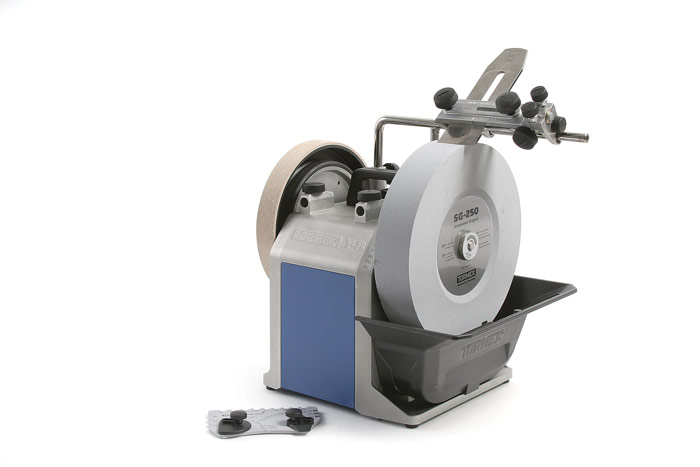
Image from Tormek of the BGM-100 ...
Tormey and plane blade on the tool rest (same as BGM-100) ...
Years before I invested in a Tormek, I built my own version of the tool rest, inspired by an article by Ian Kirby (with which you are familiar). However, my design was aimed at using a belt sander ...
This was later re-designed to include adjustability. Both articles are on my website. The original design was featured by FWW magazine.
As Wiley has stated, include some adjustability when building the Kirby tool rest. There is a reason for this: on the Tormek or bench grinders, when not using a CBN wheel, the friability of the wheels enables them to be trued to the tool rest. However, the non-friability of the CBN wheel means that you have a very small range of measurements before the blade is ground out-of-square. William may argue (correctly) that planes can adjust for such blades, but the fact is that it is nicer (less effort) when this is not necessary.