Plane finish
Brian Holcombe
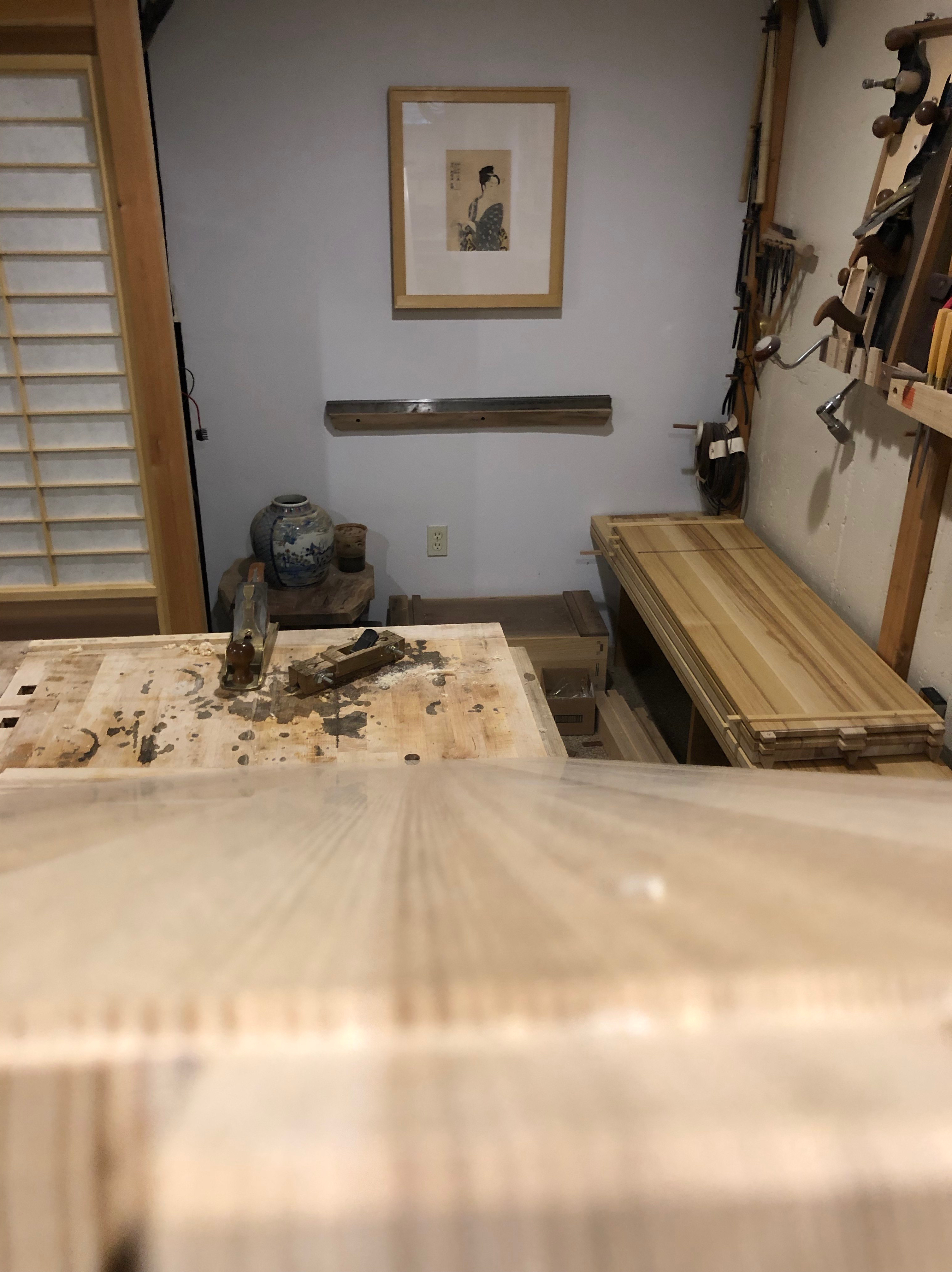
This is a plane finish on white ash. O1 iron fitted into a LN4, fairly tight set chip breaker.


Knowledge You Can Build On — Est. 1998
Plane finish
Brian Holcombe
This is a plane finish on white ash. O1 iron fitted into a LN4, fairly tight set chip breaker.
Re: Plane finish
david weaver
I know just how little of the shine your camera is picking up, too, and that in person, that looks like water with pores in it.
At least that's what I'm guessing - IIRC, you're much better with a camera than I am. I couldn't manage to get decent lustre pictures of the edges as part of the planing test. the part of ash that is in plane with the surface can really get waxy bright, though.
Re: Plane finish
Jonathan Elliott
That is some tight grained Ash, and beautifully straight too. I'm used to flat sawn with huge, widely spaced cathedrals and grain 1/8" apart or more.
Of course the finish is to drool over, nice work!
Re: Plane finish
Winston
Beautiful work. I feel compelled to share this picture I took a little while back. It helps that the reflected image was much brighter than the light on the wood, and that it's the tangential face of a piece of cherry, so there was a nice, consistent, tight-grained surface.
It's too bad that even if you have a perfectly smooth planed surface, the perfection becomes irrelevant once you apply a finish to it.
Depending on what the finish is...
david weaver
..There's an advantage to a planed surface if you can manage it without too much extra time. Sanding sealer (shellac or whatever you prefer) will raise the grain far less if the surface is cleanly planed, and you can cut out some fraction of its application.
Re: Depending on what the finish is...
Warren in Lancaster, PA
If the “grain raises” with water or finish material, it indicates a poor planing job.
A well planed surface looks better after finishing than sanded.
I muted...
david weaver
..part of my response because I didn't want to get into a back and forth with folks offering wash coat ideas or all kinds of other things to solve what is easily solved with a plane. I prefer to plane finish parts in most cases, and if I have to, scrape and then burnish spots to match the planing as close as possible because it's such a joy to seal the surfaces and see the finish build almost right away.
I would rather have a planed surface with very minor imperfections (it looks more lively) than sanded. I resent having sanded most of my kitchen cabinets, though they should get dark enough over time that it shouldn't matter. most of the reason I resent having sanded is the amount of time it took to do it. Those cabinets were for me (the mrs. wanted to have someone else do the kitchen) and I told her I'd make them look like purchased cabinets, and to some extent, i did.
I should've done as I wanted and planed everything, including the plywood.
Re: I muted...
Don Stephan
A long time finisher in my area, who does excellent work, uses pre and post catalyzed finishes that advise the wood should be finish sanded to no more than 150 grit for good adhesion. And he always has said the final result looks the same sanded to 150 or higher.
To prove prove him wrong a few years ago, I found a nicely figured cherry board and dressed the surface with a LN 4 1/2 to a perfect surface, crosscut in two, and then thoroughly hand sanded one to 150 grit. Carefully padded on each blonde shellac I mixed from flakes. I couldn"t tell which was which after a couple days. Damn, that was frustrating.
Re: Plane finish
Brian Holcombe
Totally, it's like a mirror at a low angle but it was hard to capture it well.
Re: Plane finish
bridger berdel
Doesn't this site have some rule or something against posting porn?
Shhh....
Jim Matthews
SWMBO thinks I'm here to learn something useful.
That opalescent, shimmering glow can only be found on the finest boards.
Who cares what trickery was required?
"Surface prep? Oh no - I just rolled out of the woodshop like this."
220...
david weaver
I did the same thing with a somewhat curly cherry board years ago. I thought for sure that I'd see a big difference, but I couldn't tell anything between the two sections after building shellac.
what I did notice is that it took at least twice as much shellac to build the sanded wood. I expected also to see more blotchiness in the amber shellac on the planed side, but both pieces of wood looked similar.
I like a lower build finish than that sometimes, though, especially wax.
I sent a plane to brian holcombe several years ago. I didn't sand those planes, I only planed them and then oil and wax. Brian put up a picture that wasn't even in good lighting and warren spotted right away that it had been planed and not sanded.
The other two things that get me, one of them is rational, the other one is not:
1) I have asthma. It's not constant, but it can be excited by too much dust. I generally forget that I have it (had it worse as a kid) except for once a year or so that I get bronchitis, but sanding a lot will start the wheeze
2) I hate throwing sandpaper away. I don't know why it bothers me that much, it just seems like an unnecessary waste. It's a tiny speck of money compared to what I've wasted on woodworking and guitars, but it still annoys me.
The curse of math "literacy"
Jim Matthews
Cost per unit use with disposables will do that.
See: replaceable blades vs. straight razors


