Home Articles Forums Gallery Marketplace Videos

WoodCentral Forums

Knowledge You Can Build On — Est. 1998

Another coffee table

Posts

Another coffee table

#1

Another coffee table

Derek Cohen (in Perth, Australia)

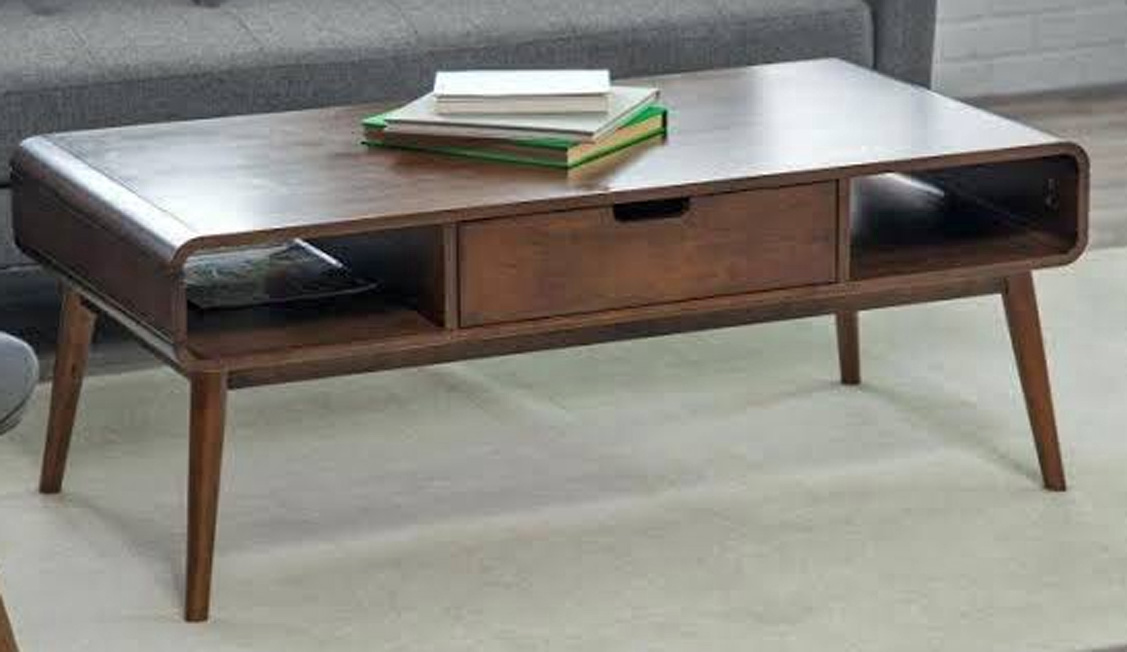
My nephew is getting married in February, and I offered to make a piece of furniture as a gift. The offer was open-ended, and the couple decided they wanted a coffee table. Their taste runs to mid century Danish, and so I sent them a bunch of example from the Internet to get the ball rolling. They fell in love with the following design, and want it in a medium dark wood (it is going to be solid wood, so possibly Jarrah) ...


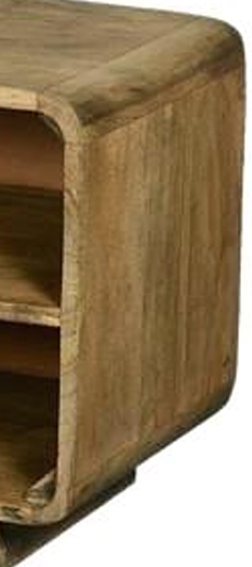
My question is how would you build the table ends ...


Here is similar end ...


I would like to make the end pieces wider so that they can create a breadboard join at each side.

Your thoughts?

Regards from Perth

Derek

Re: Another coffee table

#2

Re: Another coffee table

stuart johnson

I would create a four segmented cylinder with paper between the joints for easy splitting. Turn it round and then split along the joints. The paper should allow easy splitting. The size of the cylinder would be adjusted for the curve size.

Re: Another coffee table

#3

Re: Another coffee table

Philip Duffy

Can you find a router bit that matches the curve inside so that you could cut the curve as a "hole" in a solid 3x3 then slice off what you do not want to put to the end?

Re: Another coffee table

#4

Clint Searl

Looks kinda IKEA-ish


Re: Another coffee table

#6

Re: Another coffee table

William Duffield

I think I would try starting with a plywood tube, rip it in quarters and join it to the top, bottom and sides with loose tenons. For example (disclaimer: I never used this supplier; I found them with a quick google search):

http://www.shapesunlimited.com/products/tubes

Re: Another coffee table

#7

Re: Another coffee table

Derek Cohen (in Perth, Australia)

This is what I have come up with so far:

Looking at the photo, although not particularly clear, it looks like a plywood construction, and that the corners were created by steam bending over a form. Obviously, I am not planning to do that. Also, I do not plan to laminate a curve as this will not match solid pieces elsewhere.

One way is to use a solid corner and shape the inside and outside into a curve. Care needs to be taken with the grain direction. Something like this ...


The choice is then to either use dominos or a bread board. I think it should be the latter if the grain is running across the table top. However, if a breadboard, then the ends need to be longer, and could be a problem.

Other ideas? Hopefully better than mine

Regards from Perth

Derek

Re: Another coffee table

#8

Re: Another coffee table

TomD

Ply does not expand widthwise, as you know. Those are solid wood corners, quarter round, with the inside coved out (like the square corner you showed). The joints would be dowel or spline or biscuit like, depending on the dimensions of the parts. For one piece one could theoretically joint to square and shape in place with hollows and rounds. That technique would be commonplace on a lot of case furniture, but in a vertical aspect.

I think it is a striking piece for the style because it embraces the cheese of the round turned legs that was used a lot, but so often didn't go with the rest of the piece, and yet they look good here.

Re: Another coffee table

#9

Re: Another coffee table

William Duffield

To use plywood formed corners, you would need to use plywood for the flat components, too, and then veneer all of it. I totally understand your distaste for a plywood structural design approach, but it does result in consistent grain direction over all the surfaces, and therefore a "monolithic" look. I don't see how you would achieve that effext (if your customers wanted it) with breadboard ends in solid wood. BBE construction would require the grain on the curved corners to run perpendicular to the grain on the flat surfaces.

Whether you use Dominos or traditional breadboard end joinery, your mortises in the curved pieces and the tenons need to be kept very short, and moved towards the inside faces (instead of centered)

.

Re: Another coffee table

#10

Re: Another coffee table

GolfSteve in Calgary

My first choice would be to make the end out of a solid thick plank that has been hollowed out to the shape you want. Its a waste of wood, but easy to do with a tablesaw, a few handplanes and a scraper.

My second choice would be a laminated shape with a facefame of solid wood. If you match the grain carefully it will be unnoticeable. It will also be more stable and stronger than the first option.

Re: Another coffee table

#11

Clint Searl

Re: Yes, but mine won't be

Clint Searl

Just my unsolicited (and probably unwanted) opinion, but the design is not compelling enough to make the effort. We had one like it from IKEA, made from bent plywood, that performed well.

Re: Another coffee table

#12

Re: Another coffee table

david weaver

splines would be practical. Sliding dovetail would be more interesting, but half dovetail or whatever you'd call it so as not to have stranded grain on one side of the tail.

Re: Another coffee table

#13

An idea for construction ...

Derek Cohen (in Perth, Australia)

If I build the corners from a solid section, it is relatively straight forward to orient the grain and then plane the inside hollow and rounded outside. This is the picture I posted earlier ...


The issue is how the mix of cross- and long grains would look. Very busy in my expectation.

An idea that has occurred to me (suggested by this picture, actually) - to hide the corner being an added section - is to make the entire carcase with the grain running across, rather than than along the length. It may be possible by bookmatching to hide any joins.

I've not seen a construction like this. Could be interesting :) What are your thoughts?

Regards from Perth

Derek

Re: Another coffee table

#14

Re: An idea for construction ...

Derek Cohen (in Perth, Australia)

Just looking at this design gives me a headache. What appears so simple for a non-woodworker is a bloody nightmare when aware of the level of difficulty in the construction.

I have advised my nephew that he might reconsider a square end!

Regards from Perth

Derek

Re: Another coffee table

#15

Re: An idea for construction ...

david weaver

I think your idea of building up the corner is perfectly practical. It might also be fun to contour (It would for me). If you're not sure if it'll come out right, it's an easy thing to get close with planes and scrapers and then make a contour block and finish sand it.

I just recontoured a bubinga guitar neck last night with spokeshave, scraper, rasp and a super shear. It's super physically satisfying.

My personal thought about the design is that the combination of lines and then abrupt curves is kind of gross, but it symbolizes that point in time, and making something that first looks like a cheap flea market design but upon closer inspection is a well made high quality piece is ..well, it's kind of an interesting gimmick in a positive way.

Re: Another coffee table

#16

Re: An idea for construction ...

TomD

I like it, and there are thousands of "classics" that do similar things.

I am kinda at the point where I think we might do well to back off on the 50s and 60s, or whatever this was, given that it was a fun time in design, far more original than now, and it is largely being rubbished and mcmanssioned out of existence.

Re: Another coffee table

#17

Re: An idea for construction ...

TomD

I wouldn't do the crossgrain thing that would make for an interesting drawer casing, and probably warp on you. You could manage those things but why bother, there is nothing wrong with the design as it stands. Pretty much all the joinery stuff we celebrate is some kind of kluge, we just accept what we already know.

You could vac bag it in veneer and join two clam shells. If you haven't vac bagged you haven't lived.

You could make a stable substrate, then just hammer veneer your veneer on it which ever way you want. That is how they do the sides of pianos, though every scrap of veneer on our Bechstein lifted in those areas. Epoxy would solve that problem. Every scrap of veneer on our trimaran is still where I put it. :) In fact my catamaran went walkabout and passed me at Hwy speed, going east, then hit a light standard. The boat weighs maybe 500, the trailer, and goods and motor, a lot more. Only damage to the bow of the boat which is about 8 mm wide was a dent about the size of my baby finger. Miracle fiber W.

Re: Another coffee table

#18

Re: An idea for construction ...

david weaver

Well, it's a style that people kind of like and veneer and plywood certainly makes more manufacturing sense than solid wood.

there's not much sold in volume that looks like the coffee table in this picture, but there's a lot of indeterminate bastardized stuff. I don't know that any industrial era has been any different (starting with the commodity furniture with pressed carvings in it that went on for what...40? 80 years? I just got a local desk that looks like it was made in the 80s. it's oak, and from a distance it looks carved. most of the detail is pressed into it. That bastardization of things is pretty much the territory of commodity furniture).

As for the design, that's subjective. I don't know what people ever saw in it, but it's not necessary for everyone to like every style. If derek makes a nice piece that people first think is a commodity piece when they look at it, at least it's half interesting. The joint is so long at each corner that the joinery doesn't really matter (functionally) unless people are staging professional wrestling matches on it.

Re: Another coffee table

#19

Two more ideas

Derek Cohen (in Perth, Australia)

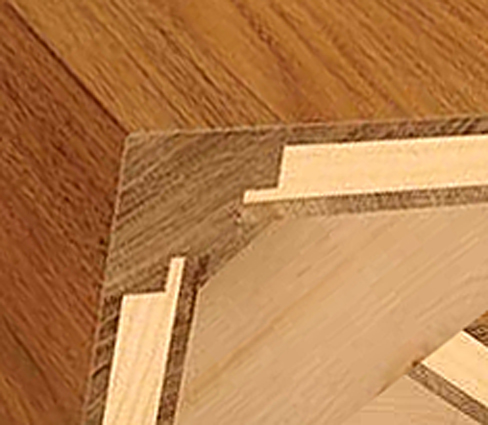
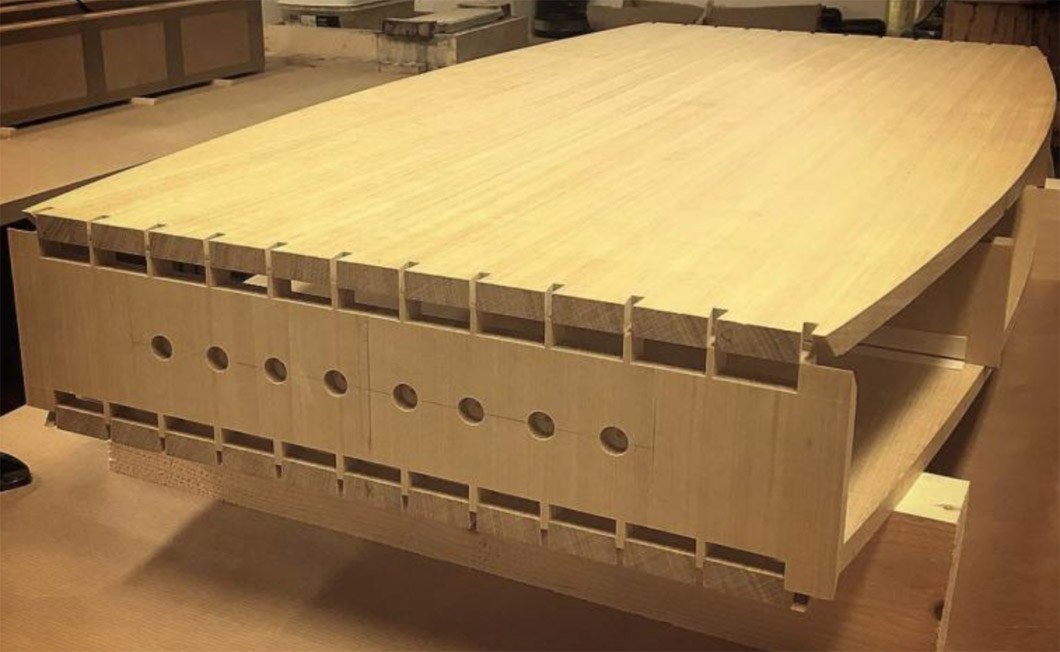
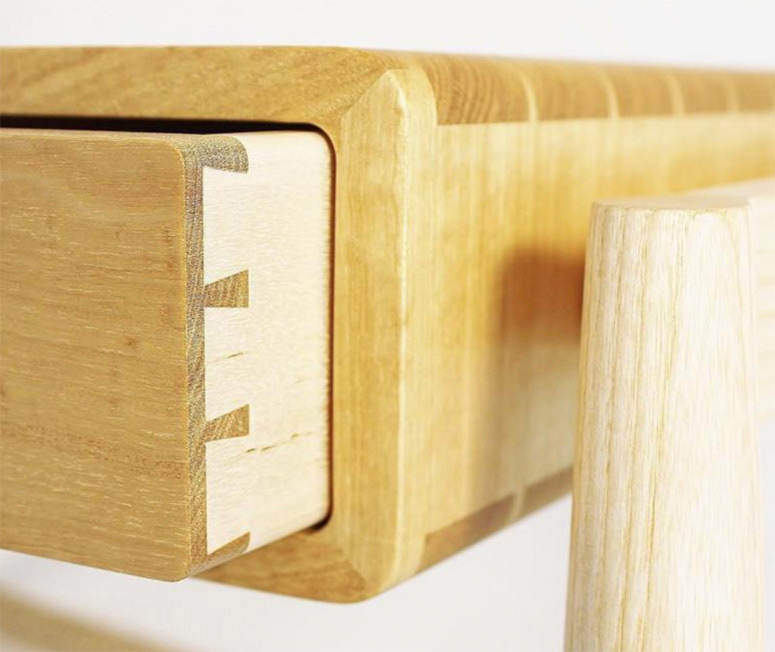
These are a cross post from SMC, where these photos were posted ...


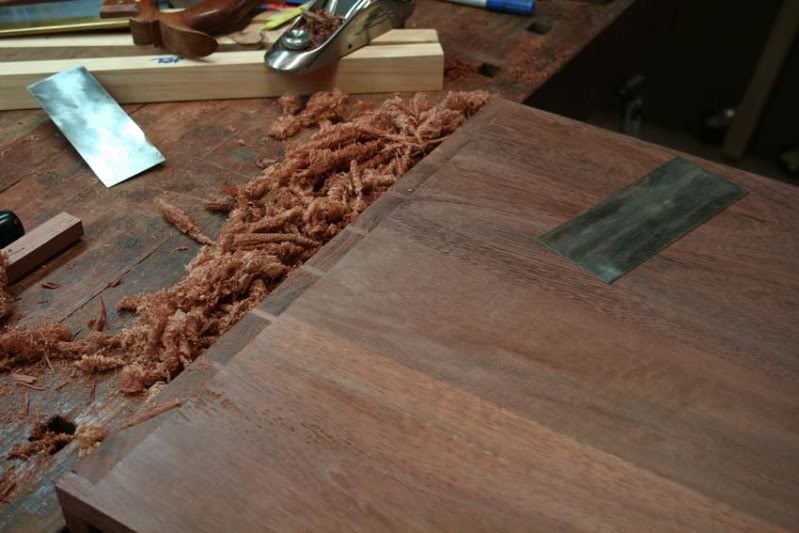
This offers two other options: dovetails (with mitred ends) followed by rounding, and a rounded mitred end. In each, the inside receives a filler, which is hollowed.

It's a toss up between the dovetailing, or simply mitering the ends and rounding them. The latter allows the grain to flow around the sides and top, while the former is interesting in a different way (I like this one).

Irony is, the nephew has acknowledged that they like a square end as well, and would enjoy either. Decisions.

Regards from Perth

Derek

Re: Another coffee table

#20

Re: Two more ideas

david weaver

that's what I was thinking of earlier, actually - join it with dovetails and round the outside. It'd be stunning in terms of decoration, but it would limit the radius to much less than the original piece. I think it's a better design with a smaller radius, though - less confusion of curves followed by straight lines to more curves.

A comment from George sticks out in my head every time I see something like that. I'd made a contour on a tool, it was a tight curve followed by a straight line. It didn't look that good and I didn't know why. He instantly said "is it curved, or is it straight lines. It can't be both - that's bad design". paraphrased more or less. I noticed that in any really good work (other than industrial design and later), he's right - such things rarely show up, but they do show up in amateur work quite often because peoples' eyes aren't trained yet.

Part of what makes the original version sort of cheap looking is that big curved radius attached to straight lines. Making it quality and keeping that is the combination that I mentioned - corny looking (a little) from a distance, but could stun people when they get up close and see real workmanship and materials rather than something that is convenient to produce industrially or semi-industrially.

And, Tom, last time you objected to my quoting of George. I hope you don't manage to step in that cowpie again.
Re: Another coffee table

#21

Re: Two more ideas

david weaver

By the way, if your nephew is into going whole hog corner (without rounding dovetails), a Brian Holcombe-ish bevel on the edge would probably do plenty to keep it looking nice long-term.

Re: Another coffee table

#22

Re: An idea for construction ...

Rob Lee

Derek -

Instead of trying to blend the corners into the vertical and horizontal surfaces, you more clearly delineate the difference - adding a pronounced fillet, or and inlaid transition detail (an ebonized inlay or other suitable material).

The rounded corners are going to finish darker (most likely), so maybe play that up a bit?

Cheers -

Rob

Re: Another coffee table

#23

Re: An idea for construction ...

Derek Cohen (in Perth, Australia)

Hi Rob

These contrasts are more of a factor in the example piece above. It looks like Maple ... ? This creates light face grain against dark end grain. However, the wood to be used (as chosen by my nephew and his fiance) is Jarrah. The constrasts will be much reduced, and the subtle effects will likely not show up. Close up, the patterning from the dovetails will be seen, but it will be the rounded ends that are emphasised.

Here is a Jarrah-on-Jarrah dovetail ...


Not the classical MCM timber ... perhaps we should rename it MCA (Mid Century Australian) :)

(EDIT: It occured to me that you may have been referring to the design with the corner section and not to the one with the dovetails, about which I replied?)

Regards from Perth

Derek

Re: Another coffee table

#24

Re: Are you leaning toward the rounded DTs?

david weaver

It sounds like you are based on your comment that the recipient finds the square edged piece favorable.

I already commented, but maybe a repeat will get everyone on the same page as you're on - I think it's an improvement and rounded or beveled to protect the tails (and the temple of anyone who sits on the floor and slips against a corner) would both look nice compared to the industrially made look of the original.

I get the sense that a lot of the danish furniture was made with profitability in mind. Not all of it, but a lot of the bent and veneered stuff. If you make a piece with DTs at the edge, and then be so bold as to round or bevel them to show off that they're airtight all the way through, it certainly won't look cheap!

Re: Another coffee table

#25

Re: Are you leaning toward the rounded DTs?

Derek Cohen (in Perth, Australia)

David, to be clear, I plan to dovetail the ends, mitre the shoulders, round the outside, and add a hollowed filler on the inside corners to finish the curved appearance.

Regards from Perth

Derek