The reason I was looking for a spokeshave
Denny
A few weeks ago I was asking about a spokehave that could be managed with one hand. Here's the project I was working on.
Work in progress:
and the finished table:
Denny
Knowledge You Can Build On — Est. 1998
The reason I was looking for a spokeshave
Denny
A few weeks ago I was asking about a spokehave that could be managed with one hand. Here's the project I was working on.
Work in progress:
and the finished table:
Denny
The reason I was looking for a spokeshave
Tom Colligan
Bravo, Denny!
Thanks Tom!
Nice table!
Bill Houghton, Sebastopol, CA
Those legs look like they're ready to start walking! Very lively spirit in the lines of that table.
Re: Nice table!
Denny
Thanks, Bill. I find that as I learn to trust my skills more, I'm more willing to experiment with design. It used to be that I would tend to "overbuild" out of caution. Now I like to push myself to make lighter pieces, but I still struggle with that sometimes.
Denny

Elegant
Re: The reason I was looking for a spokeshave
Gary
Beautiful piece! I can't tell from the photo, is the Leg/Rail Joint straight or curved? Great design.
Re: The reason I was looking for a spokeshave
Denny
Thanks, Gary. The leg/rail joint is the only straight line in the table, except for the maple top.
Re: The reason I was looking for a spokeshave
Hank Knight
Deny, I love your table. The quilted maple and the walnut are a stunning combination and your design is elegant. Great job!
Re: The reason I was looking for a spokeshave
Wiley Horne--So. Calif.
Hi Denny,
The lines are wonderful. Do you mind sharing your approach to designing the leg pattern, then transferring it onto stock. Also, what size stock did the legs start out as?
Thanks for sharing!
Wiley
Thanks, Hank!
Re: The reason I was looking for a spokeshave
Denny
Thanks, Wiley.
The legs started out as 8/4, ended up as 7/4 after cleaning up the rough stock.
I sketched a small version of the table, using a french curve and several erasers, and then enlarged the drawing so the legs were life-size (I used my computer to do this, I've also done it with Xerox machines). This helps to visualize the final table and also serves as a basis for cutting out a template.)
I traced the designs (one front view and one side view) onto 1/4" masonite and cut them out on the bandsaw. I taped the templates to the walnut and used a template cutting guide on the bandsaw to get close to final. (If you don't know what I mean by "template cutting guide", let me know and I'll dig up a link or a photo.) I could have used a router to clean up at that point but I decided to use spokeshaves for final shaping off the bandsaw.
Let me know if you have any questions.
Denny
Re: The reason I was looking for a spokeshave
AZ in Colorado Springs
Very nice! Well done. I also the graceful look of the legs. What's the finish?
Re: The reason I was looking for a spokeshave
Denny
Thanks, finish on the bottom is shellac and wax, rubbed out to satin. Top is water-based poly.
Re: Question
Larry Barrett
It is a really nice looking table. I’m curious why you could only use a spokeshave with just one hand. Were you unable to secure the table, or the legs if you worked on them before assembly, so that you could use a spokeshave with both hands?
Re: Question
Denny
I found it easier to do the shaping with the legs attached (not glued, but the sliding dovetails held everything in place almost like they were glued). This allowed me to visually compare the legs to each other as I was shaping them, easier than working on one leg at a time. I wasn't concerned with matching a template, just wanted to end up with a pleasing line. So at the finish, I needed to hold the table with one hand while shaping with the other. I'm sure there are faster, smarter ways to get this done, but this felt like the right way to do it (without routing to a template, which would have been a challenge with curves on each side of the legs.) I'd be delighted to hear any suggestions on a better way to approach this.
Denny
Re: Question
Derek Cohen (in Perth, Australia)
I'd be delighted to hear any suggestions on a better way to approach this.
Hi Denny
I do so love the lines you have created in this table, and impressed that you freehanded it all.
I am not sure of "better", however I make a mock up first in 6mm MDF, then use this as a template to mark out. I would use the bandsaw to remove as much waste as possible, and then clamp all the legs together and shape them to the lines (I prefer a spokeshave for inside curve and a small handplane for the ouside curve. This way the legs are the same and symmetrical.
Regards from Perth
Derek
Re: Question
Denny
Thanks Derek, I like the idea of clamping the legs together for shaping, but it would be challenging.
The way I'm visualizing this, having the legs shaped on all sides means they can only be clamped together while the first two opposing sides are shaped and the other 2 sides are still straight. Taking that approach, it would have to be done before bandsawing the last 2 sides, and it would be much more difficult to tape the bandsawn cutoffs back on to the shaped legs to stabilize them for their last two cuts on the bandsaw.
It might be possible to clamp the legs with a jig of some sort, but the effort might be more trouble than it's worth.
Is there some simpler way to think about this?
Thanks,
Denny
Re: Question
Derek Cohen (in Perth, Australia) It might be possible to clamp the legs with a jig of some sort, but the effort might be more trouble than it's worth. Is there some simpler way to think about this?
The way I'm visualizing this, having the legs shaped on all sides means they can only be clamped together while the first two opposing sides are shaped and the other 2 sides are still straight. Taking that approach, it would have to be done before bandsawing the last 2 sides, and it would be much more difficult to tape the bandsawn cutoffs back on to the shaped legs to stabilize them for their last two cuts on the bandsaw.
Denny, the simpler way is to begin with a template. The shape is arrived at via drawing and experimentation. I copy it onto 6mm MDF and cut this out.
The advantage of the template is that you can align it with the grain in the most desired manner, and you can create an identical outline of each leg.
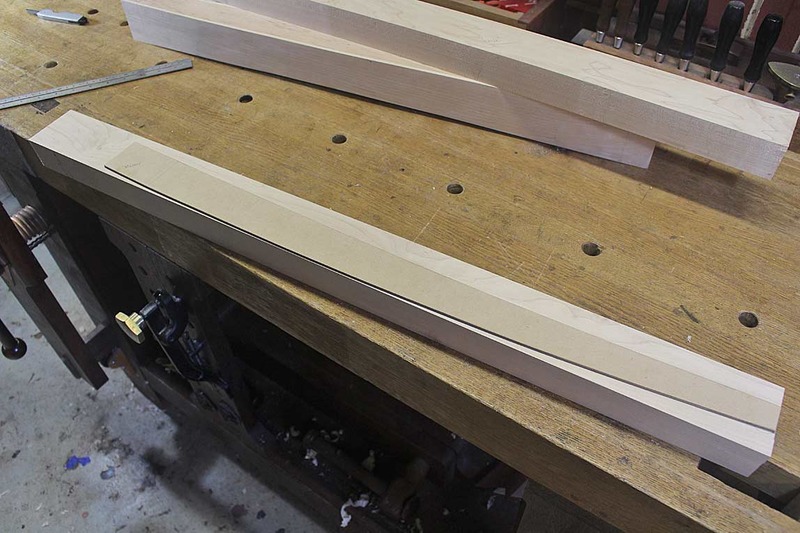
Mark them out and roughly cut away the waste ...

Now you can shape them individually.
These are the legs from my recent sofa table. These legs had compound curves. I retained as many reference sides as possible until they were no longer needed. In the case of these legs, the inner and outer curves could be made immediately, and final shaping (to a third side) took place at the end.
The articles depicting these are here:
http://www.inthewoodshop.com/Furniture/SofaTable-Legs.html
http://www.inthewoodshop.com/Furniture/TheBevelLiesInTheDetails.html
Regards from Perth
Derek
Re: Question
Denny
Thanks for the detailed reply. I did start with 2 templates for the initial shaping on the bandsaw, but once the initial shaping was done, I found it wasn't possible to register the templates with the curved legs, the templates were too stiff to conform to the curves. Probably I should have made a second set of templates in cardboard. Next time...
Re: Question
Larry Barrett
Could you not secure the table upside down on your bench? If you had a holdfast I think that would have worked. Using a spokeshave with two hands really gives you a lot more control than one handing it.
Re: Question
Denny
I tried it, but realized I'd need to stand on a ladder to work on the top half. Maybe if I was taller...
Denny, I kinda lost track,
Wiley Horne--So. Calif.
What spokeshave or scraper did you end up using? Worked great whatever it was.
Thanks,
Wiley
Re: Denny, I kinda lost track,
Denny
Wiley, I got a lot of use out of the Lee Valley standard shave, and also the Lee Valley low angle shave, which I found was pretty easy to hold with one hand (though you have to be careful working with the low angle, I had some close calls). I also used Derek's suggestion of a modified plane blade, though I found it much slower to work with but OK for some final scraping.
Just thinking about it now, it would have been nice to be able to clamp the table to the floor just to hold things in place, but I don't know how you would do that short of putting a few bolts into the concrete.
simpler way? nails of screws
Ian Neuhaus The way I'm visualizing this, having the legs shaped on all sides means they can only be clamped together while the first two opposing sides are shaped and the other 2 sides are still straight. Taking that approach, it would have to be done before bandsawing the last 2 sides, and it would be much more difficult to tape the bandsawn cutoffs back on to the shaped legs to stabilize them for their last two cuts on the bandsaw. It might be possible to clamp the legs with a jig of some sort, but the effort might be more trouble than it's worth. Is there some simpler way to think about this?
I like the idea of clamping the legs together for shaping, but it would be challenging.
nails or screws.
seriously, if you cut the legs over length you can use nails or screws through the extra material to hold the legs in pairs as you shape them.


