Home Articles Forums Gallery Marketplace Videos

WoodCentral Forums

Knowledge You Can Build On — Est. 1998

Sofa Table - take two

Posts

Sofa Table - take two

#1

Sofa Table - take two

Derek Cohen (in Perth, Australia)

It is always helpful bouncing ideas off others. The consensus reinforced my own thought that the position of the legs did not create enough overhang. The issue here is that if there is too much overhang, it does not become possible to add a drawer to the side ... and I really want a drawer.

Before I show you the experimentation I did, just a comment about the wood: I cannot use walnut for the whole build as I only have enough for the top. Importantly, I wanted a significant part of the build to be in hard maple, since it is to link to the newly built kitchen. So we shall stay with that.

What type of black walnut? Perhaps you can tell me. I had an approximately 2" thick board that was about 8" wide - too narrow for a single-board table top. I re-sawed it into two pieces and ended with a book matched panel about 22mm (7/8") thick. There was a large knot in the board, which ended up on each side of the panel. To reduce this effect, I chose to remove that side of the board. The result is more pleasing ...
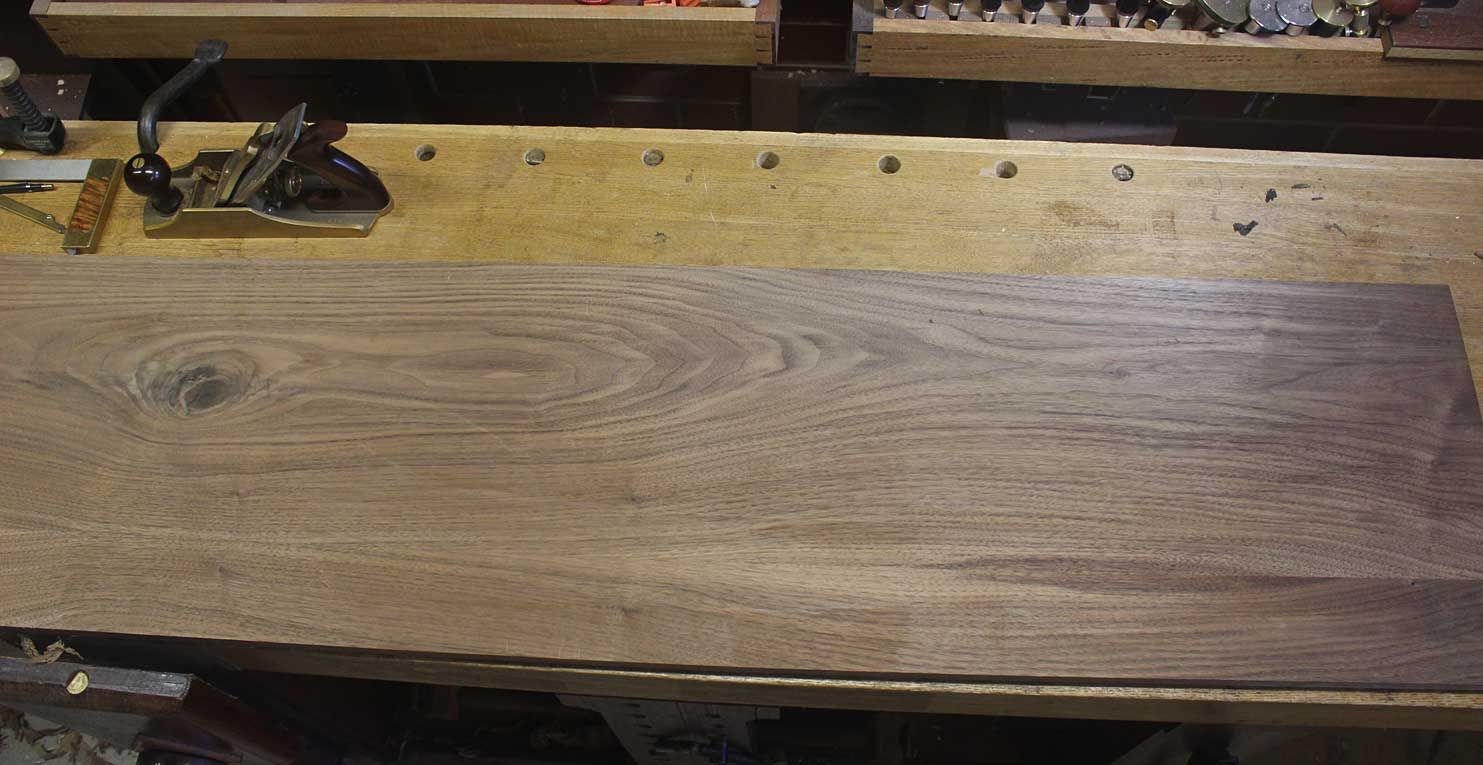
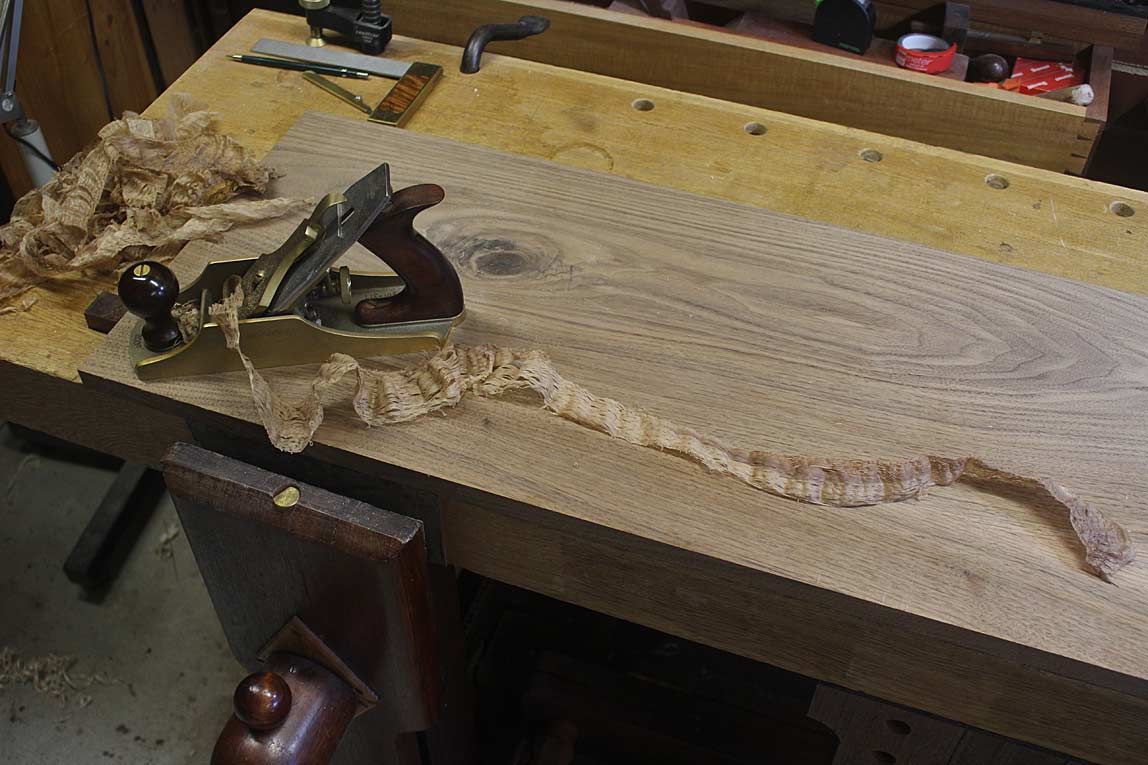
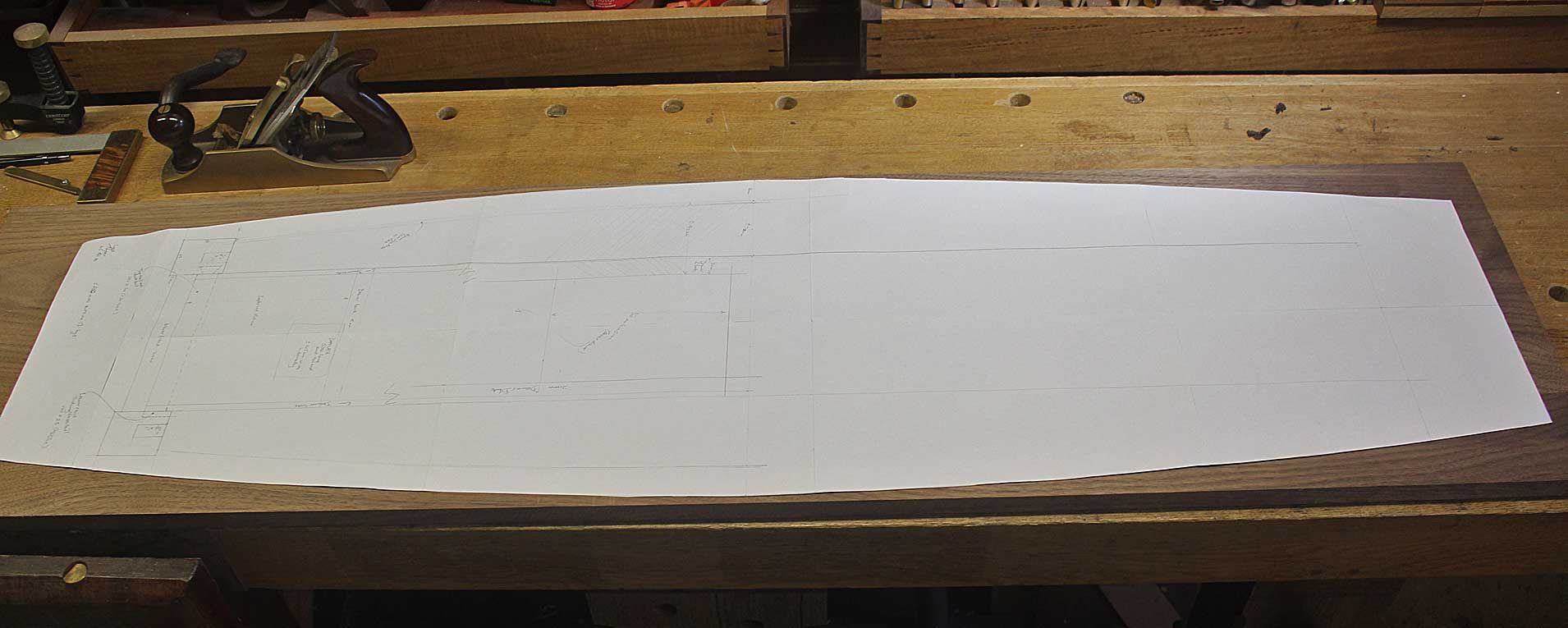

The positioning of the legs went this way:

First, I made up a couple of templates. One for half of the top ..
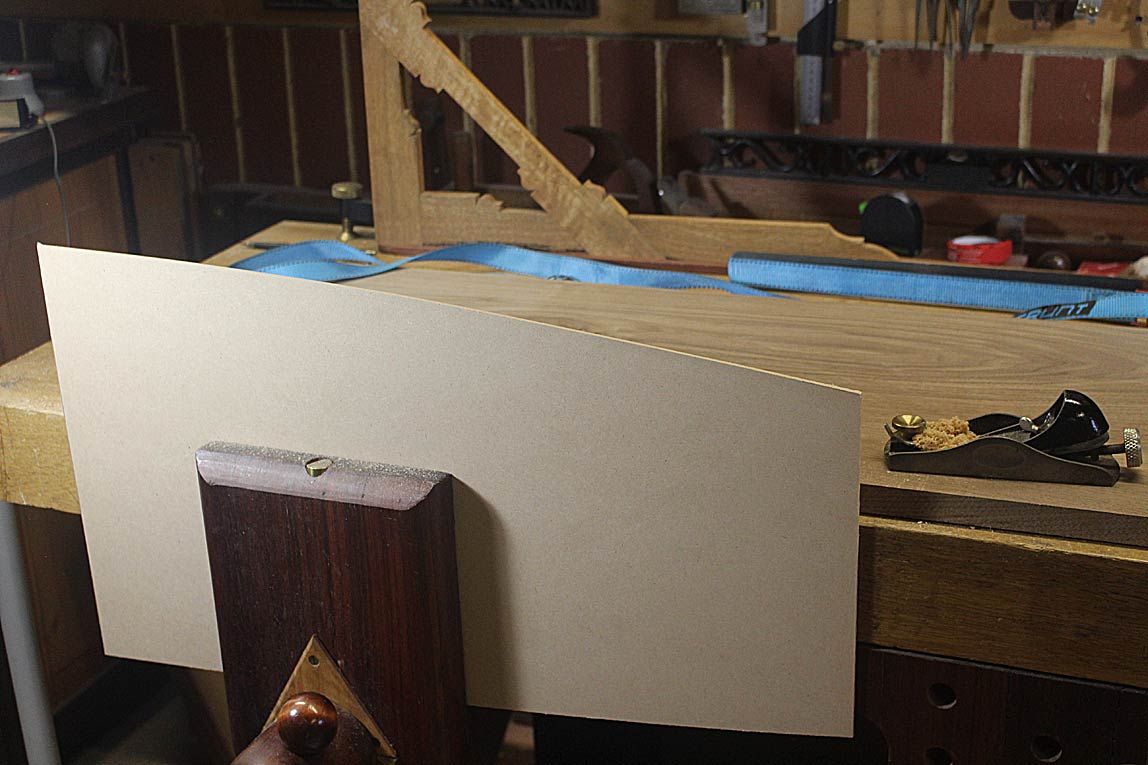

.. and one for the legs ...
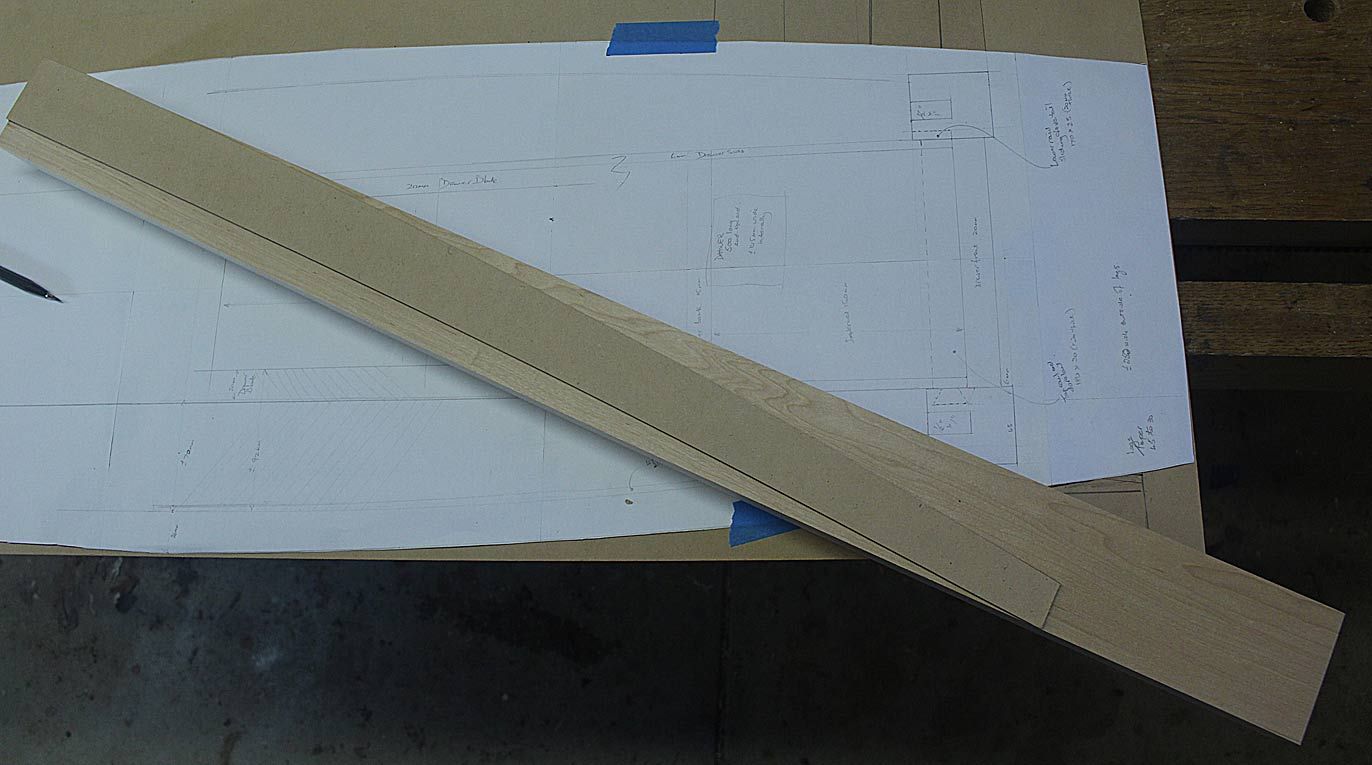

With an extra leg template, this is the original position ...
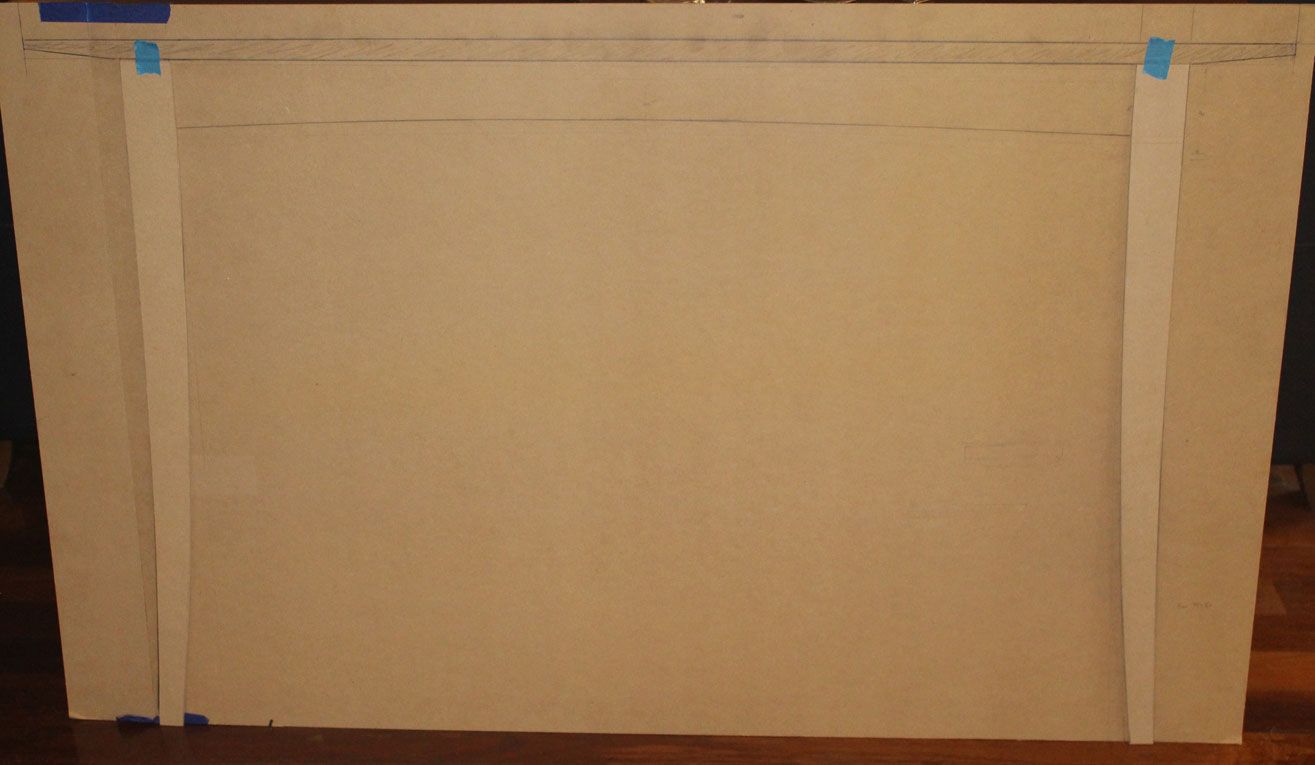

Moving the legs in by 50mm/2" ...
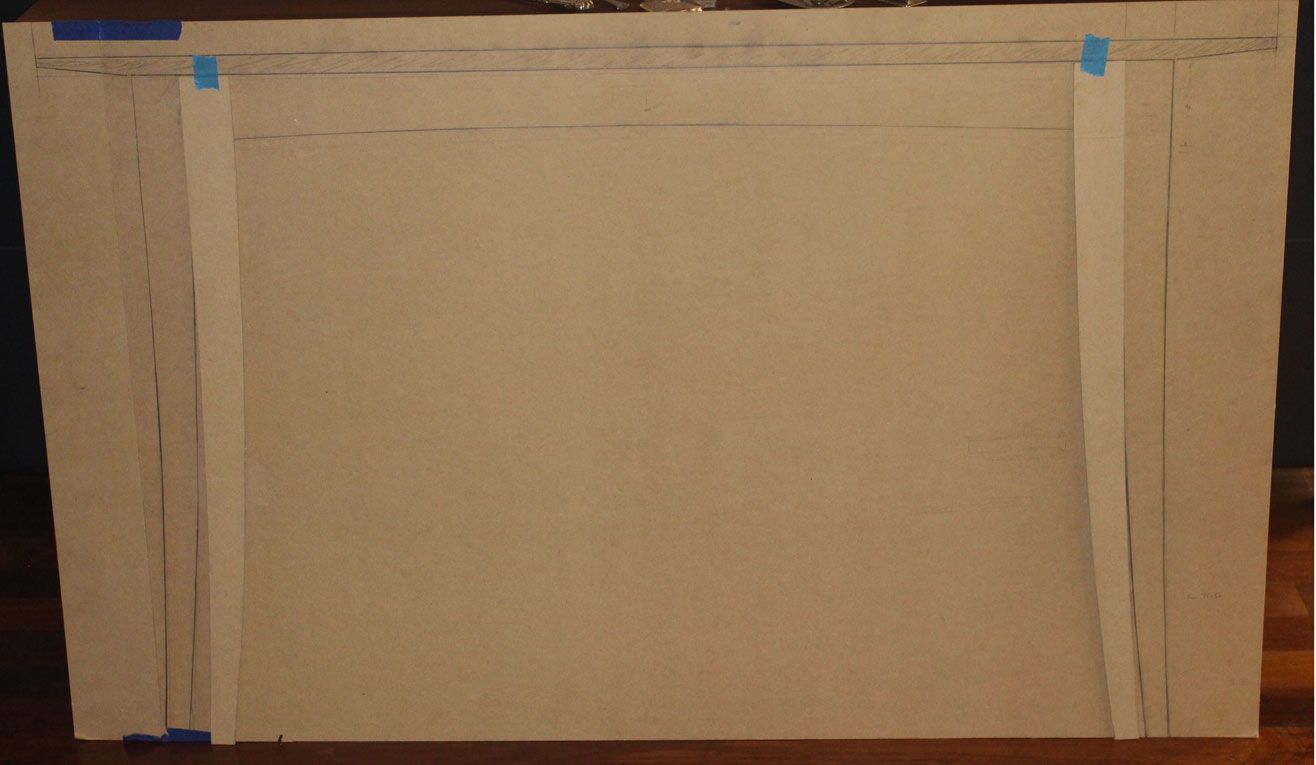

Not enough. So, moving them in by 100mm/4" ...
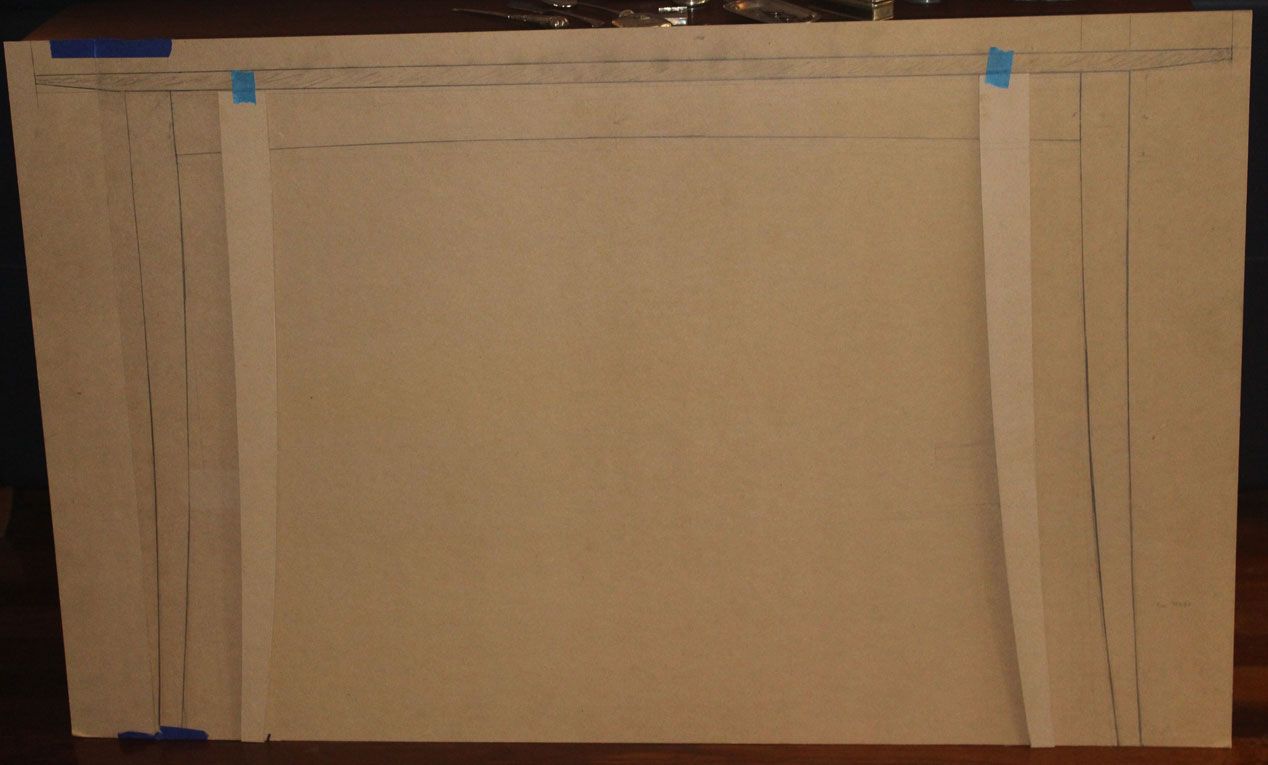

And that is what we will stay with.

I also increased the curve in the apron ...
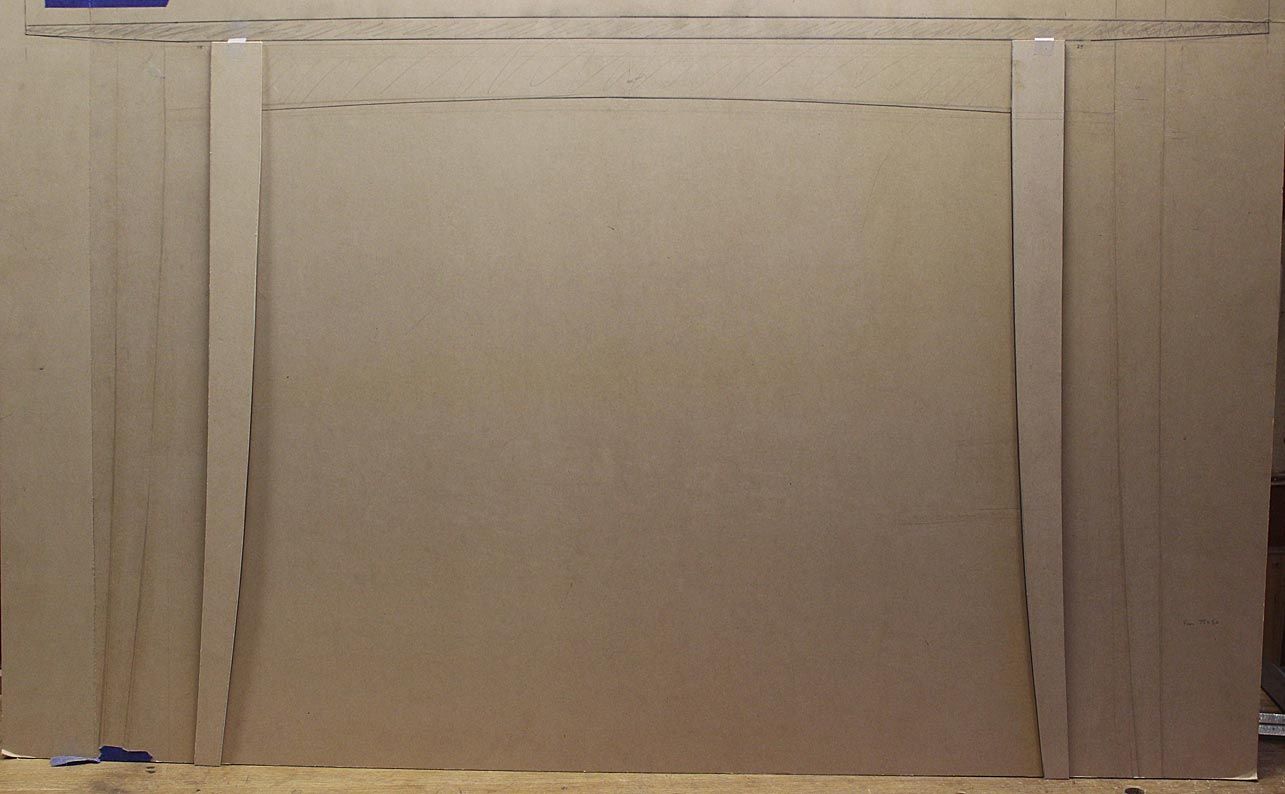

... but I am not keen on this. It looks greater in real life than in the picture (and the original curve looks stronger with the legs moved in).

The advantage of moving the legs inward is to widen the stance, which should add to stability. This is how far in the undercarriage sits ..
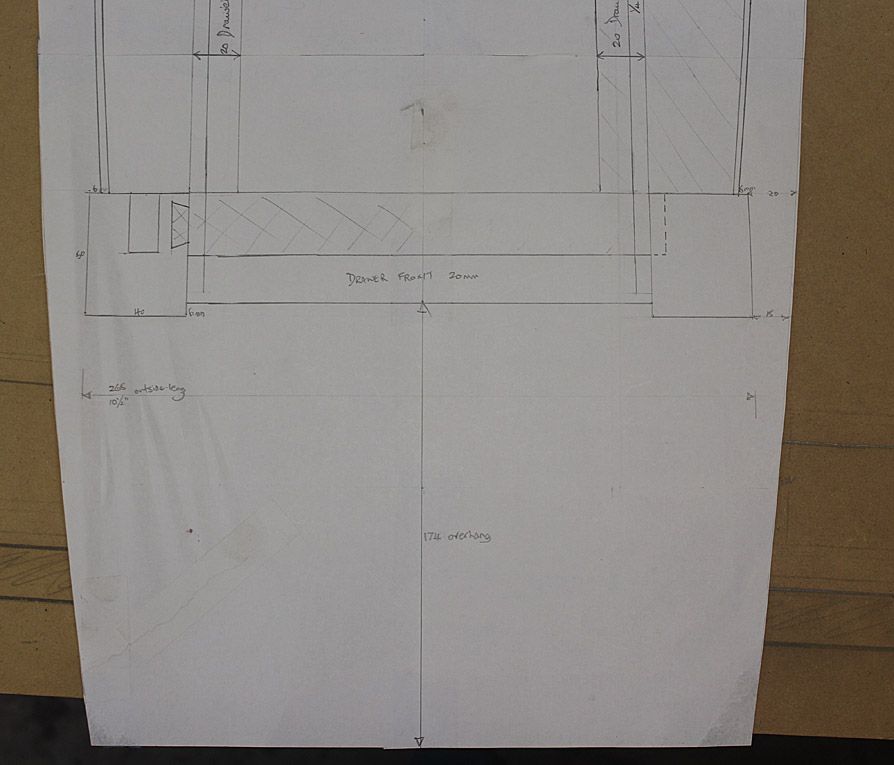

A close of of the details ...
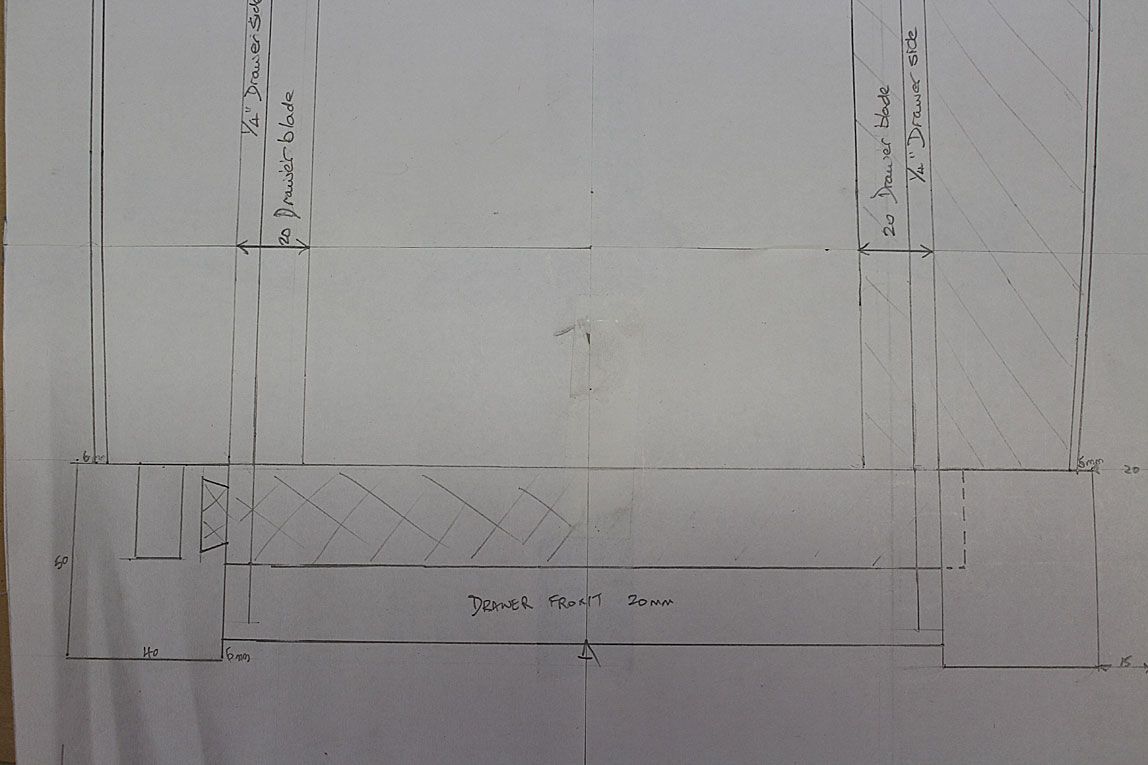

The aprons connect to the legs with a mortice-and-tenon. The left side of the plan shows the top rail dovetailed into the top of the leg. The right side shows the lower rail joined with a sliding dovetail. This is pretty standard for a drawer frame.

The apron will be built in three sections, with a pine centre sandwiched by maple. The maple will be a 4mm veneer on the outside of the bow, and on the inside provide the rebate that functions as a drawer fence and drawer blade.

There will only be a single drawer, on the left side. The other side of the table will be a solid apron, joined with mortice-and-tenon joints.

A single drawer can be made 750mm long, which will provide support for at least 300mm/12" of drawer clearance - plus some space behind for a second secret drawer, if wanted.

Any thoughts?

Regards from Perth

Derek

Re: Sofa Table - take two

#2

get thee to the lumber yard

Bill Tindall, E.Tn.

Surely somewhere in Australia there is a better looking piece of walnut for this table top. Your wood is common walnut from somewhere in eastern US. The knot looks awful and the walnut color and grain is not near the best either. The board looks like it came from walnut the grew more in the open, like in a field.

It will be easy to locate a piece of attractive 4/4 walnut 6" wide. If you can locate a piece with flat grain in the middle of the board and rift on the edge you can get a faux book match that will work. Cut one piece for the top to length off an end. Then fold this piece back onto the edge of the remainder like closing a folding knife. Slide the cut piece up and down the remainder until you get a good match along the edges. Success depends on rift grain along one edge.

see PIC for example on top and side


I like the revised leg arrangement.

Re: Sofa Table - take two

#4

It is nobel....

Bill Tindall, E.Tn.

"trying to make the best of a sad board. " One can't fault you for trying. I do it myself. Maybe somewhere some place it will find a home....just not the top of an otherwise lovely table.

Re: Sofa Table - take two

#5

Re: It is nobel....

Kees

Same problem overhere with cherry boards. I have two nice wide boards, just enough for the cabinet top. But they are also pretty bad when looking closer. So I am off to the lumber yard too. Stuff happens....

Otherwise I like the new position of the legs a ton better!

Just a quick remark. Somehow I also try to get a design fixed on some nice whole number. That's silly. Just push the legs back and forth and look. When you are satisfied with how it looks, then meassure if you really need to know the exact distance. It doesn't matter if it happens to be 11.97 cm, or 18.23. It only matters how it looks.

Re: Sofa Table - take two

#6

Re: It is nobel....

Derek Cohen (in Perth, Australia)

Just a quick remark. Somehow I also try to get a design fixed on some nice whole number. That's silly. Just push the legs back and forth and look. When you are satisfied with how it looks, then meassure if you really need to know the exact distance. It doesn't matter if it happens to be 11.97 cm, or 18.23. It only matters how it looks.

Hi Kees

One of the issues when posting a design at an early stage is that there will be many conflicting ideas from all concerned. This is not always helpful. However, it certainly forces me to try and understand the views of others and, importantly, where I am coming from.

I have gone back-and-forth on the positioning of the legs. Much of this is pressure from my wife, not just the comments on this forum, since I must accommodate her needs and aesthetic sense as well.

As I sit and ponder the way the parts come together into a whole, I see a loss of elegance as the legs close up. I think that she (and others) have seen the other sofa tables I have built, liked them, and expect something similar. However, this table was conceived with a different aim - I want it to contain a drawer. That is not conducive to an open frame.

Similarly, the impact that the curve of the apron has alters with the positioning of the legs. One aspect here is that the apron needs to be conceptualised in three dimensions, not the 2-D of the drawing/photos. The apron bows and is, therefore, a compound curve (and the bow of the apron went through several versions before ending where it is now - for similar reasons).

So I am giving more thought to the placement of the legs while I search for a replacement for the top ... partially back to the drawing board :)

Regards from Perth

Derek

Re: Sofa Table - take two

#7

Re: It is nobel....

Kees

I understand your predicament completely! How about a mockup in some MDF and spruce? Maybe even stain it to get a sense for the colors?

Re: Sofa Table - take two

#8

Board searching

Bill Tindall, E.Tn.

This question takes the conversation way off topic, but I am curious. When I have asked our large lumber producers about export sales they tell me that over half their sales are export. When we sold lumber I tried to snag packs put up for export because the grade was better. So, a lot of good lumber is leaving the US to go somewhere, but "elsewhere" is a big place.


I gather you live in or near a large city. Here in the US such a place would have more than one hardwood supplier that would stock several hundred or more bdft of all the hardwood lumber commonly produced in common sizes of 4/4, 5/4, 8/4. Additionally, there would be a few retail places, for example Woodcraft, that would have a small stock, but great variety of domestic and imported lumber. Locating lumber for a small project would not be challenged by finding the lumber, but only by finding it at the best price and quality.

What is the situation where you live for buying American hardwoods?

Re: Sofa Table - take two

#9

I find ....

Brian Roberts

that putting the leg patterns on the original drawing prevents a real feel for the new leg positions.

The eye tends to see a mixture of old and new.

Perhaps....since complete erasure of the original leg drawings is not practical....covering them with pieces of the drawing paper would allow a clearer vision of the new leg placement?

Re: Sofa Table - take two

#11

Two changes

Brian Holcombe

I like the legs moved in the furthest that you show them. Typically I do like long overhangs.

I think the leg pattern should change to be straight on the outside and a taper on the inside where your curve starts.

Too many curves, you have it in the table top so I think you should remove it from the legs and skirt.

Re: Sofa Table - take two

#12

Re: Two changes

Derek Cohen (in Perth, Australia)

Hi Brian

The legs curve-and-taper from front to back. The insides have a straight taper. The outsides are straight.

The planned curve in the apron and top is not pronounced. I plan to mock this up in pine, but I visualise this as a gentle, soft curve. I did mention in my reply to Ellis, below, that I am not completely sold on a bowed apron - the combination of curved apron with curved top may be too much.

Regards from Perth

Derek

Re: Sofa Table - take two

#13

Project drawing

Bill Tindall, E.Tn.

For what it is worth....If I draw something to scale I can predict how it looks so long as what I am drawing are orthogonal surfaces. When I started incorporating curves into projects I found that my flat scaled drawing was unreliable for predicting how the finished project would look. I was forced to adapt to making a mock-up, something I had regarded as a time and material waster. If I was faced with making this table I would overcome my frugality with time and materials and rough it out from something to see that it was going to look as good as I could design it.

I have made mock-ups with poplar which here is cheap. When they turned out well I painted them and put them to use in my house or somewhere else.

for example:


Re: Sofa Table - take two

#14

Re: Project drawing

Brian Holcombe

Drawings are not always useful, depends on the project. For cabinet making I find them occasionally useful, but truly once the piece is in the flesh it is usually a reminder of what you forgot about when drawing, the small details become large and far more important than how they appeared prior.

I typically draw when I'm working out a new concept but outside of that I rely only upon my eye and gut. I attempted to work out every detail for a while but found myself improvising so often that it was not worth the original effort.

Re: Sofa Table - take two

#15

Re: Project drawing

William Duffield

For a project like this with subtle curves, another modeling alternative is SketchUp. After you've defined the curves, you can put them all together on your computer screen, view them in perspective, rotate them to the angles they will normally be viewed from, and subtly modify the curves. While learning the program takes a while (and learning new programs seems to take longer the older I get), once learned, it is relatively quick to experiment with subtle (or even major) changes. You can change the wood. Think of it as if it were Pergo, just pictures of wood. :) You can even take a picture of the room, build a model, paste the pieces of the picture on the model, and drop the model of the furniture into the scene. You will probably still need to do a mock up in real wood and set it down behind the real sofa, but the computer can get you a lot closer than paper and pencil.

Re: Sofa Table - take two

#16

Mock-ups

Steve Elliott

One of the most important reasons I use mock-ups for furniture is to determine whether the size of the piece is right for the space. Often what looks good in the shop seems too big for the intended space or interferes with traffic flow or would look better if its height matched something in its environment.

A piece of cardboard cut to the size of a table top and set on a sawhorse with blocks to put it at the right height can help with these issues, so there's very little time invested. If it's a paying job it gives the customer a chance to approve or ask for changes.

Re: Sofa Table - take two

#17

Re: Project drawing

Wiley Horne--So. Calif.

"but truly once the piece is in the flesh it is usually a reminder of what you forgot about when drawing, the small details become large and far more important than how they appeared prior."

This is pretty much my experience too, and gives rise to some random thoughts.... Of course, if the piece is really unfamiliar to you, it takes full-size mockups to get the overall picture in focus, in two dimensions at least.

But I have to prototype the pieces. A 3/32" cockbead looks a lot different than a 1/8". A carcase bead of 1/8" is hugely different than 3/16"--but I can't see it on a drawing or even a two-dimensional full-scale mockup. Same thing with width of banding. A 25 thousandths string looks hugely different from a 1/32" string, if it's small scale like the surround of a paterae on a leg post. Bill Tindall can come up with perfect rift-sawn legs sometimes, but it takes me a lot of time overlaying a 'leg mask' onto an 8/4 plain-sawed leg blank, trying to find the best leg in it, or even an acceptable leg. Lots of time you can't tell until you put finish on it, so the grain jumps out. How many times have you arranged and rearranged three 8" boards trying to find the top? And you still have to get finish on them to know.

As Brian says, working with the thing 'in the flesh' is when I begin to find out what that wood is going to add up to.

Wiley

Re: Sofa Table - take two

#18

Re: Three 8" Boards

William Duffield

I calculate the possible number of combinations is 192, or double that if the top is to be asymmetrical.

Re: Sofa Table - take two

#19

two big pluses . . .

Bob Lang

. . . for using SketchUp:

1) you can visualize what you're designing in three dimensions, from any possible point of view. It's way too easy to create something that looks amazing in a standard orthographic view that is just plain ugly in the real world. And as William mentions you can render it with different types of wood and put it in a model of the room it's going in.

2) you can copy an entire model in no time flat, modify the copy (or copies) and compare iterations side by side.

I can see the value of a full-size 3D mockup, but those take a lot of time and it's easy to get stuck with a design that isn't the best because we start to like things simply because of the time we have invested in doing conventional drawings and making mockups.

Bob Lang

Re: Sofa Table - take two

#20

Re: two big pluses . . .

Brian Holcombe

Sketchup helps in some cases, rather aggravating in others. I find it completely useless for chair making and would rather do all of it by hand and work backwards into a 3d shape if need be.

It's great for cabinet work, helpful to mentally work through complicated designs.

Easier still to work out proportions that are a paper guess.

Not great at showing reality. I wish it had a function for providing an eye-level perspective from a scaled distance (it may well have this, but I'm unaware of it). Furniture always looks good at a low perspective if it is a good design at all, that's why furniture photography is almost always done at a low perspective. It's easy to fool yourself into thinking that your design is good because you designed it at a low perspective and it looks nice where in reality when viewed from a standing perspective it man appear bulky or otherwise unwieldy.

I realize that I am making the good the enemy of the great here, but I think it's fair to offer honest perspective on these devices. There is no substitute for gut instinct.