Home Articles Forums Gallery Marketplace Videos

WoodCentral Forums

Knowledge You Can Build On — Est. 1998

Piercing long boards

Posts

Piercing long boards

#1

Piercing long boards

Derek Cohen (in Perth, Australia)

My original idea for the sofa table's front apron was to pierce it. I thought that this would do two things: add a bit of whimsy, and also create a filigree that would lighten the solid front.

The bowed apron is planned to be built from solid pine with a 4mm veneer of walnut behind a 4mm veneer of hard maple, the latter which would be pierced.

I have never done piercing before, but am prepared to practice to get this right. It does not seem particularly difficult ... as long as one is able to saw forwards. The problem with the apron is that it is too long to do this. Either the saw must turn, or the blade must turn in the saw. I have two Knew Concepts fretsaws, one is a 5" that I use for dovetails. The blade turns to 90 degrees. The other is an 8" KC fretsaw, which is especially for jewellers, and the blade turns 360 degrees.

When sawing straight, there is no problem. I have tried a few different types of blades to saw along the board. One was a 46 tpi spiral fretsaw blade. Interesting blade. I could go sideways, but the cut out looked like a rat gnawed its way through the board. My regular 15 tpi blades were too coarse. And the very fine blades I had (purchased in error many years ago) produced a fantastic cut moving straight ahead, but they just snapped when changing direction (any sideways tension is too much).

Is there a secret to this?

Here is the pattern I made and transferred to the maple veneer ..
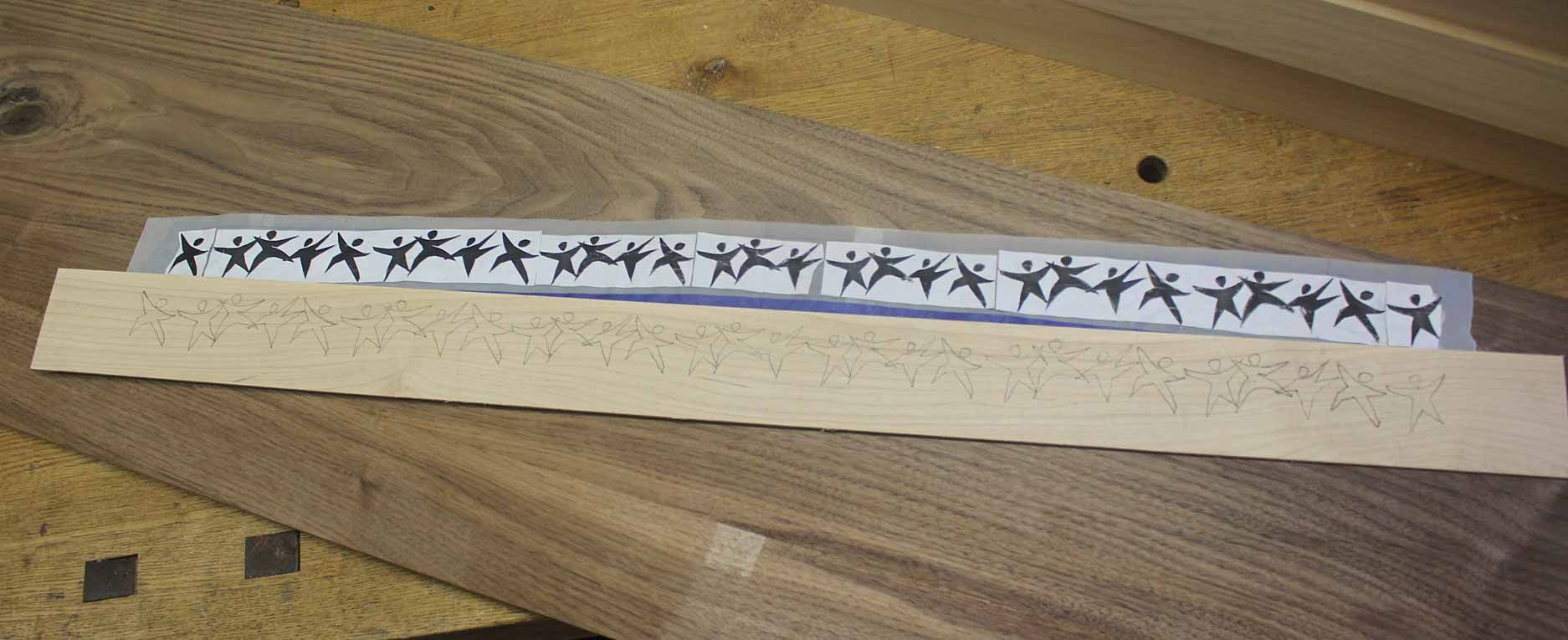

Some practice pieces ...


Regards from Perth

Derek

Re: Piercing long boards

#2

Fretwork

Warren in Lancaster, PA

We call this fretwork. We use a fretsaw for making the cuts. The blades break easily if they are overstressed and beginners are more likely to have problems. Sometimes we make two cuts going into a sharp corner rather than try and turn on a pin head. Sawing frets is an art, not some trick one learns how to do.

I recommend starting with a traditional geometrical pattern. Patterns for fretwork are often carefully designed to avoid delicate short grain areas. Your pattern has short grain stems and spikes which are too vulnerable to breakage while sawing. You must keep the grain direction in mind both when designing and executing. Even after being glued to a background, short grain areas are vulnerable to breakage. Also you have islands of material, parts of the pattern which are not connected to the rest of the fretwork.

Re: Piercing long boards

#3

Re: Piercing long boards

Bill Tindall, E.Tn.

Borrow a scroll saw....one that has a motor on it. The task will become trivial.

You can grab a fret saw blade with pliers and bend it 90 degrees at the jaws. The bend will enable sawing in a direction where the straight blade doesn't.

Re: Piercing long boards

#4

Re: Fretwork

Bill Tindall, E.Tn.

While I don't agree that fretwork is hard to learn to saw, at least with a scroll saw, his point on the difficulty your pattern presents is spot on. Short grain features can be dealt with by laying up a "plywood" board for the pattern to be sawed.

Hint on sawing sharp points. Saw into the point. Back the blade out of the point to a waste area, turn it 180 degrees and then back the blade into the point. Then saw the pattern back out from the point. Fret sawing is tedious. But not difficult. Someone experienced will do it times faster, but I don't subscribe that they will do it any better.

For long patterns divide them at some advantageous feature and rejoin on application.

Re: Piercing long boards

#5

Re: Fretwork

Derek Cohen (in Perth, Australia)

Hint on sawing sharp points. Saw into the point. Back the blade out of the point to a waste area, turn it 180 degrees and then back the blade into the point.

This is good advise, Bill, but I am not sure how to apply it in my situation. Because of the length of the panel/apron, it is only possible to turn the saw in a 45 degree arc. Or am I missing something? All the videos I have watched of fretsawing patterns involved the piece being rotated while the fretsaw was kept in one spot. I cannot do this. How would you?

Regards from Perth

Derek

Re: Piercing long boards

#6

Re: Fretwork

Bill Tindall, E.Tn.

"How would you?" see earlier answer. borrow a scroll saw. It worked for me on the occasion that I needed some fret work for a piece. I decided that I didn't like the tedium of fretwork and vowed not to incorporate it in anything else.

Long runs of fretwork are common in Period American furniture. Maybe they did it in sections. On a scroll saw it is somewhat stressful handling a 40" long piece that is mostly done. However repairs are easy to make. ;)

Re: Piercing long boards

#7

Re: Piercing long boards

Dennis

I would suggest a different approach. First 2-2.5mm, or even thinner in thickness makes sawing easier, and reduces the shadow effect when viewed at an oblique angle. I would pierce every corner with a .5mm drill bit, use the largest possible drill bit for each head, and abdomen. Then using the saw, absolutely vertical, with a very light hold, move it up and down like a piston cutting with the grain, in the same direction you would use a knife(so if the saw deviates, it runs into the waste). Use a dryed out bar of old-fashioned laundry soap as lubricant. Cleaning corners or in the case of the heads (that are meant to be out of round) with the saw, a knife, or file.

Re: Piercing long boards

#8

Re: Fretwork

Warren in Lancaster, PA

I don't know what you mean by a 45 degree arc. We are able to adjust the fretsaw so the blade is perpendicular to the frame or cutting toward the frame, and often switch it around in the middle of a cut. Here is a nice Roubo saw:


Re: Piercing long boards

#9

Re: Fretwork

Derek Cohen (in Perth, Australia)

Hi Warren

That is a very nice fretsaw. Do you have one like it? I've not seen one, or know if they are available. I do have a prototype Knew Concepts, which I cannot show here, but it works in a similar way, that is, the blade can rotate.

I do understand the principles of fretsawing. I am also a fairly quick learner. The blades that I have been snapping are 4.0 from Otto Frei (purchased some years ago in error). They are very fine. The slightest over tension on the saw snaps them. However, they are fantastic when I get the tension right. The other blades I have are 18 tpi. Very different. I use them for removing dovetail waste. They cut fast, but are coarse. I have not snapped a blade like this in many years.

The problem I have is that the work cannot be turned, and I need to practice turning the blade in the fretsaw. This is new for me.

This is the workpiece (the figures are close together - what you saw before was just a board I used for practicing saw cuts). Notice that some of the lines run along the board. Others may be reached with a diagonal cut ...


Regards from Perth

Derek

Re: Piercing long boards

#10

English Used Tool Sites

david weaver

Derek -

Saws that look of that type or similar (with a flat steel frame and various types of adjustable blade holders) show up on UK used tool dealers' sites fairly often.

https://www.tooltique.co.uk/product/antique-fret-saw-with-two-part-handle-and-lever-tightening-adjuster/

This is the first one that came up. Not sure if it works identically, but I know when haunting those sites for other things, I've seen various old wood and metal fret saws, and they never go for too much. If I've seen 10, maybe 2 are identical.

Re: Piercing long boards

#12

Re: English Used Tool Sites

William Duffield

On that particular saw, you can only turn the blade in the handle in 90 increments. That's probably too coarse and adjustment for Derek's patterns. But there are fret saws that will do the job. Another antique illustrated by Chris Schwarz actually had a steel cable and pulley linkage between the two blade holders that allowed both ends of the blade to be rotated together, to keep the blade from twisting.

Re: Piercing long boards

#13

Re: English Used Tool Sites

david weaver

That one is sold, too. It's worth asking around until you find what you want. At the price of antiques, I can't imagine entertaining a $200+ "titanium" saw, but I know the latter sells better.

Re: Piercing long boards

#14

Re: English Used Tool Sites

William Duffield

I don't have a Titanium saw (They're real Titanium, no quotes), but I do have one of the Knew Concepts red Aluminum fret saws. They are very stiff and light, which is an advantage, and their rotation control is in 45° granularity.

I'd like to know more about the Roubo saw that Warren illustrates. From the square hole in Fig. 7, I suspect it may also have a 90° turning granularity, and further, that all the mechanism in the handle is for tensioning the blade, not turning it. There are lots of plates in Roubo's books, so I don't know where to begin looking for more details without an index. Searching the text for "fret" is not helpful.

Re: Piercing long boards

#15

Re: English Used Tool Sites

david weaver

That wasn't directed at you necessarily, William. Apologies if it seemed that way.

I had one of the aluminum ones at one point, too, but am happier with a saw that has a bit more weight, thus it went to ebay and was gone. That style may have more value (the low weight) to someone who does a lot of very thin cutting or who is working on thin metal, which I'd assume is the intended market.

One thing about the "it" tools, they are easy to sell on Ebay.

(The other thing about them, for the price of one titanium saw, you could have five or six nice vintage fretsaws of various designs. You might have to work one or two of them to get them right, but that's a small price to pay. It's like infills or just about anything else - what I have on the bench here is about the cost of one new boutique infill plane: https://s11.postimg.org/mks0nkqlf/20170521_191641.jpg . Even for someone who isn't making money with tools, and thus doesn't have to justify output, that's pretty stark).

Re: Piercing long boards

#16

Re: English Used Tool Sites

William Duffield

No offense taken. My only point was that Knew Concepts uses Titanium in some of their saws, for the same reason it is used in military aircraft, because it is very light and strong. Unlike some companies, who use high-tech buzz words just for marketing, Lee and Brian at KC use it for valid engineering reasons, because stiffness is an advantage in fret saws.

As a side note, their original Titanium saws, which required too much of the metal to justify the cost, were discontinued when they ran out of scrap. Their new Titanium saws do not have as elegant an appearance, unless you are a fan of steel truss bridges. :D

Re: Piercing long boards

#17

Re: English Used Tool Sites

david weaver

I can only vaguely remember the original saws, though I remember the red aluminum ones pretty well because I had one in my hands for a little while.

I'll have to rethink how I use quotes, I see how that came across. I know he uses titanium, the real kind of titanium. I put it in quotes because it's practically a separate class of fretsaws. "titanium" fretsaws, where I'd maybe use the term "import", "classic/lancashire-looking" or "wooden".

Too many quotes. They're rarely required. I did buy a "barely used" norris recently, but I found out that it was more than "barely" surface ground once I got it and was "barely anything" like the seller said. If I'd have gotten it for the price it should've been, i could've had a titanium fretsaw with the proceeds.

Re: Piercing long boards

#18

Re: English Used Tool Sites

William Duffield

How about ¡TITANIUM! ? :D Does that make it look like it's really Titanium, as opposed to ostensibly titanium or a cheap Chinese titanium knock-off?

While most of the word processors buried in our operating systems come equipped with spell checkers, you rarely find one with grammatical and punctuation checkers. From the gibberish young people post on Twitbook these days, you'd think they aren't taught that in school anymore.

While I have my grammar nazi hat on, I need to mention that I should not be capitalizing the names of chemical elements. :(

Re: Piercing long boards

#19

Re: English Used Tool Sites

David weaver

In my youth, I boasted that I only paid attention in math. I think my grammar shows it!

Plus, nobody tells you there are so many words in real math!

And now you tell us there's fake Chinese titanium! I thought it was just poor quality.

Re: Piercing long boards

#20

Re: Fretwork

William Duffield

Even in period Chippendale and Federal pieces, the fretwork was usually sawn in plywood. Of course, the veneers were sawn by hand and the plywood glued up by hand from three layers.

Re: Piercing long boards

#21

bridger

Re: Piercing long boards

bridger

Have you tried making your cutouts with a sharp knife?

Re: Piercing long boards

#22

Re: Piercing long boards

Derek Cohen (in Perth, Australia)

Thanks for the suggestion, Bridger.

Yes, I tried this. It was not a look I liked.

I have continued practicing and now am getting good results. The two main aids have been to drill all the corners of the sharp direction changes, and to use a finer blade. I found some 36 tpi, and these are so much easier to get a clean cut with than 15 tpi (which are fine for dovetails but not this work).

I think that I will save the idea for another project.

Regards from Perth

Derek