Home Articles Forums Gallery Marketplace Videos

WoodCentral Forums

Knowledge You Can Build On — Est. 1998

Files, rasps, floats, rifflers, etc

Posts

Files, rasps, floats, rifflers, etc

#1

Files, rasps, floats, rifflers, etc

Josko Catipovic

Can someone help me grasp the difference between (woodworking) files, rasps, floats, rifflers and other metal blanks with toothy protuberances? I use files for filing metal, and have a big ol' rasp in my tool cabinet that probably hasn't been used in 30 years. Other than that, I'm clueless.

I do see that wood carvers use them, but do folks find uses for them in more mundane forms of woodworking?

Re: Files, rasps, floats, rifflers, etc

#2

Jack Guzman from Maine

Re: Files, rasps, floats, rifflers, etc

Jack Guzman from Maine

I use half round nicholson rasps for general shaping,finer toothed hand cut rasps for a smoother surface and files for the best surface before scraping or sanding. I use round rasps for elongating tenons and creating tapers among other jobs. I have many various files and rasps and besides these tasks I find many woodworking uses for them. I could manage without them but I would not want to.---Jack

Re: Files, rasps, floats, rifflers, etc

#3

Re: Files, rasps, floats, rifflers, etc

BrianMonumentCO

A rasp is a like a file but more aggresive teeth

A riffler or riffler rasp is a two ended rasp with shaped surfaces on each end.

A float is a tool used in making planes it has single cut very aggressive teeth that are full width and have a tapered blade.

A woodworking file is much like a metal file.... According to some it is more like a rasp.

The cut is at least a bastard cut file.

As a gunsmith, I used metal files to work both metal and wood.

I hope we get more info...

Re: Files, rasps, floats, rifflers, etc

#4

Re: Files, rasps, floats, rifflers, etc

Derek Cohen (in Perth, Australia)

Can someone help me grasp the difference between (woodworking) files, rasps, floats, rifflers and other metal blanks with toothy protuberances? I use files for filing metal, and have a big ol' rasp in my tool cabinet that probably hasn't been used in 30 years. Other than that, I'm clueless.

I do see that wood carvers use them, but do folks find uses for them in more mundane forms of woodworking?

Hi Josko

Files may be used for both metal and wood. I keep a separate set for each. The ones for wood are great for fine smoothing. However, they work very slowly, which is why one would rather use a rasp for more rapid removal of waste.


Generally, the teeth on a file are made by machine, and even in size and position. They are different to the teeth on a rasp, where the better ones are formed by hand and act like tiny planes. Forming them by hand (called stitching) creates irregular spacing, and this acts to avoid tracks forming - consequently, one can achieve a fairly smooth surface from coarse teeth.


Generally, one side is flat while the other is round. They come in many different teeth size (referred to as "grain") ...
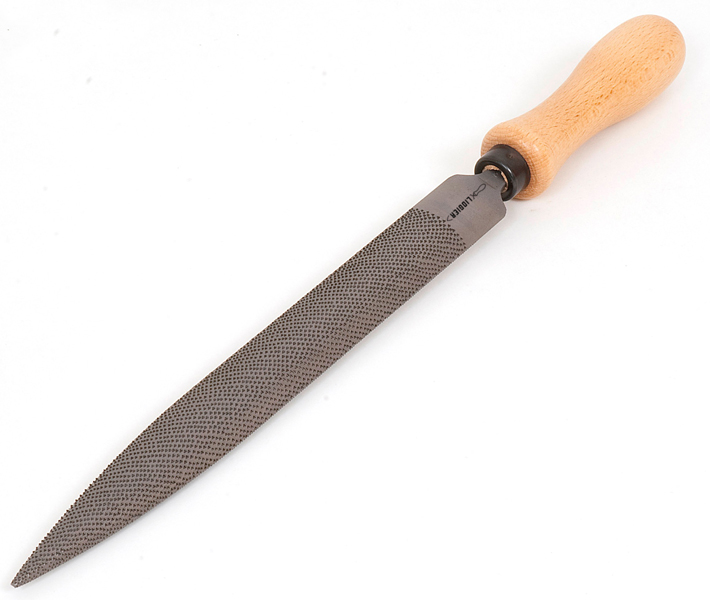

The tooth sizes (grain) are numbered from 1 to 15, with 1 being the coarsest, and 15 the finest. In practice, only the sizes between 4 and 14 are commonly used.


A riffler is essentially a small rasp, used for detail work (in wood or stone). The heads may be made in different profiles to aid in shaping.


As with rasps, rifflers are available in different grains.

A different type of rasp is the Japanese Shinto, which is a series of hacksaw blades joined together ...


Floats are are a cross between a file and a saw. They have teeth shaped in profile like a rip saw, but have wide teeth (say, 1" across). They are sharpened the same way as a saw, and are used to plane wood. Planemakers use them for creating (for example) a bed, and cabinetmakers use them when truing joinery ...

A joinery float ...


This one is used on tenon cheeks ..


Regards from Perth

Derek

Re: Files, rasps, floats, rifflers, etc

#5

Jack Guzman from Maine

...correction

Jack Guzman from Maine

I meant to say elongating mortises not tenons.---Jack

Re: Files, rasps, floats, rifflers, etc

#6

Re: Files, rasps, floats, rifflers, etc

William Duffield

A rasp is not like a file. Each tooth of a rasp is struck individually, and has a sharp point. The cutting edges of files and floats are struck with a tool that looks more like a plane blade, leaving a ridge all the way across the face of the file. The top of the ridge is relatively flat. A second cut file is struck with another row of ridges at an angle to the first series of ridges, breaking them up, but still leaving the cutting edges more or less flat on top. The fibers left on the surface by a rasp are shredded and broken. Therefore the rasp cannot leave a finished surface, and must be reworked by finer, smoother tools. At the other end of the spectrum are floats and the Iwasaki Japenese files, which leave a finished, smooth surface, like a plane blade. Regular files are somewhere in between.

Re: Files, rasps, floats, rifflers, etc

#7

Re: Files, rasps, floats, rifflers, etc

BrianMonumentCO

Actually according to manufacturers, a second cut file is between a bastard cut and a smooth cut file.

The file you are referring to as a second cut is REALLY known as a flat file.

A mill cut file, one of the more common file cuts, has a single set of strikings all parallel.

The flat file has two sets of strikings, each at a two different angles creating what appears to be individual teeth shaped like a pyramid.

Some nicholson half round files are mill cut on the round side and flat cut on the flat side

As far as a file and a rasp being similar they most definitely are. They share a similar shape, they both cut surfaces and share a common basic purpose. The exact details and how they are made are different. That does not make them disimilar.

Re: Files, rasps, floats, rifflers, etc

#8

Iwasaki files

Wiley Horne--So. Calif.

Sir Wm and all,

Have you tried the Iwasaki files? Some years ago, my friend Konrad was amazed by them. And he was using them on very hard Dalbergias which were hard on the European handmade rasps.

Just curious about the experience people are having with these Japanese files.

Wiley

Re: Files, rasps, floats, rifflers, etc

#9

Re: Iwasaki files

Derek Cohen (in Perth, Australia)

Hi Wiley

I have a couple of Iwasaki files. I'm rather late to them, having used traditional rasps for quite a long time now. The promise of a smooth surface lured me to them, and purchased two a few months ago.

The first time I put one to wood, I found it grabby. It seems to be easing up as i use it, but I am wary of putting it to wood in anger until it has worn in more. The surface quality is closer to a file file than a fine rasp.

A sharp rasp is a joy. They cut easily and do not grab. Ditto files. The Iwasaki files seem to me to be more like floats, and we have all experienced how a nearly sharpened saw can be grabby until it has dulled a little.

I wonder if my experience is shared by others?

Regards from Perth

Derek

Re: Files, rasps, floats, rifflers, etc

#10

Re: Iwasaki files

Bob Entwisle in NJ

Hi Derek,

Yes, the first time I used an Iwasaki, grabby was what stood out. I think they just require a little different touch than the conventional rasps and files that I am used to using.

Bob in NJ

Re: Files, rasps, floats, rifflers, etc

#11

Re: Iwasaki files

William Duffield

I have this one:

https://www.woodcraft.com/products/iwasaki-8in-half-round-extra-fine-file

I haven't used mine much, and haven't put a handle on it yet. It definitely needs a handle, because like Derek and Bob have noted, it can be grabby. When it grabs, the tang is quite uncomfortable. It's worse in tough woods, like ash and oak, but tends to behave itself better in harder woods. Although I haven't used it on poplar or pine yet, my guess is it would be even more difficult to get the right touch to make it cut these woods well. I also tried it on some cocobolo and some walnut, and with a little practice, it behaves itself much better, and removes material in a hurry, leaving a very smooth surface. It is cut for a right-hander, and I'm left-handed, so it is easy for me to get it going at the wrong angle, and either grab, or leave lots of ridges. A small attack angle adjustment makes it work much better, and leave a much finer surface. I can't say that for a right-handed hand-stitched rasp, with which I have to swap hands to make it perform up to my expectations.

I'll try to get a handle on it this week and then get a little more experience with it. I don't know how long it will hold an edge, or whether sharpening it when the time comes will be effective.

Re: Files, rasps, floats, rifflers, etc

#12

Re: Iwasaki files

Josko Catipovic

Thanks to all for this wealth of replies and shared knowledge. As the previous post brings up, does anybody sharpen these tools, and if so, how? On a related note, how does one decide a file (rasp, float,...) is too dull to use?

Re: Files, rasps, floats, rifflers, etc

#13

Re: Iwasaki files

William Duffield

Sorry for the really annoying ad preceding Bob Rozaieski's video on sharpening files and rasps.

https://logancabinetshoppe.wordpress.com/2010/12/03/quick-tip-7/

I use distilled white vinegar, which I buy in large jugs. It's probably the cheapest item Costco carries. :D While you can use a piece of PVC pipe and cap, or even cut the top out of a water bottle to hold the vinegar, after kludging this a few times, I decided I needed a more structured approach for the large range of file and rasp sizes in my arsenal, so I got this set of polypropylene graduated cylinders.

https://www.amazon.com/gp/product/B007FZZUF8/ref=oh_aui_detailpage_o00_s00?ie=UTF8&psc=1

If you don't want to sharpen them yourself, there is an excellent commercial service that will sharpen them for you:

http://www.boggstool.com

For more info, try searching the WoodCentral Archives, which has a vast amount of information on this and myriad other woodworking subjects.

Re: Files, rasps, floats, rifflers, etc

#14

Re: Iwasaki files

wilbur

I found that I liked the Iwasaki files the more I used them. I don't think, however, that it was because they dulled and became less grabby. I think that I learned to really concentrate on not having any downward pressure as I used them, and that's what took away the grabbiness. Using these files is a lot like sawing that way.