Home Articles Forums Gallery Marketplace Videos

WoodCentral Forums

Knowledge You Can Build On — Est. 1998

Hinge installation

Posts

Hinge installation

#1

Hinge installation

Bill Tindall, E.Tn.

It is spring, or at least it was until today when the temperature dropped 40 degrees. Spring flower hikes and garden planting has slowed the display cabinet. Today's bad weather drove me into the shop.

Power tools remove a lot of material quickly. In cases where a little material removal is needed power tools can remove too much quickly. It is in these cases where I turn to hand tools. One of my favorite, because it works so well and requires so little skill to use, is the router plane.


I am fitting doors to display cabinet. I don’t do this operation often enough to ensure a good fit on the first try. Indeed, when I test fit the door I thought the gap (1/16”) was too great. To get the gap closed to a more ideal 1/32 I needed to increase the depth of the hinge mortise 1/64”, a trivial task with the router plane.


First I made scoring cuts with a chisel, driving it into the mortise at a steep angle (so as to loosen a chip) to an estimated 1/64” depth. Next the router plane easily deepened the mortise the required amount.


I haven’t snugged the screws for the picture. When I do the gap will close to an acceptable amount with no risk of binding.

Re: Hinge installation

#2

Re: Hinge installation

Gary B.

Nice Bill. I need to get a router plane!

Re: Hinge installation

#3

That was the objective...

Bill Tindall, E.Tn.

....to show an example of how handy it can be. And LV has free shipping :)

Re: Hinge installation

#4

Yes, the router is the very thing for

Wiley Horne--So. Calif.

excavating the upper leg posts for certain Federal-style inlays:

https://www.flickr.com/photos/78661951@N07/16162409970/in/album-72157650032340348/

For those wanting to do stringing, I like the LV stringing tools better than the options from LN, or the Preston stringing router.

Wiley......also a big fan of free shipping

Re: Hinge installation

#5

In the above example, where a

Wiley Horne--So. Calif.

rectangle 1/8" deep was being excavated, I found I could use the spear-point blade and swing the router around in such a way as to clean out and detail the edges and right into the corners. I mention this, because I had wondered what the spear point blade was good for.

Wiley

Re: Hinge installation

#6

I prefer the LN tools

Bill Tindall, E.Tn.


The LN circle maker provides a secure gripping shape. The straight line cutter takes some getting used to. I added an extension that made it easier to control. But for a lot of long straight runs the mini router and fence is a great time saver, like for stringing the border on a set of drawers.

Re: Hinge installation

#7

Re: I prefer the LN tools

Wiley Horne--So. Calif.

Well, I certainly won't argue with those beautiful results!

As between the LN and LV tools, the main reason I prefer the LV is the type of cutter. It is like a tiny gouge mounted in a plane, with integral scribing cutters in the lead. This little cutter is wondrously sharp and picks up a continuous shaving, to as deep as 1/8" (in multiple passes), though you can go shallower if you want. When cutting a rectangular pattern, as when stringing around a paterae on leg posts, you can cut almost to the very corners, leaving very little to be done with a tiny chisel. I also like the cutter widths of 25, 32, and 40 thousandths.

In contrast, I thought the action of the sawtooth cutter from LN was crude and difficult, though it is surely some lack of technique on my part, as you do extremely well with it, as do others. Here is the LV system:

http://www.leevalley.com/us/wood/page.aspx?p=69874&cat=1,43314,69873

Do I recall that Sir William of Duffield made his own attachment to go with either the LV or LN tools?

Wiley

Re: Hinge installation

#8

But which size router plane?

Ian from Sydney

Bill

If you had the choice would you select the LV full size or the medium size router for that job?

Re: Hinge installation

#10

Large

Bill Tindall, E.Tn.

Even at large, the sole of the large just bridged across the hinge mortise. I can't think of anything I do that the large is too large.

Re: Hinge installation

#11

Clarification

Bill Tindall, E.Tn.

I think the LN (Steve Latta) circle cutter clearly superior. It cuts nicely through the grain transitions of a circle and it provides a secure shape for holding and control.

The LN straight line cutter is a mixed bag. I don't find it comfortable to hold. It reminds me of a LN shoulder plane. There is no convenient place to grab it.

It's cross cut teeth do nicely cross grain. In inexperienced hands the teeth jam up with a rip cut. Latta could cut the string trough for a Federal leg in seconds. I never got close to that speed. But, it is easy to make your own cutters for the straight line cutter from pieces of 0.032" band saw stock. Not surprising, filing a rip tooth does better in straight lines. I suppose if one could find a file small enough the tooth pattern of the LV cutter could be fashioned. How do they cut that profile?

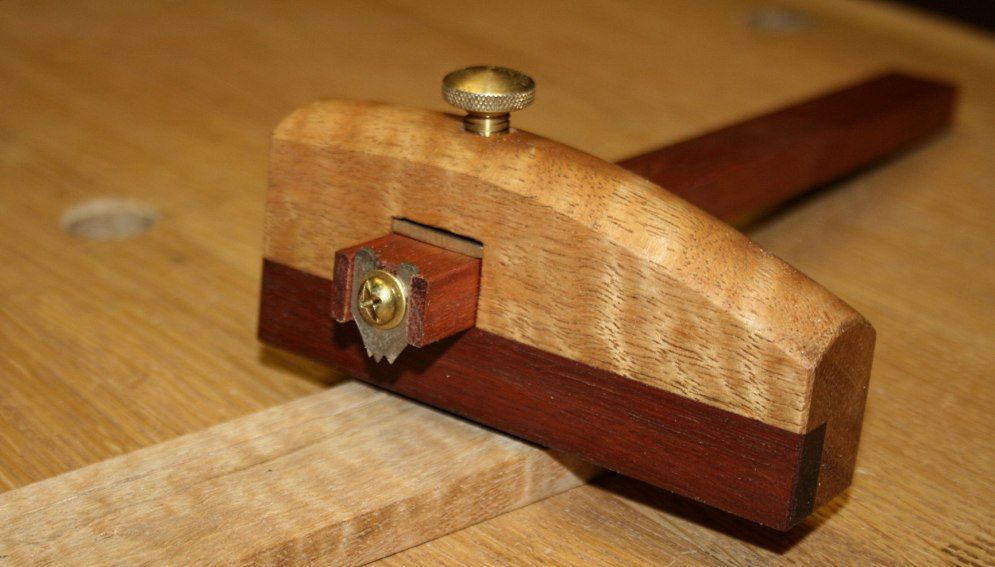
I wonder, for straight lines, if a marking gauge that holds a cutter could not be used for cutting troughs. I like multitaskers. I must explore this option. I would find my marking gauge much easier to hold than the LV cutter.

But what Steve Latta actually uses for long straight cuts is the Dremel router and a mini base. Beginners will break some bits until the proper feed rate is discovered, but once discovered this arrangement is blazing fast.

Re: Hinge installation

#12

Spear point cutter

Bill Tindall, E.Tn.

It offers less cutting resistance. I probably could have done without the chisel scoring if I had used the pointy cutter. But I was too lazy to change out from the big flat cutter I had in the tool

Re: Hinge installation

#13

LV inlay cutter for their Large router plane?


Re: Hinge installation

#14

Re: Can the LV be sharpened?

Wiley Horne--So. Calif.

It's not practical to sharpen. Each cutter is double-ended though. I cut many string lines in satinwood (which is hard) and noticed no dulling. But no, you can't sharpen them.

Wiley

Re: Hinge installation

#15

Picking up on one point

Wiley Horne--So. Calif.

"I wonder, for straight lines, if a marking gauge that holds a cutter could not be used for cutting troughs."

Yes. You need a 'tooth' shape. Here's one, a gift from Konrad Sauer, that he adapted from Garrett Hack, made out of a piece of saw plate:

https://www.flickr.com/photos/78661951@N07/8063422865/in/album-72157631713450111/

The only thing to note is that this tooth has to be square and sharp--it takes preparation. Every face polish-honed, the four side faces and the bottom face also. You start the cut by tilting it at about a 30-40 degree angle to the work, then bring it more upright once the sides are cleanly scored. It makes a very clean cut.

Wiley

Re: Hinge installation

#16

Here's my version of that ...

Derek Cohen (in Perth, Australia)

I hate buying tools when I think that I could make them myself. So, I purchased the LN cutters ...

Slicing ...


Grooving ...


(one gauge could do both).

Regards from Perth

Derek

Re: Hinge installation

#17

Re: LV inlay cutter for their Large router plane?

Derek Cohen (in Perth, Australia)

I have used it to mark and score the lines for a through mortice, but not inlay, per se, as yet. It did a wonderful job of this.

Did you know that Rob Lee designed this?

Used here with the fence ...


Regards from Perth

Derek

Re: Hinge installation

#18

Re: Hinge installation

Josko Catipovic

How would the LV Hinge Mortise plane work out for this? I realize it's a more specialized tool than a router plane and am wondering what its' advantages might be. Is there any reason to choose it over a router plane?