scraper burnisher *LINK*
Jack Guzman from Maine
I just saw this in an ad for luthier supplies. It is a neat idea. I'm going to make one.
I hope it is ok to post this . If not I will delete it.---Jack
scraper burnisher
Knowledge You Can Build On — Est. 1998

scraper burnisher *LINK*
Jack Guzman from Maine
I just saw this in an ad for luthier supplies. It is a neat idea. I'm going to make one.
I hope it is ok to post this . If not I will delete it.---Jack
scraper burnisher
Re: scraper burnisher
Derek Cohen (in Perth, Australia)
Hi Jack
This design has been out a while, in one form or another. Obviously it works ... but I do wonder how much it can be bettered?
My own preference is to just freehand with a carbide rod. This provides the opportunity to turn the hook in a progressive manner:
1. Beginning with a square edge, the steel is first drawn out ...

2. The hook is then formed in two stages, an initial bending at about 5 degrees, followed by a second bending at about 10 degrees ...

I am not sure at which angle "your" jig is working, but it looks like it is just the 10 degree. Over some years of doing this, I found that the steel often needed two stages to bend. When this was not done, the resulting hook was very small, and also did not last as long.


Regards from Perth
Derek
Re: scraper burnisher
Jack Guzman from Maine
You make some good points Derek however there are two reasons that one gets my attention. First,my burnisher broke awhile back. It consisted of a short carbide injection nozzle glued into a handle. It is now too short to rehandle except in a device such as the one shown. Second due to arthritis and other issues,my left hand is almost useless and my right is not as strong as it used to be so that particular design looks easier for me to operate. We will see. ---Jack
Re: scraper burnisher
William Duffield
I definitely agree with Derek. KISS! I've made several using a carbide rod stuck into the end of a simple turned handle.

I make them with a ferrule because there is a lot of sideways pressure on the handle, which could easily split it.
No-bunisher scraper
Derek Cohen (in Perth, Australia)
This is the most amazing tool for shaping or rapid removal of waste. It does not provide as smooth a finish as the card/cabinet scraper, but it works so much faster, and is easier to hold. Plus there is less heat build up.
I made the following out of the end of a 3/16" thick O1 plane blade (this is where you can use those worn out infill blades).
Acknowledgement to the Stewmac website, where I no doubt took on board the idea in some past visit.
Take the blade to the grinder (I have a 180 grit CBN wheel, but any grinder will do the job) and create a hollow around the edge. Use fluid movements to ensure that the edge is smooth-ish.


Use it for roughing, like a scrub ...

Create the angles and curves that you consider important for your work.
Much thicker shavings than your average card scraper ...

Regards from Perth
Derek
Re: scraper burnisher
Wiley Horne--So. Calif.
Hi Jack and all,
It's an interesting tool. Its working is more subtle than a straight rod stuck longitudinally in a handle.
The Stew-Mac carbide rod is inserted in the stock in such a way that it is parallel to the wider flat sides of the stock, but is at an angle to the nose of the stock. This means you can select any of a range of angles to put on the hook--say, from 5 to 15 or 20 degrees by eyeball. Do this by altering the angle of the stock to the scraper edge you're turning. For example, if the stock were at right angles to the scraper edge, you would be selecting the max. angle set by the drill press. But if the stock were at some smaller angle to the scraper edge, as shown in Stew-Mac's photos, then you would be at 1/2, 1/3, or any other fraction of the max. angle. And these variations could be repeated fairly consistently, by recalling what you did before.
I would be very interested to see what Jack does with the concept, and his impressions of how it works out!
Wiley
Re: No-bunisher scraper
William Duffield
But yours doesn't have the depression ground into the face for a thumb rest. 
There is a useful video on Stew-Mac's page for their "Ultimate Burnisher."
I have a turning scraper with a very similar shape, except it has a long handle. 
https://www.amazon.com/Robert-Sorby-Finishing-Outboard-Scraper/dp/B0036B0S9S
Beautiful tool, and another link... *LINK*
Wiley Horne--So. Calif.
Hello Derek and all,
Wonderful looking tool!
Looking at your plane blade 'persuader'--or maybe Zamboni--reminded me of Bill Carter's use of a blunted chisel and blunted gouges. Bill Carter being the famous British planemaker.
Here is a link to Bill Carter's illustrated use of these tools:
Thanks for showing that ground off plane blade!
Of course, Bill makes it look so easy!
One more picture ...
Derek Cohen (in Perth, Australia)
This was taken when I was building the bow front drawers for the Lingerie Chest ...
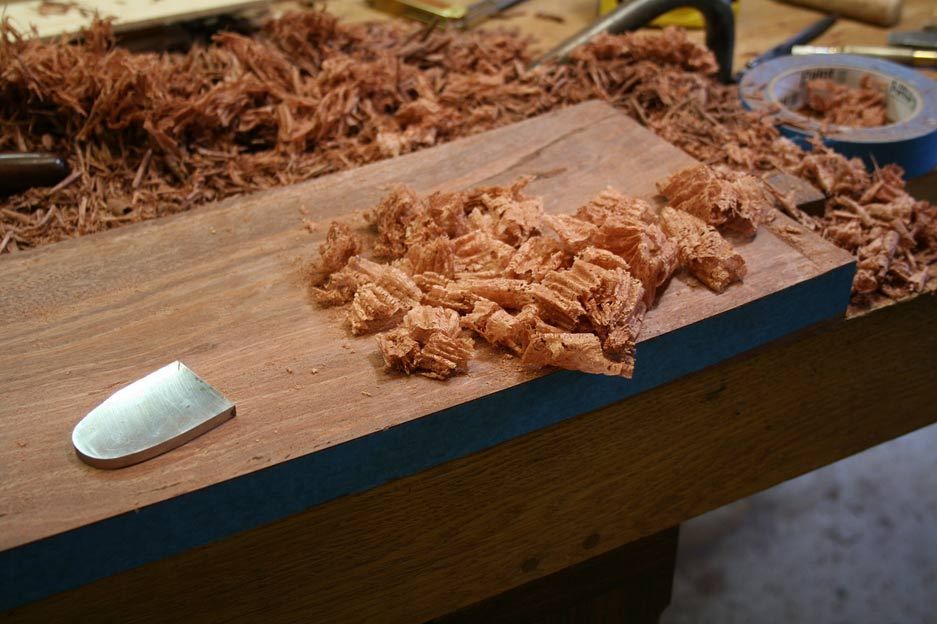
Regards from Perth
Derek
Re: scraper burnisher
William Duffield
Aha! It took me a little while to get my head around your explanation of how you could vary the angle with the Stew-Mac burnisher, but I eventually figured it out. Yes it works, in some ways analogous to how you can effectively lower the cutting angle, open the mouth and back off the chip breaker just by skewing a plane.
I'm not sure it is any more effective or gives you any more control than simply lifting the handle of a more traditional and simplistic burnisher a degree or two, but over the limited range of angles that the burnisher works, It should perform as well. Some people suggest that a longer rod on a simple burnisher works better because it allows you to push or pull the steel of the scraper away from the corner as you work it, but I am not convinced. I've made and used one that had only one inch of carbide sticking out the end of the handle, and had no problem turning a completely successful burr with it.
Re: scraper burnisher
Joe Rogers, Northern Virginia
I can vouch for Sir Wiliams burnisher. I have had one for years and love it. Thanks Bill!
JR


