Home Articles Forums Gallery Marketplace Videos

WoodCentral Forums

Knowledge You Can Build On — Est. 1998

Good Hope Hardwoods - Walnut Slabs & Specialty Hardwood Lumber

I got to meet Mr. Norris at the show

Posts

I got to meet Mr. Norris at the show

#1

I got to meet Mr. Norris at the show

Bill Tindall, E.Tn.


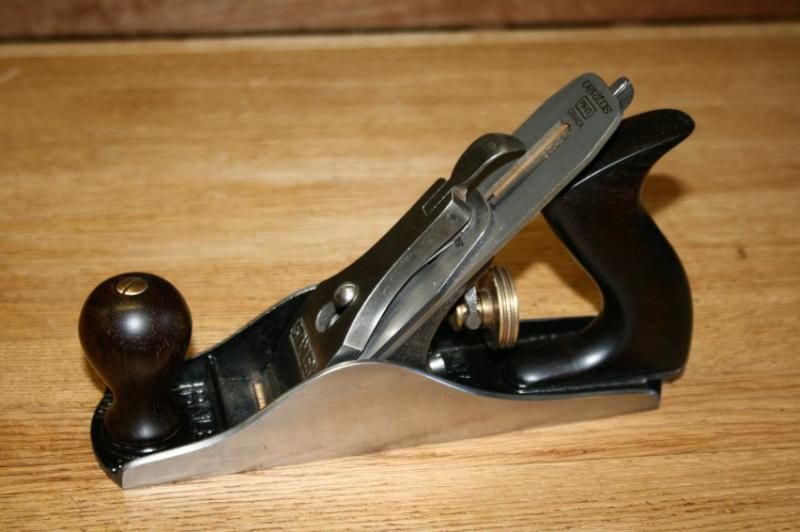
A highly motivated seller had this Norris for sale. Mr. Donnelly appraised it for me as well as checked its working condition. It was a price that I would pay for our plane research purposes.

Honed it up a bit and tried maple. I'll need to go to the gym if I intend to plane maple, but the surface looked like polished glass (not that it matters for my finishes).

Thought about the fact that this plane was designed for mahogany, not maple. Found a piece of walnut- close enough. The (power)jointer had picked out around the knot shown in the picture, as would be expected. A few swipes of the plane and the torn grain was gone. No new torn grain appeared on uphill sloping grain around this knot.

I see why people are enthused about this style of plane for finish planing. One doesn't need to know much more than how to sharpen to be successful using it.

For those like me that have never seen one......the adjuster is novel. The shaft that advances the blade is threaded outside and inside. The inside shaft actually drives the blade forward. The result is like a gear reduction to advance the blade. The blade can therefore be advanced in tiny increments.

Re: I got to meet Mr. Norris at the show

#2

Re: I got to meet Mr. Norris at the show

Hank Knight

Glad you are having a good experience with your A5, Bill. I love mine! As you can see, it works just as well on maple.

[URL=http://s50.photobucket.com/user/hankknight/media/DSC_0002Small.jpg.html][/URL]

Re: I got to meet Mr. Norris at the show

#3

Re: I got to meet Mr. Norris at the show

Derek Cohen (in Perth, Australia)

Bill, I have a Spier smoother that is similar. This was a plane I restored from a shell many years ago. Bedded at 47 1/2 degrees, as is the Norris, it really did not perform very well on interlocked grain. It was fine with straight-grained woods, but these woods are the exception to the rule where I live. As a result, I put the Spier aside, and it lived on the shelf for many years.

A couple of years ago, when I began experimenting and using the chipbreaker, it occurred to me that this may be the key to releasing its potential. Thus set up, the Spier demonstrated that it was very capable and, in fact, it was a plane reborn!

I was concerned that my efforts in restoring (a loose word, since I had a bit of fun with the build) the plane had included creating a tight mouth (as was the vogue at that time), and that this would impede shavings escaping with a tightly set chipbreaker. Obviously the mouth was not as tight as gnat could make it, since the shavings flow well and straight with the chipbreaker up close.

Have you tried yours like this? The curlies in your photo suggest the chipbreaker was not used at that point.


Regards from Perth

Derek

Re: I got to meet Mr. Norris at the show

#4

Re: I got to meet Mr. Norris at the show

Bill Tindall, E.Tn.

Hank Knight was at the Georgia tool sale and he has a plane exactly like the one I bought. He reported that it is his go to plane, which is to say he has considerable experience using it. He told me the shavings would jam with a cap iron set as close as it needs to be set to get any benefit(maybe). The maybe is that Kees' work suggested that the optimum cap iron distance was greater with a higher bedding angle plane.

In any case I set the cap iron well back from the blade tip for my abbreviated test. I don't expect to ever encounter a planing situation where the tear out threat looms greater than planing the knot shown in the picture. If the Norris reliably planes the stuff I typically plane without diddling with the cap iron setting then the Norris my be accepted into the fold for my planing needs.

It will take some getting used to its "feel", having been accustomed to using a #5 Bedrock for the majority of my planing needs. We shall see. I'll give it a chance. If it performs better than the Bedrock for my needs I will use it. And if not I can easily sell it without a loss. My curiosity about these planes will have been satisfied.

Re: I got to meet Mr. Norris at the show

#5

Re: The pendulum swings back

TomD

This raises interesting questions about why the single blade is working at a higher angles when this has been largely dismissed by the Certaintists around here.

It also raises the question of what is special about a Norris. It's just a plane. Many other planes have Norris type adjusters in them. And there are many other ways of getting precise adjustments, though we have only recently be assured that nothing could in any practical sense improve on Bailey planes. There are also many planes that have additional features that can be adjusted, and there are sets that substitute whole planes for those things that can be adjusted in adjustable planes.

Re: I got to meet Mr. Norris at the show

#6

Re: The pendulum swings back

Derek Cohen (in Perth, Australia)

This raises interesting questions about why the single blade is working at a higher angles when this has been largely dismissed by the Certaintists around here.

It also raises the question of what is special about a Norris. It's just a plane. Many other planes have Norris type adjusters in them. And there are many other ways of getting precise adjustments, though we have only recently be assured that nothing could in any practical sense improve on Bailey planes. There are also many planes that have additional features that can be adjusted, and there are sets that substitute whole planes for those things that can be adjusted in adjustable planes.

Hi Tom

First off, the Norris is not a high angle plane. At 47 1/2 degrees, the bed is not significantly higher than a common angle, 45 degree frog of a Stanley.

Is it the mass of the plane? Well, I have had superb results with both heavy and light planes. They don't come heavier than a (bevel up) Marcou which, several years ago, I would have sworn was the best performing plane on the planet.


Yet I can now achieve the same high level of tearout-free planing on interlocked grain with a UK-made Stanley #3 I inherited from my father-in-law 20+ years ago. Here it is cleaned up and with a PM-V11 blade and chipbreaker ..


I do believe that a thick blade (and the Norris has a 3/16" thick parallel blade) can help deliver improved performance over a Stanley - when they are used with the chipbreaker pulled back. But, as mentioned above, this difference largely disappears with the chipbreaker closed up.

So, it is the wooden infill that is the Norris' secret weapon? If so, why does Karl Holtey rest his blades on steel pins inserted into the wooden infill?

I think that there are planes into which you can design-in performance. And then there are Spier and Norris.

Regards from Perth

Derek

Re: I got to meet Mr. Norris at the show

#7

practical planing

Bill Tindall, E.Tn.

The Norris I was using was making a thin shaving, it had a tight mouth and it is somewhat higher angle then a Stanley. We know that all these factors contribute to less tear-out.

We know that a cap iron set to an optimum distance lessens tear-out. Optimum may depend on shaving thickness and other factors.

What is important for someone actually planing something that is part of a piece of furniture under construction is what is the least fiddly route to risk-free planing for the task at hand.

Those of us that actually build something face planing situations where unanticipated tear-out will wind up as a permanent feature of the finished furniture. This fact focuses the mind on risk-free. In my past risk-free was achieved with sand paper. I now have at my disposal planes that are almost as risk free as the sand paper, and they have other benefits to offer.


Yesterday I was fitting the bull nosed molding to what will be the top and bottom of the display case. Slightly oversized molding is glued on. The over hang of the edges and imperfections at the miters are planed flush.

Ash is not nice to plane. I once never risked hand planing it. The above trimming could best be done with a block plane if tear-out was not a concern. Tear-out in this case would mean a defect I would get to live with, for starting over with these pieces is not an option. I was confident the Norris would not experience tear-out, it was sitting on the bench, so I used it. I suspect I could have been equally successful with a #4 Stanley with an optimally set cap iron. And it may be that someone experienced with a block plane could have been successful. Others might have used a file. Years ago I would have sanded or scraped.

Re: I got to meet Mr. Norris at the show

#8

Re: The pendulum swings back

Hank Knight

The celebrated Norris adjuster is not a big deal for me. I find that I cannot adjust the depth of cut on the fly with the lever cap tightened down, and the lateral adjust is balky. I set the depth of cut with the lever cap barely snug and tighten it only when he adjustment is as close as I can get it. It usually takes several tries to zero in on the depth I'm looking for. I set the lateral adjust at the same time and fine tune it with hammer taps after the cap iron is locked down. The Stanley adjusters are much easier IMHO, but I still fine tune the lateral adjustment on my Stanleys with a hammer.

Re: I got to meet Mr. Norris at the show

#9

Re: practical planing

Bruce, a MN Galoot

I've planed a fair amount of ash, but doing that bullnosing I would have used my Veritas DX60 block plane. Calling it a block plane doesn't seem right. It's shaped like one but acts much more like a teeny smoothing plane.

Re: I got to meet Mr. Norris at the show

#10

Re: practical planing

TomD

"Those of us that actually build something face planing situations where unanticipated tear-out will wind up as a permanent feature of the finished furniture. This fact focuses the mind on risk-free. In my past risk-free was achieved with sand paper. I now have at my disposal planes that are almost as risk free as the sand paper, and they have other benefits to offer."

Why would unanticipated tear out end up as a feature. That is just unprofessional. You should try selling guitars, it will concentrate the mind on both the disaster that occurs when you ruin a piece of wood worth hundreds of dollars, and sometimes it just happens, and whether you can just plow on regardless when you blow a piece up. The smallest scratch makes the piece unsaleable.

Those of us who have been at this a while know the normal transition between planes and sandpaper is the scraper, which meets all you criteria. But at the time I started the hand planed finish was the big deal. Late 70s and Krenov and all that.

Re: I got to meet Mr. Norris at the show

#11

Re: Risk Free

TomD

Risk free is a hugely moving target.

With Osage bows and I only have a few projects there. That stuff seems damned. Some of the stock would haul out huge chunks regardless of how is it planed to the extent that some of the guys who work it on a regular basis use toothing planes on it, not for the normal reasons. It is funny, because it is a fabulous structural wood to "fail" like that. In the samples I have the very fast growth rate may have something to do with it.

Guitars can have multiple species of tropical woods one doesn't even really know the origin of, with positively boiling grain. And they are always bookmatched which means the seams will always have reversing grain.

Your sample is at a toddler level.

Re: I got to meet Mr. Norris at the show

#12

Re: Risk Free

Warren in Lancaster, PA

If you can't use a common pitch plane to smooth a board with through strokes in either direction, then you haven't mastered the double iron. You don't need sandpaper or scrapers if you can learn to plane.

Re: I got to meet Mr. Norris at the show

#13

MN ash

Bill Tindall, E.Tn.

The ash I have seen in MN is different from what grows here. By the time I see ash in boards here it is one of three varieties and I don't know which. I don't know if the variety is different to plane or trees within a variety vary. But occasionally I see ash that the grain tears easily. It is the only species where I have found boards that I could not joint smoothly on the power jointer no matter how slow or how light the cut. Larger divots are removed on the thickness planer and I don't even try a hand plane. I have torn out pieces on the thickness planer times large than with any other N. American wood. I've shoved several thousand bdft through a planer so I do have some experience with it. Additionally, quartered grain of any kind is difficult to hand plane. I have enough experience with ash that I just don't take chances with it, especially on a quarter sawed molding.

In some other discussion people spoke of how soft ash is. Not the ash I work. It is every bit as hard as fast growth red oak (ash here is typically fast growth for it does not compete well in dense forests).

I picked out a nice splinter using the block plane on the edge overhang. Mr. Norris was on the bench having just breezed through a knot so that is what got used.

Re: I got to meet Mr. Norris at the show

#14

I don't think he meant tearout as...

Bill Houghton, Sebastopol, CA

...a "permanent feature" to be a positive thing.

Re: I got to meet Mr. Norris at the show

#15

Re: MN ash

Bruce, a MN Galoot

I don't know what kind of ash I get locally, except I'm fairly sure it's not black ash. That seems to grow in the northernmost part of the state. It might be what we call green ash. Anyway, it's relatively easy to plane but with occasional grain reversals thrown in. Those can be nasty. That DX60 has an adjustable mouth, a very sharp blade and low angle. Every bit helps.

Re: I got to meet Mr. Norris at the show

#16

Re: MN ash

TomD

The stuff that grows on my property is hard There are three varieties hereabout, but I don't know which one we have. I have also turned Olive ash, which is hard. The stuff we cut seems the same as the wood I have bought for gunnels, and that is normally White Ash. It all seems relatively placid.

Re: I got to meet Mr. Norris at the show

#17

Re: Risk Free

TomD

As I said, I had a preference for planes from the beginning. I don't know why the snarky tone in my earlier posts. Scrapers exist and people seem to use them. Possibly because of the only recent discovery of the double iron.

Re: I got to meet Mr. Norris at the show

#18

Recent discovery

Warren in Lancaster, PA

You suggest that the use of the double iron is a recent discovery. It is not.

It's use is documented in

Salivet 1792

Nicholson 1812

Holtzapffel 1850

Odate 1984

and many others.

The Kato studies were referenced in a Schwarz blog in2007, having been previously mentioned on Woodcentral

https://blog.lostartpress.com/2007/12/31/chipbreakers-the-no-6-way-to-reduce-tear-out/

The use of the double iron has been documented on this forum in

2006

http://www.woodcentral.com/woodworking/forum/archives_handtools.pl/bid/3106/page/1/md/read/id/82660/sbj/makes-no-sence/

2007

http://www.woodcentral.com/woodworking/forum/archives_handtools.pl/bid/3107/page/1/md/read/id/117554/sbj/some-thoughts-but-no-new-tests/

2010

http://www.woodcentral.com/woodworking/forum/archives_handtools.pl/bid/3001/md/read/id/150238/sbj/chipbreaker-distances/

Some of these discussions included comments by yourself.

Re: I got to meet Mr. Norris at the show

#19

Opposite experience

Brian Holcombe

I find ash to be very easy to plane. I am generally working finished surfaces with a chip breaker in all but very few scenarios. Spindles, for instance, are one recent scenario in which I'm not using a chip breaker.

So, most commonly I'm using a chip breaker to help in the creation of a good surface. I don't find that I normally need to go beyond a straight shaving (one that doesn't curl) and sharp blade to get a clean surface.

If it were not clean at that point, my recourse would be to take thinner shavings, which require even tighter settings on my chip breaker to do so. In all but the worst reversals this would not be required and so normal planing would produce a fine finish.

I find planing especially reliable, and without the dubbing and hollows created by sanding, it is a superior process. The surface created is also much more capable of resisting damage by water, a huge plus on pretty much any and every piece of furniture, even those with a film finish.