Ergonomics of coffin smoother
Tony
During my last health induced forced layoff from woodworking I seem to have lost the knack of pushing my coffin smoother around. Any tips to using it well?
Knowledge You Can Build On — Est. 1998
Ergonomics of coffin smoother
Tony
During my last health induced forced layoff from woodworking I seem to have lost the knack of pushing my coffin smoother around. Any tips to using it well?
Re: Ergonomics of coffin smoother
Wiley Horne--So. Calif.
Hi Tony,
Good to hear from you, and very sorry about the health matters.
What is the blade width on the smoother? As I get older, I tend to prefer narrower irons. You can simulate the effect of a narrower iron by skewing the plane some (which also lowers the effective blade pitch). You might find this a useful diagnostic (to test for blade width) even if you don't want to skew the plane regularly.
Have you tried pulling rather than pushing? One uses different muscle groups, and you might find one way more effective than the other. Related to this is bench height. As the bench gets high, pushing tends to shift more of the load onto one's arms; when the bench is too low it's hurting your back; but when at a 'goldilocks' height you get your legs and more upper body muscles into play. If the bench is at the right height, you shouldn't have to 'pinch' the plane when pushing--no real finger pressure at all--just the heel of the hand on the butt and a guiding hand (with loose fingers) somewhere around the throat or a little forward of the throat.
Finally, coffin smoothers don't tend to have much friction with the work, but you might try a little candle wax or Johnson's wax on the sole to see if it makes a difference to you (it will on metal planes for sure).
Thin cuts, if tough going. And think about adding a little camber when you sharpen. This narrows the effective blade width, and creates a bit of slicing action of the iron. Personally, I think all bench planes benefit from some degree of camber, even if small in the case of smooth planes.
Wiley
Re: Ergonomics of coffin smoother
Tony Wilkins
Thanks for the response Wiley. The plane has a 1 5/8" blade and it's just over six inches long. I haven't tried pulling. You're mentioning it and I read an article by a Adam Cherubini suggesting it this morning.
Re: Ergonomics of coffin smoother
Derek Cohen (in Perth, Australia)
Hi Tony
There is not a lot to add to the wise comments of Wiley who, as I recall, has the same Old Street smoother as yourself.
What I will emphasise is that you take light cuts with the plane. The bed is 55 degrees, which creates significantly higher resistance than a common angle plane (45 degrees). You can set this up more easily if you use a setting block. The one I recommend is simply a piece of glass glued to hardwood ...
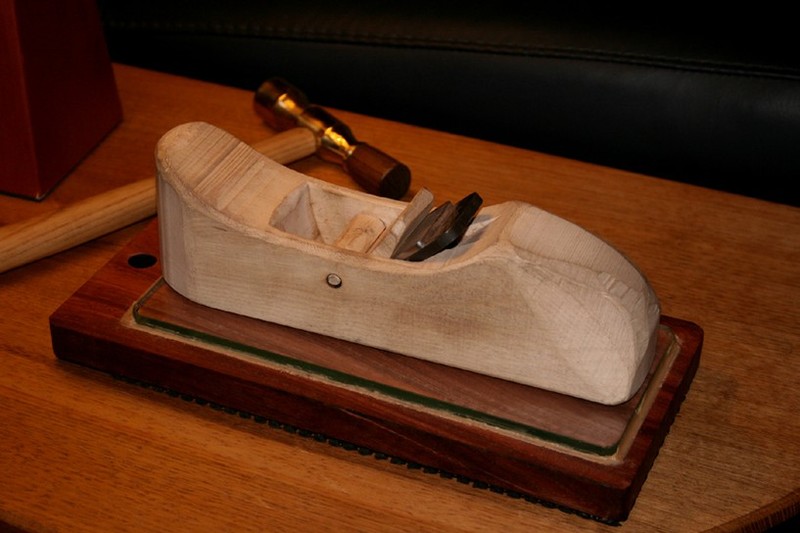
The glass will not damage the blade. Press the blade flat into the glass, and firm up the wedge. This should set the plane up for a very fine cut, or none at all. It is easier to increase the depth of cut a smidgeon than to reduce it but the same amount.
The other factor is getting your weight down low and pushing the plane from its rear, rather than trying to lever it at an angle while standing over it. As Wiley mentioned, bench height plays a part here. If your bench is too low, bend your knees. Most power comes from the hips. Try not to push with your shoulders.
I have written about ergonomics of plane use here: http://www.inthewoodshop.com/ToolReviews/VeritasCustomPlanes3.html
Give us some feedback.
Regards from Perth
Derek
Re: Ergonomics of coffin smoother
Jim Matthewd
Double check blade sharpness, chip breaker setting,
chip clearance, etc.


