New WoodChat!
Home Articles Forums Gallery Marketplace Videos

WoodCentral Forums

Knowledge You Can Build On — Est. 1998

Need a tree taken down or milled?

Sharpening pain

Posts

Sharpening pain

#1

Sharpening pain

Svante

Hi,

During five years I have used my Norton stones 1000, 4000 and 8000. The stones have been trued frequently on a Norton flattening stone. Everything worked fine.

Being a bit overambitious I got the idea to true the flattening stone with abrasive paper on a thick glass surface. I must have been rocking the stone so I got a belly on the flattening stone (without notice) and when truing transmitting the belly the waterstones. I worked through the back of most of my chisel until I realised my mistake.

I was able to get the truing stone and the waterstones flat again but not the chisel backs. They have a belly and rock when I am trying to flattening them.

Any suggestion on how to get them flat again?

Best regards,

Svante

Re: Sharpening pain

#2

Re: Sharpening pain

Wiley Horne--So. Calif.

Hi Svante,

The chisel backs are now convex as I understand it. One technique to get them back flat is, first, to make them slightly concave, then lap them flat in your usual sequence of 1000, 4000, 8000.

To get them concave, you can use the corner or edge of a coarse waterstone; or coarse sandpaper on a stick or paddle; or work them carefully on a belt sander or grindstone. It's just a metal-removal problem, which can be done by eye without anything fancy.

Wiley

Re: Sharpening pain

#3

Re: Sharpening pain

TomD

You could put all you emphassis on the center of the chisel and move it back and forth until it is flat. But it is tough as it will tend to tip. You can put a piece of AL tape on the stone so the edge end is supported and as you move it back and forth you get a flat on the apex of the convex. You can support the handle end for the same result.

Alternatively you could burn a hollow in the center on say a grinder, so you have two co-planar resting points and then rub the whole thing down till it is flat.

The other method is to pick away at the excess material, some chisels you could actually cut the surface back with a file, or diamond file, or grinder, but you attack the high points above the reference surface rather than some repetitive motion on a flat surface hoping to get a transfer of surface conditions.

Re: Sharpening pain

#4

Re: Sharpening pain

Svante

Thanks, I will try the belt sandler....

Re: Sharpening pain

#5

Don't try the belt sander

Bill Tindall, E.Tn.

You can get in trouble in the blink of an eye with a belt sander. Without a great deal of experience you are likely to wind up vastly worse than you are now.

Speaking of, what is the problem with what you have in hand? Do the chisels not work somehow? Unless you experience a problem using them, leave them alone. Once polished I never mess with the back of a chisel or plane blade. there simply is no need to. If the polished back is not flat by 0.001" , so what?

Re: Sharpening pain

#6

Re: Do try the belt sander if you want to

TomD

That is like saying use a hand saw to rip lumber, you can get into a lot of trouble using a BS or TS. Which is to say it is true... But well within average skills. I should say though that with a belt sander you want to drag your edge, you don't want the belt turning so it meets the edge first, you can skew the chisel and usually get away with that. And then to that I would qualify by saying all my rough grinding (down to a pre-HT edge of maybe 1/32") is done with the belt coming at the edge first, leading the edge. But that isn't sharpening mode.

Advantages of belt grinders are that:

- You don't move the tool you just present it. This makes control a lot easier.

- While grinding on hard wheels is easy enough, belts are less likely to burn a tool

- They cut faster which speeds certain jobs up, but one still needs to work within the capacity of the tool.

Basic strategy is the same, learn to hold the tool against the moving surface with full contact, and "no" cutting or heating happening. This is like learning to rub the bevel, or find the bevel in woodturning. In woodturning once you are there, you alter the angle to take a cut. In grinding, you just apply more pressure.

Belts cut so fast that you don't need a lot of speed for sharpening. Remember Scary Sharp was a manual process. Variable speed is a big advantage on a belt grinder, and these days it is a cheap option off ebay etc. I paid 25 bucks for two varaible 1/2 HP motors, off craigs. Reducing speed is going to make things easier, and reduce any danger of kickback (never happened to me on a belt grinder, but it is possible).

Belts can't blow up; and while they produce dust from the abrasive on the belts, particularly real steel grinding belts seem to produce a lot less dust than one gets off soft wheels, for an equal cut.

Re: Sharpening pain

#7

Re: Do try the belt sander if you want to

Curt Putnam

I read it as a handheld belt sander. Those are called project wreckers for good reason.

Re: Sharpening pain

#8

Not from me

Wiley Horne--So. Calif.

In my original post, and I should have made this clear, I was referring to either a bench-mounted sander, or to a hand-held sander upended in a vise. In other words, the sander stationary, the tool being presented.

Further, the idea is to find an edge, preferably where the belt curves over a pulley to isolate a small patch of belt, so that the work can be focussed at the center of the chisel back.

Re: Sharpening pain

#9

Re: Not from me *LINK*

steve voigt

The other day, I refurbished the iron from an old moving fillister, and I used the technique Wiley is describing, but on a 6" dry grinder. I set the tool rest very high, then lifted the iron slightly up off the tool rest and set the iron down on top of the wheel. Kinda hard to describe, but I'm using the wheel the same way Wiley describes using the pulley on a belt sander.

Tim Manney describes an alternative technique (link below), which would probably work better for narrow chisels. Either way, the key is to do some dry runs with the motor off, and establish some visual references so you can position the tool accurately.


Tim Manney blog post

Re: Sharpening pain

#10

Re: Don't try the belt sander

Svante

Some of the chisels have a slight belly, probably they work fine as they are. Others have a more severe belly and need to have their backs flatten. Thanks for the warning, I will use the sander very carefully.

Regards,

Svante

Re: Sharpening pain

#11

Re: Do try the belt sander if you want to

William Duffield

I'd sooner bring a chainsaw or a rabid beaver into my shop than one of those handheld belt sanders. A place I used to work used the big PC model for flattening glued up panels. It's name was Cujo.

Re: Sharpening pain

#12

Agree with that

Bill Tindall, E.Tn.

I regard the portable belt sander as the most difficult tool in my shop to use successfully. It can ruin what is under it in a fraction of a second.

I owned several varieties over the years and all but one made divots at the end of the sanding strokes. These divots were imperceptible by feel but they would take up stain more than the rest and make a dark spot. Hand sanding them out was tedious. The only machine that didn't make divots was the big Porter Cable machine. I still use it occasionally but I live in fear of its wood eating propensity.

But on the topic at hand, when we made chisels and plane blades we needed to flatten the back of dozens of pieces. I did initial flattening on a 6" horizontal belt sander and Zirconia belts. I never could get backs flat enough. Belts have a slight curl which differentially abrades across the surface. The initial "touchdown" needs to be perfect or the first pace to hit will leave a low spot. I longed for the ability to have the piece in position and then start the belt. We wound up finishing the backs on a Mikita horizontal disk sharpening stone with water lube. This approach worked reliably.

Personally, I would need for a chisel to be out of flat a lot before I would risk engaging it on a spinning abrasive belt.

Re: Sharpening pain

#13

Re: Do try the belt sander if you want to

TomD

Belt sanders are easy to use on table tops, and pretty fast. The whole key is lifting up on the rear handle, just enough. A friend of mine used to have a table rental business, and he once plugged his switched on BS while I was leaning on his table. It ran me over like an Abrams tank. :) That can wreak a project.

Re: Sharpening pain

#14

Re: Agree with that

TomD

If those hand held sanders aren't working for you, you are doing it wrong. Not like they haven't been around for decades as an industrial tool. Tage Frid was a big proponent. One nice thing about them is that for what they do, they don't produce as much dust as one might think. Still an outdoor tool for the odd time I use mine. Some of them have a frame to limit things like divots and the China Syndrome. They are a tool that closes in on unlimited cutting geometry, but that is a capability in the right hands. I am not sure why I bought mine. But for production they will level a table in a few seconds. You can then move on to a finish plane.

For tool work though. My first sander was this thing:


Now I use this thing with a 1.5 HP motor, I wish it had a 3HP motor, but I use it outdoors too much for that:


While you can drop a fair amount of cash on a 2x72, this design was created to be home make-able with not much more than a drill press, and hand tools. If you can weld you can make it quicker.

For flattening you add this platen, the platen adjust for angles while the rest is fixed on this model:


For convex grinds you can add this, though I just slack belt it:


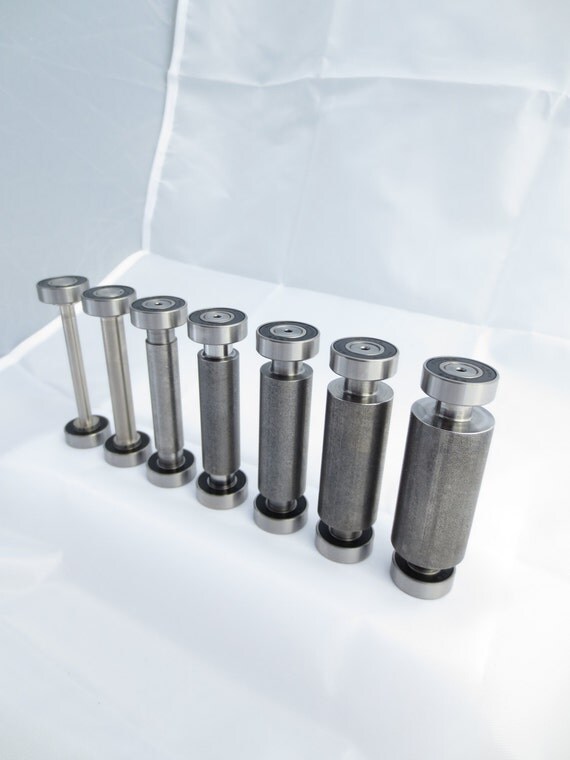
For details I welded up a version of this that uses adapted drum sander parts and some barrels turned out of solid stock.


Great belt sander characteristic is that the belt moves at the same speed no mater the size of the contact wheel and then almost all of these units are variable speed to boot.

Re: Sharpening pain

#15

Re: Grinder parts

TomD

So the KMG style grinder started out as this huge thread on Bladeforums in which it was designed by the assembled throng. And Beaumont made the parts. But these things are so popular that there are many people who now sell parts or kits, not to mention all the scabbed to together projects.

One thing I have been looking for, for about a 5 years, is a 6x1 inch contact wheel. I want one to make a reduced size 2x72 for 1 inch belts. I find that I use the LV one 10-1 to my use of the 2x72. I use the 2x72 to make metal projects, I use the 1x42 to maintain tools. You can use a 1x42 for both, to some extent, if you have a powerful motor. Wally Hayes has a samurai sword video where he makes a sword with a 1x36 without even a powerful motor. But one would rather not.

Anyway, holly grail! This place has all sizes of 1x wheels:

http://www.knifegrinderparts.com/collections/all

1x wheels have become popular as people realized that you could split a 2x72 belt in half and double the number of plunges you could make on knives. But that is not what I wanted one for, and so far had only seen 8" models. However the red LV grinder would probably suit most people. The key is the belts.

Re: Sharpening pain

#16

Re: Grinder parts

Bruce, a MN Galoot

A couple months back I was at a knife show and a guy demonstrated a Burr King. Absolutely amazing--I couldn't hear it run, and I've never seen steel disappear so fast. I have a home built 2 X72, functional but not quite so refined.

Re: Sharpening pain

#17

Personally think a Dremel grinder is lower risk

Ian Neuhaus

at worst you'll end up with a partially hollow back, a bit like a Japanese chisel.

The technique is to grind on a stone to locate the high points, then take a bit off with the Dremel,

back to the stone to check,

continue till all of the chisel back is in contact with the stone. Move onto the next chisel.

Re: Sharpening pain

#18

What size grinding wheel do you use in the Dremel?


Re: Sharpening pain

#19

Re: Grinder parts

TomD

Yeah, partly it is the machine, partly it is the belt, and partly it is how powerful and adjustable the motor is. 3hp is a nice amount. It's like wood lathes. I have the big union graduate, bowl lathe that Richard Raffan had in his early videos. It is specked with a 3/4 hp motor. 22 inch capacity. Today a lathe like that would be 3-5hp. And in both cases the extra horse power isn't scary as it can be on a table saw. The really big grinders aren't all that dangerous, the main issue are fire, air, and tiny particles that may get into the eyes, therefore spaceman suits, or Racals. I am not sure the particles are all that dangerous to the eyes, but you need to keep your MRI potential open if that maters to you.

Re: Sharpening pain

#20

Re: What size grinding wheel do you use in the Dre

TomD

They make some little barrel type grinders you could use. Both a sanding drum one, and a vitreous bond one. If I was going to spot it in, I might just use scrapers.