New WoodChat!
Home Articles Forums Gallery Marketplace Videos

WoodCentral Forums

Knowledge You Can Build On — Est. 1998

A55 Smoothing Plane

Fastening a top with traditional pocket screws

Posts

Fastening a top with traditional pocket screws

#1

Fastening a top with traditional pocket screws

Bill Tindall, E.Tn.

Fastening a top with traditional pocket screws

I am using this technique to fasten the top and base to the bed side chests of drawers. Shown arethe steps for making a pocket in the base frame.

I learned this technique from Steve Hamilton. I will illustrate the steps while not attempting to flaunt the result. Steve’s handiness with a carving chisel greatly exceeds mine so his results look better.

The problem is how to get the pocket located so the screw sticks out the right amount, and not through the top. :( Easy as it turns out.


1. Drill an angled hole in the apron. PIC1

2. Align the screw to be used so that the desired amount sticks above the apron (the part that will embed in the top to hold it on) PIC 2


3. Mark the location of the screw head on the apron.

4. Drive a chisel into the apron at the location established in step 3. This operation locates the bottom of the pocket. PIC 3


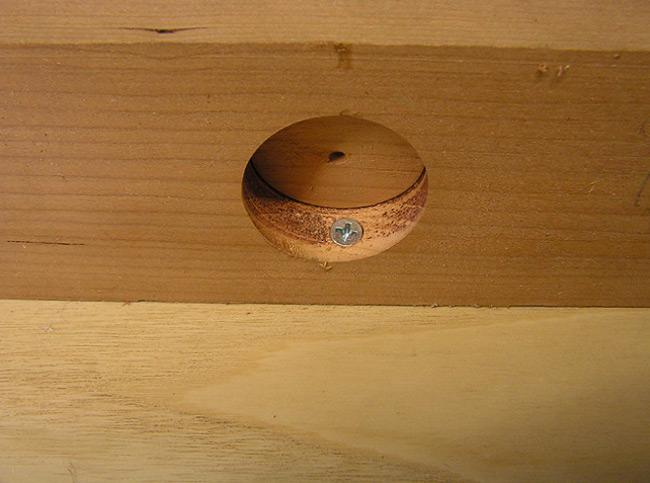
5. Carve out the pocket up to the flat established by the chisel cut with a gouge. Pic 4


Re: Fastening a top with traditional pocket screws

#2

Re: Fastening a top with traditional pocket screws

Brian Holcombe

Bill,

Why do this as opposed to buttons?

Re: Fastening a top with traditional pocket screws

#3

A partial answer

Bill Tindall, E.Tn.

In the case of the base for these pieces there was no place to screw the buttons. Basically it was a narrow frame of the base attached to a bit wider frame of the cabinet.

In the case of an apron to a top, I don't know. If one can make the pocket as fast as Steve, the answer would be its quicker. I have never seen a button on older furniture, always pocket screws. Maybe wiser heads can answer your question.

Re: Fastening a top with traditional pocket screws

#4

Re: A partial answer

Brian Holcombe

I'm just interested for my own edification, I prefer battens, etc to attach tops and build around that usually.

Re: Fastening a top with traditional pocket screws

#5

The gouge

Wiley Horne--So. Calif.

Hi Bill and all,

I was advised on SAPFM that a No. 9 gouge was a good sweep. Yours looks great--what did you use for a gouge sweep?

Wiley

Re: Fastening a top with traditional pocket screws

#6

this one

Bill Tindall, E.Tn.


It is a Keen Cutter I bought somewhere for $15 thinking I might use it some day for something. It has a small chip. How does one sharpen these things?

BTW, the 8th pocket hole looked a lot better than the 1st.

Over on the Main message board it was pointed out that I should be using a Kreg pocket hole jig for making these holes, and Kreg flat bottom screws. How did Townsend and Goddard get by?

What I may have failed to mention is that one does not set the pocket screw at 90 foot pounds torque like one might for putting together a Kreg'ed face frame. The idea is to just hold the top on and provide some wiggle room for expansion.

Re: Fastening a top with traditional pocket screws

#7

What I have done

Bill Tindall, E.Tn.

I don't like the looks of the steel clips for attaching a top on fine furniture. I bought some 3/4" brass bar stock and make brass clips. For some reason I never consider wood buttons. I should mend my ways, I suppose.

Re: Fastening a top with traditional pocket screws

#8

Gouges

Warren in Lancaster, PA

I would use a firmer gouge or a carving gouge for this work. A firmer gouge usually has two ears, corners that stick out at the back end of the flute and a bolster next to the handle. Or it could have a socket. A carving gouge usually has a flute that gradually diminishes at the back end and a gradual taper to a bolster. Both of these are usually sharpened with the edge even all the way across, which is helpful for this work.

Your gouge is ground to a rounded point, like the way we sharpen a coving gouge for turning. If it has no bolster or socket it probably is a turning gouge.

Re: Fastening a top with traditional pocket screws

#9

Re: Fastening a top with traditional pocket screws

TomD

I wouldn't do that, but if I did I would use a screw head that wouldn't split the wood, one can see a bulge. You have made a very nice pocket with a good flat surface to receive the screw. I always use pan head screws, probably traditionally they would have used a round head screw, which is basically similar but with a slot head. And there are other screws of the type. I normally use a fairly stout screws and I may clip the point to get more bearing. The point is only there to ease entry in rough work. One can modify a screw as a tap. I wouldn't use hardened screws like drywall screws, unless I expected steel studs.

Re: Fastening a top with traditional pocket screws

#10

Re: Fastening a top with traditional pocket screws

TomD

I don't see any provision for wood movement, so I suppose one might use it were there was none. If that is a situation one regularly found. I don't tend to. I suppose one could ovalize the holes. I think before going to those extremes I would use those figure of 8 fittings that are fast and technically sound But I haven't tried them yet.

Re: Fastening a top with traditional pocket screws

#11

Re: The gouge

steve voigt

Hi Wiley,

Were you thinking of a certain width? As you probably know, on a no.9 the width of the gauge is (approximately) equal to the diameter (so the gauge cuts a semicircle).

Re: Fastening a top with traditional pocket screws

#12

Re: The gouge

Wiley Horne--So. Calif.

Steve,

I couldn't find the exact post over on SAPFM. For sure, the recommendation was a No. 9 sweep. The width I believe was 18mm (3/4"). Maybe 5/8". Anyway, I bought a No. 9 by 18mm, and it seems good for the purpose (I never used it :( :) ).

Wiley

Re: Fastening a top with traditional pocket screws

#13

Re: Fastening a top with traditional pocket screws

David Charlesworth

I have seen many Victorian kitchen tables where the tops are attached with pocket screws.

Most are now split. (Due to central heating ?)

Pocket screws may be OK where large potential movement is not present , but buttons and slot screws seem a better solution to me.

The wooden button is a clever and sophisticated method, which I was taught. Don't know when they were first used.

David

Re: Fastening a top with traditional pocket screws

#14

Re: Fastening a top with traditional pocket screws

North of the Border

Wood movement is something people all too often forget about.

If this type of pocket-screw fastening is done to a man-made material top like plywood, it should be fine. Otherwise as you pointed out, it is a time bomb for splitting, depending on the humidity swings.

Re: Fastening a top with traditional pocket screws

#15

Re: Fastening a top with traditional pocket screws

steve voigt

I agree with you, David. Hey, we finally agree on something! :D

Most of all, I don't understand spending many hours making a nice table, and then using such a makeshift solution to fasten the top.

Re: Fastening a top with traditional pocket screws

#16

makes sense...question

Bill Tindall, E.Tn.

"Both of these are usually sharpened with the edge even all the way across, which is helpful for this work."

Agree, this gouge is ground like a fingernail profile spindle gouge, but it didn't start out as a spindle gouge. It is a socketed Keen Cutter, ground at less than 25 degrees. Hard to measure accurately with what I have but it may be as little as 22 degrees.

The problem I had making the excavation is that the outside corners didn't cut and I had to twist and turn the tool to slice the sides of the excavated "cove" cut, and not very well I might add.

So I should regrind it at (25 degrees") straight across the end?

Re: Fastening a top with traditional pocket screws

#17

Re: Fastening a top with traditional pocket screws

TomD

It could be a signature move where given the very high standard of construction throughout the craftsman leaves a trace to show that dang it, he had his eye on the clock.

Re: Fastening a top with traditional pocket screws

#18

Re: makes sense...question

Warren in Lancaster, PA

For most work it is helpful to have a firmer gouge with a straight edge. Since we often use it riding on the bevel (as in the case of making a pocket like this) a micro bevel is not a great idea. I would use a 30 degree bevel.

Re: Fastening a top with traditional pocket screws

#19

cause vs correlation

Bill Tindall, E.Tn.

As far as I have ever seen all tops fastened to aprons were historically done with pocket screws, at least once screws were invented. Hence, all split tops would be fastened with pocket screws. Therefore, it can't be said whether the pocket screws had anything to do with the result. At most there is a correlation.

Personally, I think splits in Period furniture had more to do with the curing of the lumber used as well as the misuse of the furniture after it fell out of fashion and was relegated to the barn.

I think those of you who think that pocket screws keep a top from responding to humidity changes are not correct in assuming a traditional pocket screw immobilizes the top to the apron.

Re: Fastening a top with traditional pocket screws

#20

Re: cause vs correlation

Brian Holcombe

I tend to agree with that, the screw can allow a certain amount of side to side movement. I have some tables with the tops screwed to battens and they have gone quite a few seasons without issue or even hint of issue.

I do feel that brass screws should be used, they will bend before a top will split.

I do also think that central heating exacerbates wood movement issues.

Re: Fastening a top with traditional pocket screws

#21

Re: cause vs correlation

North of the Border

Whether it was a cause or a correlation, why take a chance?

If there are no other practical solutions, I'd take a calculated risk after looking into lumber, the seasonal factors, etc.

Whenever I build a heirloom piece that I may pour in a month of work -- whether by machine or hand or both -- I keep all risky factors to a minimum, including making mock-ups to test my designs and theories. It is part of fine craftsmanship, at least in my book (and I forgot if it was James Krenov or Tage Frid who said plan for success not mistakes or something like that).

Re: Fastening a top with traditional pocket screws

#22

thanks

Bill Tindall, E.Tn.

I believe the wrong sized gouge and the wrong grind is part of what results in my clumsiness excavating the pocket, the other part being lack of carving experience. I will be taking advantage of the LV free shipping to get the proper size firmer gouge for making this excavation. I have seen enough old furniture assembled with the proper use of pocket screws that I don't fear their application.

Re: Fastening a top with traditional pocket screws

#23

Re: Fastening a top with traditional pocket screws

Sgian Dubh

Bill, you probably already know of the similar table or cabinet top fastening result using a Forstner or sawtooth bit. It's not a traditional hand excavated pocket at all of course, and some may object to the look (and the decidedly untraditional approach), but it works, it's suitable for some types of furniture and other sundry joinery, and it's pretty quick, especially if you install the Forstner bit in a pillar drill and tilt the part (rail, etc) on the table at an appropriate angle using a support to hold up one edge. Slainte.


img

Re: Fastening a top with traditional pocket screws

#24

follow up

Bill Tindall, E.Tn.

Properly ground the profile and increased bevel angle from 22 degrees to nearly 30. What a difference! I think that with a properly ground gouge and a bit of practice I might cut these pockets near as neatly and quick as a pro. But I need a bigger gouge. I think 5/8" would be ideal for the task.

The strange thing is that I bought this gouge and one with an even greater "finger nail " profile from someone at a SAPFM meeting where I presumed the owners would have known what they were doing.