New WoodChat!
Home Articles Forums Gallery Marketplace Videos

WoodCentral Forums

Knowledge You Can Build On — Est. 1998

Compare cordless drills on the numbers that matter

The Butler's Desk - Closing the Case

Posts

The Butler's Desk - Closing the Case

#1

The Butler's Desk - Closing the Case

Brian Holcombe

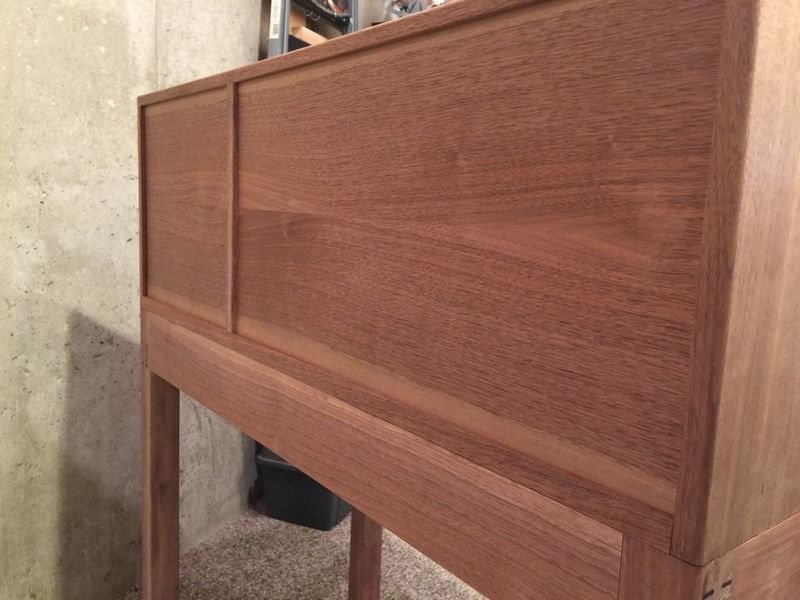
Good morning! The cabinet back panels are not completed and installed into the Butler's desk. If any were wondering my reasoning behind having fully blind dados to hold the web frames, it should now be apparent, at least, in terms of aesthetics. Having the web frames installed into blind dados allowed me to retain full thickness of the outside carcass in the view from the back of the case.

https://brianholcombewoodworker.com/2016/06/23/the-butlers-desk-cabinet-back/

^^Click the above link for the full essay :) (especially you, Bill)


Re: The Butler's Desk - Closing the Case

#2

Re: The Butler's Desk - Closing the Case

Hank Knight

Brian, tha is just fantastic work! Thanks for posting. I have enjoyed following your progress on this piece.

Re: The Butler's Desk - Closing the Case

#3

Re: The Butler's Desk - Closing the Case

Brian Holcombe

Thank you Hank! And thanks for following along with the build!

Re: The Butler's Desk - Closing the Case

#4

question

Bill Tindall, E.Tn.

"I had to create blind dados to hold the web frames and have them install inside the case, " What part of the case does this statement apply to?

That back panel deserved to be a door on the front of something. Pretty!

The legs are looking less too big as the parts get added.

I'm still bewildered by the front. I seldom can determine where your novel joinery is headed.

Re: The Butler's Desk - Closing the Case

#5

Re: question

Brian Holcombe

Thanks Bill!

Web frames refers to the right hand side of the case from the front view. They are also known as drawer dividers.

I plan to first produce a drawing on the next build do that people can stay tuned a little more easily.

Re: The Butler's Desk - Closing the Case

#6

Web frame...why?

Bill Tindall, E.Tn.

I expect we will get a more detailed picture of right-front when the drawers come up for discussion. I suppose drawers go over there? If so that is a complicated arrangement to simply hold them. Web frames will stiffen a case where that is needed but stiffening is not a need in this case. More conventionally the divider is simply mortised into the case side and a runner mortised loosely between the runners to allow case side expansion. I typically use some variation of this approach with the divider, but not the runner, mortised or dovetailed into the case side, blind or not.

In Period pieces the drawer runner is often found to be dadoed into the case side. I have never been sure why. Maybe to accurately locate the runner? Maybe a consequence of simply plowing a dado across the case to locate runners and dividers (I have used this reason)? To hold the runner more securely when the runner is simply nailed on(I have used this reason too).

Re: The Butler's Desk - Closing the Case

#7

Re: Web frame...why?

Brian Holcombe

My web frames are basically that, but slightly more involved by adding the rear stretcher/spreader bar.

The runners are dadoed into the sides, the dividers mortised and the additional spreader bar keeps them tight in the dados at the rear of the case.

The mortises along the sides are made long so that when the case shrinks in the winter months it will not cause interference.

I see the benefit of dados being that you can locate the drawer runners somewhat permanently, where screws or nails have the ability to move a bit.

I appreciate the inquisitive questions, this is what the web frames look like from inside the case. That joint at the rear is a bridle joint and the runners are dadoed into the case. After the job is mostly done I'll come back and apply some small pins or screws to keep everything in place.


I cover how I built my drawers in next week's post.

Re: The Butler's Desk - Closing the Case

#8

Now I understand

Bill Tindall, E.Tn.

Your construction is hard to follow because you assemble stuff in ways I have never encountered.

Not sure I would call what you did a web frame, and calling it such led me to misunderstand the construction. I think of a web frame as being, well, a frame, rigid and usually assembled with M&T joinery. Its purpose is to either stiffen the inside of a limber case or be a transition between case and feet. The cherry chest of drawers recently pictured sits on a web frame to which the feet are attached, a common approach in Period Furniture.

I have never had an opportunity to discuss this point with someone that has studied Period Furniture but I think housing the runners in a dado may have been a by product of how the case was laid out. One of the challenges in case work is for the drawer support to wind up on one plane. Plowing a shallow dado across the case side and then locating the dividers and runners with this dado ensures the front and back divider is in the same plane when these are inlet into the case sides with M&T or dovetail. It was then common to simply nail a runner into the dado. The function of the nail only had to be to keep the runner from falling out of the dado. The construction is robust and lasts centuries and was relatively quick to do.

Re: The Butler's Desk - Closing the Case

#9

Re: Now I understand

Brian Holcombe

That makes sense to me, and is partially why I did it this way in this case.

I am not formally trained nor have I even read a book on cabinet making, so what I do is often my own interpretation of what should be done and how to do it, but I'm usually glad to see that period stuff is similar.

I've improved on my work over time with research and most of my research is often in Ming dynasty or sashimono and tansu.

My first bit of furniture making was a small table with drawer that I still own, I made it almost entirely with sliding dovetails as the only available tooling I had was a Bridgeport mill and dovetail router bits.

Re: The Butler's Desk - Closing the Case

#10

Works for me

Bill Tindall, E.Tn.

I stick my head into antique furniture every chance I get. I figure if it has lasted a century or two it must be made with good engineering that I will copy. I save what little creativity I have for what shows.

I don't have any fault with your engineering other than sometimes I don't understand it. No Cardinal Rules of construction are violated.

Plus....I have wondered if tools and techniques influence engineering. It is a fact that some operations trivial with power tools are not so with hand tools and visa versa. I am facing this situation right now in a set of bed side chests of drawers. Daughter wanted a modern frame and panel construction. What would be trivial with floating tenon, if I had the means to do this joint a large number of times, has become challenging with the techniques I have in my "tool box" . Hence, I would have avoided this design for my own furniture.

Re: The Butler's Desk - Closing the Case

#11

Re: Works for me

Brian Holcombe

Similar logic behind my investigating Ming and sashimono furniture; I build modern and so much modern design is designed to mimic Asian aesthetics. I like to see how they accomplished things and utilize that directly, rather than looking to modern furniture which is mostly built using machine tools.