Mortise gauge preference?
Bill Tindall, E.Tn.
I don't own a quality mortise gauge. Having just made a bunch I am motivated to buy one. What do you all prefer that can be readily bought mail order?
Knowledge You Can Build On — Est. 1998
Mortise gauge preference?
Bill Tindall, E.Tn.
I don't own a quality mortise gauge. Having just made a bunch I am motivated to buy one. What do you all prefer that can be readily bought mail order?
Re: Mortise gauge preference? *LINK*
Hank Knight
Bill,
I have used several different mortise gauges over the years with varying degrees of annoyance and frustration. I have settled on two that do the job well with minimal annoyance. The first is a double-iron Kinshiro Japanese gauge. Kinshiro was the name of the maker, and he is either out of the gauge business, or dead. His gauges are no longer available. But Derek Coheh has pretty successfully duplicated a Kinshiro gauge using the iron set from a much less expensive gauge that is currently available. I'll post a link to his blog "In the Woodshop" below where he explains the process. It has some good photos, so you can get an idea of what a Kinshiro gauge looks like and how it works.
Of the commonly available gauges today, Glen Drake's Tite-Mark is my favorite. They use a sharp disc as a cutter and are relatively easy to adjust, especially with the micro adjust feature. You have to change out the regular cutting disc and replace it with a pair of mortise discs, but it's not difficult and minimally fiddly. They are pretty pricy, but are solid and well built - better than others on the market, IMHO.
Of the two, I think I prefer the Kinshiro, but it's a close call. I frequently use them together on the same project with different settings. I don't notice any difference in their performance.
In the Woodshop - Kinshiro
Re: Fixed Linky
Re: Mortise gauge preference?
William Duffield
I like this dual marking gauge from Veritas, item # 05N70.10:
http://www.leevalley.com/US/wood/page.aspx?p=67466&cat=1,42936
The optional shaft clamp makes it a lot more convenient. It is a very versatile gauge.
Before Veritas invented it, I used a Crown mortise gauge, also offered by Lee Valley, item # 35N01.01:
http://www.leevalley.com/US/wood/page.aspx?p=32621&cat=1,42936,42948
It also works well, and I still have it and use it whenever a project needs two gauges set up. I will not argue with anyone who says the Tite-Mark is a better gauge, but the Veritas works well enough for me, and I find it less fiddly than messing with the extra set of mortise cutters that are needed for either the Tite-Mark or Veritas single beam gauges.
There must be a subtle trick to using the Japanese gauges that I haven't been able to get my head around. I can't figure out how to adjust the blades to fence distance without disturbing the distance between the blades (which it seems to me must be set to the width of the chisel first).
they do have free shipping, tempting
Blatant plug for Aussie tool maker
ian neuhaus
Colen Clenton.
I have one of these http://www.hntgordon.com.au/colen-clenton-marking-out-tools/colen-clenton-gauges/product/210-ebony-slide-mortice-cutting-gauge.html in Rose Sheaoak
I've found it a superb tool, but will admit it was only affordable because it was a gift.
Re: Mortise gauge preference?
Derek Cohen (in Perth, Australia)
I don't own a quality mortise gauge. Having just made a bunch I am motivated to buy one. What do you all prefer that can be readily bought mail order?
Hi Bill
Firstly, a thank you to Hank, who paid me the compliment for pointing to a "Kinshiro" type gauge I made. I must point out that this is not a mortice gauge, but rather a single knife gauge. I do have a Kinshiro, which was a gift several years ago from Wiley. I treasure it and use it a great deal .... but I would not send you down that path - not because they are expensive and unobtainable now, but because they have limitations.
The Kinshiro, and imitations, cut the best line of all the gauges I have. However, they have knives at a fixed length, and this means that they cannot transfer marks to something offset (e.g. a stretcher to a table leg). I have seen a maker who has modified his to do so, but they are still expensive and difficult to find. Brian has one, so he can comment.
Here is the Kinshiro along with my single-blade copy ..

The ideal mortice gauge has this facility, that is, can mark offset depths without changing the setting for the tenon/mortice width. The relatively new Veritas double wheel gauge does this (with the accessory clip - why is it not sold as a unit? The photo below was taken before I purchased the clip). I have one of these. Note that the bevels of the blades face away from each other, which permits the shoulder line to be square ...

This is a great gauge ... but I am having some difficulty with it - the reversed wheel struggles to cut smoothly. I must be doing something wrong as many others offer glowing praise here. For me, the blade is catchy. I have sharpened, even replaced it with another. Same story. I like the concept, so I persevere.
One could do this with two single wheel gauges. The wheels do not cut very deeply, so the bevel side is a non-issue really.
I would avoid the double-wheel-on-a-single-arm mortice gauge. Both Tite Mark and Veritas make them. I find them very frustrating since I cannot get enough penetration on hardwood to have good visibility. You may be more successful on softwood.
The ideal mortice gauge is actually a fixed gauge, one sized to the chisel you use. So you may need a couple for the various sizes of chisels (and then one goes back to the Start and gets one gauge capable of varying widths!).
My solution to this was to make my own mortice gauge - one with fixed blades that allows for offset, and where fixed blades can be swapped out for others of different widths. The fence design is influenced by Kinshiro ...
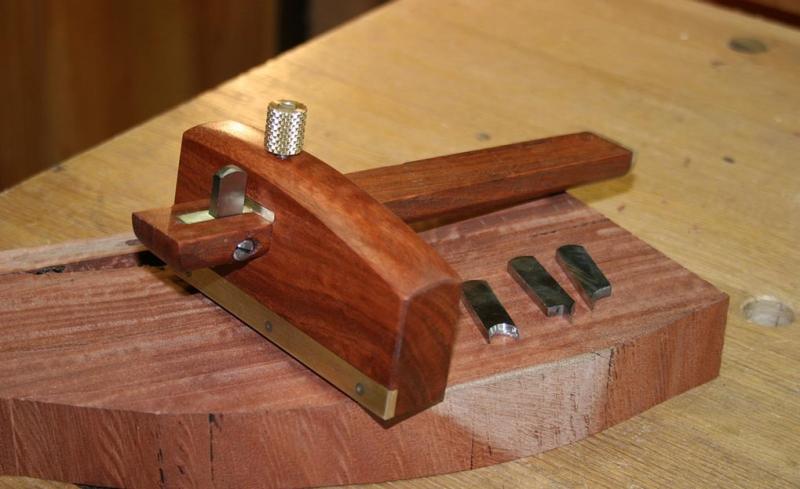
Here, a range of blades can be locked into a "cassette" when needed.
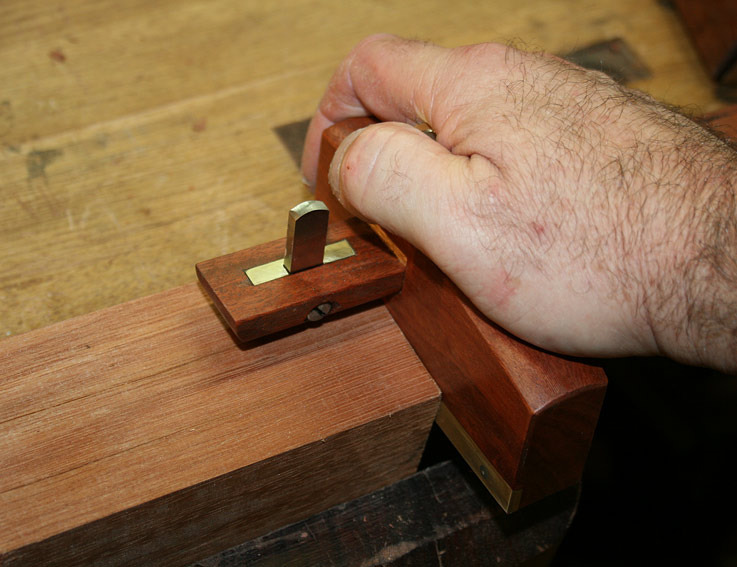
The concept and gauge works very well. I love it.
No doubt Warren will mention (as he has before) that he has made a bunch of simple gauges with nails to the widths of his chisels. That is indeed another way to go. The alternative to this is a variable pin mortice gauge. This is the one area where I would support using pins since they are running with the grain. There are plenty of cheap offerings available.
Regards from Perth
Derek
Re: Mortise gauge preference?
Brian Holcombe
Thanks Derek!
One of the Kinshirou type are made by Matsui Seimitsu under the brand Matsui Measure.
So Yamashita (Japan-Tool) can probably source them, since he sells Matsui products. I bought my Kinshirou through So, he's a good friend and incredibly good source. I generally go to So first, but he's a one man band and gets a bit swamped at times so if I need something immediately then I use other sources.
Suzuki Shrieber has them listed on her website;
https://suzukitool.com/tools/japanese-woodworking-tools/layout/matsui-kama-kebiki.html
And if you don't mind working with very plain English then Teshiba's Mandaraya Shop is also a great source;
http://www2.odn.ne.jp/mandaraya/matsuikamakebiki.html
I usually just link the page in an email and say 'please bill me via PayPal'. Teshiba is fast. He's made up wooden boxes to ship replaceable blade saws to me, ect, and still ships right away. He's a great source for everyday tools, like replaceable blade saws, joinery planes, etc.
I actually bought my Matsui gauge through Tomohito Iida, who is also a good source. Tomohito is a fine fellow and great retailer, I will usually buy through him during one of his 'sales' which is twice or three times a year and generally offered to repeat clients.
Stu also listed them, but had them marked as 'sold out'.
Re: Mortise gauge preference?
William Duffield
The Veritas dual marking gauge and accessory clip are now sold as a unit 05N70.10, ref. my other post). I agree that the clip is essential. I'm guessing they are still selling them separately because lots of people (like you and me) bought them before Veritas invented and added the clip.
I also suspect the reason the reversed wheel is giving you problems is that its bevel tends to push the fence away from the work. The harder the wood, the stronger the effect. I also notice that Veritas suggests marking with one cutter at a tie, which is easier to do with a dual arm wheel gauge than with other gauges with the knives permanently aligned. However, that may not be such a good idea if you are having trouble controlling cutting with the reversed wheel. If you cut with both wheels engaged, at least for the initial cut, the forces of one bevel will at least counteract the forces of the other bevel. You might even try making a couple passes with the outer wheel only and then engage both wheels at the same time, so that the deeper initial kerf overpowers the shallower kerf of the inner wheel.
Of course, my "inner" and "outer" nomenclature assumes you are set up for marking a mortise. Roles are reversed when set up for marking a tenon.
Re: Question
Hank Knight
"Of course, my "inner" and "outer" nomenclature assumes you are set up for marking a mortise. Roles are reversed when set up for marking a tenon."
William, do I understand from your comment that you reverse the wheels on the Veritas gauge for marking mortises and tenons? If so, that would seem to introduce an error equal to the thickness of the wheel into the layout. What am I missing here?
Re: Mortise gauge preference?
Hank Knight
Hi, Derek,
I feel pretty stupid referring Bill to your article about making a Kinshiro style KNIFE gauge! I've admired the article since I first saw it, but thought all along that you made a mortise gauge using a set of double irons. I think, however, it would be easy enough to do using your technique.
Yes the Kinshiro gauge has the limitation you pointed out and it can be tricky to set the depth of the inset without messing up the mortise width setting until you get the hang of it. I don't find the limitation on transferring marks a big deal. I use two gauges more often than not, and multiple gauges solve this problem.
There are two reasons I like the Kinshiro gauge. The first one you noted in your post: it cuts the best line. The cutting edges of my gauge have the points ground back at a slight angle to create a modified spear point that facilitates marking in either direction. Most other Japanese gauges I've seen do not have this feature and marking in reverse is not so easy with them.
The second thing I like is the heft and shape of the fence. It fills my hand, is easy to grasp and gives me a sense of solid registration against the work piece that I don't quite get with other gauges I've used.
Finally, I have one issue with the Veritas gauge that may be nit picky, but here it is. I have a Veritas single wheel marking gauge. It has a rubber (or similar synthetic material) O ring through which the beam passes as it enters the fence, the purpose of which is to provide some friction to keep the beam from sliding around willy-nilly until you tighten the locking screw. I found the elasticity of the O ring to complicate setting the depth of the gauge precisely. There always seemed to be a little movement of the beam when I released it and it required some back and forth fiddling to get it to settle on the mark. A small issue to be sure, but I found it annoying and I've pretty much given up using the gauge in favor of others don't have this issue. This may be a total non-issue with the new double beam mortise gauge. I don't even know if they have the O ring feature.
Anyway, that's my $.02.
Hank
Re: Mortise gauge preference?
Bill Tindall, E.Tn.
"It has a rubber (or similar synthetic material) O ring "
I have the same annoyance with mine. I seldom use it. I like the one from LN much better.
What I did
Bill Tindall, E.Tn.
I took advantage of free shipping, I am such a sucker for free shipping, and bought the LV Japanese gauge. I'll make it work somehow.
Re: Question
William Duffield
No, I don't reverse the wheels. Like it shows in the Veritas documentation, I just reverse the depth of the two beams. Their diagrams might be a little confusing, because they have turned the gauge over between the second and third illustration. In the middle drawing, beam "C" is on top and beam "D" is on the bottom. In the right drawing, "D" is on top and "C" is on the bottom.

You can make either setup directly from your mortise chisel, using the other ends of the beams, because the distance from cutter "C" to the end of its beam is exactly the same as the distance from cutter "D" to the end of its beam.
Another potential point of confusion is that the following picture, showing "tool slaving", is upside down compared to the two diagrams above.

Both drawings are from the Lee Valley on-line tool catalog.
Re: Mortise gauge preference?
TomD
I have then in several levels of quality right up to hundreds of dollars (bit of a mistake there). My flat out all time favourite is a single blade, single bevel Japanese white oak gauge I got from LV over 30 years ago. It uses a simple screw adjust and I prefer that to a wedge. It is very ergonomic, the blade is great (though it is just some bent piece of probably mild steel), very comfortable in the hand. When set about half way tight, it can be more easily adjusted for very high precision than any other I have used. Whether taking a measurement off a digital caliper, picking up an earlier line, whatever, it is always the easiest to adjust, whether scrunching, or tapping.
The fence length is perfect for reaching around on parts where the support is at a distance.
They make more expensive ones in tropical woods, but my experience with fancy woods has not been positive, I find the feedback one gets has a dry or brittle quality, I see no upside over plain Japanese white oak. I should say I have only the one marking gage of Japanese construction, all the others are western in some form or other. It just happens to work the best.
Re: Question
Hank Knight
Thanks for the clarification and photos, William. They make perfect sense.


