New WoodChat!
Home Articles Forums Gallery Marketplace Videos

WoodCentral Forums

Knowledge You Can Build On — Est. 1998

Compare cordless drills on the numbers that matter

Japanese Toolbox Build

Posts

Japanese Toolbox Build

#1

Japanese Toolbox Build

Brian Holcombe

Evening Gents!

I've started on a new build, in this build I'm working my way through Chris Hall's Japanese Tool Box. I do hope you will check it out and look forward to your input.

[url]https://brianholcombewoodworkerblog.wordpress.com/2016/02/16/the-carpentry-ways-japanese-toolbox-build/[/url]


Re: Japanese Toolbox Build

#2

Re: Japanese Toolbox Build

TomD

That is a pleasing project to see come together.

For anyone who want to use a fret saw, but doesn't have a deep throat one. You can usually get the same result by bending the blade at a 45.

Re: Japanese Toolbox Build

#3

Re: Japanese Toolbox Build

Brian Holcombe

Thanks Tom!

Nice idea on the fret blades, so far I've been fine with the coping saw though I do see the appeal of a smaller blade, may make life easier in tight spots to saw closer to the edge.

Re: Japanese Toolbox Build

#4

Re: Japanese Toolbox Build

TomD

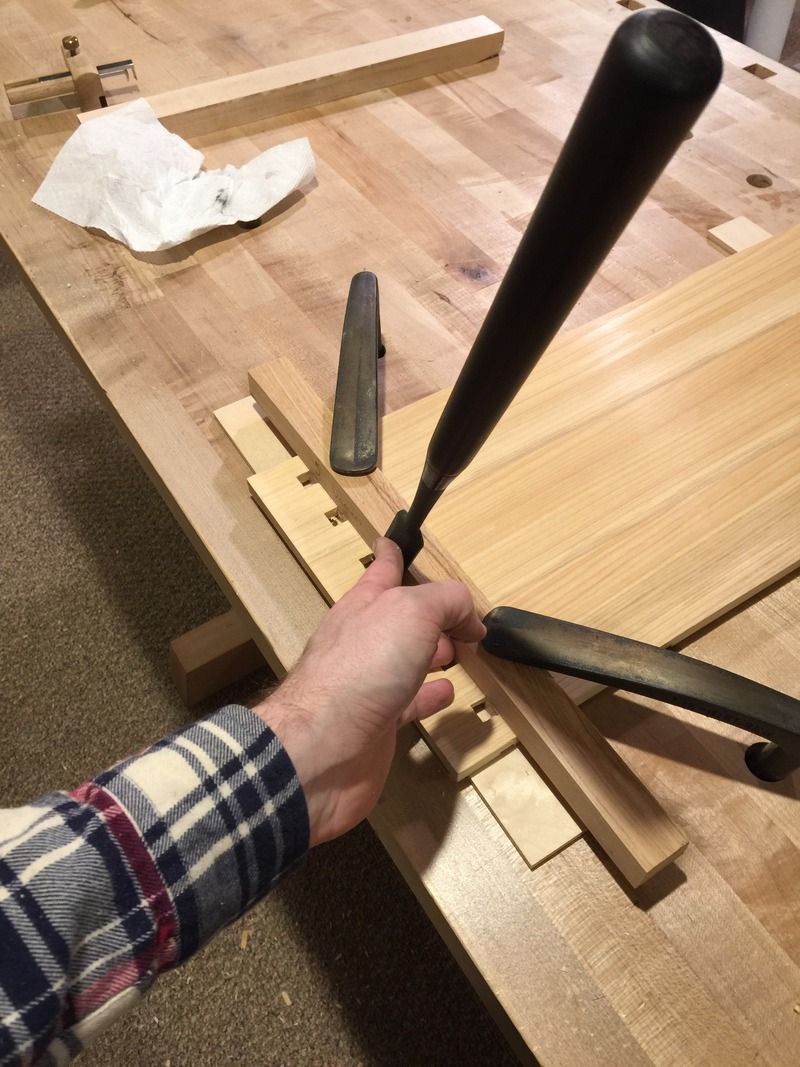
I may be using the wrong term. I use a pretty aggressive blade. If one mounts the blade backwards so the teeth face the frame, and flare it out 45 degrees, then one can work it into a dovetail or whatever backwards and saw away. The result is that as long as your frame is about 60 percent the depth of the dovetail or tenon, you could saw a board 40 feet wide, no throat limit. Using a really fine blade would get old fast. :)

To flare the blade, you need two pliers, say, and to make a real bend with the pliers close together. This probably needs its own thread and pictures. Oops.

Basically we can probably all imagine cutting along the dovetails, or tenons, with the blade 90 degrees to the frame. Only problem is that if the blade is a tight fit, at some point you can't get it in there, this allows one to work a fat blade in a thing kerf, and yet have no limits to the geometry.

Re: Japanese Toolbox Build

#5

Japanese Toolbox Build - Part II

Brian Holcombe

Thanks Tom, but having a bit of trouble visualizing. Any chance you could take a photo?

Part II is ready, been doing my fair share of resawing these days, hah. I've been getting my exercise to say the least. Please take a look;

https://brianholcombewoodworkerblog.wordpress.com/2016/02/19/the-carpentry-way-japanese-tool-box-part-ii/


Re: Japanese Toolbox Build

#6

Re: Japanese Toolbox Build - Part II

TomD

That is way better than obscure saw talk.

By the way, is this conceived to be an actual style of Japanese toolbox or is it the designer's take with embellishments. Odate promoted a version that was nailed together. I did a version of Roy's box that he said was not to be dovetailed, and dovetailed it, seemed like an actual case for the joint, so I am all for upjointing.

Re: Japanese Toolbox Build

#7

Re: Japanese Toolbox Build - Part II

Brian Holcombe

It seems like most historic examples are quickly assembled with nails or light joinery. Chris designed this as a joinery study for his carpentry study group. It's intentionally designed to stress the layout procedures and accuracy. I find myself mildly exhausted by it, as normally I have partial assemblies which I can complete in and of themselves. This project is made In a way where 90% of it must be completed before it is assembled.

I've cut down on it slightly, but Chris' plans in their original form call for 12 hell tenons, 28 wedged through tenons, 4 through tenons, 2 sliding dovetails and nearly every connection has a housing.

Mine will have 4 hell tenons, 6 half lap dovetails, 38 wedged through tenons, 4 through tenons and two sliding dovetails and all of the connections are housed.

Re: Japanese Toolbox Build

#8

White cypress

Warren in Lancaster, PA

I never heard the term "white cypress" before, either as a tree or timber. Do you know the Latin name or where this tree grows?

Re: Japanese Toolbox Build

#9

Re: Japanese Toolbox Build - Part II

david weaver

>>Mine will have 4 hell tenons, 6 half lap dovetails, 38 wedged through tenons, 4 through tenons and two sliding dovetails and all of the connections are housed.<<

You can make a claim with something like that that is similar to what the glue maker's say.

something along the lines of the joints being stronger than the underlying woods.

Re: Japanese Toolbox Build

#10

Re: White cypress

Brian Holcombe

Hi Warren,

From what I have gathered it's a name applied to a group of cypress trees that grow in the southern states. I wish I could be more specific, so I will inquire with the yard.

Re: Japanese Toolbox Build

#11

Re: Japanese Toolbox Build - Part II

Brian Holcombe

Hah! I never thought that I would actually use a sizable amount of material making wedges....I've started making them and so far I'm surprised by how much material I need.

Re: Japanese Toolbox Build

#12

Re: White cypress

david weaver

Chamaecyparis thyoides has some references to white cypress (though it's not cypress), but I don't think even choice pieces would look like what Brian is using.

Re: Japanese Toolbox Build

#13

Re: White cypress

Warren in Lancaster, PA

Thanks, Brian. I was wondering if it was what we call white cedar, Chamaecyparis thyoides, a very fine wood that was used in Philadelphia for drawer parts in the 18th century. It is also called Atlantic white cedar or Southern white cedar to distinguish it from Thuya occidentalis, Northern white cedar of the northern states and Canada. Both these trees have close relatives in Asia.

Since posting I found the term white cypress (among five other terms) referring to bald cypress Taxodium distichum in a 1913 text. Also a South eastern US tree. I have a sample of this wood but have not really worked it. I think it is a little more waxy than white cedar.

The true cypresses (Cupressus) are found in western US.

Re: Japanese Toolbox Build

#14

Re: White cypress *LINK*

JDK

Wikipaedia lists four species known by that name:


White Cypress

Re: Japanese Toolbox Build

#15

Re: White cypress

Brian Holcombe

Interesting that Atlantic White Cedar is listed under that label as well. This would certainly make nice drawer stock from what I've experienced. I'll inquire further and see if this wood actually is Atlantic White Cedar.

I'm really itching to pick up some true old growth stock in one of the prized softwoods and put it to use.