New WoodChat!
Home Articles Forums Gallery Marketplace Videos

WoodCentral Forums

Knowledge You Can Build On — Est. 1998

Reach the woodworkers who ACTUALLY BUY

marking gauge

Posts

marking gauge

#1

marking gauge

John Pappas

I received a Veritas wheel marking gauge for Christmas. Testing on various different woods I find that the line it makes is difficult to see because it is very fine. I need to run a sharp pencil down the line as an aid. A line 'scratched' by a pin type gauge is easier for me to see. At this point I don't really see any advantage for the wheel gauge. Thanks for any suggestions/comments from those using a wheel gauge?

Re: marking gauge

#2

Re: marking gauge

Bill Tindall, E.Tn.

If you got the right gauge the ability to adjust the depth with a fine thread is a huge advantage to me at least.

If you want a fatter line dull it or press harder.

Re: marking gauge

#3

Re: marking gauge

Bruce, a MN Galoot

I have the same wheel gauge, as well as a couple Stanleys of the same type, and like them very well, hard-to-see line and all. I think the advantage of the wheel gauge over the scratch-type is that there isn't a potentially rough scratch edge to try to fix. If I have a hard time seeing the line, I do like you and make a light line with a very sharp pencil.

Re: marking gauge

#4

Re: marking gauge

John Pappas

I did dull the wheel and I like it better. If, in time, I think that was a mistake, I can get a replacement wheel.

Re: marking gauge

#5

Re: marking gauge

William Duffield

A wheel marking gauge is intended to replace a traditional cutting gauge, not a pin marking gauge. The wheel gives your mark one vertical edge. which is often used to guide a saw or a chisel, continuing to remove material up to the edge. You would use it for example, to mark the edges of a rabbet, or the shoulders of a tenon from the squared end of the board. The typical wheel gauge would not be appropriate for marking the near edge of a mortise, but would mark the far edge. This consideration is applicable to through mortises, for which you need to preserve the surface on both sides of the mortise. It doesn't matter for regular mortises, because the surface will be hidden by the shoulders of the tenon.

For marking through mortises, either the mortising attachments for the Veritas gauge or the Veritas dual marking gauge would be appropriate. Reference the last three figures on this page: http://www.leevalley.com/US/Wood/page.aspx?p=67466&cat=1,42936

I think best practice for making a heavier line is to make multiple passes. A very light first pass is much less likely to follow the grain, and subsequent passes with track the first pass instead of following the grain.

Re: marking gauge

#6

easy to sharpen

Bill Tindall, E.Tn.

lay flat on stone of your choice and rub. I have sharpened mine many times on fine diamond stone.

Re: marking gauge

#7

Re: marking gauge

Derek Cohen (in Perth, Australia)

Hi John

I really like the wheel gauges for their thin lines. I prefer cutting gauges to pin gauges because the lines are clean and unidirectional (unlike the triangular indent of a knifed gauge) owing to the thin cutting wheel. They can do this both with the grain and across the grain, unlike a pin, which is best used with the grain.

The lines are "light" and the key factor here is that you must remember to deepen them progressively with a few extra strokes.

The alternative - which is a revelation once you start doing this - is laying down a layer of blue masking tape over important joinery on wood surfaces where lines are generally difficult to see, and scoring over this. One only requires a single stroke.
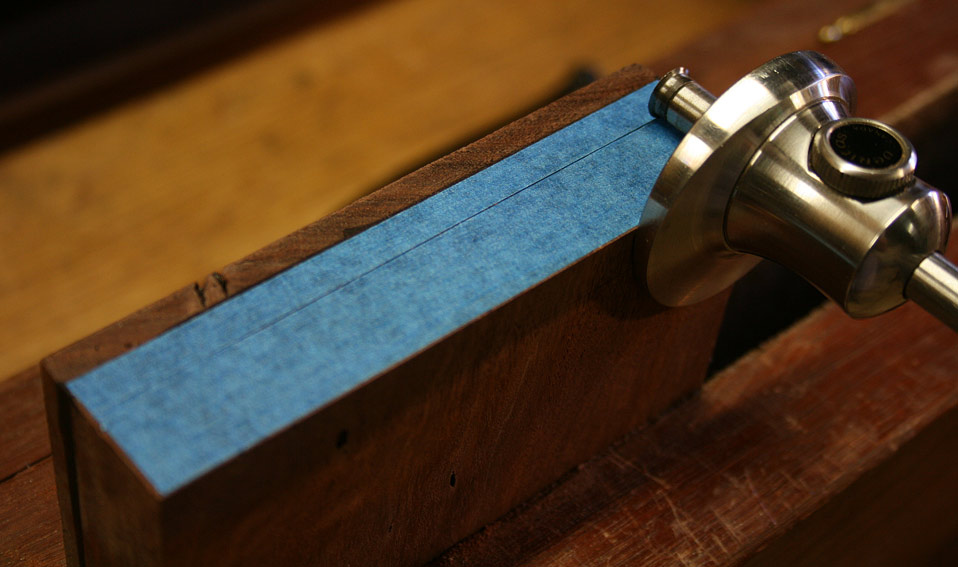

The resulting lines starkiy contrast with the background, making it so much easier to work accurately.
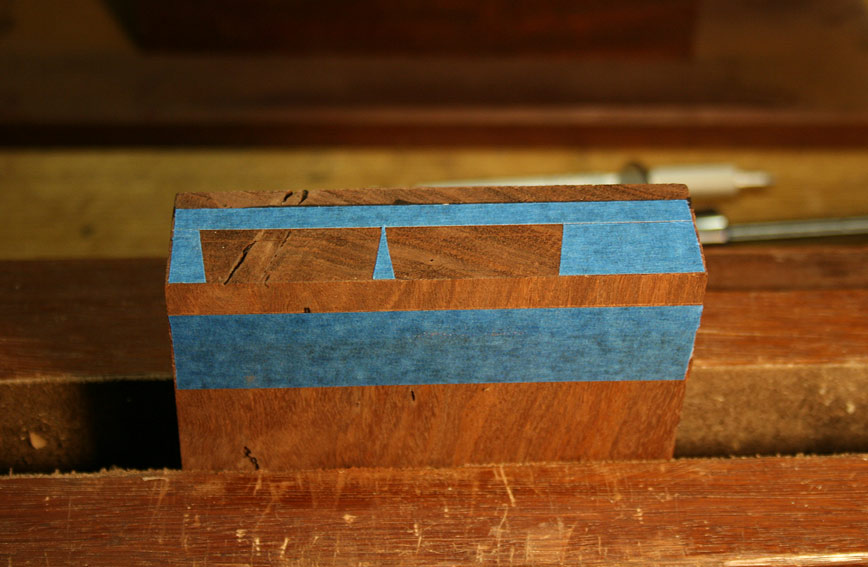

The dovetail is one example, but you can do this for tenons as well.

I am not trying to sell the blue tape, however, just trying to demonstrate that the clean, fine lines of a wheel gauge are so good that initial impressions when contrasted with one's experience of other gauges is an anticlimax. You just need to know what to do with the fine line, whether to deepen it or to use it as is.

Regards from London

Derek

Re: marking gauge

#8

Thanks for the helpful comments.