Advice needed
Ron Harper
Making drawbore pins. Want tapered Octagon handles. I thought I would rip the bevels to taper the square with a saw then scribe and bevel the corners with a spokeshave. Make sense?
Knowledge You Can Build On — Est. 1998
Advice needed
Ron Harper
Making drawbore pins. Want tapered Octagon handles. I thought I would rip the bevels to taper the square with a saw then scribe and bevel the corners with a spokeshave. Make sense?
Re: Advice needed
William Duffield
Handles?
My theory is that the old way to do it (of course, even in the 18th Century not everyone was doing it the same way) was to use the offcuts from the ends of the tenons. Since they would be a little short to taper with a spokeshave (depending on the style, a spokeshave might have no other use on that piece of furniture) you could trim them to octagons by setting them on end on the bench top (or on a small scrap block) and taper and bevel them freehand with a chisel. At least, with practice, that would be the quick way to do it, which would be important if you were getting paid by the piece. You're going to have to pick up the chisel anyway to pare the tenon shoulder before you remove it from the vise.
Pins vs. pins
Bill Houghton, Sebastopol, CA
I think Ron was talking about the tapered steel pins used to test the drawbore before installing the actual wooden pegs/pins/dowels in final assembly.
I think Sir William was talking about the pegs/pins/dowels.
Ron, if your handle design is just a straight octagon, a block plane will probably work better than a spokeshave. Think about a wooden fixture to set the handle stock in after you've ripped it to size - V-shaped slot with a stop in it, all made from suitable boards, no nails or screws visible on top. That way, if your plane slips and hits the fixture, you won't be cursing, as you might if you clamp it in a metal vise or somewhere that your plane could scar the workbench.
Re: Pins vs. pins
William Duffield
Doh! Let me try again to provide some information you might be able to use.
If your handles are a simple taper in cross section, Bill's advise is spot on. lA spokeshave would work, too.
If your handles' cross sections are barrel shaped, you need a more sophisticated approach. Don McConnell at Old Street Tools offers a tutorial on how he does it.
http://www.planemaker.com/docs/octhandles.pdf
But this isn't Don's first piece of advise on octagonal handles. Here's an older post on OldTools:
http://swingleydev.com/ot/get/108959/single/
If you are trying to decide whether you want a straight taper, or something more sophisticated, Chris Schwarz analyzes the advantages of Adam Cherubini's design here:
Bob Rozaieski offers a tutorial on a different method in a video on his Logan Cabinet Shoppe blog. Since you are working to fit a straight piece of steel, you don't need to go through a process that complicated.
https://logancabinetshoppe.wordpress.com/2011/06/24/episode-35-re-handle-a-chisel/
If you want to lay out a regular octagon, with all 8 facets the same width, Bob Smalser offers a tool to do it, in two variations:
http://www.woodcentral.com/cgi-bin/readarticle.pl?dir=smalser&file=articles_646.shtml
I have used another method, but it requires a lathe with an indexing head, so it's probably not what you are looking for.
Re: Pins vs. pins
TomD
You could have it done before reading all that stuff. The last item works well on spars, and other long objects. On small objects it doesn't normally have the support.
Re: Advice needed
Ron Harper
Thanks All. Once again you come through. William. The links are especially helpful. These are not chisels, so Schwarz's appreciation for proper bevel alignment does not apply. However I have a lot of old chisels that I have wanted to put matching handles on, so in that application, Chris's point becomes quite relevant. Can get just a little complicated, since All the chisels are socketed, and I have no lathe. Planning to copy Richard McGuire's bench too bungee lathe. I have been away from here for awhile. Have moved into a 9 by 17 ft shop space. Absolutely no more floorspace available. Probably will not get to new chisel handles for a month or two. Will post photos when in process.
Re: Pins vs. pins
Ron Harper
Hey Bill, good to hear from you. Actually I believe that after I get the stock tapered I can put it in my face vise and cut the chamfers with your excellent suggestion of a block plane, or my beloved 604
Thanks
Re: Advice needed
William Duffield
Good to see you again, Ron. Welcome back.
Of course, there are other reasons Chris's analysis doesn't apply: Chisels are often struck with a mallet, while draw bore pins are finessed. And draw bore pins need to be twisted, while chisels only need to be aligned with the work. So, draw bore pins benefit from a handle that you can get a good grip on. I suspect that four flat faces with four smaller corner chamfers would work better than a regular octagon with eight faces all the same width.
I guess you're not going to squeeze a planer, jointer, cabinet saw and router table in there, are you? You might not even have room for a #8, and definitely not room for a great wheel lathe and an apprentice to crank it for you. 
Re: Advice needed
Ron Harper
Since we last talked, I have gone almost "old order" Galoot. I have a 12 inch planer. Every other operation is powered by cheese burgers and pulled pork. I am 70 years old and I foresee a time when I might want a bench top bandsaw exclusively for ripping on big projects. But not yet. I so very much enjoy how I work wood.
I did run to a friend's shop yesterday to bore 4 holes 2.5 inches deep with a forstner bit in 12/4 curly maple. I have a nephew who is a professional guitarist traveling a lot and I am making a pick box for him. But, for the most part, I have no regrets at all about getting rid of all my piwer tools. I do wish I had the floor space for a treadle lathe.
Re: Advice needed
William Duffield
While I enjoy woodworking the old ways, if I'd been living in colonial times, they would have put me out to pasture years ago.
Have you considered the treadle lathe/bench that Stephen Shepherd drew up plans for? It doesn't take up much room, as it's built into the bench, with the flywheel underneath. However, unlike a spring pole with removable poppets, the head stock will always be standing above one back corner of the bench. The tool rest and tail stock are removable.
Select the "Support Stephen Shepherd" button at the top of this page, navigate to Full Chisel Store, and from there to the Full Chisel press.
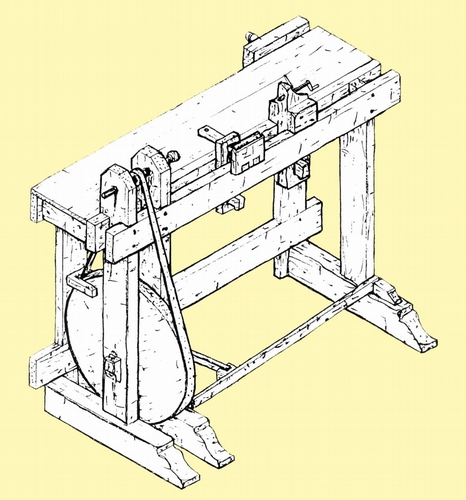
This is a view from the back, unless you are primarily a turner. Don't mistake the lathe bed ways for a tool tray. There's no bottom in it.
Re: Advice needed
Ron Harper
Have Stephen's plans. Pondering. Given the size of my work space, I use all room under my bench for storage. Going to try Richard'sbench top lathe first. I can hang it high on tge wall out of the way when I don't need it. Very minimal hardware. Have turned a little on a pole lathe. So,I think it might work for me. Not ideal. Of course.
Re: Pins vs. pins
William Duffield
For support, you could start with a long stick and cut off both ends after you've marked it out. But you're right; an octagon gauge works a lot better for oars, spars, and even bowl gouges than for tool handles intended to be used with one hand.
I didn't really expect Ron, or anyone else here, to read and watch all of the references. Glancing at the pics, introductions and the start of the video would probably eliminate most of them from consideration. I just don't know which technique any particular person would find most useful. It's kind of like finding dinner at a smorgasbord.


