We value your privacy.
We use cookies to enhance your browsing experience, analyse site traffic, and personalise content.
By clicking “Accept all”, you consent to our use of cookies. You can also choose
“Essential only” or learn more.
In the most recent long "discussion" of cap irons, you posted the following:
"... I used to plane, scrape and sand. Then in 1976 I noticed that the scraper was actually degrading the surface. I used it one last time in 1977. In 1978 I realized that the sanding was also degrading the surface and abandoned that also. I also noticed that a cap iron too close yields a cloudy surface. I have finished straight from the plane since that time..."
Could you elaborate on this "cloudy surface" phenomenon you noticed? Was this after a finish was applied? Were most/all species affected? I do not doubt you experienced this, but I'm trying to envision why a close cap iron would make a wood surface "cloudy". Any idea as to what is actually happening to the wood fibers to make them "cloudy"?
I'm no warren, but I've experienced the same thing. The fibers from a too close set cap iron are more scraped off than cut, and the surface left shows it.
If you want to experience it, set the cap iron so that the iron barely shows at all, and then set for a coarse smoother shaving. You'll feel the plane first wanting to stop you and then not feeling smooth in the cut. The surface will be dull if the effect is minor and hairy if it's major.
The softer the wood, the worse the effect.
Before there is a hairy feel, on very soft woods, the cap iron set too close can leave visible crushing in the surface of the wood, even though the surface is fairly smooth.
There is no problems like the above once you get a good reliable typical set for your cap iron, though, you never set it close enough to cause any of the above because it mitigates tearout without being set so close.
John, if you plane a piece of Eastern white pine, or butternut or other tender wood with a very close cap iron and a heavy cut, you will get an extreme version of what I am talking about. On pine you can get a roughness that you can feel. There is a sweet spot where things work very nicely and the farther away from that spot, the more the plane tears the surface or is hard to push or scuffs the surface.
It is like a baseball bat. If you hit the ball eight inches from the sweet spot you will feel the sting; if hit two inches away it depends how discerning you are whether you notice it or not.
A lot is going on in the half milimeter cylinder around the edge. Analysis is very complicated, so observations become more important. It would take a lot of research to quantify what we know from experience and intuition. I suppose if you take a cap iron with a flat 50 degree bevel and move it ever closer to the edge at some close point the assembly will act more like an 80 degree iron and less like a double iron.
In the paper we are currently translating this phenomena is explored. At some point of closeness the cap iron exerts so much force parallel to the long axis of the shaving that it begins to fold up (accordion). With the microscope they observed damage of the wood fibers below the blade tip when the cap iron effect was too great. To quote, with the cap iron angle at 80 degrees and too close to the blade tip "Deformation of the chip extends below the plane generated by the path of the cutting edge".
Perhaps they say as much in parts not yet translated but I would presume the excessive pressure from the shaving is crushing the wood cells below the blade tip.
A surface scraped with a properly set-up scraper, in skilled hands, will result in as clear a surface as any produced by a similarly well set up and used hand plane.
The underlying premise behind this whole thing is flawed, you see.
By all means use the cap iron to good effect. If the surface off the plane looks fine then leave it and move on. But, if you need to scrape you can rejoice in the fact that if you learn to do it right then your surface will leave nothing to be desired.
The whole notion of 'abandoning the scraper' is absurd on its face. Anybody having done so simply does not know how to use one with the requisite skill. Period.
A scraper surface looks nice if the burr is polished and the cut light, but it can sometimes be a little lacking on something like cherry, especially something like quartered cherry.
I don't know what you normally work with, but cherry is the standard here because ...well, because it's Pennsylvania.
In the case where someone planes something and wants an identical look, though, you can scrape and burnish with shavings if the wood is soft like that. It takes longer than planing, though.
The cloudy effect is dependent on the species. Softer woods show a more pronounced effect, but it is not the case that certain woods give problems and others do not. It is more a matter of degree. Also the thickness of the shaving plays an important role here. The thicker the shaving, the farther the cap iron needs to be to avoid interference. Or in other words, a close cap iron demands thin shavings. Again there is no magical line where problems arise, instead the farther from the ideal the poorer the surface.
Here are some thoughts from Steve Elliott in 2010:
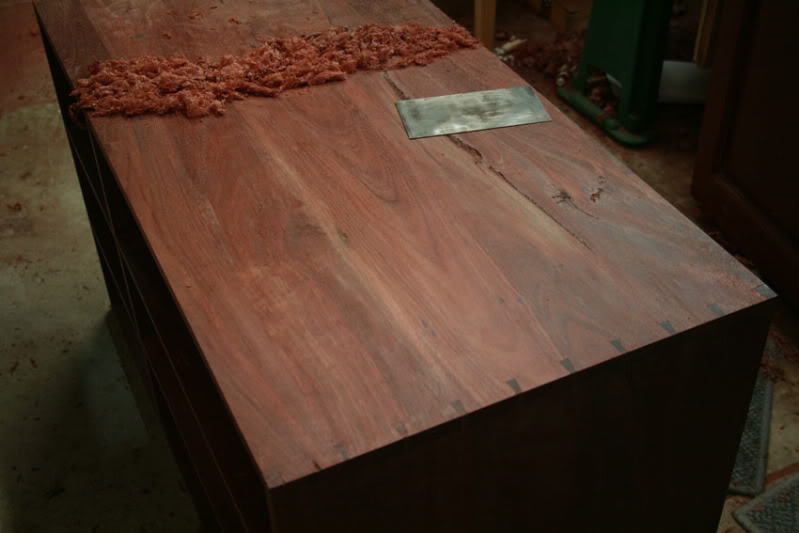
How dare you even show a photo of a scraper and a flat surface, as if one was used on the other. The blasphemy is beyond human comprehension. One can practically hear shorts becoming knotted and lips curling into a vicious snarl of which the Hound of the Baskervilles would be proud.