New WoodChat!
Home Articles Forums Gallery Marketplace Videos

WoodCentral Forums

Knowledge You Can Build On — Est. 1998

VPS-Level Performance. Fully Managed. No Hassle.

The wire when sharpening

Posts

The wire when sharpening

#1

The wire when sharpening

Derek Cohen (in Perth, Australia)

Something that has fascinated me is that some write of removing a wire edge that is large and easy to see. In a recent video that Paul Sellers posted, he removed a wire edge from a plane blade that looked like this ...
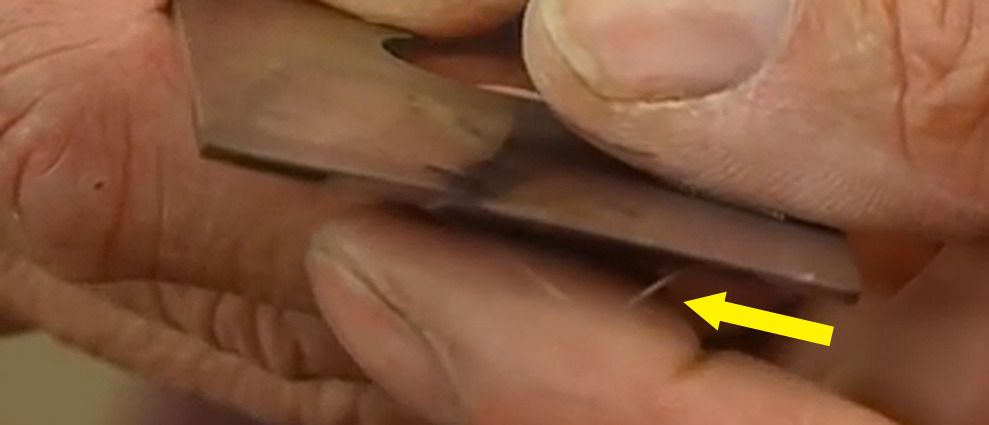

Now I am not concerned about the edges I get when sharpening. They are certainly sharp enough. But I never see - never mind remove - a wire edge like that in my sharpening efforts.

Sharpening starts with creating a wire edge, and there is no point in moving along to the next higher grit unless it is created. This is my guide. I suspect that I never raise a large wire. I tend to stop when can just feel it with a finger tip. Is there any point in raising a large wire? All one needs to be sure of is that you hone across the bevel, from front to rear. The wire gets smaller with each succeeding finer stone. It should disappear at the end, and be little to nothing to remove after the final polishing stone.

The only reason I can see for such a large wire, or there being a wire that is that the steel is soft and a too-large wire is created at the start, that too much time is spent sharpening, or the steel is tenacious at letting go, that is, pushing the wire from one side to the other (A2 is like that).

Any thoughts?

Regards from Perth

Derek

Re: The wire when sharpening

#2

I have seen it

Bill Tindall, E.Tn.

Depends on the toughness of the steel and where one begins in the grinding/sharpening. For typical steel and typical sharpening this wire edge just melts away as you have seen.

However, the exceptional toughness of CPM 3V even at high hardness leads to some interesting wire edges as the sharpening is refined on a edge. I have seen the remains floating in the lubricant as sharpening is refined. The steel Lee Valley calls PM V11 is also exceptionally tough at high hardness so I would expect some interesting wire edges to form here too. But I haven't ground on this stuff to know.

Who is this Peter Sells, a name that has recently come up here on occasions? He must write and claim a lot but does he build stuff?

Re: The wire when sharpening

#3

Re: I have seen it

Gary B.

Paul Sellers is a Woodworker, who I've been watching on youtube with some interest as of late. He really does seem to have come up through a professional shop. Some of his "Quick and Dirty" methods might bother some of you. He seems like the real deal to me...He has a series (Woodworking Master Class) that can be free.

Re: The wire when sharpening

#4

Re: I have seen it

David Charlesworth

I sometimes see a tiny wire edge on the sponge cloth, which I wipe/clean the blade on.

This is generally when getting a larger wire edge than usual.

Things like creating camber from scratch (straight blade), or dealing with a large chip.

best wishes,

David

Re: The wire when sharpening

#5

Re: The wire when sharpening

Steve Voigt

I think it matters a lot what the sharpening media is. I remember someone, maybe it was Warren, writing that the friable nature of waterstones, with little bits of slurry rolling around on the surface, tends to cause the wire edge to disintegrate in little bits rather than remain intact.

I sharpen with oil stones. When my stones are very freshly abraded, the wire edge will often come off as Derek describes, in one big continuous strand. But when the stones are broken in, it doesn't happen.

Why? I have no idea. It's probably completely irrelevant to actual work, but fun to contemplate on a lazy Sunday afternoon. :)

Re: The wire when sharpening

#6

Re: The wire when sharpening

Hank Knight

I sharpen with oil stones too; and, like Steve, I sometimes see the long, feathery remanents of the wire edge on my stones. I don't bother trying to remove the wire edge until I finish with my finest stone. Then I flip the blade over and gently abrade the remaining wire edge away. I start with either a side-to-side motion on the stone or by pushing the edge forward on the surface of the stone. I think that removing the wire by dragging the blade backwards on the stone causes it to break off and leave a ragged, less than satisfactory edge. Abrading it away, rather than breaking it off, leaves a more consistent, fine edge. I don't have any emperical evidence to which I can point, but I also believe that a tiny wire edge remains, even after I complete the stone regimen. That's what the strop is for - to take the wire edge down to it's tiniest manifestation. Whatever is left of it after stropping fractures and breaks off in use; but it is so small, it's departure doesn't affect the edge in any meaningful way.

Re: The wire when sharpening

#7

I chekced him out

Bill Tindall, E.Tn.

I was curious how he set up a plane. He is off by 10X (2=3 mm) on setting the cap iron to do anything useful but hold the blade on the plane. Apparently this "well known" procedure was overlooked in his formative years.

Re: The wire when sharpening

#8

Re: The wire when sharpening

TomD

I have seen wire edges. It basically means you have sharpened too long at the lower grit which is something one hopes to avoid. For beginners the problems of not enough time on task are normally greater so specifying going for the wire is a reasonable teaching thing. I have watched Sellers on a few subjects and he seems oriented to beginners, which is the sweat spot for him, but I don't put too much stock in what he says for others. So in this case it is reasonable to explain about the wire edge, but it is no more an objective than a plane shaving is, once you know the road, you don't care about mile markers, or sign posts any more.

I assume wire edges are formed as the sharpening proceeds, one gets to the point where the edge is being formed, and the last trace amount bends out of the way, and as one continues to sharpen it the bent away foil lengthens. Eventually it is large enough to come off under it's weight or manipulation, and one has the needle like remnant. If one uses a jig and sharp stones, they shouldn't leave much uncut, and the wire shouldn't form. I don't doubt there are materials more prone to wire edge formation than other materials, but I am not particularly interested in the subject.

Re: The wire when sharpening

#9

Re: The wire when sharpening

Bruce McCrory

Maybe, that thing is a grey hair from his scalp?

I do notice "wire" edges are easier to make on traditional Stanley blades, which that one likely is.

Re: The wire when sharpening

#10

Re: The wire when sharpening

Warren in Lancaster, PA

As Steve noted above, I think it seems that oil stones are gentler on the burr than water stones, and I have speculated that the slurry, loose grit was a factor.

There are some weird notions in this thread. One can feel a very slight burr, but a wire edge is a continuous burr without gaps and you need to be able see it to know that it is continuous. The amount of burr needed is dependent on how dull the tool has become. If the edge is rounded from wear, a burr will form before this rounded area is completely eliminated. If one stops at the first hint of a burr the tool will be sharper but not optimum. A tool that is still quite sharp does not need much burr to get beyond the worn area,

Likewise if there are tiny chips in the edge, a burr will be felt before these small gaps are eliminated. A visible continuous wire edge lets us know these chips have been eliminated.

Re: The wire when sharpening

#11

a 10X lens substitures for experience

Bill Tindall, E.Tn.

A quality 10X hand lens is adequate to see the details of sharpening- tiny chips, the burr, failure to entirely remove the "dead" edge, etc. . I find it especially useful when sharpening something that for me will be the first time, for example a new, or someone else's, knife. It is easy to see if my new bevel has overcome what ever bevel was there before.

I began using this crutch when I occasionally found the edge still not optimum after sharpening. The lens revealed the problem and showed me what was needed to overcome the defective sharpening. It was often the issue Warren brought up-failure to remove all of the dead edge, or on a new to me edge it was often failure to overcome the previous bevel with my bevel.

Re: The wire when sharpening

#12

Re: a 10X lens substitures for experience

Jim Matthews

I suspect this particular blade was identified earlier, before making the video, to illustrate forming a wire edge. It's difficult to see the sort of burr most of us can feel (on the order of 2 thousandths of an inch) with standard resolution cameras.

The coarsest stone I use probably raises a burr near the size of the abrasive media used, smaller than I can see, bot large enough to "test" by hand.

While I have not seen this particular video, it is important to note that few instructors have been so frequently been misquoted in an field as Mr. Sellers.

Re: The wire when sharpening

#13

Looking at burrs

Warren in Lancaster, PA

If you hold the chisel just right you can get the light to reflect on a burr that you would otherwise not be able to see. You can then see whether it is continuous or has minute gaps. I have been looking at burrs for over 50 years. Maybe if I lacked this experience (knowing what I am looking for) I would not be able to pick it out at my age.

Re: The wire when sharpening

#14

Re: Looking at burrs

Jim Matthews

My vision is no longer acute enough to make out the wire edge formed when sharpening my "go to" blades. I suspect this large wire edge was deliberately raised in the video shown, as a demonstration.

Re: The wire when sharpening

#15

Re: Looking at burrs

Warren in Lancaster, PA

I suspect this large wire edge was deliberately raised in the video shown, as a demonstration.

Jim, I just watched the video for the first time. I dozed off around the 6:30 mark and had to go back. It could be that he started with a sharp iron and then using a normal routine gave more than normal wire edge. Or it could be deliberate as you suggest.

One thing, sharpening at a high angle as he does (maybe 42 degrees) encourages the burr to break off more easily than it would at a more refined angle. I would be surprised if there were not participants in this thread that could do a better job.

Re: The wire when sharpening

#16

Re: The wire when sharpening

Brian Holcombe

I can't recall ever getting those wire edges unless I'm reworking a bevel in rough grits. He starts his re sharpening at 220 grit and does not work the back until 1200, so it does not surprise me that it creates that large wire.

When I re sharpen I am not going down to 220 grit, the lowest would be 1000. 220 is in the realm of reshaping in my mind, but that seems to be his goal. He is avoiding the temptation to cheat by raising the bevel angle, presumably by starting at 220 every time.

Sellers approach is not for me, but I do see the practicality of it.