New WoodChat!
Home Articles Forums Gallery Marketplace Videos

WoodCentral Forums

Knowledge You Can Build On — Est. 1998

A natural, durable finish with minimal coats and fuss popular among woodworkers, flooring professionals, and furniture makers

Two new mortice/cutting gauges

Posts

Two new mortice/cutting gauges

#1

Two new mortice/cutting gauges

Derek Cohen (in Perth, Australia)

Introduction

As one of the few handtool-orientated woodworkers in my local woodwork club, I have been asked to present a regular lecture at meetings on handtools. This will be hands-on, for example, using tools to create joints. This coming month I plan to present a demonstration on mortice-and-tenon joinery.

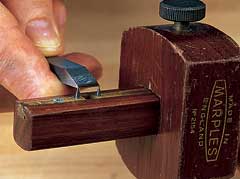
It occurred to me that the only mortice gauges I own are Japanese, not Western types. I have two, one being a Kinshiro (thanks Wiley), which is the very best mortice/cutting gauge, in my opinion. It is not simply that they are so well made and have amazing knives that leave a clean line, but they are ergonomically so well designed, and fit the hand like a glove. I also like that the Adjuster Screw is situated so that they may be tightened with one hand.

I have built a number of single cutter gauges based on the Kinshiro, which are excellent for dovetails, or may be used in pairs for mortice-and tenons. The wide fence provides a lot of extra stability.

Original Kinshiro on the right ...


One should mark mortices and tenons from the same gauge, working from a reference face. In this regard, the single flaw of the Kinshiro is that that are not suited for marking mortices that are set back from the edge of a stretcher ..


The advantage of the traditional Western mortice gauge is that one adjusts the pins to the width of the mortice chisel, and then the fence may be adjusted in-and-out as necessary.

My thoughts went along the path of a fixed gauge, that is, one that was set up for a specific mortice chisel size. Indeed, why not make two, or more ..?

I also recalled I had a rarely used set of Tite-Mark wheel cutters for a mortice gauge. Perhaps these could be pressed into service? At the same time, while I like and have a number of wheel gauges, I found that these wheels required more downforce than a knife. Perhaps a heavier gauge than the Tite-Mark ...?

In the end I built two different mortice/cutting gauges. The first one looks traditional but has a few novel features, one of which I have not seen elsewhere. The second looks novel, but is more traditional.

Gauge #1

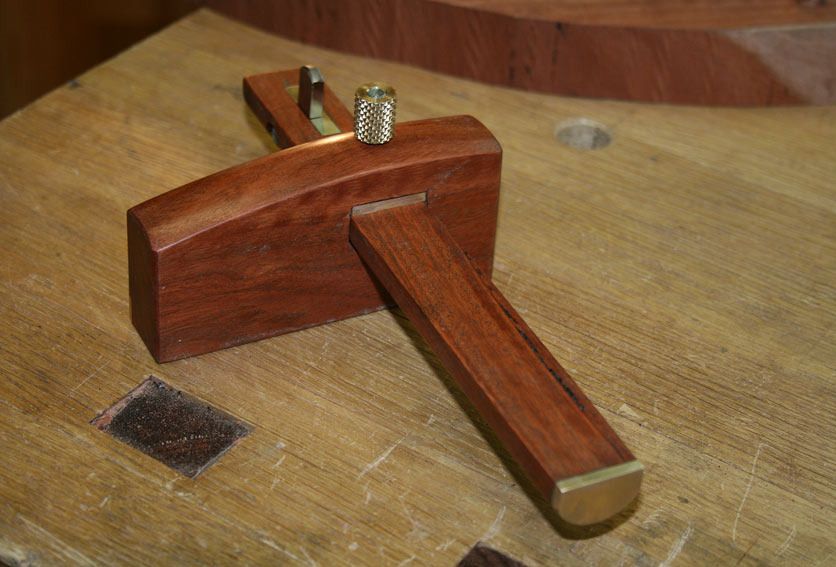
The first gauge is based on the Kinshiro profile, but has a Western arm. It is made from some scrap Fiddleback Jarrah and brass. The fence is 4 1/2" long x 2" high ...
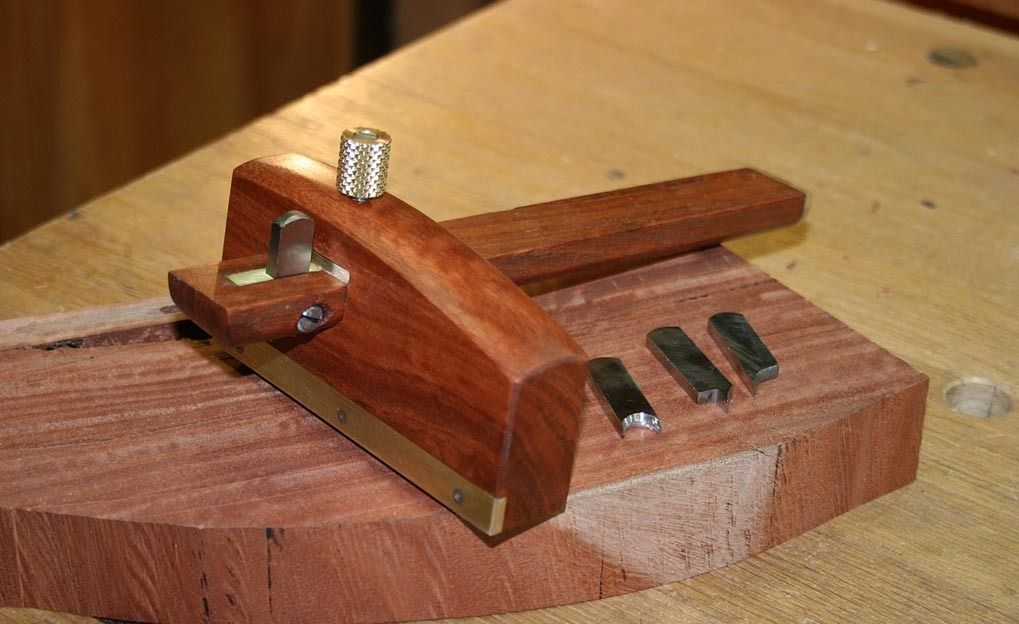

The novel feature here is that the blade is a fixed width, but is exchangeable for other fixed width blades ..

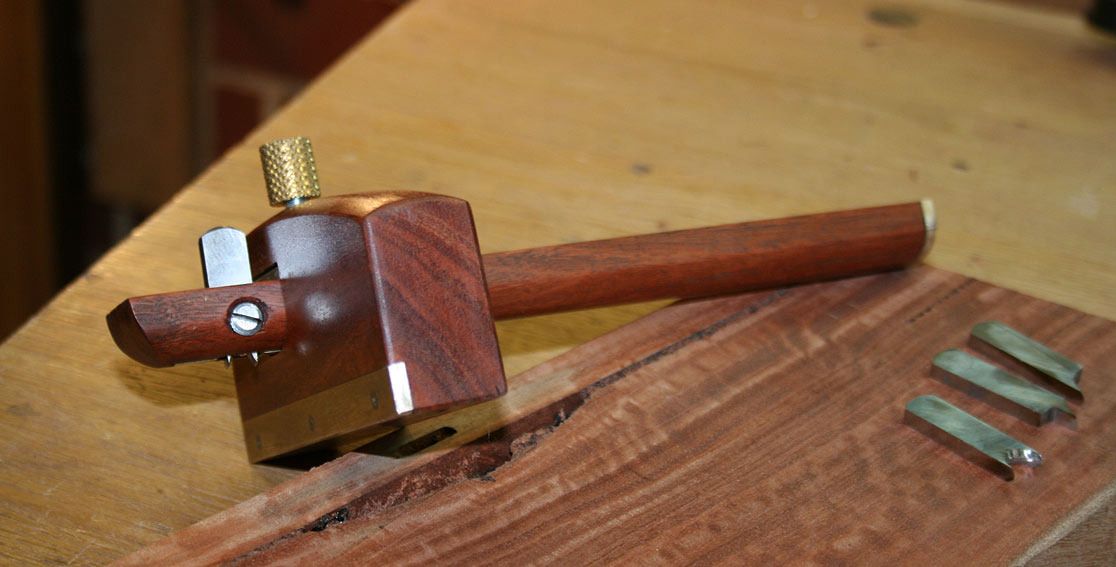
The knives are made from 4mm thick HSS (they should not need resharpening for a while!). So far I have made double-sided knives for a 1/4" and 3/8" mortice-and-tenons, and two straight knives (I made a second when I realised that the first would score 3/8" away from the fence). The idea for these knives came from dovetail planes.


The knives sit in a brass "cassette". This is fitted permanently in the arm ...
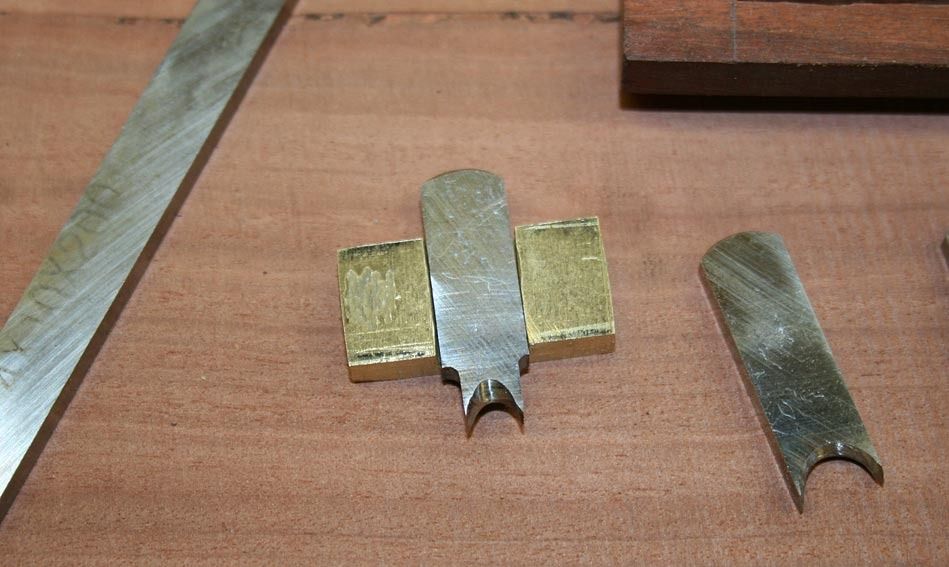

As seen in the first image, each knife may be dropped in or out and is held with a set screw. As mentioned earlier, I have not seen a similar system on a marking gauge before.

The second design feature is a rounded lower section to the arm ..


The reason for this is twofold:

Firstly, this is a very strong design that locks the arm very securely. Just a little downforce and there is no sideways movement at all.

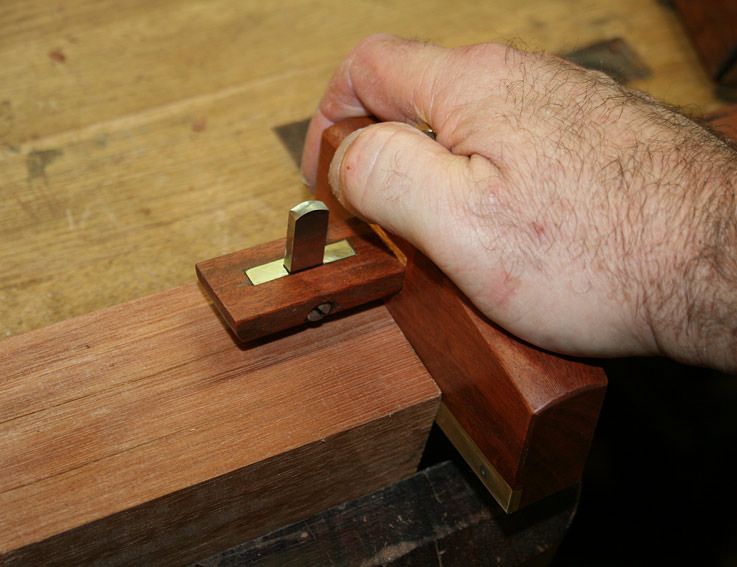
Secondly, the rounded lower section offers better visibility that either a square section or a cutaway at the knife.

In practice, this is very comfortable to use, and the knives cut clean lines both with and across the grain.

Gauge #2

The second gauge was less clever and more fun - really an opportunity for a little functional art. It turned out to be a wonderful user.

The face is 1/4" thick (very hard) brass, the wood is more scrap Fiddleback Jarrah, and the arm was donated by an ex-screwdriver. The knives are the Tite-Mark ones mentioned earlier.
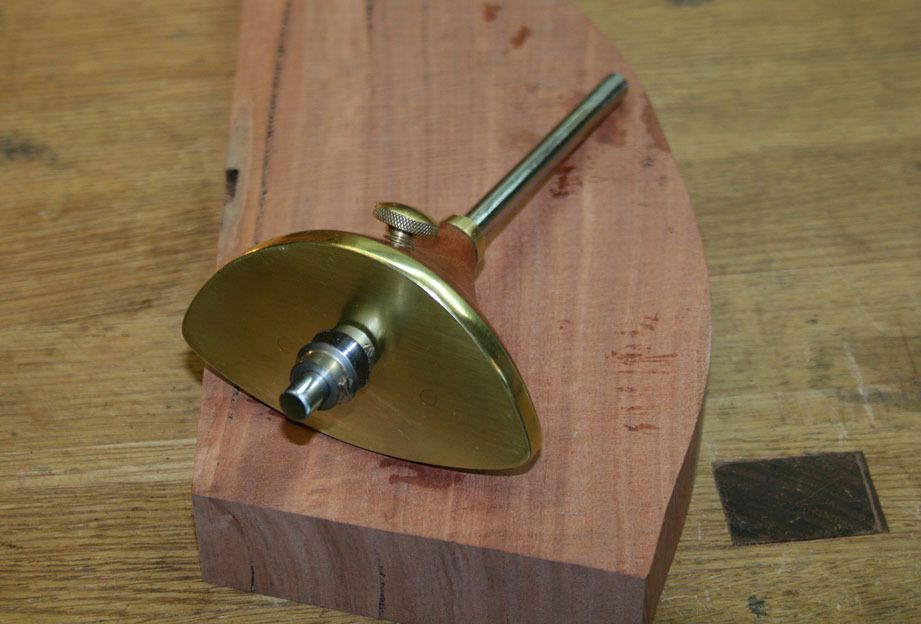
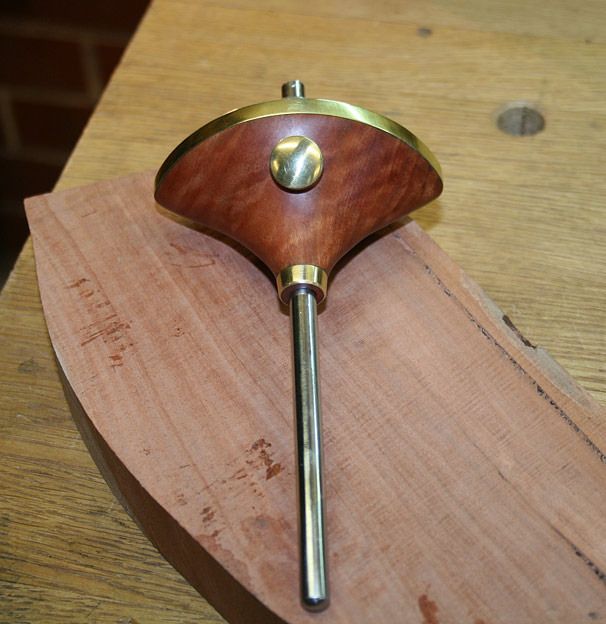

Here it is set up for a 1/4" mortice chisel and a 3/4" thick stretcher ...
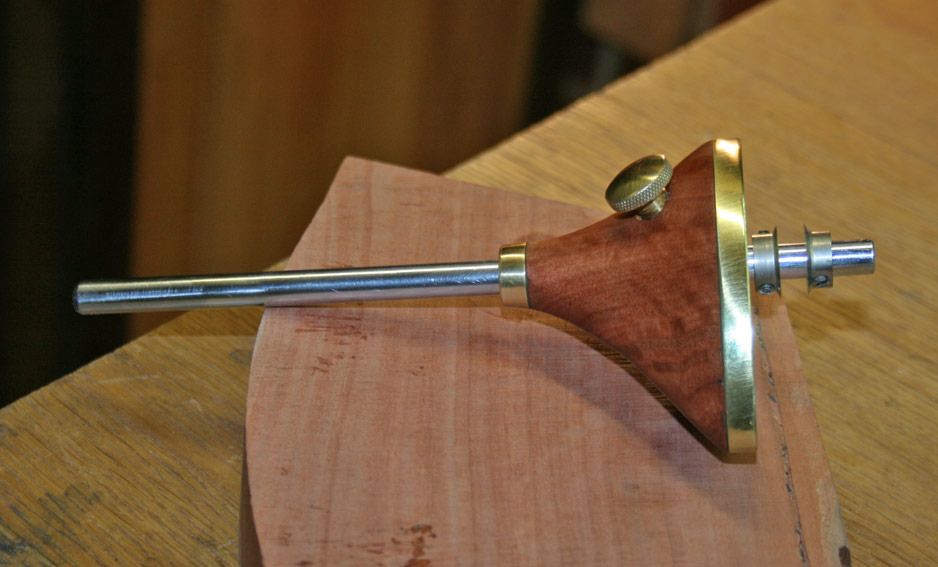

The adjuster screw is set at an angle (the end is rounded so it grips easily and tightly). This is allows the palm of the hand to rest comfortably over it.

Remove one wheel and you can use it as a cutting gauge ...
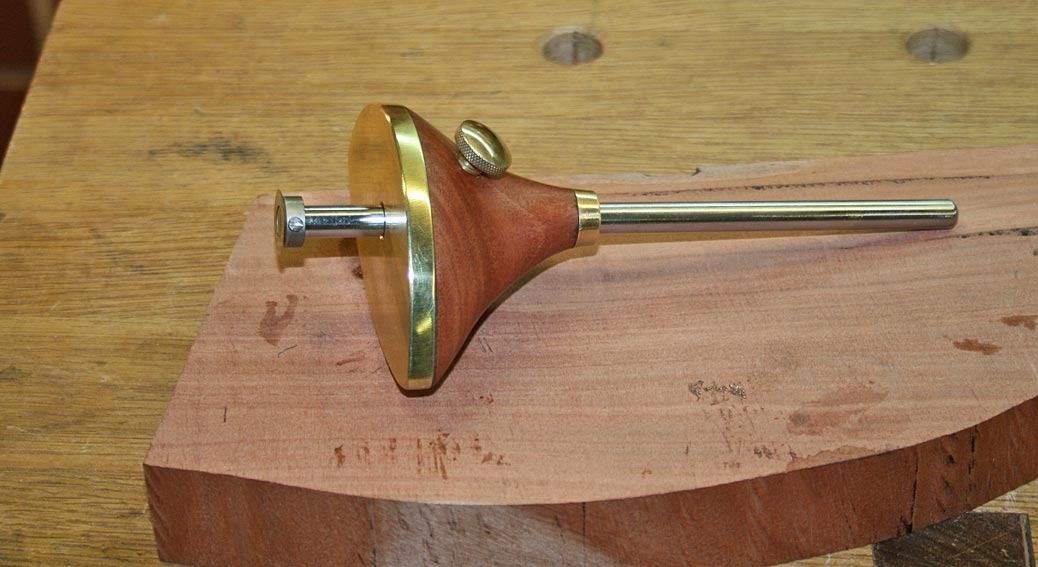

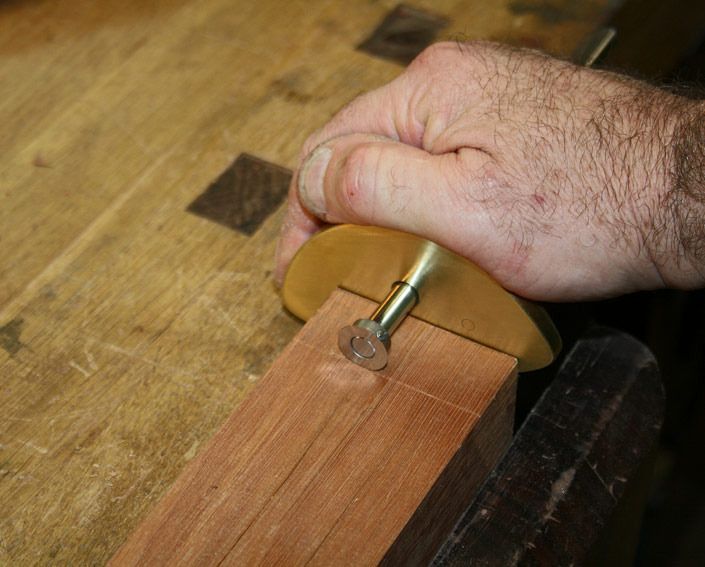
It is also very comfortable to hold, and the extra mass over the Tite-Mark is very noticeable ..

Here is a size comparison of the two gauges along with the Tite-Mark and the offset Veritas ...


Your comments and critique welcomed.

Regards from Perth

Derek

Re: Two new mortice/cutting gauges

#2

Re: Two new mortice/cutting gauges

david weaver

Well done on the new gauges. Extremely cleanly made.

I have the double pin gauge like you've shown, and I've used it almost exclusively for mortises, but last year bought a couple of japanese gauges (three, I guess, maybe four).

The last one I got was from Stu's (toolsfromjapan), and it's got a screw holding the blades together so that you have the same effect (keeping the set width), it moves like silk (the beams are stainless and the knives welded to the ends are super blue).

What do you think of the scratch stock potential of the gauge you made?

Re: Two new mortice/cutting gauges

#3

Re: Two new mortice/cutting gauges

Derek Cohen (in Perth, Australia)

Hi David

Yes, I'm aware of the locking potential of the Japanese gauge you have. It is an modification that some have made to their Kinshiro gauges. It's not something I want to do, and the situation is not an issue if you work with same-size frames. It was a good excuse to build a couple of gauges! :)

As a scratch stock? Not great - I have a scratch stock that I built from a marking gauge ...


The new gauge will only deal with 3/8" wide blades. That would be OK for simple/narrow beads .. nothing wider.

Regards from Perth

Derek

Re: Two new mortice/cutting gauges

#4

Re: Two new mortice/cutting gauges

Brian Holcombe

David, I have one from Masui as well, but it's much more similar to the kinshiro with an ebony face and without a screw locking the two blades together. It came by way of Iida when, he offered it to me shortly after running out Kinshiros.

Re: Two new mortice/cutting gauges

#5

Wonderful!

Hank Knight

Derek,

I like both of your new gauges very much. I have a small Kinshero that I've been meaning to copy for a long time. You have given me the push I needed. Thanks.

I have two questions:

First, I don't understand the beam locking system. How does the knurled knob exert pressure on the brass plate? The purpose of vertical post attached to the pressure plate in the photo of the fence with the beam removed is to keep the pressure plate in place. The length of the post appears to almost equal to the dimension of the fence above the plate and it appears to be long enough to reach the base of the knurled nut. Is that an illusion? How does the knurled screw (nut?) exert pressure on it?

Second, is there a threaded metal insert imbedded in the fence (and also in the beam for the cutter locking screw) or are the threads cut into the wood? Jarrah is probably hard enough to hold the threads, but I wonder how well they would hold up under constant wear, especially in our American hardwoods.

Nice job. Very attractive gauges.

Hank

Re: Two new mortice/cutting gauges

#6

Re: Two new mortice/cutting gauges

david weaver

I know nobody is into this kind of talk when I say something like this, but: the matsui gauge is really a spectacular little piece of gear for $125.

The best "deal" I've seen on japanese gauges is finding old ones that were well cared for on ebay for about $25, then you get the benefit of substantial and well made irons, but sometimes new is nice.

Re: Two new mortice/cutting gauges

#7

Re: I wouldn't...

david weaver

....do anything to the kinshiro, either. I don't blame you. It would probably quarter or halve the value of it, and it's something that can be done with a $25 gauge off of ebay if needed.

Re: Two new mortice/cutting gauges

#8

Re: Wonderful!

Derek Cohen (in Perth, Australia)

Thanks Hank.

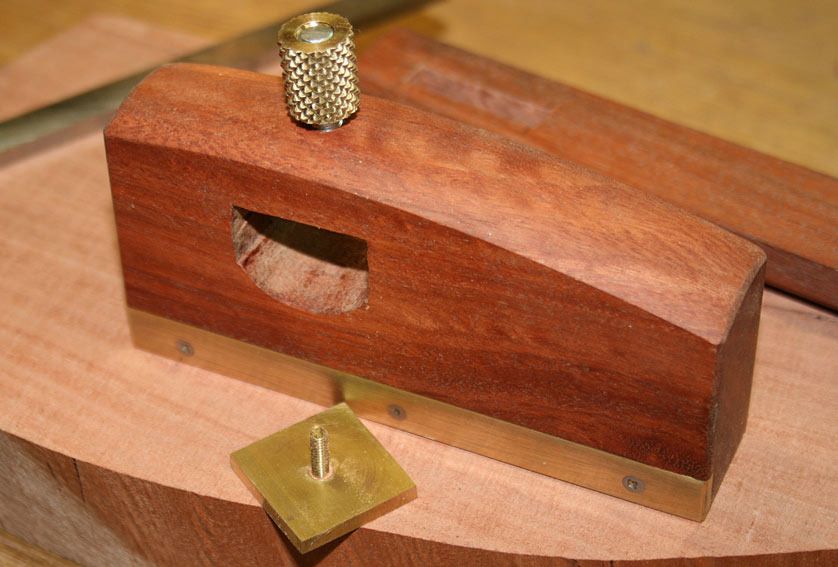
The mechanism looks like this ..


First drill the thin hole for the brass plate. Then drill for the knurled knob screw, and tap this. The downforce of the knob presses on the spike on the brass plate, which loads the arm.

Jarrah is indeed tough and hard enough to hold a thread. The set screw is a M8 (8mm wide), so the threads are large enough to spread the load.

Regards from Perth

Derek

Re: Two new mortice/cutting gauges

#9

Re: Two new mortice/cutting gauges

Derek Cohen (in Perth, Australia)

David I have these two. One is a Kinshiro, the other is a vintage gauge I purchased several years ago from So Yamashito (in Sydney) ..


Regards from Perth

Derek

Re: Two new mortice/cutting gauges

#10

Re: Two new mortice/cutting gauges

TomD

I prefer the type where the screw exits to the rear. I have an old one now that needs a hardware upgrade as the screw is galling a little. I haven't seen anything to exceed it (of course your far better made hardware probably would). I like the idea of a wedge, but they just aren't as adjustable as these. I can set one to a thou off a digital caliper, nothing works as well that I have seen. When the screw sets to the rear, it doesn't get in the middle of hand placement, and it squares the beam. As cheesy as the mechanism is, I think it might be preferable to many more complex ones on a fenced plane. And there are such Japanese planes with adjustable single beam fences.

Re: Two new mortice/cutting gauges

#11

Re: Wonderful!

Hank Knight

Thanks, Derek. Makes perfect sense. The vertical post on the pressure plate is not as tall as it looks in the photo. Your diagram explains it perfectly.

Re: Two new mortice/cutting gauges

#12

Re: Two new mortice/cutting gauges

Brian Holcombe

I'm lazy, so new is nice for me.

The Masui gauge I bought from Iida was about 1/2 way between the two in terms of cost. I'd like to get one more of them at some point for the same issue Derek had.

Derek, gorgeous work!