New WoodChat!
Home Articles Forums Gallery Marketplace Videos

WoodCentral Forums

Knowledge You Can Build On — Est. 1998

Support WoodCentral when buying things you need

Scraper Burnisher - Hardness Counts

Posts

Scraper Burnisher - Hardness Counts

#1

Scraper Burnisher - Hardness Counts

david weaver

For the last 10 years, I've been using a crown burnisher. It's hard in parts, but near the ferrule, it's soft enough that the cards notch it. I'm not the first person I've seen mention this, either.

To use it, I have to grip further up on the rod itself, and make sure the card scraper doesn't get further down than the middle of the handle. I'm sure the scraper cutting the burnishing rod just results in the edge of the scraper getting torn off.

Perhaps 8 years ago, I got a hock burnishing rod. On a whim, I took my unused hock rod out of the drawer this weekend and stoned off a tiny bit of surface rust on it and used it on the cards I had laying around, which were both 1095 from different places.

What I can't believe is how much better and easier the burr is rolled with the hock. I also have a small piece of carbide rod, but same issue, it's not in a handle.

For almost 10 years now I've been working a whole lot harder than I have to to roll a burr because the crown burnisher is marginal hardness. I've always ascribed to rolling the first burr lightly and then increasing pressure on subsequent rolls as needed, as I'd imagine a lot of economy of effort minded folks do. the crown never did it well on the first few rolls until more pressure is used (and even then, the burr never really impressed - functional, I guess, is about as good as it could be labeled). A properly hardened rod does it perfectly. I can't believe I didn't make some effort earlier. I'd say I can't believe that crown would make a burnishing rod that can be cut by card scrapers, but i've got several little crown tools and a dovetail saw and it's not that surprising - none of them really impress.

Not much of a story, I know, and nothing magical about the hock rod, it's just not too soft like the crown.
Re: Scraper Burnisher - Hardness Counts

#2

Re: Scraper Burnisher - Hardness Counts

William Duffield

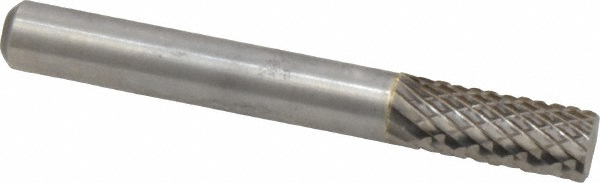
Crown burnishers are made for English scrapers. Bahco and L-N (Swedish 1095 steel) are a lot harder, as you've discovered. I put my Crwn burnisher away quite a while ago, and use only carbide now, because I don't have to worry about lwhether it is hard enough. I used to get my carbide from people operating high pressure water cutting machines, but that source "dried up". Sometimes, I had problems with the nozzles not being smooth enough on the outside, I think because they had been using abrasives in the water jets. I'm now using the shank end of 1/4" diameter carbide circular files and rasps that I get from one of the surplus and used tool vendors who come to the woodworking shows. They're usually around $6 each, and look like this one:


The most convenient thing about them is that you just drill a 1/4" diameter hole in the end of a stick, smear a generous gob of epoxy on the toothed end, shove it in and slide a ferrule over the end. At that cost, I don't worry about the possibility of dropping it on the floor. I just make sure the diameter of the handle is larger than my dog holes (3/4"), so I have a convenient place to drop it while flipping the scrapers in the vise.

Re: Scraper Burnisher - Hardness Counts

#3

Re: Scraper Burnisher - Hardness Counts

William Duffield

It looks like the burr the picture I selected has a carbide head brazed onto a steel shank. That's not what you want. You want one that is solid carbide.

Re: Scraper Burnisher - Hardness Counts

#4

Re: Scraper Burnisher - Hardness Counts

Derek Cohen (in Perth, Australia)

David ... David ... David ...

Where have you been? :)

I am tempted to send you one of my old burnishers ...


:D

Here is the ultimate burnisher. Tony Z sent me a piece of carbide rod several years ago. The important feature was that it was highly polished. A second feature that I have come to appreciate is that it is a skinny rod. I like the delicateness of the tool I made. It is both light and capable of high downforce.

It is the lower burnisher. For comparison, above, is your Crown burnisher (long since given away) ...


Regards from Perth

Derek

Re: Scraper Burnisher - Hardness Counts

#5

carbide wins

Bill Tindall, E.Tn.

There are numerous sources of 1/4" carbide rod. Tool blanks, Formica trim bits, carbide end mills, used upside down, etc. Stuck in a sitck carbide makes the best device for rolling an edge. It is virtually frictionless.

Re: Scraper Burnisher - Hardness Counts

#6

Re: carbide wins

Jeff Heath

Agreed on the use of carbide tool stock. I made mine out of a piece that was in a lot of endmills and reamers I purchased from a retired toolmaker at a garage sale. Works much better than my old burnisher I bought 2 decades ago from Woodcraft.....

Re: Scraper Burnisher - Hardness Counts

#7

Re: Carbide and Others

david weaver

Thanks for the suggestions, guys.

I do have a stub of carbide that Mel Fulks sent me, and I will at some point buff the matte finish off of it with diamonds and put it in a handle.

It's about the size of a 1/8th bit, and about two inches long.

I'll get around to epoxying it into something at some point.

I try to plane finished surfaces wherever I can, so this nuisance hasn't been as much of a nuisance for me as it would be for a religious scraper.

Re: Scraper Burnisher - Hardness Counts

#8

Re: carbide wins

TomD

It also is regarded as stiffer. In machining circles this is often the winning factor, there are pros and cons to HSS and carbide on cutting, mostly for carbide, but not entirely. When it comes to stiffness and chatter, carbide wins hands down. So can't hurt for rolling a burr, though I can't say it is something I struggle with most days.

A real key to rolling a burrs is doing the prep work to get a good sharp edge to start with, and in recent years, I have lost my desire to work through a thousand stones. I just touch it to the belt sander, and go from there. This is not as good as all the stages, but the speed advantage is so total I don't care. If the edge is nice and clean it rolls easily. It may be that one does not get as many refreshes out of it, but I sharp again in the time it takes to roll it.

Re: Scraper Burnisher - Hardness Counts

#9

Re: other means...

david weaver

I've got a couple of scrapers that i used to work through a polishing waterstone. I've found a washita a FAR better stone for scrapers than waterstones, and here's why:

* washitas cut fine enough for a finished surface type edge on a burnisher

* washitas cut slowly on steel hardened in the low 60s, but they cut steel hardened in the low 50s quickly. That makes them great pocket knife stones (pocket knives are usually somewhere in the middle to middle high 50s in my experience)

I always thought it was a pain in the rear to hone the scrapers until I started using a washita stone. I think some would find a good washita a difficult stone to use for chisels and planes, depending on how they use it, but for scrapers it's fantastic.

I suppose a settled in fine india would also do it.

I sometimes scrape things where I plane other parts of a piece, and I'm not worried about polishing the scraper edge to the nth degree blackbelt waterstones, because I leave the top of my scrapers dull to burnish a surface after scraping it. I know the argument of applying a finish, but I don't apply much finish, just a couple of wipes of shellac and then wax.

Re: Scraper Burnisher - Hardness Counts

#10

Re: Scraper Burnisher - Hardness Counts

Joe Rogers, Northern Virginia

Glad I got mine before the source went dry :-)

Joe

Re: Scraper Burnisher - Hardness Counts

#11

Re: Scraper Burnisher - Hardness Counts

Alex Grigoriev

An easy source of carbide rod: 1/8" solid carbide Dremel bit (about $10).

Re: Scraper Burnisher - Hardness Counts

#12

Re: Scraper Burnisher - Hardness Counts *LINK*

Kees

+1 on the Crown burnisher. Piece of cr@@.

Quite a different message from mr. Sellers btw. But he often has "different" ideas. Or maybe he uses very soft scrapers.


https://paulsellers.com/2015/02/scraper-burnishers-that-work/

Re: Scraper Burnisher - Hardness Counts

#13

Re: Scraper Burnisher - Hardness Counts

david weaver

I get Paul's gimmick, the minimalist gimmick. It sometimes yields ridiculous things, like that horrible 2x4 router plane that he makes that you can see doesn't even work that well on whitewood.

But in this case, I agree that you can find something suitable around the shop and get by with it. The cost of a hock rod, however, is $14, and the various carbide bits and pieces guys have put together have been between a couple of bucks (one in a kit from HF) to $10 for the dremel cutter.

I do wish I wouldn't have bought the crown, but there was nobody telling me they were junk, and they were sold from everywhere when I got mine. I recognize that the crown is fine if the scraper is softer than what I have - to some extent - but the part of it down near the tang is so soft that anything catches in it and cuts it. It's defective.

Re: Scraper Burnisher - Hardness Counts

#14

Re: Scraper Burnisher - Hardness Counts

Tony Z

As important as the hardness of the burnisher, is the degree of polish. The carbide of mine (mentioned by Derek) was from spent portions of tooling in my manufacturing plant. It had a mirror polish as well as a natural lubricity from the specific chemical composition used for that grade of carbide.

The Crown (mentioned by David) probably was plated (overtop a polished semi-hard piece of steel). This would work for infrequent usage or until the time that the edge of the scraper wasn't polished enough and caused the plating to scratch.

Re: Scraper Burnisher - Hardness Counts

#15

Re: Scraper Burnisher - Hardness Counts

david weaver

I think it's just a piece of buffed HSS rod. It's just not as hard as it should be all over, and it's obnoxiously different in hardness along its length.

I don't know what they do to harden their turning tools, but I've seen George mention before that sorby's tools are in his opinion soft and he's rehardened them for craftsmen at Williamsburg.

I've not seen anything from crown that's exceptionally hard, either, and have felt that their tools and sorby's tools (speaking of turning tools that would be made from HSS rod) are similar hardness.

I haven't used my carbide yet for the same reason you suggest, it's got a little bit of tooth to it, and I need to buff it off with diamonds. that's maybe over the top, but I don't want my scraper surfaces to differ much from planed surfaces if I can help it, and when I do scrape, I always burnish the surface of what I scraped with a handful of shavings after I've scraped - thus no tolerance for a scraper edge that is mangled a little bit from a coarse finish.

I've found the amount of shellac that wood will take is similar between cleanly planed and scraped and then burnished with shavings. Sanded wood, sanded and vacuumed and then burnished with shavings still soaks in more shellac, and that's annoying.

Re: Scraper Burnisher - Hardness Counts

#16

A carbide burnisher doesn't have to be complicated

Bill Tindall, E.Tn.

Any machine tool catalog is going to have end mills or even tool blanks in 1/4" diameter (ideal in my mind) and they are going to be polished as much as anyone needs them to be. They slide across scraper steel seemly frictionless.

If adverse to machine tools then look for a Formica trim bit, the one piece affairs, which are similarly polished. Misenheimer (Morristown, TN) and any other place that makes tooling for the woodworking industry will sell 1/4" carbide mill blanks and they are similarly cheap and polished.

Indeed, the advantage of carbide is its nearly frictionless travel across the scraper, which leads to optimum control of how it is working to form the edge.

Re: Scraper Burnisher - Hardness Counts

#17

Re: Scraper Burnisher - Hardness Counts

William Duffield

I've also polished carbide burnisher stock with diamonds. I chuck it in the headstock of my woodturning lathe. For 5/16" ø and larger, I use step jaws on a scroll chuck. For 1/4" ø and smaller, I use a Jacob's chuck with a draw bar. For the final buff, I apply a bit of 0.5 micron diamond paste to a small block of hard wood. I think the last substrate I used was some lignum vitae scrap left over from making some bandsaw guide blocks.