LN #1 or LN #2
JDK
Does anyone have these planes (or their equivalent)? What do you use them for?
Knowledge You Can Build On — Est. 1998
LN #1 or LN #2
JDK
Does anyone have these planes (or their equivalent)? What do you use them for?
Re: LN #1 or LN #2 - no
TomD
Anything that you own and use, at least of this type, could probably become a favourite. For me, the smallest LN I own is the 3, and while I wouldn't call it useless... I never use it. I guess if I was an online tool promoter, I could get it out every now and then so that I could tell everyone how useful it is... I liked this era in LN plane manufacture, when every new plane they added was made of Bronze. I sorta lost interest when they started using the high tech sewer pipe metal for their plane bodies, I gather it is excellent. Though I always wondered why if it is such good sewer pipe it rusts so badly. When I start making the Trump money I am running bronze sewer line.
On the 2, LN says:
"Based on the Stanley Bedrock design, this small smoother is useful where a light, compact, bench plane with a 45° pitch is more effective than a block plane."
In other words, nowhere.
The 1 they pretty much admit is a toy. They say it's great because it handles like a block plane. So I am guessing it is perfect for those situations where a compact bench plane with a 45° pitch is more effective than a block plane, but you would rather use a block plane for it's handling qualities, but need it in a bench plane format.
Got it.
Re: LN #1 or LN #2
Patrick Gibbons
Can't remember my source, but read once that the 1 and 2 that were made by Stanley were popular with woodworkers who were older. As I get older, the argument holds some water. My hands are stiffer now than they were as a younger man. This has not only hampered my guitar playing, but my woodworking as well. Use of a block plane for an extended period results in a cramped hand. A carpenter working out in the cold would have even more of a problem. I will point out that while woodworkers today prefer a low angle block, it seems that a 45 degree block was more popular in the past than now. While small, a 1 or 2 would still be easier to hold than a block plane. If your choice was a 45-degree-bedded block or a No. 1, you might prefer to use the 1.
Re: LN #1 or LN #2
Joe Rogers, Northern Virginia
You need both to complete the set...
ducking and running
Joe
Re: LN #1 or LN #2 - no
Steve Voigt
If you want a plane in that size, a small coffin smoother is a vastly more useful tool, in my opinion.
Re: LN #1 or LN #2
TomD
With a block plane of the right style you aren't gripping it so much as pushing against one's palm with it. Like using a cane.
Now a Japanese plane is gripped, and unless the exercise set you up for further use of it, it could be a problem.
My thing with the small 1&2 is that I can't get my hand properly into the big ones, let along the small ones, so I don't see an ergo advantage. Rightly or wrongly the the first thing they do with arthritis tools is make the handles huge. When that time comes for me, I will just bob the edges of my blades so my 1.5 inch jack is one inch, and take advantage of the full size tools.
"or their equivalent"
Wiley Horne--So. Calif.
i have a Konrad Sauer extra small (XS) No. 4, which has a 1-7/16" iron. This is an infill coffin smoother. Roughly a No. 2 in cut width.
I don't own a block plane.
I use Konrad's XS coffin smoother for small items, such as thinning strings (to be inlaid) down to the channel width, say 0.025" or 0.032". Or leveling inlay flush to a surface, where I am trying to limit how wide a cut is made. Or doing final fitting of small drawers, or drawers with narrow sides.
If I didn't have this plane, I could use something else. But its advantage is that it is handy for one-handed use, where you're holding the work still with one hand and planing with the other. And it's got heft.
Easy to balance a small plane on small work, or use it one-handed, or limit the cut area.
Wiley
Re: "or their equivalent"
Steve Voigt I don't own a block plane."
"i have a Konrad Sauer extra small (XS) No. 4, which has a 1-7/16" iron. This is an infill coffin smoother. Roughly a No. 2 in cut width.
Wiley, when I made this smoother,
http://blackdogswoodshop.blogspot.com/2013/11/a-mini-coffin-smoother-in-cocbolo.html
I modeled it very consciously on that exact plane (the XSN-4). Since then, I've picked up my block plane maybe twice; mostly it just gathers dust. If I ever get a chance to meet Conrad, I will have to thank him. A bevel down smoother that you can hold in one hand beats the pants off a block plane, I'm now convinced.
The only possible drawback to both our planes is that the blade will need replacing in a few years, when it gets too short to adjust. But I'm willing to pay that price.
Re: "or their equivalent"
Bruce, a MN Galoot
that is one very, very nice plane, Steve!
Re: "or their equivalent"
Steve Voigt
Thanks Bruce!
More details
Wiley Horne--So. Calif.
Hi Steve and all,
I'm curious how you chose cocobolo to mortise--must have been quite a job!? By some cosmic luck, Bill Clark of C&W sold me his own cocobolo 2" smooth plane a few years ago. That is a great plane, but I'll never know how he carved curves into that cocobolo. Any case, cocobolo makes for a convincing plane.
What iron did you use in your plane? What bedding angle? It's a double-iron plane, right?
On a personal note, I think Konrad would appreciate your dropping him a note at his website. He is very much a people person, and very good in his ways--like if he puts something out in the garbage that has sharp edges, he writes a big warning note for the garbage men to see the next morning. Drop him a line.
Wiley
Re: More details
Steve Voigt
Hi Wiley,
It's interesting, the relationship between hardness, density, and workability. I have to admit I don't fully understand it. I chose Cocobolo because I had it on hand. I would rate it as a difficult but not excruciating wood for planemaking. Making a plane from hard maple is nearly as tough, despite the fact that Cocobolo is far harder and heavier.
Shortly after I made this plane, a gentleman commissioned me to make another out of Jatoba. Though it's similar in weight and hardness to Cocobolo, it's a nightmare to work. I hope to never make another plane out of it. More recently, I made a full-size smoother out of Goncalo Alves. Again, a very hard and heavy wood, but it was a joy to work with, much easier than any of the others, hard maple included.
To answer your other questions: the iron is a Hock double iron. it's bedded at 50°. I really like 50° for double irons. By the way, thinking about the iron reminded me that the pictures of that plane were taken before I modified the top of the iron. After looking some more at Conrad's plane, I ground a moderate radius on the top of the iron, and it made huge difference in ergonomics--the curve nestles perfectly in the palm.I'm sure you've noticed this on your XSN-4. Somewhere on the blog there's a pic of the Jatoba plane with this curve, if anyone cares to make something similar.
Oh, and I did leave a comment on Conrad's blog some time ago, and got a very gracious response. He seems like quite a nice fellow, and wow, those planes are beauties.
Re: LN #1 or LN #2
bridger
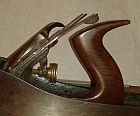
I have a #2. I also have a number of block planes (they seem to follow me home). I've never owned or used a #1.
a bevel up block plane can be sharpened with a 45 degree bevel. it still won't be a #1. the #1 has an actual tote, even if it is so small that you will get 3 fingers into it at best. but most importantly, it has a chipbreaker. I've never seen a block plane with a chipbreaker. I have spent enough time doing the analysis and design to determine that I won't gain enough from converting a block plane to a bevel down with chipbreaker configuration to be worth the effort. sure would come in handy say, 2 or 3 times a year, though.


