We value your privacy.
We use cookies to enhance your browsing experience, analyse site traffic, and personalise content.
By clicking “Accept all”, you consent to our use of cookies. You can also choose
“Essential only” or learn more.
While I have a "few" Festools, and lots of Swiss Cheese work surfaces, I don't have (and have no desire for) an MFT. Might this concept change all that?
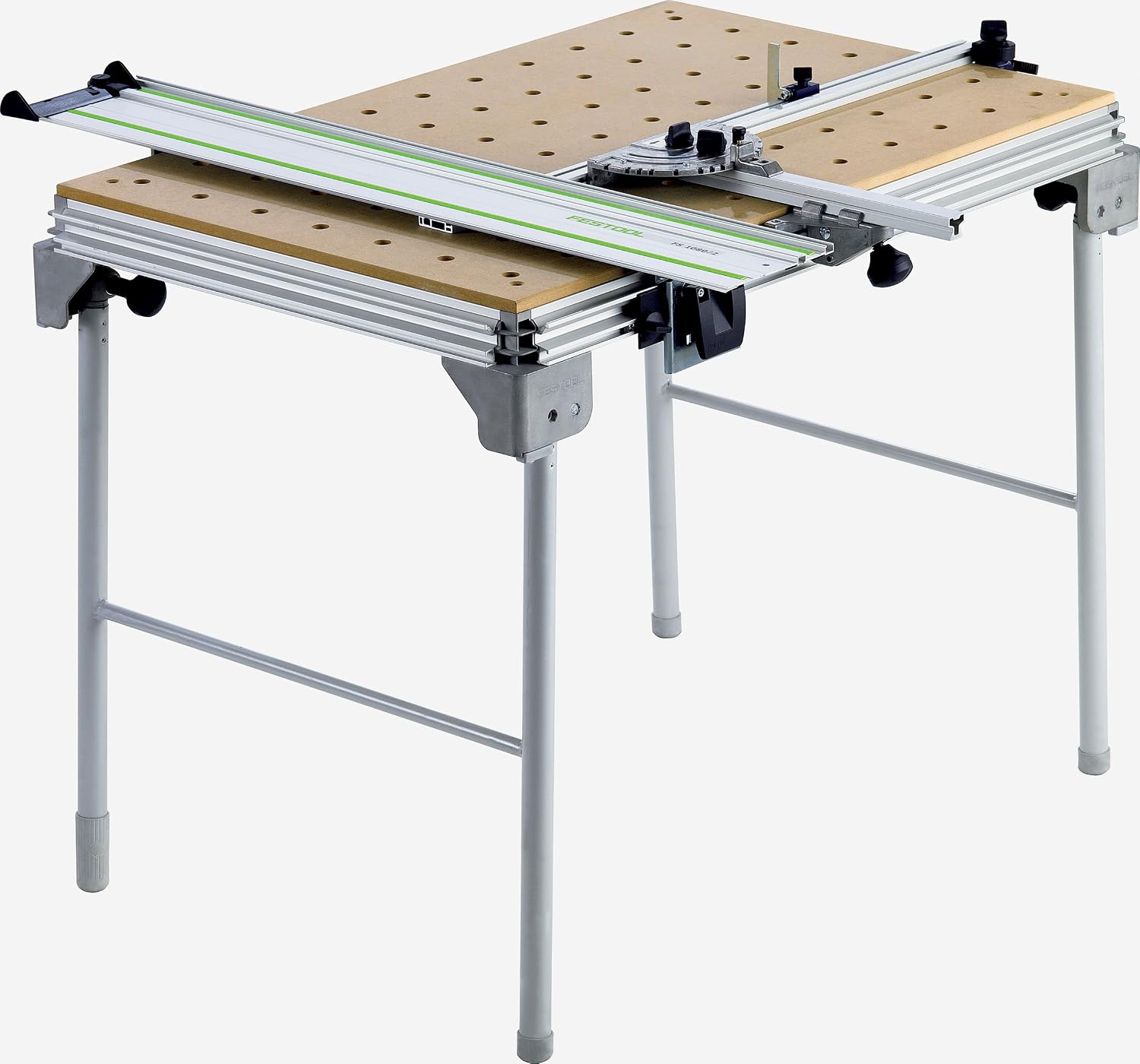
It's Festool jargon: MultiFunction Table, a bunch of extruded aluminum channel and an MDF top and spindly legs. Really a sorry excuse for a workbench, but if you sacrifice sufficient electrons and carbide to the cause, it works very well, and works very well within their system. Whether the system will continue to be effective over the centuries, like the hand tools we and our ancestors have used to build our civilization, is yet to be determined.
Whether the system will continue to be effective over the centuries, like the hand tools we and our ancestors have used to build our civilization, is yet to be determined.
Well, when you put it in that perspective, probably not.
on how you like to do things. The potential advantage I see is to the Moxon. If you're going to use a Moxon, having a table behind it is to the good, provided you can clamp vertically onto the table, so that, for example, after sawing and cleaning tails, you can mark the pins using the table to support and clamp the completed tails board. And if the MFT has a t-square, that will be useful in aligning the tails board for marking. But you see, I'm already making 8 or 10 assumptions . It could be a very neat and compact joinery bench top, provided that's how you want to work. And maybe unbeatable for a portable rig.
I was very impressed by Roger Myers' Moxon + table setup, that he posted some months ago. It's a good reference.
I suspect that I'd want my Moxon higher than that appears to be but the table part would want to be lower so that I can reach across it. An MFT makes more sense (to me) if one is thinking about dumping the tablesaw
Yes, you can clamp vertically to the extrusions on the side of the table, and there are squares and rails you can use to align your work. [Reference photo.] I don't know whether the attachments for these and the Moxon vise would get in each others' way. If you are as tall as Roger, you might find the MFT a bit low for comfortable sawing at 35-7/16", but Chris Schwarz has no problem with working on surfaces that are a lot lower than I would find comfortable. Thus, the rationale for building a custom bench-on-bench to hang your Moxon vise on.
The legs are stiffer than they appear, but still much less so than the legs of a Roubo or other traditional woodworking bench.
The MFT is lighter and more portable than my Work-Mutt, even without my bench-on-bench installed on top of it. And, there is a lot to be said for the Festool/Tanos systainer system for carrying around and organizing your accessories.For those of us who like round bench dogs, note that the dog holes in the MFT are not 3/4" (19 mm); they are 20 mm.
The Festool quick-grip clamps that slide into the rails (and Incra T-track) and drop into the dog holes only work in work surfaces that are 3/4" thick or less, which is too thin to support traditional hold fasts, especially in MDF, so there are compromises.
Lee Valley offers a couple of products for working with the MFT:
Yes, a lot of people find that a track saw and MFT do most of what they ask of their table saw. If you are building cabinets from 4x8 sheet goods, breaking down the plywood to finished size can be more efficiently done than with a table saw, (and much, much less expensively than a panel saw), especially if you don't have room for a permanently set up infeed and outfeed table. With the Festool track saw, your first cut is often your final, finish cut. Dust collection is often better than my cabinet saw (unless I also hook up the Festool dust collector to the cabinet saw's blade guard), and definitely better than my D8 thumbhole rip or my Stanley miter box. The Disston and Stanley are definitely quieter than the forked tailed alternatives.
Since, as I imagine, the priority is to add a Moxon vise to the armoury, it is the pros and cons of the Moxon set up that needs to be explored.
The advantage of a Moxon is that it raises the sawing point up to a comfortable height. Otherwise any twin-screw vise would serve as well.
Placing a table directly behind the Moxon vise has, in my book, a built-in issue: if, when transferring tails to pins, the tail board is set flush with the chop (as your photo suggested), there is a high likelihood that the top of the chop will eventually be destroyed by knife cuts (as the knife cuts across the tail board).
One more thing, I am not sure whether the example you show is going to be stable enough for sawing owing to the rubber wheels at the base. I am sure that they will cause the "bench" to rock back-and-forth ...
Is the MFT mostly a worksite thing? This is a thing that we don't seem to have as well developed as others. The whole Inca line of alloy tools could essentially be set up offsite, and I have seen it in places like shops that were being fitted out, where they were making real cabinets, while the inclination over here would be to install some kind of pre-builts.
As far as my shop is concerned, anything that falls into another bench, or more tailed tools is totally going to have to take second place to a CNC. At the price Festool wants for a thumb tack CNC is a far better deal.
Correct nomenclature aside, is the vise in your first illustration an all metal vise, used by blacksmiths, and similar to or the same as what we usually now call a post vise?
Yes, it's a European worksite idea, with applications on this side of the pond as well. Over there, when you move out of an apartment, you take all your kitchen cabinetry, appliances, sink, etc., with you. When you move into an apartment, you can go to IKEA and buy cabinets, etc., or you can hire someone to build you cabinets, which they usually do right in your kitchen (instead of buying/building them off site and then installing them). The ideas behind Festool is to keep all your tools and all their accessories organized and together, so you can easily move what you need into the apartment, do the job, not leave any dust, and get out. It's also nice to have a minimum of extension cords and power tool cords laying all over the floor while you are working. Festools are also popular here in the US for finish carpenters and cabinetmakers who work in the big cities, where theft of tools on the street, while unloading and loading your van is a major concern. The security of being able to control your dust collector and all your tools and tool boxes with one hand, all the way from the van on the street to the apartment and back again is de rigueur. If you need to set something down while you turn around to pick something else up, either on the street or while getting on of off a service elevator, something valuable and critical to getting today's work done is gone in a flash. For these and other reasons, I've had several professional customers who work under these conditiions tell me, "I can't afford to NOT use Festools." It's a totally different environment than a home workshop where you are building custom, one-off furniture and accessories not under extreme time and profit pressure.
I think the guy who devised this particular "blended" approach is going to realize that the wheels will be giving him serious stability problems when sawing. I also agree that the Moxon double screw vise works better raised a bit above bench height, unlike the illustration in Moxon (but we're beating a dead horse on that issue). I like your idea of the flip up spacer, when you can make it work with the rest of your installation. In this guy's case, he probably has a related problem: I suspect he doesn't have a Stanley #3 to set behind the jaws to use as a spacer. Those Festool Rotex sanders just don't have any flat surfaces that you can rest a board on. Maybe he can come up with a way to raise the top of the jaw by the height of a Systainer-1 and use the difference in height between that and a Systainer-2 (53 mm, about the width of a #4) for spacing. (Tongue planted firmly in cheek on that one.)
Let's hope he solves the problems, and doesn't regress to router cut dovetails. But, I think he will find that his approach to hand cut dovetails is much less than optimum.
They're no substitute for a 3 or 4 inch thick maple slab and a couple of holdfasts, and neither is the MFT. Even with free Lee-Valley shipping, their prices are awfully difficult to justify.
My primary meaning was to "blended woodworking," the judicious use of both hand tools and power tools, but of course the allusion to the Blendtec advertisements was intentional.
My favorite Blendtec video is the attempt to blend the Chuck Norris action figure.
Point to that pic and ask a blacksmith what the work holding device is called and he`ll most likely reply "That`s a leg vise".
Different trades had different names for nearly the same device. The names also varied by location, what something was called in New England might go by a completely different name on the Gulf Coast.
Leather workers and sail makers used something similar to what is in Warren`s pic constructed mostly of wood with wider jaws and a cord and lever to close and lock the jaws. These trades called their work holders something else entirely.

 . It could be a very neat and compact joinery bench top, provided that's how you want to work. And maybe unbeatable for a portable rig.