New WoodChat!
Home Articles Forums Gallery Marketplace Videos

WoodCentral Forums

Knowledge You Can Build On — Est. 1998

Fast and affordable laser cutting – so you can make the parts you can’t find anywhere else

a few spokeshave questions

Posts

a few spokeshave questions

#1

a few spokeshave questions

mreagan

I took this from my spoon thread below.

I would like to pick up a spokeshave(s) to help shape spoon and ladle handles, most of which will be curved. It will be used to hog off some wood as well as make fine detailed cuts. I am looking at dave’s shave (flat) and the veritas wood handled flat spokeshave. Will dave’s shave hog of wood? Also the veritas can be bought in a set (with good cost savings) does anyone have experience with the concave and convex shaves, and are they useful in what I intent to use them for?

I love the idea of antique but I really don't have a lot of shop time to figure out how to renovate and make it work. Thanks in advance from a guy who has no experience in spokeshaves…

matt

Re: a few spokeshave questions

#2

Re: a few spokeshave questions

Larry Barrett

My 2 cents.

If you are looking for a way to hog off wood, consider a drawknife. New ones can be expensive, but check eBay. Hatchetts also good for hogging off wood.

Spokeshaves in general are not too useful for this purpose. You can set the iron to take a heavy shaving on either style of spokeshave, but at best this does not approach what a drawknife or hatchett can do. I have the 3 LV shaves you are referring to and use the flat 99% of the time, even for making things like chair rungs. The concave shave has a fairly large radius, so not likely to be helpful for spoon handles. I can't see any use for the round shave for making spoons. They are all nice shaves and nicely made. But the flat is most useful.

BTW, it is really hard to go from a stick to something that is reasonably accurately round straightaway. The most accurate way to make something round is to first make it square, then octagonal, then knock off the corners. This is quickly done with a drawknife, then flat spokeshaves. If further rounding and smoothing is needed, go to a scraper.

Re: a few spokeshave questions

#3

Jack Guzman from Maine

Re: a few spokeshave questions

Jack Guzman from Maine

Spokeshaves aren't the tool for hogging off wood. For that I would use a drawknife or rasp.I have alot of different kinds of spokeshaves. Some are better for working on curved surfaces, some for endgrain, some for difficult hardwoods and some are better for soft wood. The one thing they all have in common is that they "shave"off thin slices of wood hence the name"spokeshave". When making a spoon I saw the outline then using saw cuts,get as close to my final shape as I can. Then I refine the shape with a drawknife and/or a series of rasps. The spokeshave is for smoothing out tool marks and getting to final shape.Hollowing the spoon is done with a tool called a scorp or gouges or even curved rasps or rifflers. As to shaves ,Daves shaves won't disappoint you. He makes good tools. Lee Valley's shaves are also an excellent choice.There is no one shave that does it all. Just get one and start using it til you get the feel of it and know what you want.---Jack

Re: a few spokeshave questions

#4

Re: a few spokeshave questions

Bill Houghton, Sebastopol, CA

I'm with Larry on the flat spokeshave being far and away the most useful. Round-bottomed shaves (curved front to back) are useful only in tight corners, and are tricky to learn: you're balancing on a very narrow sweet spot.

I have the Stanley version of the concave shave, and figure I'll find a use for it someday - at $1 at a yard sale, I don't have a lot invested, so I can wait.

I don't own the Veritas shaves; I'm a fan of Stanley No. 52s (the straight-handled version of their simple shave), because they'll tuck into tighter corners. The adjusting nuts on the Stanley 151, which is the inspiration for the Veritas shaves, get in the way surprisingly often, to the point that I gave away mine.

I'm also with Larry on the usefulness of a drawknife. To use one well in what you're working on now, you really need a shaving horse (or shaving pony - Google that for a design that clamps in a workbench vise, useful if your shop space is limited). But you wouldn't need a big one. Don't buy new; this is a simple tool, and you can find a vintage one easily, for way less than a new one. 6-8" would be about right for your spoons, although a 10" (the most common I find around here) would work, too.

A drawknife can go from hogging off great chunks of wood to fine shaving instantly, all depending on how you move it. It's hard to describe the difference; if you think about what you want to do, your body can quickly learn what to do. Just don't practice on an other-finished spoon.

Re: a few spokeshave questions

#5

Re: a few spokeshave questions

Paul In NJ

Hi Matt,

I'm with the others, if you want to really remove wood fast, get a drawknife and learn to sharpen and use it. They are a very common tool and you should have no problem finding a decent one.

I have a variety of spoke shaves and if I had to pick just two, one would be a traditional wooden one with no adjusters and just tangs protruding. I can take maybe a 1/32" shaving at most. These excel on end grain. Lee Valley's low angle and Dave's shave is similar to this in that they are low angle as are the spoke shave kits you can buy. The other shave you would have to pry from my hands is the Boggs Lie Nielsen round bottom shave. The radius is large enough that I don't feel hampered doing flat, convex, or concave surfaces. It is versatile, compact, well balanced, and chatter free. I like that it doesn't have adjusters, a little tap here and there and you are good to go. These take a finer shaving. It is worth every penny. Can you tell I like this one?

I dislike the shaves that have those two little adjusters. The adjusters have a lot of lost play and also throw the balance off. Other than that they will do a presentable job.

Brian Boggs has an excellent DVD on spokeshaves and drawknives, well worth watching.


From Lie Nielsen website.

Paul Dzioba

Re: a few spokeshave questions

#6

Re: a few spokeshave questions

Tom

I have owned quite a few types over the years, my favourites currently are the Lee Valleys with the round handles. I got my first in the late 70s to do work on paddles. There, the flat one is good for contouring blades, the concave one is great for shafts, and the convex one for working around necks. I use them all, in different sizes. A few years back my Kuntz concave shave broke, one of the worst ones in my collection. That kind of thing is a welcome relief at times where one can "upgrade". I still miss it because it cut a certain profile the replacement does not. When working something subtle like the handle for a plane I may have them all out.

The Dave's type is more and end grain unit, in my hands. Which is cool.

Re: a few spokeshave questions

#7

Re: a few spokeshave questions

Derek Cohen (in Perth, Australia)

I would like to pick up a spokeshave(s) to help shape spoon and ladle handles, most of which will be curved. It will be used to hog off some wood as well as make fine detailed cuts. I am looking at dave’s shave (flat) and the veritas wood handled flat spokeshave. Will dave’s shave hog of wood? Also the veritas can be bought in a set (with good cost savings) does anyone have experience with the concave and convex shaves, and are they useful in what I intent to use them for?

I love the idea of antique but I really don't have a lot of shop time to figure out how to renovate and make it work. Thanks in advance from a guy who has no experience in spokeshaves…

Hi Matt

As others have recommended, drawknife to rough out and spokeshaves to shape. Spokeshaves, rasps and scrapers to finish.

Whether vintage or new, there are differences, and the choice of spokeshave can very personal. For example, I prefer spokeshave without adjusters just because this makes them that little bit less top heavy. I am used to adjusting woodies with a hammer, so this suits me just fine. Nevertheless, there are excellent spokeshaves from LV that use adjusters.

I mostly turn to the 3 Boggs shaves from LN (flat, round and curved), along with the LV LA spokeshave, which excels on end grain (and would be a metal equivalent of one of Dave's shaves). A recent purchase of the LV version of a small Preston round has proved really useful for tight curves (note that this one did need some tuning, but came up very well). I imagine that anything from LV, LN Dave, Woodjoy, and Clifton should work out of the box, or require only minor tuning.

In the vintage area I really like the Stanley #53, which has an adjustable mouth and is excellent for thicker shavings. The Stanley shaves all generally have wide mouths and take a thicker chip. This is important when roughing out.

The flat shaves do a reasonable job on gentle curves as well, and it is only when the curve gets tighter that a round bottom is needed. These come in different sizes, which have varying degrees of curve, and less or more reference surface at the mouth. It is this that makes them tricky to use, since you are balancing on a small area. They require a slightly different technique to use than flat soled shaves.

The flat shaves also come, like planes, with different bed (and cutting) angles. The LN bed is 40 degrees. I have HNT Gordon at 55 degrees. For dry wood with interlocked grain these make a difference. Unlikely to be an issue for green wood when carving spoon handles.

Do not forget that you can make scrapers to suit the shaves you want. These are very useful for specific shapes. I've filed them out of old bandsaw blade. This one was made quickly and simply ...
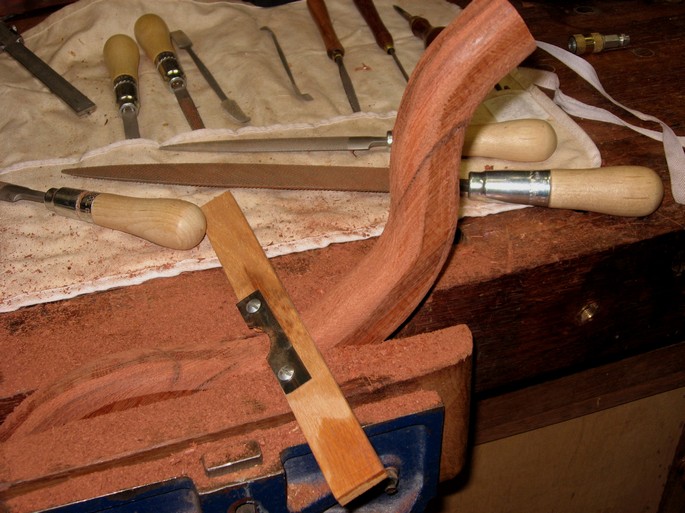

Regards from Perth

Derek
Re: a few spokeshave questions

#8

Re: a few spokeshave questions

Tom

LV did the first Boggs commercial shave, and then came out with their shaves which I think are more versatile. The Boggs is a really nice shave and has a lovely compactness. And it has a simplicity that is highly effective. That said there are times when one wants to do some heavy cutting, I am not taking wasting, because I agree on the DK for that. But there are big, dry, hardwood jobs also, and I prefer the size of the LV for those. There is also plenty of wood you can't drawknife, because it has too much reversing grain. Boggs at one point had moved to roughing his chairs with power tools, and used the shaves for finishing (which is similar to what they are for when working by hand, so not that big a difference). And he is using veneer grade logs. Also, he is pretty much always working a round. Stuff like paddles can involve a full width cut. So there are always different factors to consider.