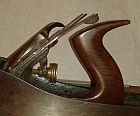
Re: #7 vs #8 jointer plane
Tom
"tom- you're overanalizing this."
No, I am correctly analysing. I really wish people got this point about planes, because once on thinks about them correctly, their use is more rational, and easier. I have proved incapable of explaining it well in writing over decades of trying. It really needs video. David Charlesworth did a great job of describing stop cuts in one of his tapes, and if you understand that process you understand what the relationship of blade projection and sole length gets you.
If you are more an action type, get two equal straight board edges, and two planes, one plane short and the other long. Set both to take the same reasonable shaving. Use stop cuts until you have both edges planed to the point where neither plane can take a cut, except at the ends. You will notice the jointer cut less curvature into the board. That is all it does differently than any other plane. They are longitudinal hollows. Just as one might have a set of hollows of different radii, one has a set of planes that introduce different longitudinal curvature. They do have other features, like degree of blade camber, blade width, but those are incidental.
"the #8 is more accurate because of length"
Accuracy is not an inherent function of length. Say a jointer holds curvature to 1 thou over 22 inches, and a jack at 1 thou over 14 inches. One is a better tolerance in a certain sense, but accuracy is properly a mater of how close to that setting a plane holds. You would have to develop a standard, but there is no real reason why a shorter plane would be less accurate. It will even hold the same tolerance, but at the "cost" of taking a finer shaving. However, jointers were not designed to take finer shavings, so they will not necessarily have a gear you can shift down into to deliver a tighter tolerance. I have one that does, but it is 18 inches, and hard to hold the tolerance even at that length. It is normally considered easier to hold tolerances over shorter distances/lengths. There are some boutique uses for all this stuff, but the main use with a jointer is jointing edges, and that can successfully be done with normal performance, nothing crazy refined.
" and more stabl because of weight."
The lack of stability in heavy metal planes, or their need for weight to cut, is largely a mater of poor design. I have wood planes that weight a 1/4 what metal ones do, and have low CGs, or better cutting geometry than metal planes. In any case one should get good results with anything, with practice.
" it's also more work to use, more expensive to buy and doesn't fit in as many toolboxes. use what you like. you *could* flatten your benchtop with a #2, but if you had access to a #7 I bet you'd use that. "
I have 4 or 5 jointers from 18 inches to 30ish. I would not choose them for flattening a table. They would not be any better at that than any other plane, and they are very heavy. About 35 years ago I got a commission to make a round table, and one couldn't just walk along the edge leaning out a bit towards the middle to take a cut, on had to reach right to the center and beyond, then lift the 7 pound 7 ounce weight of the Record jointer all the way back. I was early 20s at the time, but I still got complaints from my back.