Starrett 14D Narrow Blade?
Tony - Memphis
Anybody know where I can get a narrow blade for my Starrett 14D square? I've looked high and low but can't locate one. I've got an email in to Starrett. Maybe they can help.
Thanks,
Tony
Knowledge You Can Build On — Est. 1998
Starrett 14D Narrow Blade?
Tony - Memphis
Anybody know where I can get a narrow blade for my Starrett 14D square? I've looked high and low but can't locate one. I've got an email in to Starrett. Maybe they can help.
Thanks,
Tony
Re: Starrett 14D Narrow Blade?
William Duffield
You're going to have fun finding that one. I can't find the Starrett 14D square in the Enco, MSC, McMaster-Carr or Grainger catalog. Even the old (1998) Starrett catalog I have only lists it as a complete package with the head and all three blades. EDP # 50118. The 453 and 457 Series squares appear to use the same blade.
Did you try Tools for Working Wood?
Re: Did you try Tools for Working Wood?
William Duffield
I tried them a few weeks ago, and discovered that they are no longer carrying Starrett parts and accessories. It might have had something to do with some problems they had procuring some other Starrett item for me earlier.
http://www.toolsforworkingwood.com/store/item/ST-SDOUB.XX
If you want the whole kit and kaboodle, they're a great company to work with.
Re: Did you try Tools for Working Wood?
David Charlesworth
Try L-N.
David
Thanks all!
Tony - Memphis
No luck yet. Wish I had just bought the set when I bought the square. Oh well. I am trying to learn to cut dovetails and have discovered that one thing I owe more concentration on is cutting the tails perp to the face (tails first here). In worrying too much about getting the angle correct (staying on my marked line), I find that I am pushing the saw. So, I thought the thin blade would be easier to check my tail "walls" with. It is hard to check them with the wide blade of the 14D (~1/2?). Anyway, once I realized what I was doing, I was able to get one decent dovetail. Still practicing....
I love the little 14D. I use it for lots of tasks.
Tony
Two thoughts
Wiley Horne--So. Calif.
Hi Tony,
Just a couple things that might help. On getting the tail walls square to the face....
1. Start with vertical saw cut. Years ago I think in the 80s, I read an FWW article by Ian Kirby--most helpful!. Among other things he taught, he taught a simple detail whose whole point was to keep the tail walls square to the face. The procedure was to make the first saw cut into the tailboard endgrain with the saw held vertical. No angle at all. The whole point--and the only point--was to get the first cut dead square on your mark across the end grain. You're cutting into the waste, and it's a shallow cut, so there's no harm in it. Having made that first cut square, then the saw is angled, but the first vertical cut gives you a square reference to guide the rest of the cut.
2. Gang the pieces to be sawn. The longer the reference line across the end grain, the greater the accuracy (squareness) of the saw cut. Do both drawer sides, of if more than one drawer, do four drawer sides ganged. Additional benefit: you only lay out the pattern on the one face you're looking at--the others need only have scribe lines laid on (in addition to the end grain marks across all the ganged pieces).
2 cents.
Wiley
Thanks!
Tony - Memphis
I have his book and that was one of the points I learned reading his book. Actually, his book is on my bench as we speak. I've found that I do better starting the cut on the far edge at a slight angle, then lowering the saw.
I've done a few dt's before. I did half blinds on a lowboy I did and I cut throughs on a hidden box in a dresser I built. Those turned out pretty fair, but it has been a while. I'm building a wall mounted desk for my wife out of some really nice tiger maple. I started out thinking simple drawer boxes of good plywood, then I had a change of heart and thought that we be awfully tacky in comparison to the rest of the desk (the drawer fronts will be kind of artsy carved and dyed "waves/scrolls" - think Roman mosaic pattern). So, I decided it would be a good time to sharpen my dt skills (as in acquire some!). Using some nice pine I got at Lowes.
Tony
Re: Thanks!
William Duffield
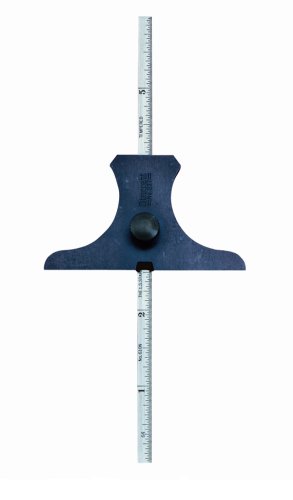
For your particular application, a Starrett # 237 depth gauge might work. See the last photo.
I have an old Lufkin No. 509 depth gauge that performs the same function, but mine is worn and no longer holds the rule exactly square to the slots in the head. So, if you find an old one or one made by a different manufacturer, make sure you test it before buying.


Same thought!
Tony - Memphis
I have one of the Starrett depth gauges and had he saem thought. Haven't been back out to try it or check it for square yet. I bought mine as a second from Starrett. It is ugly, but I couldn't find anything wring with it. I've used it a lot.
Thanks,
Tony
Re: Same thought!
William Duffield
Even my sloppy old Lufkin can be set to square, using another square, and tightened down enough so it stays square for an operation like checking dovetails, but it doesn't set as securely as a real square. Nor is it as flexible at setting a small angle as the Starrett 453, so it wouldn't be useful for a patternmaker, either.
'Tis Purty Square...
Tony - Memphis
Checked the depth gauge last night. It is pretty darn close...at least as close as my eye can tell against a Mitutoyo machinists square. Closer than my dovetail sawing will probably ever be anyway.
Tried cutting two boards at once too. I thought it would be harder, but it wasn't. And I can see that it gave me a better reference to square with a line across both boards (these are 1/2" drawer sides). So, I am going to try that some more.
Tony


