New WoodChat!
Home Articles Forums Gallery Marketplace Videos

WoodCentral Forums

Knowledge You Can Build On — Est. 1998

Want Better Milling & Firewood Knowledge?

Difficult Tenon Shoulders Made Easy

Posts

Difficult Tenon Shoulders Made Easy

#1

Difficult Tenon Shoulders Made Easy

Derek Cohen (in Perth, Australia)

Today I needed to check whether the tenon shoulders of some curved stretchers were square .

This reminded me of a jig that Jeff Miller posted on his blog, which previewed a forthcoming article in Pop Wood magazine. This consists of a vise and a flush cutting saw (attached to the sole of a "plane").

Link: http://furnituremaking.com/wordpress/tenon-shoulders/

Jeff's jig:
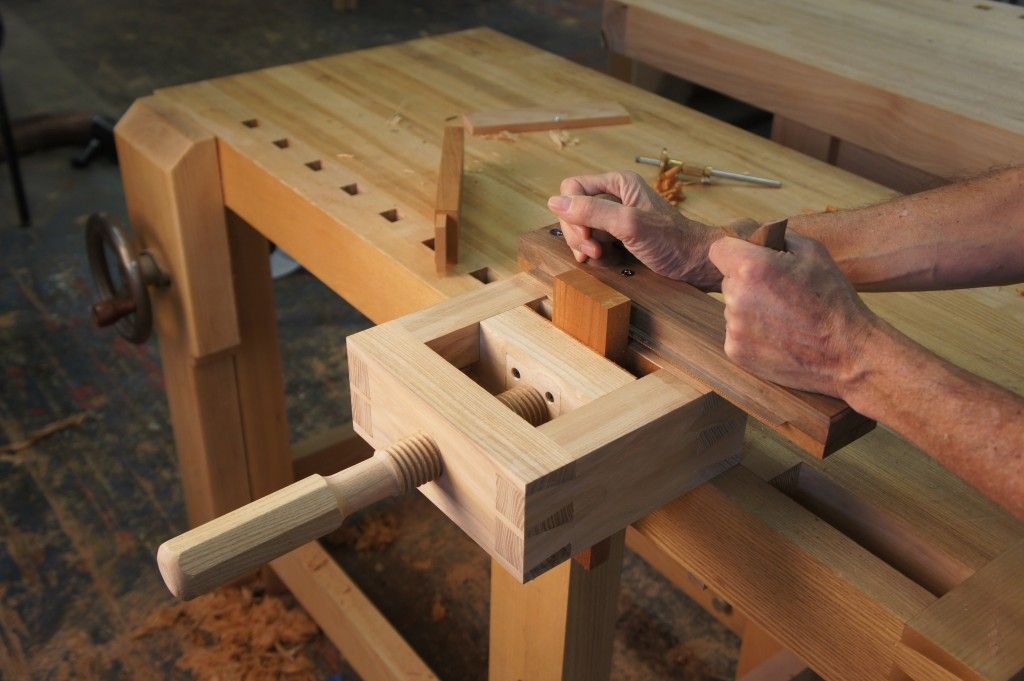


I needed this today. However it occurred to me that I already had one .... as do many of you as well.

"I do?", you ask. Yep .. it's your Moxon dovetail vise.

As long as the chop is aligned with the rear of the vise and has some width for regiistration, then you are good to go.

Line up the shoulder you know ...
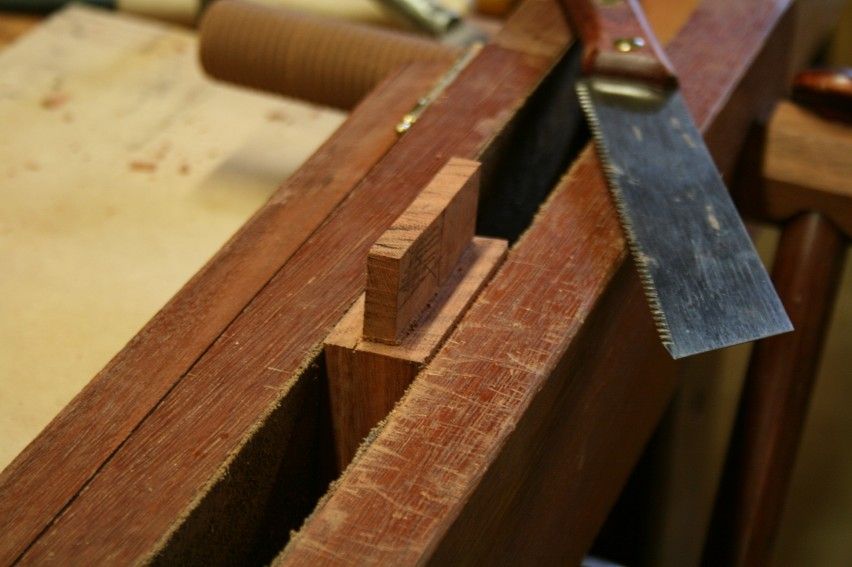

Use a flush cutting saw to cut the opposing shoulder. This will be square with the first shoulder ...
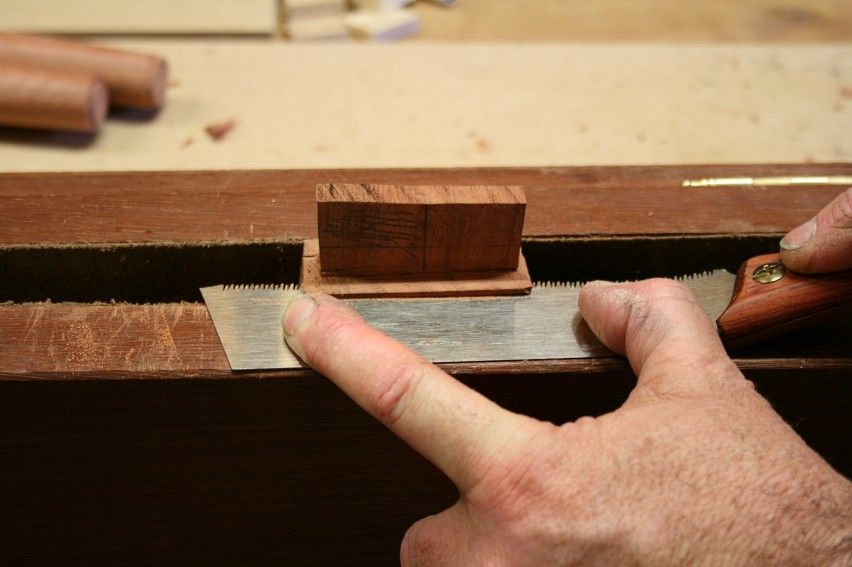

You can use a paring chisel if you only need to trim a little from an existing shoulder ...
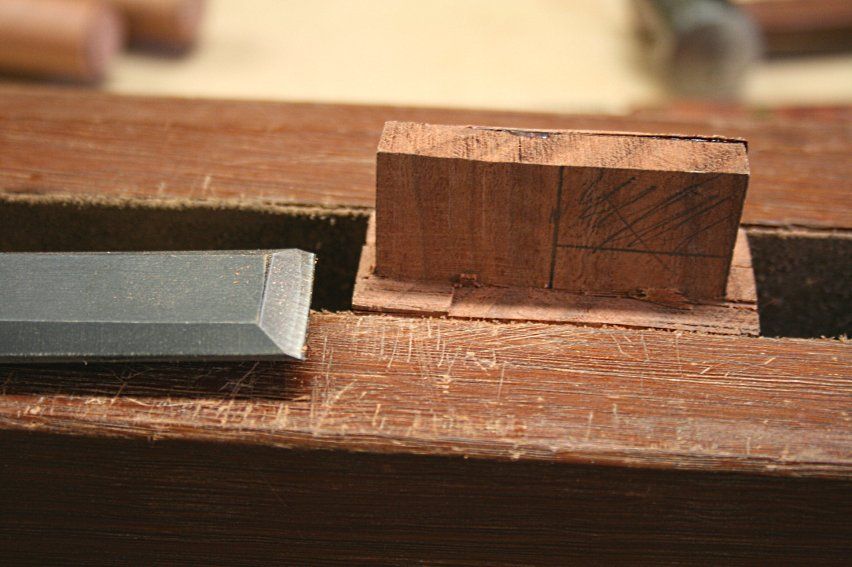

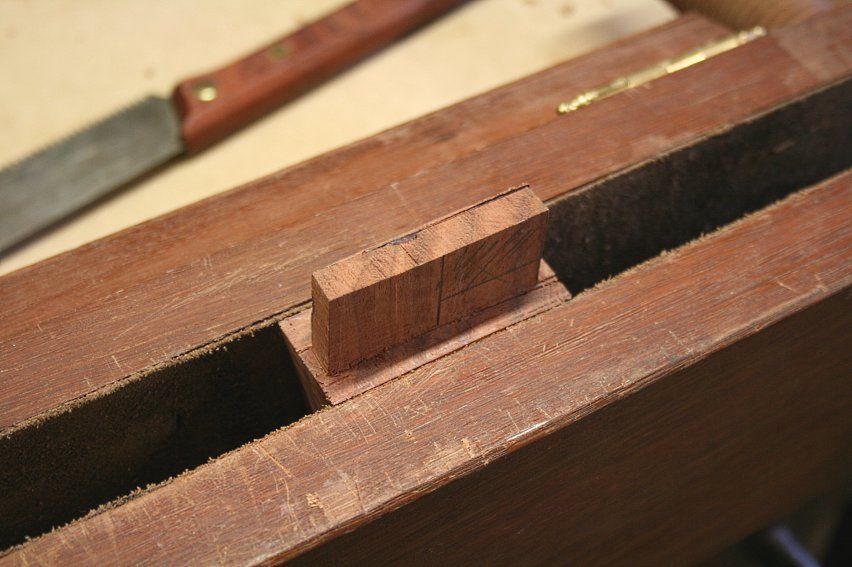
Done ...

Regards from Perth

Derek

Re: Difficult Tenon Shoulders Made Easy

#2

Re: Difficult Tenon Shoulders Made Easy

William Duffield

But, the chop is hung on and supported by the vise screws, so a dead flat surface is far from assured, as there is a lot of slop in the screws and nuts, even if you use the superb Benchcrafted hardware.

Jeff mentioned that this appliance had been forgotten, and he rediscovered it. I wonder if one reason it had been discarded, besides the obvious transition to table saws, tenoning jigs, routers, etc., is because even in its most robust form the flat top was subject to too much seasonal movement and wear to provide the needed acuracy over the long term?

I'm just speculating here. Jeff's jig and your adaptation of it appear to be really good ideas, and a great incentive to build some very interesting hand tools.

Re: Difficult Tenon Shoulders Made Easy

#3

Re: Difficult Tenon Shoulders Made Easy

Bill Houghton, Sebastopol, CA

Your approach seems superior to the magazine's jig (with Sir William's caveat regarding precision), in that you can align the clean shoulder with a known reference; although I confess I haven't gotten past Megan Fitzpatrick's opening editorial in the current Pop Wood issue.

But for those of us without Moxon vises, why not just a few pieces of wood clamped to the piece of stock? I'm visualizing something like a tuning fork, with two straight sticks, running parallel to each other in both X and Y axes, and the opening between being equal to the thickness of the stock being worked (you could use a piece of scrap from the project wood as the block between the sticks). The open end is then clamped to hold it on.

In many ways, this is similar to the longstanding practice, when installing flooring in an existing house, of using a piece of the flooring to guide a saw in undercutting the door casings and jambs.

Re: Difficult Tenon Shoulders Made Easy

#4

Re: Difficult Tenon Shoulders Made Easy

Steve Voigt

Jeff's jig is fine, I suppose. Derek, I actually prefer your version, since it doesn't involve building a separate tool--it's an ingenious adaptation of what you already had.

The thing that bugs me a lot about Miller's approach is that there's a jig, usually a pretty elaborate one, for everything. He has a jig for sawing the cheeks, this one for the shoulders, and a third for paring the mortise (an entirely unnecessary operation most of the time). So, three jigs for a basic, essential skill that can reliably be done jig-free.

It seems to me that he's trying to completely remove "workmanship of risk" from the equation, trying to replicate the power-tool way of working in a hand tool environment. At which point one has to ask:why not just use power tools?

I'm by no means anti-jig, but there has to be a balance, because every time you use a jig, you forgo the opportunity to develop a skill.

(this is by no means directed at you, Derek; the subject of Miller's jigs just got me all riled up)

Re: Difficult Tenon Shoulders Made Easy

#5

Re: Difficult Tenon Shoulders Made Easy

William Duffield

So, are you suggesting, instead of building Jeff's special purpose saw, you could just use a Fein MultiMaster with Jeff's jig? :D

…ducking and running, while you and Steve throw offcuts and newly learned Scottish insults at me.

Re: Difficult Tenon Shoulders Made Easy

#6

I said LONGstanding practice

Bill Houghton, Sebastopol, CA

When we did our kitchen years back, I used a handsaw (Western type). My contractor son uses a Japanese saw. No need for electrons.

No need for Scots insults here, either...

Re: Difficult Tenon Shoulders Made Easy

#7

Re: Difficult Tenon Shoulders Made Easy

Tom

"It seems to me that he's trying to completely remove "workmanship of risk" from the equation, trying to replicate the power-tool way of working in a hand tool environment. At which point one has to ask:why not just use power tools?"

Well, the risk Pye was referring to is in part the design risk, and Derek already has that covered, though I suppose there is always the risk you do a perfect job, and end up with an ugly chair, if by choice.

There is the pure oops risk, which as you point out can be eliminated with jigs. It can also be eliminated with such a huge range of specialized tools that they cover the range of skills one uses to work. A plane is nothing more than a jigged blade. Bet even a Chisel is a jig, as is a saw. I like to think of all tools as molds that have some function that is totally skilless. It helps understand tool function. But of course there are different degrees.

A place like this at times seems anti skill for a variety of reason, in part because in aggregate every conceivable tool is used by someone here. In my case I have many tools that I own, and either can't find, or don't bother with most of the time.

I think it is a fundamental mistake to assume power tools are skill free, or risk free as far as the material is concerned. One can freehand with either tool type. Like chainsaw carving, or use of a grinder, or freehand bandsaw. There is a concept of unlimited/limited geometry. The plane is a limitation on the geometry of a chisel. A bandsaw, or rotary burr has relatively unlimited geometry.

The jig happiest group I know are US guitar makers, but unlike here, many of them don't really seem to be woodworkers. Guitar already involves the skill of playing, and making the box into an instrument, which isn't really woodworking, and they often have to gear up to sell their product...

Re: Difficult Tenon Shoulders Made Easy

#8

Re: Difficult Tenon Shoulders Made Easy

Tom

Wooden clamp, though some care in alignment would be required.

Re: Difficult Tenon Shoulders Made Easy

#9

Re: Difficult Tenon Shoulders Made Easy

Tom

You can also just drive it into the mortise and use the adjacent surfaces to trim the shoulder, though not in your specific case.

There are many ways of using those trim saw, to skillessly sneak in and trim things. I use the LV ryoba relentlessly. One use is to zero in on guitar neck joints where one needs a 2mm slot, and one fires in a cut with a saw, then uses stacks of veneer to keep raising the saw so that it widens the slot. Very clever little things. I also use it a lot on dovetails.

Re: Difficult Tenon Shoulders Made Easy

#10

An even easier jig ...

Derek Cohen (in Perth, Australia)

I needed to check the shoulders again, was too lazy to pull out the Moxon vse fr this, looked around the workshop, and came up with this ...


Surely everyone has a couple of wooden handscrew clamps?

Regards from Perth

Derek

Re: Difficult Tenon Shoulders Made Easy

#11

Re: An even easier jig ...

Tom

Yeah, I mentioned that 2 posts above. I still think we should call it a Cohen Jig consistent with the thread on Sawmill Creek!

Re: Difficult Tenon Shoulders Made Easy

#12

Re: An even easier jig ...

Derek Cohen (in Perth, Australia)

Hi Tom

I must be deaf, dumb and blind (my wife says so :( ) but I cannot find a reference to your post. Anyway, this is not much of a jig, and I am sure that multitudes have written about it, so I am very happy to give you equal billing and share with you the financial gains we make on this! :D

Regards from Perth

Derek

Re: Difficult Tenon Shoulders Made Easy

#13

Re: Difficult Tenon Shoulders Made Easy

Patrick Gibbons

Paul Sellers has a faster and easier way to trim tenons. Use a square to line up from the chosen side and then use a knife registered against it to pare the wood. It takes seconds and is square and straight. No jig to build and very precise.

Re: Difficult Tenon Shoulders Made Easy

#14

Re: Difficult Tenon Shoulders Made Easy

Derek Cohen (in Perth, Australia)

Hi Patrick

I think that you have missed the issue here. This is not about straight tenon shoulders. This is about marking on a curve. That is a different kettle of fish.

Regards from Perth

Derek

Re: Difficult Tenon Shoulders Made Easy

#15

Re: An even easier jig ...

Tom

Wood clamp reference dead above, I was having an aneurism at the time 04.24 hrs and couldn't remember the proper, name, but those are the only common wood clamps I know about.

Just funning, or I would be a right prat if I wasn't, which is always possible. Keep on sawing!

Re: Difficult Tenon Shoulders Made Easy

#16

Re: Difficult Tenon Shoulders Made Easy

Tom

I haven't seen the article yet, someone said it was downloadable. What is this marking on the curve issue?

Re: Difficult Tenon Shoulders Made Easy

#17

Re: Difficult Tenon Shoulders Made Easy

Patrick Gibbons

Derek, you're right that I misunderstood. However, could you use a sliding bevel set at the proper angle? I would think that a bevel would have the same problem as the Moxon vise, registration without movement off the line.

Re: Difficult Tenon Shoulders Made Easy

#18

Re: Difficult Tenon Shoulders Made Easy

Derek Cohen (in Perth, Australia)

Hi Patrick

Where do you register the sliding bevel when the surface curves? At best you have an approximation.

I put this to the test today for real, marking and sawing the curves front and rear stretchers - had to trim off a bit from each end to get the "real" square.

I'll let you know tomorrow whether I have a chair or firewood!

Regards from Perth

Derek

Re: Difficult Tenon Shoulders Made Easy

#19

Re: Difficult Tenon Shoulders Made Easy

Patrick Gibbons

Makes sense to me now. Won't the vise cheeks also run the risk of false registration? Sorry if I'm still not getting it.

Re: Difficult Tenon Shoulders Made Easy

#20

Re: Difficult Tenon Shoulders Made Easy

Tom

If there isn't any way to rest the bevel, how does it get held in the clamp.

Re: Difficult Tenon Shoulders Made Easy

#21

A real example ..

Derek Cohen (in Perth, Australia)

My previous report on the chair build was aimed at determining the correct position for the mortice - and also whether the tenon shoulders were square across the upper and lower sides.

I had used templates to mark out the plan shape of each (front and rear) curved stretcher, however the shoulder angle of each tenon was gauged by eye. That is not the most reliable method (parallax and all that).

To my eye there was something definitely wrong.

I used the wooden hand screws to square up the shoulders. Here's how ...

Firstly, this is the curved stretcher (it is a compound curve, curving in two directions). There is no way one can simply use a square or even a sliding bevel to determine the square as there is no reference flat area.


If I was building a dedicated vise, the clamp/jaws would be narrow to minimise the effects of a curve. The hand screw here was sufficiently narrow for this task.

When clamped it made contact along both sides of each shoulder. You can see how much is to be removed.


Before sawing, ensure that both clamp sides are coplanar ...


Now saw with a flush cutting saw (no set to damage the clamp) ..


The tenon cheek was measured square to the shoulder on both sides ...


Regards from Perth

Derek

Re: Difficult Tenon Shoulders Made Easy

#22

Re: A real example ..

Patrick Gibbons

I see you have several elements making this a fun project.

Re: Difficult Tenon Shoulders Made Easy

#23

Re: A real example ..

Tom

That tenon still looks as though it is leaning to the left, when if anything it should lean to the right, however your method picks up three point of reference the lower concave side of which is likely to push it to the left, as you acknowledge in your comment about the narrowness of the jaws of a jig.

The way I would do it, assuming that at least prior to the coping I was looking for the shoulders to be square to the tenon, is just place a plate on the tenon face and pick that up outboard with a square, and draw the tenon, that will be square to the face of the tenon.

What a job like this actually cries for is a set of plans, which I doubt I would bother with, though drawing merely the joints would not be a large job, then the position of parts can either be achieved with a template, or triangulation.

Another option would be to get some small L brackets, flat like framing squares. Strongtie makes theres, or maybe one has enough of them lying around in the form of sharpener jig angle setters, etc... Simply stack these on top of each other to make a collar that will allow one to collar the joint.

Another way to look at all this is in terms of the various way of laying things out. One method we are most familiar with is the method that uses a surface of a workpiece as reference. This is absent on this piece, except possibly the tenons would serve. Another option is a rule of squares approach, and another still is a centerline option, which in some regards in this case would be easier to do on a plane where you can place it wherever it bets fits.