The Chair - Stretchers
Derek Cohen (in Perth, Australia)
Next chapter: http://www.inthewoodshop.com/Furniture/The%20ChairStretchers.html
A question for all: how would you go about coping the tenon shoulders?
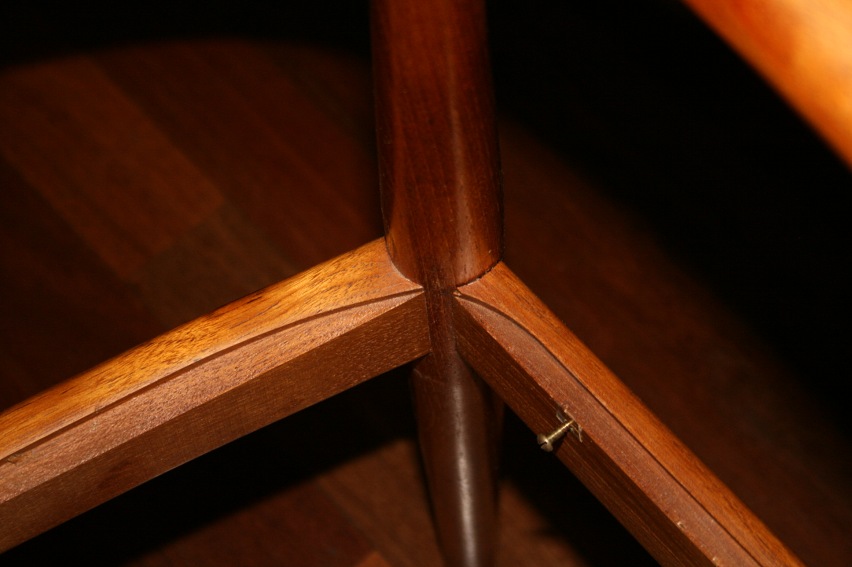
Regards from Perth
Derek
Knowledge You Can Build On — Est. 1998
The Chair - Stretchers
Derek Cohen (in Perth, Australia)
Next chapter: http://www.inthewoodshop.com/Furniture/The%20ChairStretchers.html
A question for all: how would you go about coping the tenon shoulders?
Regards from Perth
Derek
Re: The Chair - Stretchers
Bruce McCrory
I thought your intent was slip tenons? If not, measure twice and pare carefully.
Re: The Chair - Stretchers
William Duffield
I would use loose tenons, in my case, Festool Dominos, but that is not the only option. Then I would build a jig that totally enclosed and securely held the end of the stretcher, and drill a hole of the appropriate diameter using a high quality, sharp Forstner bit, through the jig and the end of the stretcher.
If I wanted to do it totally with hand tools, I would use an incanal patternmaker's gouge of the appropriate diameter to finish the shoulders, guided by a jig similar to the one, above, that you would build for drilling out the end of the stretcher. The jig is a simple, tight fitting box with thick walls for precise registration of the gouge, and its end shaped concave with a Forstner bit the same diameter as the spindle at that point.

Coping curved shoulders
Ellis Walentine
Hi Derek,
I see you are moving right along with your facsimile of the Wegner chair. Thanks for posting the excellent process shots.
My suggestion for making those curved shoulders would be to first make the tenons with straight, square shoulders, then cope the shoulders using a very low angle chisel, preferably with a sweep to it similar to or tighter than the radius of the cope. Yeung Chan used to make his own little chisels and knives from industrial hacksaw blades for jobs like this, although I don't recall seeing any with sweeps. That would require some blacksmithing work to form the flat blade into a curved one.
Good luck.
Ellis

Re: The Chair - Stretchers
Sgian Dubh
An in-cannel gouge with the appropriate sweep is what I use if the job can't be set up on a spindle moulder, and I'm assuming you're not planning to use either one of those or an inverted table router. You cut the shoulder square and winkle out the curve with the gouge. Slainte.
Re: The Chair - Stretchers
don stephan
"winkle out the curve" . . . where do you Brits get all these marvelous expressions? Glad I never had to conjugate that verb in school.
Re: Coping curved shoulders
William Duffield, on the Cohansey
Your photo brings back many fond old memories.
At the same woodworking show, IIRC, during his dissertation on his Ming Dynasty chair, Yeung explained how he fitted two intersecting round chair parts. The problem was that they were not at right angles and both parts have round cross sections. His explanation was enlightening, and an inspiration for both of the simpler suggestions I made for Derek's problem. You can see the chair here. It's not difficult to figure out which joint it is we are discussing.
http://www.crfinefurniture.com/1pages/grads/chan/chanchrsde.html
I can highly recommend his book, "Classic Joints with Power Tools." Of coures, all of these techniques can also be precisely executed completely with hand tools (as evidenced by the original chair that he reproduced). Here is a link to a more recent YouTube video of some of his joinery.
http://m.youtube.com/watch?v=IqvKGKzOwFA&desktop_uri=%2Fwatch%3Fv%3DIqvKGKzOwFA
Ellis, I don't recognize the other guy in the photo. Can you identify him?
That would be Andy Rae
Ellis Walentine
Andy was an editor for us at AW, and then he worked for Lark Books as an editor, where he brought in books such as the one you cited. We were all pals and colleagues in those days.
Ellis
Re: The Chair - Stretchers
Tom
One option would be to leave the shoulders square and work the mouth of the mortise to receive the square shoulders. Then when you look down you don't see any gaps, not that you would allow such a thing... And you have several points of engagement for the vertical load path.
Re: The Chair - Stretchers
Tom
I'm set up for this kind of cheating when making bikes, where there are some weird angles. There are a bunch of different way to make the copes, but since my inclination is towards one offs, I have made a number of special contact wheels that fit a jig I made for my 2x72 sander. This allows me to make a perfect cut to any diameter, while accounting for the belt thickness. The skilly bit is that the actual cutting is freehand eyeball stuff, but it can actually be done to a very high degree of accuracy, by following a process. Once the copes are done, you can join the pieces with epoxy hardware bonded hidden threaded rods. These pins go in oversized holes so there is never a question of skill in making this joint. This is about the strongest joint there is. But it would take cheating and avoidance of handwork to Olympian levels.
A common way of doing this stuff in a mill or drill press or notcher, is to cut the radii with a hole saw. There are tricks for modifying the hole saws so they run better, and there are makers who custom make hole saws to any diameter you want out of solid HSS bar stock.

These notchers are pretty cheap. This one looks pretty cheap, and plain bearings are all you actually need:

Re: The Chair - Stretchers
Sgian Dubh
A bit of winkling is always good Don. There are all sorts of things can be winkled if you're in either the mood or need. I've never bothered with conjugating an act of winkling though: I'll leave that to you, ha, ha. Slainte.

Re: The Chair - Stretchers
Jesper, Denmark
Derek,
I tried to look for clues in the video from PP Møbler. The only thing shown there was the finishing of the tenon shoulders with a half-round rasp or file. No doubt the current chairs are CNC machined there also.
The other noticeable thing is that the cut-outs to receive the seat are significantly deeper in the video than on your photo of the chair you bought. It also seems to me that the fit of the stretcher tenon shoulders to the round legs in your photo are not up to PP Møbler and other Wegner shop standards. Maybe it is just the photo
Re: The Chair - Stretchers
Derek Cohen (in Perth, Australia)
Hi Jesper
I agree that a couple of the leg joints have small gaps. The reason for this is that the "furniture restorer" who sold the chair had "re-glued the joints".
Looks like I shall be re-doing his re-glueing at some stage.
Regards from Perth
Derek
Re: The Chair - Stretchers
William Duffield
Let us hope he didn't use aliphatic resin glue or chair doctor or gorilla glue, but since you put "restorer" in quotes, I fear the worst.
Re: The Chair - Stretchers
Curt Putnam
Out of curiosity, why is the use of Chair Doctor an unhappy event? Just genuinely want to know. TIA
Mr.Chan has settled in to teaching
charlie belden
Eight or 10 years ago, I attended one of his earliest classes at a Woodworking Show at the San Mateo County Fairgrounds. He brought his deceptively simple "tool box" and his tools - but no planned demo or subject to teach. He was initially quite nervous and unsure of what to do. Then questions about the tool box and the tools. With a subject near and dear to him, he loosened up quite a bit and we learned a lot about the tools he'd made and their purposes, along with how to sharpen them and use them. The handles were plane and simple, not the fancy handled ones shown in the photo. I guess with success comes BLING. It's good to see that he's comfortable being well known now.
Apparently the show promoter had promised him a Forrest WW II saw blade. The show was closing and he was semi frantically trying to find either the promoter or the Forrest booth. Having picked up a WW II ten minutes before, I was able to take him to their booth. Don't know if he got his saw blade - I had "stuff" I needed to pickup and get out to my van (can you say JoinTech Cabinet Maker System?).
A friend with 20+ years making just about anything that can be made out of wood, took a handtools class from this quy. In that class he discovered what he believed was "really sharp" was no where near what Yueng Chan considered sharp.
Re: Mr.Chan has settled in to teaching
Tom
I have appropriate, if necessarily long distance, respect for Mr Chan. Yet there must be a 1000 or maybe 100 000, or a million dudes in the US who have made a few dozen tools; some thousand who have attended College of the Redwoods; and countless others who have done one project that stretched them. I don't really know what the big deal is.
Re: The Chair - Stretchers
David Charlesworth
Scribing would be good, but I'm not sure if there is an easy way.
Perhaps a mixture of scribing and a template?
I faced similar curves on a semi copy of a Shaker table. Found that nibbling with a tighter radius in cannel gouge was easier than trying to match the curve.
Wondering if my nibbling is related to Richard's winkling?
best wishes,
David
Re: The Chair - Stretchers
William Duffield
One problem I have with ChairDoctor is the unknowns. What does it actually do to the wood? The only descriptive terms are "swell" and "fix".
What's in it? Is it reversible? Chairs are complicated, with varied and complicated stresses. Over time, they have to be repaired again and again, as the stresses are redistributed when individual joints are "fixed," and as new people sit in them. What will happened to the doctored joint when you need to disassemble it to repair the next joint?
What is the expected working life of this glue? Used properly, hide glues are almost indefinite, since they are completely reversible and can be reapplied to the wood centuries hence with no damage to the wood. There is some indication that aliphatic resins start to fail in 7 or 8 decades. Cyanoacrlyate has a much shorter working life, and begins to become embrittled within a very few years. Without trying to cover all different types of glues, the point here is that different types of glues have very different working characteristics and therefore very different applications. Well-built chairs should be expected to survive with conscientious maintenance for several centuries. Do you care about that, or do you just want to get the chair out of your shop and the money in your pocket?
If you use a product that you can just squirt and forget, how do you know the extent of the real damage to the joint itself? Maybe, for a sound repair, the tenon (or the mortise) needs to be completely rebuilt. How will you know, if you never closely examine the joinery itself?
Another term used in the advertising is "difficult to repair." If you can't totally disassemble a chair without doing further damage to it, you shouldn't be repairing it. It just encourages laziness. And don't get me started with the chair kludgers who glue up a chair and drive brads through the joint to hold it while the glue dries instead of a proper set of clamps.
Re: The Chair - Stretchers
William Duffield
I thought you two both spoke the same language?  But maybe Richard picked up that term when he was working in Texas?
Yeung is one of a kind *LINK*
Ellis Walentine
Hi Tom,
You'd have to know Yeung and his ingenuity and amazing skill to appreciate the uniqueness of his abilities. When I first met him, probably around 1995, he was an unknown, but he had won the Bay-area guild's annual 2x4 contest several times, with creations you'd need to see to believe that they had come from a single length of 2x4. My friend Simon Watts, who was working as our West Coast editor at the time, brought him to our attention, and we followed him avidly as he became involved in researching the precise construction methods for Chinese furniture joinery. We showcased some of that work in a magazine article, and the following year, he expressed interest in studying with James Krenov, whom he deemed a great master. I wrote the letter of recommendation for him, and he entered the COR that fall.
Yeung's strengths besides relentless perfectionism include his uncanny problem-solving abilities and the intricacy of his engineering and craftsmanship. The book he wrote for Lark (edited by Andy Rae) contains just a few of the jigs and fixtures he has devised over the years for precision power-tool joinery.
He has passed some of his detail-oriented sensibilities along to his children, including his eldest son Brian, who attended MIT and now teaches there. Click the link below to see some of his origami work. His wife cooks up some of the best pot stickers you ever ate, too.
Ellis
Brian Chan's Origami
Re: The Chair - Stretchers
Sgian Dubh
Nah William, I didn't pick that up in Texas. David, myself and yourself all speak the same language pretty much with regional oddities and different spelling. I'm more likely to have picked up winkle from living in Scotland. The Scots version of English has some lovely words, e.g., timeous (and its variants), high heid yin, Heid Bummer and anent, as well as less polite ones such as scunnered, bawbag, blootered, bampot, etc.
Anyway, Derek's tenon shoulders look like a winkling or nibbling job to me, with an in-cannel gouge as I said before. It's a KISS job married to a bit of patience and skill. Slainte.
Great potential here
Ellis Walentine
... for some rich insults: "Jane, you scunnered bawbag, you blootered bampot." Maybe I should find out what they mean before I trot them out in conversation. 
We could use a glossary of these colorful terms.
Ellis
Re: Yeung is one of a kind
Tom
Thanks Ellis, it has to be something. Thanks for filling in the blanks. I rarely get to see any of these people in action.


